Foucault News

News and resources on French thinker Michel Foucault (1926-1984)

Bazzul, J.
The ‘subject of ethics’ and educational research OR Ethics or politics? Yes please!
(2017) Educational Philosophy and Theory, pp. 1-11. Article in Press.

DOI: 10.1080/00131857.2016.1270184

Abstract
This paper outlines a theoretical context for research into ‘the subject of ethics’ in terms of how students come to see themselves as self-reflective actors. I maintain that the ‘subject of ethics’, or ethical subjectivity, has been overlooked as a necessary aspect of creating politically transformative spaces in education. At the heart of egalitarian politics lies a fundamental tension between the equality of voices (or ways of being) and the notion that one way of being or one voice may be deemed more legitimate than another; which in turn puts the equality of beings into question. Building from Michel Foucault’s work regarding ethics and subjectivity, I suggest that a ‘subject of ethics’ can be viewed, in part, as a series of relations of self that form the horizon upon which a subject comes to work on themselves relative to moral codes and power relations. Ethical relations of self can be a useful concept for those interested in educational research that furthers social and ecological justice. In the conclusion of this paper I also discuss the limitations of locating ethics entirely within a constituted human subject. © 2017 Philosophy of Education Society of Australasia

Author Keywords
anthropology; ethics; Foucault; justice; politics; qualitative research; subjectivity

Chang-Kredl, S., Wilkie, G.
What is it like to be a child? Childhood subjectivity and teacher memories as heterotopia
(2016) Curriculum Inquiry, 46 (3), pp. 308-320.

DOI: 10.1080/03626784.2016.1168262

Abstract
Foucault’s notion of heterotopia offers a novel way to understand teachers’ conceptualizations of childhood, in juxtaposing adult memories of childhood with their present context of teaching children. Memory writing prompts were given to 41 early childhood teachers, and the resulting written narratives were analyzed as heterotopic spaces. The study follows two trajectories. First, in terms of teacher development, we examine how the construct of heterotopia can help teachers and teacher educators understand the impact of memories on their current assumptions about childhood. Second, we argue that examining the teacher’s internal experiences through heterotopia can contribute to theoretical thinking about childhood. The study’s findings suggest that it is a considerable but meaningful challenge to examine our subjective experience of childhood in relation to our understanding of children today. This process may be useful in assisting the teacher to disentangle the imagined, remembered, conceptualized and actual child, and to interrupt our tendencies to project our own experiences onto others. Perhaps, there is a childhood that exists in heterotopic spaces, not quite the subjective or psychical child, but not quite the external child either. This may be the liminal childhood that the early childhood teacher, preoccupied as (s)he is with childhood, experiences. Theorizing teachers’ subjectivities as they are linked to their memories of childhood is a complex endeavour, and Foucault’s heterotopia provides rich images of strange juxtaposition that may be useful in thinking about childhood and teaching. © 2016 the Ontario Institute for Studies in Education.

Author Keywords
Curriculum studies; heterotopia; memory; narrative methods; student and teacher experiences; teacher development

Hull, G.
Equitable relief as a relay between juridical and biopower: the case of school desegregation
(2016) Continental Philosophy Review, pp. 1-24. Article in Press.

DOI: 10.1007/s11007-016-9372-6

Abstract
The present paper looks at the intersection of juridical and biopower in the U.S. Supreme Court’s school desegregation cases. These cases generally deploy “equitable relief” as a relay between the juridicially-specified injury of segregation and the biopolitical mandates of integration, allowing broad-based biopolitical remedies for juridically identified problems. This strategy enabled the Courts to negotiate between these forms of power. The analysis here thus suggests the continued relevance of juridical power, and also the limits of Foucault’s own analysis, which suggested that biopower tended to fully colonize juridical power by way of norms. © 2016 Springer Science+Business Media Dordrecht

Author Keywords
Biopower; Desegregation; Education; Foucault; Juridical power; Racism

Ragab, A.
Monsters and patients: An archaeology of medicine, islam, and modernity
(2016) History and Theory, 55 (4), pp. 112-130.

DOI: 10.1111/hith.10832

Abstract
Foucault’s analysis of the history of evolutionary thought in Les Mots et les choses introduces monsters as incomplete beings that form important steps on the evolutionary ladder toward the terminal species. Monsters represent attempts by nature to achieve the perfection of the terminal species and are, therefore, significant for naturalists in constructing the details of the natural continuum. Despite their incompleteness, monsters underwrite the natural continuum and evidence the grounding of this continuum in reality. To a great extent, the continuum of nature, proposed by Foucault, resembles a continuum of civilization through which the history of the world and the history of colonization were often seen. The non-European emerged as the monster that showcased the deeper history of the more-perfect European. In the same way that monsters were written into natural history as intermediary and incomplete beings, losing in the process their uniqueness as independent species, the colonized were written into the (new) World History as objects of colonization, modernization, and development and as the living fossils of a bygone European past. This new history was not only created for European consumption but was also an important part of European-style education in the colony shaping colonial and post colonial identities and perceptions of self and other.

This article uses Foucauldian monsters to understand the making of historical narratives about the precolonial past in nineteenth-century Egypt, where one of the earliest European-style medical schools in Africa and Asia was built in the early nineteenth century. In this school and surrounding emerging educational system, narratives about science, modernity, and religion produced new histories that came to form colonial subjects.Finally, the article asks about a post colonial/post monstrous epistemology, what it might look like and whether and how it can emerge from the postcolonial condition. © Wesleyan University 2016.

Author Keywords
Egypt; Islam; Medicine; Monsters; Postcolonial; Religion and science

Fejes, A.
The confessing academic and living the present otherwise: Appraisal interviews and logbooks in academia
(2016) European Educational Research Journal, 15 (4), pp. 395-409.

DOI: 10.1177/1474904116636637

Abstract
In this paper, drawing on the work of Michel Foucault, I argue that academics are enmeshed in power relations in which confession operates, both on and through academics. Drawing on Foucault’s genealogy of confession, I illustrate how academics are not only invited to reflect on performance, faults, temptations and desires in their work and private life, but as teachers they mobilise the same kind of technology in relation to students. These power relations are connected to wider changes in society, where discourses on New Public Management have become all pervasive in organising and governing public institutions. The examples of the use of appraisal interviews and logbooks as governing techniques illustrate how government currently operates through the freedom of the individual. The paper ends with a discussion on how books of life could introduce a different relation of the self to the self in academia, and thus provide opportunities to live the present otherwise. © The Author(s) 2016.

Author Keywords
academia; appraisal interviews; Confession; Foucault; higher education; logbooks

cartaz

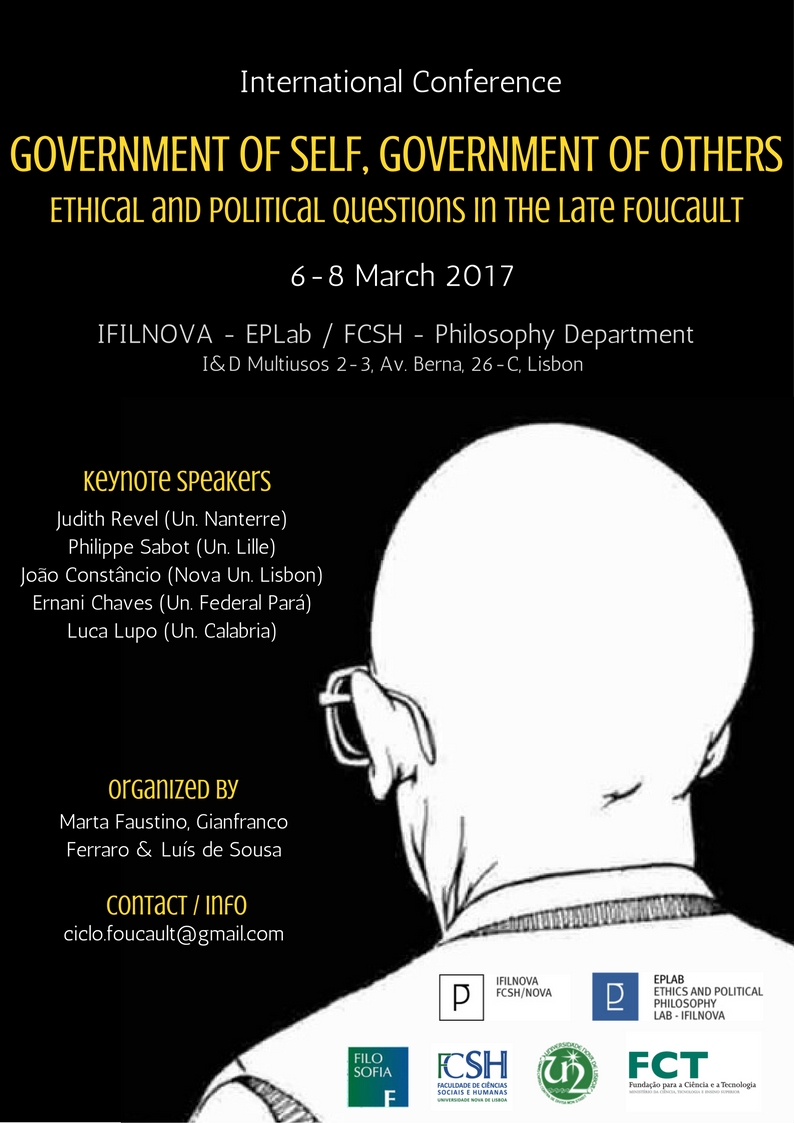
International Conference
“GOVERNMENT OF SELF, GOVERNMENT OF OTHERS.
Ethical and political questions in the late Foucault”

6-8 March 2017

IFILNOVA – EPLab / FCSH – Philosophy Department
I&D Multiusos 2-3, Av. Berna 26C, Lisbon

Live streaming: https://videocast.fccn.pt/live/fcsh_unl/foucaultconference

PROGRAM

6th March | Multiusos 3

09h30 – 10h00 Opening
António Marques (Director of IFILNOVA)
João Luís Lisboa (Coordinator of the Philosophy Department)
10h00 – 11h00 | Chair: Gianfranco Ferraro
Judith Revel (Paris West University Nanterre, France), “Subjectivation éthique, subjectivation politique: du “Je” au “Nous”?”

11h00 – 11h30 Coffee-Break

11h30 – 13h00 | Chair: Susana Viegas
• Ester Jordana (Bau/University of Barcelona, Spain), “Ethics of care (of the self and the others)”
• Amélie Berger-Soraruff (University of Dundee, UK), “Why We Should Take Care of Ourselves: Foucault According to Stiegler”
• Dominika Partyga (London School of Economics, UK), “Judith Butler on Self-Crafting: Between Nietzsche and Foucault”

13h00 – 14h30 Lunch

14h30 – 15h30 | Chair: Luís de Sousa
João Constâncio (IFILNOVA/New University of Lisbon, Portugal), “Foucault and the Problem of Recognition”
15h30 – 17h00 | Chair: Marta Faustino
• Karim Barakat (Duquesne University, USA), “Understanding Power relations through Governmentality”
• Laurence Barry (Hebrew University of Jerusalem, Israel), “Truth, Government, Subjectivity”
• Edgar Straehle (University of Barcelona, Spain), “On authority: a discussion between Foucault and Arendt”

17h00 – 17h30 Coffee-Break

17h30 – 19h00 | Chair: Marília Muylaert
• Marta Faustino (IFILNOVA/New University of Lisbon, Portugal), “Truth-telling as therapeutic practice: self-examination and confession in Foucault’s late writings”
• Andrea Teti (University of Aberdeen, UK), “Rethinking Foucault’s ‘Confessing Animal’”
• Kurt Borg (Staffordshire University, UK), “The Subversive Truth-Telling of Trauma: Survivors as Parrhesiastes”

***

7th March | Multiusos 2

10h00 – 11h00 | Chair: Gianfranco Ferraro
Philippe Sabot (University of Lille, France), “Le sujet et le pouvoir (de la vérité)”

11h00 – 11h30 Coffee-Break

11h30 – 13h00 | Chair: Bruno Dias
• Gianfranco Ferraro (IFILNOVA/New University of Lisbon, Portugal), “Qu’est-ce que nous sommes?” L’impatience de la liberté comme travail critique”
• Sam O’Brien (Monash University, Australia), “Parrhesia, Self-Government and the Political”
• Valeria Gammella (University of Naples Federico II, Italy), “La «conjoncture socratique»: la parrêsia philosophique comme tâche éthique et politique”

13h00 – 14h30 Lunch

14h30 – 15h30 | Chair: Marta Faustino
Luca Lupo (University of Calabria, Italy), “A matter of time. The stance of the Ancients towards the future in Foucault’s lectures at the Collège de France”
15h30 – 17h00 | Chair: Bartholomew Ryan
• Federico Testa (Monash University, Australia/ University of Warwick, UK), “‘The great cycle of the world’: Knowledge of Nature and the Cosmologic Perspective of the Care of the Self in HS”
• Bruno Dias (Centro de Filosofia/University of Lisbon, Portugal), “Critique of power within the bounds of mere resistance: the political uses of the late Foucault”
• Antonio Moretti (University Vita-Salute San Raffaele, Italy), “The issue of power between will to truth and parrhesiastic subjectivation”
17h00 – 17h30 Coffee-Break
17h30 – 19h00 | Chair: Luís de Sousa
• Giovanni Damele (IFILNOVA/New University of Lisbon, Portugal), “Which liberalism? Foucault, neoliberalism and ordo-liberalism”
• Matko Krce-Ivancic (University of Manchester, UK), “The care of self: is it perpetuating neoliberalism?”
• Rainer Mühlhoff (Free University of Berlin, Germany), “Governing by Affect. Subject and Power in post-industrial economy”

***

8th March | Multiusos 3

10h00 – 11h00 | Chair: Marta Faustino
Ernani Chaves (UFPA/Federal University of Pará, Brasil), “Cinismo e política: Foucault contra Hadot”

11h00 – 11h30 Coffee-Break

11h30 – 13h00 | Chair: Luís de Sousa
• Marília Muylaert (UNESP/São Paulo State University, Assis, Brasil), “O Cuidado de si, a dobra do fora, Foucault e Deleuze: intercessores para a ética-estética-política da Psicologia”
• José Caselas (Centro de Filosofia/University of Lisbon, Portugal), “A questão política em Foucault e Agamben: do Cuidado de Si ao Uso de Si”
• Susana Viegas (IFILNOVA/New University of Lisbon, Portugal), “A dobra e a anulação do sujeitar-se nos filmes de Joachim Trier”

13h00 – 14h30 Lunch

14h30 – 16h00 | Chair: Gianfranco Ferraro
• Evgenia Ilieva (Ithaca College, USA), “Foucault and Patočka on the Care of the Self”
• Élise Escalle (HAR/Paris West University Nanterre, France), “Notes towards a critical history of «musicalities». The use of musical pleasures and the care of the self in the 4th book of «Περί Μουσικής» («On Music») by Philodemus of Gadara”
• Erik Zimmerman (The New School for Social Research, USA), “Defending the Care of the Self from an Ethics of Self-Care”

16h00 – 16h30 Closing remarks

Visser, L.M., Bleijenbergh, I.L., Benschop, Y.W.M., Van Riel, A.C.R., Bloem, B.R.
Do online communities change power processes in healthcare? Using case studies to examine the use of online health communities by patients with Parkinson’s disease
(2016) BMJ Open, 6 (11), art. no. e012110,

DOI: 10.1136/bmjopen-2016-012110

Abstract
Objective: Communication technologies, such as personal online health communities, are increasingly considered as a tool to realise patient empowerment. However, little is known about the actual use of online health communities. Here, we investigated if and how patients-use of online communities supports patient empowerment. Setting: A network of primary and secondary care providers around individual patients with Parkinson’s disease. Participants: We conducted case studies to examine our research question. We interviewed 18 patients with Parkinson’s disease and observed the use of online health communities of 14 of them for an average of 1 year. Primary outcome measures: We analysed the interviews and the online conversations between patients and healthcare providers, using Foucault’s framework for studying power processes.

Results: We observed that patient empowerment is inhibited by implicit norms that exist within these communities around the number and content of postings. First, patients refrained from asking too many questions of their healthcare providers, but felt obliged to offer them regular updates. Second, patients scrutinised the content of their postings, being afraid to come across as complainers. Third, patients were cautious in making knowledge claims about their disease.

Conclusions: Changing implicit norms within online communities and the societal context they exist in seems necessary to achieve greater patient empowerment. Possibilities for changing these norms might lie in open dialogue between patient and healthcare providers about expectations, revising the curriculum of medical education and redesigning personal online health communities to support two-way knowledge exchange.

Sabrina Smith and Matthew Atencio, “Yoga is yoga. Yoga is everywhere. You either practice or you don’t”: a qualitative examination of yoga social dynamics
(2017) Sport in Society, 20(9), 1167–1184.

https://doi.org/10.1080/17430437.2016.1269082

Abstract
Within the context of yoga’s increasing popularity, the prevailing view that yoga is ‘good for everyone’ is often perpetuated by participants. This view is derived from popular media portrayals and activities, as well as scientific research purporting yoga’s health benefits for all citizens. This paper accordingly investigates these dominant claims reproduced about yoga practise in the United States using a qualitative study involving five practitioners. We specifically invoke Michel Foucault’s concepts of discourse and governmentality to interrogate how yogic ‘truths’ are negotiated, taken up, and reproduced by several participants in the San Francisco area. Five in depth semi-structured interviews were conducted with a diverse demographic sample of yoga participants. Our findings suggest that these various individuals invested in and reproduced the ideals of social inclusion and multicultural diversity with the accompanying view that yoga operated as a community or ‘family’. The practitioners subsequently acknowledged specific barriers and instances of exclusive practises within yoga and its communities. Yet, in some cases the participants countered that these perceptions of exclusion and barriers to practise could be overcome by individual choice-making; this latter view implicates a specific mode of neo-liberal self-governance. Our analysis therefore suggests that the yoga participants invested in and reproduced ideals of individualism and meritocracy relative to normative neo-liberal yoga discourses. © 2017 Informa UK Limited, trading as Taylor & Francis Group

Index Keywords
California, human, human tissue, individuality, perception, physician, qualitative research, semi structured interview

visibility_is_a_trap_grasso

Observer blog

– Edouard Malingue Gallery (Hong Kong) will showcase a neon text installation by French artist Laurent Grasso (*1972). Over seven meters wide, Visibility is a Trap, 2012, is a direct reference to Michel Foucault’s theory of Panopticism as elaborated in the theorist’s seminal text ‘Discipline and Punish’ (1975).

Picture from the archello site

Springer RA, Clinton ME. Doing Foucault: inquiring into nursing knowledge with Foucauldian discourse analysis. Nursing Philosophy. 2015 Apr;16(2):87-97

DOI: 10.1111/nup.12079

Abstract
Foucauldian discourse analysis (FDA) is a methodology that is well suited to inquiring into nursing knowledge and its organization. It is a critical analytic approach derived from Foucault’s histories of science, madness, medicine, incarceration and sexuality, all of which serve to exteriorize or make visible the ‘positive unconscious of knowledge’ penetrating bodies and minds. Foucauldian discourse analysis (FDA) holds the potential to reveal who we are today as nurses and as a profession of nursing by facilitating our ability to identify and trace the effects of the discourses that determine the conditions of possibility for nursing practice that are continuously shaping and (re)shaping the knowledge of nursing and the profession of nursing as we know it. In making visible the chain of knowledge that orders the spaces nurses occupy, no less than their subjectivities, FDA is a powerful methodology for inquiring into nursing knowledge based on its provocation of deep critical reflection on the normalizing power of discourse.

KEYWORDS:
Foucault; discipline; identity; methodology; nursing knowledge; professional self