Foucault News

News and resources on French thinker Michel Foucault (1926-1984)

Published on Jun 29, 2017
El viernes 18 de septiembre, Judith Butler dictó su segunda conferencia “Foucault, obrando mal, diciendo la verdad”. En esta ocasión, las palabras de introducción fueron las de Daniel Berisso y Facundo Giuliano, docentes a cargo del seminario “La educación entre la violencia ética y el reconocimiento responsable. Un abordaje ético-político”

Hull, Gordon, The Subject and Power of Bioethics (July 14, 2017). Journal of Ethics, Medicine and Public Health (Forthcoming). Available at SSRN: https://ssrn.com/abstract=3002513

Abstract
The present paper argues that late work of Michel Foucault is helpful in understanding contemporary bioethics. Specifically, Foucault’s writings on biopower and subjectivity are increasingly relevant as we consider the intersection of public policy and clinical ethics in a socio-political context increasingly structured by the demands of neoliberalism. Although Foucault’s earlier work on the clinical gaze has been important to bioethics, that is no longer as important as his later, incomplete research into power and subjectivity.

The paper develops this argument in four steps. In the first, I look at a classic phenomenological approach to clinical bioethics by Richard Zaner, starting from which I develop a Foucauldian perspective. In that section I also offer a basic outline of what I take Foucault’s primary theoretical contributions to be by way of an initial explication of the biopower-subjectification nexus. The following two sections of the paper present exemplary applications of Foucauldian theory to two areas at the intersection of public policy and clinical bioethics. The first is the procedure for testing women for the BRCA1/2 mutations, mutations that impose on carriers a significant risk of developing breast and ovarian cancer. A comparison between American and Dutch practices underscores not only the new ways that genetic testing interpret the body, but also the importance of local political and cultural contexts for understanding how the test is presented, administered and managed. The second is a consideration of the intersection of employee wellness programs and wearable technologies. In it, I develop Foucault’s thought that subjects in the Christian West have long been encouraged to understand themselves confessionally, offering to authority figures the “truth” about themselves. I then interpret the compulsory use of wearables as a verification strategy for compliance with wellness programs as exemplary of such confessional strategies. The final section ties the discussion back to the clinical encounter as Zaner formulates it as an inherently moral encounter structured by vulnerabilities that matter for understanding the selfhood of patients. Based on the preceding examples, I make the case that American understandings of selfhood are increasingly separated from any sense of publicness, and that this structuring of selfhood is of increasing importance in framing and adequately understanding bioethics today.

Keywords: Foucault, bioethics, biopower, clinical ethics, Zaner

Behrooz Ghamari-Tabrizi, (2009) “When Life Will No Longer Barter Itself”: In Defense of Foucault on the Iranian Revolution. In Sam Binkley, Jorge Capetillo (eds) A Foucault for the 21st Century, Biopolitics and Discipline in the New Millennium, Newcastle, Cambridge Scholars Publishing pp.270-290

On Academia.edu

When Michel Foucault’s journalistic accounts of the Iranian Revolution appeared thirty years ago in Italian and French papers, friends and foes alike thought perhaps the author of Madness and Civilization had gone mad. The philosopher of the land of laïceté was enamored with the spirituality of a massive political action. His defense of the revolution––in spite, and, more importantly, because of its Islamic character––turned him into the butt of French ridicule. The intelligentsia interpreted Foucault’s fascination with the Iranian Revolution as being kin to, at worst, Heidegger’s Nazi temptations, and, at best, Marx’s Orientalist stab at India.

Public attention to Foucault’s reflections on Islam and Iran was confined to the French circles during the years of revolution in Iran itself, 1978-1980. Although a number of essays engaged Foucault posthumously in the early 1990s, the terrorist attacks of September 11, 2001 renewed interest in his musings on political Islam. One might reasonably ask what Foucault had to do with these acts of atrocity. But as I shall demonstrate, a host of Left and liberal philosophers, sociologists, historians, and essayists exploited the atrocities of 9/11 and other recent violent encounters of Muslims in Europe as the basis for launching a feverish attack on the proponents of what they dubbed “cultural relativism.” They warned that nihilism and the awakening of the antiquated regimes of power were the inevitable consequence of the erasure of the Enlightenment as the Universal Referent. But it was not until Janet Afary and Kevin Anderson published Foucault and the Iranian Revolution: Gender and the Seductions of Islamism, that Foucault was tried and convicted as the chief perpetrator of malefic cultural relativism. Afary and Anderson raise fundamental questions about Foucault’s critique of modern disciplinary power in order to prove the consistency between his philosophical oeuvre and his revolutionary sympathies for what they call pseudo-fascist Islamism.

read more

stuartelden's avatarProgressive Geographies

161514-foucault-w-warszawie-remigiusz-ryzynski-1Remigiusz Ryziński discusses his book Foucault w Warszawie, an account of the short period Foucault spent in Poland in the late 1950s – between his time in Uppsala and Warsaw. While the interview is in Polish, machine translation seems to give a good gist.

The book sounds fascinating, as it has used previously unaccessed archive sources. Hopefully some publishers are exploring translation rights. Thanks to James Tyner for the link.

View original post

Power inscribes order on space through codes. Bureaucratic codes measure and normalize dynamic ecologies and constitute the substrate of any infrastructural system, organization, and praxis. They striate space and punctuate time to increase efficiency, maximize profit, reduce risk, and maintain order in cultural, social, economic, and political spheres. #decoding gauges the agency of spatial practices in relation to the challenges and capacities prompted by codes and protocols.

Organized by students in the Doctor of Design Studies program, this conference investigates the impact of codes, concerned with mapping of environments, demarcation of legal territories, operational protocols of logistics and risk management, and codes of building and subtraction. By exposing the spatial and socio-cultural implications of micro-politics embedded in the hidden codes and protocols, we speculate about the potential agency of design practices mediating between processes of normalization, and the live, complex, and unpredictable ecologies of human habitation.

Reinvenções de Foucault

Ana Kiffer.(org.)
Antonio Pele.(org.)
Francisco de Guimaraens.(org.)
Mauricio Rocha.(org.)
Rafael Becker.(org.)

Lamparina, 2017
ISBN 978 85 8316 050 2Cód. barras 9788583160502

Em 1973, Michel Foucault apresenta no Collège de France o Curso “A sociedade punitiva”, parte do conjunto de análises que servirão de base ao livro Vigiar e Punir, de 1975. As gravações do curso foram perdidas e apenas uma transcrição e o resumo foram conservados. Publicado em dezembro de 2013, o Curso sugere muitas questões aos leitores de Foucault e solicita a reformulação de algumas convicções correntes sobre sua obra. Variações sobre a análise da prisão, continuidades e rupturas em relação a Vigiar e Punir e esclarecimentos (ou novos enigmas) sobre a complexa relação entre Foucault e Marx são alguns dos assuntos que emergem da leitura do Curso. Em 2015, um evento acadêmico na PUC Rio teve como fio condutor a interpretação de ‘‘A sociedade punitiva’’ no horizonte da obra foucaultiana. Os trabalhos apresentados por pesquisadores argentinos e brasileiros são agora compilados e oferecidos ao público no livro Reinvenções de Foucault.

Pesquisadores participantes: Mauricio Rocha, Edgardo Castro, Ana Kiffer, Peter Pál Pelbart, Joel Birman, Susana Murillo, Francisco de Guimaraens, Angelica de Britto Pereira Pizarro, Cristina López, Antonio Pele, Fabián Ludueña Romandini, Marcelo Raffin, Rachel Nigro, Bernardo Carvalho Oliveira, Leon Farhi Neto, Andrea Moreira Streva, Eduardo Stelmann, Fernanda Ferreira Pradal, Juliana Moreira Streva, Felipe de Andrade e Souza, Clécio Lemos, Julia Naidin, Rafael Cataneo Becker, Alessandra Vannucci, Aline Caldeira Lopes, Larissa Drigo Agostinho.

Sumário

Apresentação
Mauricio Rocha

“Surveiller et punir”: entre dispositivo y veridicción
Edgardo Castro<

“Attica, Attica!”: Foucault e os 39 detentos
Eduardo Stelmann

Ilegalismos: uma categoria sobre o poder punitivo seletivo em diálogo com o marxismo?
Fernanda Ferreira Pradal

Foucault y Marx: aproximaciones a la construcción de un dispositivo de lectura
Susana Murillo

O poder de matar do Estado em Michel Foucault: uma investigação sobre o racismo
Juliana Moreira Streva

O biopoder e os direitos em Michel Foucault
Francisco de Guimaraens

O problema da norma no funcionamento do poder em “A sociedade punitiva”
Angelica de Britto Pereira Pizarro

Entre a lei e a norma
Andrea Moreira Streva

Tempo de vida e tempo de trabalho em “A sociedade punitiva” de Foucault
Felipe de Andrade e Souza

“Homo penalis” no Brasil neoliberal: entendendo o grande encarceramento a partir de Foucault
Clécio Lemos

De la guerra contra el derecho: consideraciones sobre los aportes y limitaciones del enfoque belicoso del dispositivo jurídico
Cristina López

A infâmia e o “Intolerável”: personagens da dissidência na filosofia de Foucault
Julia Naidin

Reformular “la sociedad punitiva” como crítica al capitalismo
Antonio Pele

La disciplina monástica medieval como dispositivo económico-político: una genealogía complementaria de “Vigilar y castigar”
Fabián Ludueña Romandini

O problema da resistência em Foucault: da guerra civil à dispersão?
Rafael Cataneo Becker

Las cuestiones de la verdad y la subjetividad en el proyecto “Vigilar y castigar”
Marcelo Raffin

Foucault e o “estruturalismo”: uma relação “problemática”
Rachel Nigro

Antígona e a coragem de dizer a verdade
Alessandra Vannucci

Entre o amor e a guerra: união homoafetiva e Forças Armadas no Brasil
Aline Caldeira Lopes

A própria vida como prova: perigo e experimentação na educação em Foucault
Bernardo Carvalho Oliveira

Foucault e a questão do sujeito
Joel Birman

Michel Foucault e o nomadismo intelectual
Leon Farhi Neto

O diagrama, funções e operações
Larissa Drigo Agostinho

Cadernos do corpo para o cárcere da alma
Ana Kiffer

Da dessubjetivação nomádica à subjetivação herética: Foucault, Agamben, Deleuze
Peter Pál Pelbart

CALL FOR PAPERS
The eighteenth annual meeting of the Foucault Circle

John Carroll University
University Heights, OH
April 6-8, 2018

We seek submissions for papers on any aspect of Foucault’s work, as well as studies, critiques, and applications of Foucauldian thinking.

Paper submissions require an abstract of no more than 750 words. All submissions should be formatted as a “.doc” or “.docx” attachment, prepared for anonymous review, and sent via email to the attention of program committee chair Joanna Crosby (foucault.circle@ gmail.com) on or before December 14, 2017. Indicate “Foucault Circle submission” in the subject heading. Program decisions will be announced during the week of January 15, 2018.

This year’s meeting will include a discussion session on Foucault’s 1971 lecture on the work of Manet, Manet and the Object of Painting. The meeting will begin Friday afternoon with a guided tour at the Cleveland Museum of Art focusing on Manet’s work. Morning and afternoon paper sessions will be held on Saturday, followed by a business meeting and dinner. The conference will conclude with paper sessions on Sunday morning. Presenters will have approximately 40 minutes for paper presentation and discussion combined; papers should be a maximum of 3500 words (20-25 minutes reading time).

Logistical information about lodging, transportation, and other arrangements will be available after the program has been announced.

For more information about the Foucault Circle, please see our website:
http://www.foucaultcircle.org
or contact our Coordinator, Ed McGushin:
emcgushin@stonehill.edu

Funding for the 2018 meeting of the Foucault Circle is being provided by
the Don Shula Chair in Philosophy.

David Garland, ‘What is a “history of the present”? On Foucault’s genealogies and their critical preconditions’ Punishment & Society (2014) 16(4)365 – 384
https://doi.org/10.1177/1462474514541711

Abstract
In this article Michel Foucault’s method of writing a “history of the present” is explained, together with its critical objectives and its difference from conventional historiography. Foucault’s shift from a style of historical research and analysis conceived as “archaeology” to one understood as “genealogy” is also discussed, showing how the history of the present deploys genealogical inquiry and the uncovering of hidden conflicts and contexts as a means of re-valuing the value of contemporary phenomena. The article highlights the critical observations of present-day phenomena from which a history of the present begins, paying particular attention to Foucault’s concept of “dispositif” and his method of problematization. Foucault’s analyses of Bentham’s Panopticon, of the disciplinary sources of the modern prison, and of the technology of confession are discussed by way of illustration.

Schuilenburg, M., & Peeters, R. (2017). Gift politics: exposure and surveillance in the anthropoceneCrime, Law and Social Change, 1-16.

Open access

Abstract
This article discusses the role of gift relations in the Anthropocene. We reinterpret Mauss’s original concept of the gift to understand its application and transformation in a social context that increasingly sees human behavior as a resource for the realization of governmental and corporate objectives. Contemporary gift relations focus on reciprocity through personal data instead of physical artifacts, and on promoting control and consumerism instead of forging moral and personal obligations. In our analysis, we distinguish two important elements. First, gifts are used to elicit voluntary exposure of personal data by individuals. In exchange for personal data, people are granted material or immaterial rewards. Second, gift relations have a pervasive element of surveillance that aims to influence behavior through personalized feedback or mechanisms of punishment and reward for good behavior.

stuartelden's avatarProgressive Geographies

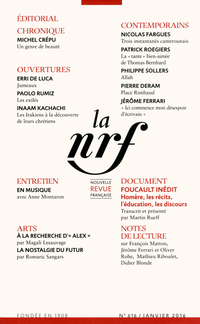
mediumAnother piece of Foucault from the archive was published last year – Michel Foucault, ‘Homère, les récits, l’éducation, les discours‘ edited by Martin Rueff in NRF. Apparently these notes date from the drafting of The Archaeology of Knowledge.

I’ve ordered a copy of this issue, but I found the reference just by chance – I’m wondering if there is a composite list of recently published short pieces by Foucault. My own piece, ‘The Uncollected Foucault‘ appeared in Foucault Studies in 2015 (open access), and was an attempt at a comprehensive list, but it’s already eighteen months out of date. I have a Google Scholar alert but it didn’t pick this one up. There was also an interesting piece on literature and madness in Critique last year. Is anyone else keeping track of new pieces of evidence?

View original post