Foucault News

News and resources on French thinker Michel Foucault (1926-1984)

Mameni, S.
What are the Iranians wishing for? Queer transnational solidarity in revolutionary Iran
(2018) Signs, 43 (4), pp. 955-978.

DOI: 10.1086/696628

Abstract
This article explores the role of desire in Iran’s revolutionary movement. In a series of essays on the 1979 revolution, Michel Foucault asked, “What are the Iranians dreaming about?” This article takes up this question to consider the place of dreams in the formation of revolutionary subjects who find themselves displaced and marginalized within the social fabric. I argue that Foucault’s “repressive hypothesis,” which he developed as he wrote about the uprising in Iran, encourages us to read Islam not as a repressive force but as a site of desire that animated anti-imperialist political action in Iran. I enter this conversation though the audiovisual archives of North American feminists Kate Millett and Sophie Keir, who traveled to Iran in 1979 as a gesture of feminist solidarity. While their archive documents their own alienation, displacement, and eventual expulsion from Iran, it nonetheless provides a view of transnational homosocial strategies that enabled feminist resistance to gendered oppression in Iran. I revisit this failed historical moment of global sisterhood, and Muslim dreaming, to ask if there is a critical agency in desiring that can be used by displaced subjects to create new social movements.

‘Showing that scientific demonstration is basically only a ritual, that the supposedly universal subject of knowledge is really only an individual historically qualified according to certain modalities, and that the discovery of truth is really a certain modality of the production of truth; putting what is given as the truth of observation or demonstration back on the basis of rituals, of the qualifications of the knowing individual, of the truth-event system, is what I would call the archaeology of knowledge.’

Michel Foucault. Michel Foucault, (2006) [2003]. Psychiatric Power. Lectures at the Collège de France, 1973- 1974. Tr. Graham Burchell. Houndmills and New York: Palgrave Macmillan, p. 238

Marcela Renée Becerra Batán, Epistemología histórica y técnicas de sí. El psicoanálisis del conocimiento objetivo y la vigilancia epistemológica (Bachelard) y las técnicas de sí (Foucault), Epistemología e Historia de la Ciencia, ISSN 2525-1198, 2 (2), 2018.

Open access

RESUMEN
Este trabajo se sitúa en el marco de una indagación acerca del estilo de la Epistemología Histórica –tanto la Épistémologie Historique(EH) como la Historical Epistemology (HE)-, en el camino señalado por Braunstein (2002, 2008, 2012).  En este marco, me pregunto si  podría ser  uno de los rasgos distintivos de este estilo el concebir a la epistemología  como un trabajo sobre sí, mediante ciertas técnicas de sí. Orientada por esta inquietud, en este trabajo realizaré el siguiente recorrido: me detendré en el “psicoanálisis del conocimiento objetivo” y la “vigilancia epistemológica” (Bachelard) y luego, en las “técnicas de sí” (Foucault). Plantearé a continuación qué podría aportarnos un cotejo entre dichas elaboraciones para pensar las técnicas de sí en el ejercicio epistemológico y, en definitiva, para “hablar de nuevo” sobre las relaciones “razón-verdad-vida” (Ayres, 2017). Por último, en la conclusión, procuraré destacar la importancia de estas cuestiones para concebir y practicar la Epistemología Histórica en nuestra actualidad, especialmente en relación con las ciencias humanas.

PALABRAS CLAVE

Epistemología Histórica; Técnicas de sí: Bachelard; Foucault

Historical Epistemology and techniques of the self. Psychoanalysis of objective knowledge and epistemological surveillance (Bachelard) and techniques of the self (Foucault)

Abstract.
This article is situated within the framework of an inquiry about the style of Historical Epistemology -both Épistémologie Historique (EH) and Historical Epistemology (HE) -, in the way pointed out by Braunstein (2002, 2008, 2012). In this context, I wonder if it could be one of the distinctive features of this style to conceive epistemology as a work on itself, through certain techniques of the self. Oriented by this concern, in this article I will take the following route: I will stop at the “psychoanalysis of objective knowledge” and the “epistemological surveillance” (Bachelard) and then, at the “techniques of the self” (Foucault). I will then consider what could bring us a comparison between these elaborations to think about the techniques of the self in the epistemological exercise and, ultimately, to “speak again” on the relations “reason-truth-life” (Ayres, 2017). Finally, I will evaluate the conclusions reached and I will try to highlight the importance of these issues to conceive and practice Historical Epistemology in our time.

Keywords: Historical Epistemology – Techniques of the self – Bachelard – Foucault.

Stehr, N., Adolf, M.T.
Knowledge/Power/Resistance
(2018) Society, 55 (2), pp. 193-198.

DOI: 10.1007/s12115-018-0232-3

Abstract
Francis Bacon’s famous metaphor that knowledge is power has been the intellectual springboard for many scholars to offer misleading observations about the inordinate authority and power of knowledge. Among the important implications that Bacon derives from his metaphor is the assertion that individuals provided with experimental skills and practical knowledge are those most entitled to hold executive office, rather than the aristocracy of blood. In this essay, we critically analyze Michel Foucault’s ambivalent version of the closeness of knowledge, power and authority. © 2018, Springer Science+Business Media, LLC, part of Springer Nature.

Author Keywords
Domination; Foucault; Knowledge; Power; Resistance; Sociology of knowledge

Kawasaka, K.
Contradictory Discourses on Sexual Normality and National Identity in Japanese Modernity
(2018) Sexuality and Culture, 22 (2), pp. 593-613.

DOI: 10.1007/s12119-017-9485-z

Abstract
This paper aims to analyse the relationship between discourses of gender/sexuality and construction of national identity and normativity in Japan. Firstly, I will analyse discourses of two influential theorists of queer studies, Michel Foucault and Eve K. Sedgwick, examining how Western cultural identity and modernity have been represented through sexuality and geography in their discussion. Secondly, I will review representations of gender and sexual normality and deviances in pre-war Japan, arguing how contradictory discourses and representation of gender and sexual norms were constructed with Japanese national identity through cultural differences between Japan and the West, or Japanese tradition and Westernisation. Finally, I will examine political functions of contradictory discourses of gender/sexual normativity against sexual minorities including within contemporary ‘LGBT-friendly’ discourses in Japanese society. Through these discussions, I will point out: firstly, Japanese modern gender and sexual normativity has been sustained by contradictory discourses and confusing cultural distinctions between Japan and the West, rather than definitive transitions towards Westernisation and clear cultural distinctions between Japan and the West; secondly, how these contradictory discourses of definitions of hetero/homosexuality and differences between Japan and the West have politically functioned against sexual minorities even now. Thus, I suggest that it is more fruitful for sexuality studies in/about Japan to focus on contradictory discourses, their historical and social contexts, and power dynamism rather than seeking the solutions for these contradictions. © 2017, Springer Science+Business Media, LLC, part of Springer Nature.

Author Keywords
Asian modernity; Japanese masculinity; Japanese modernity; Japanese nationalism; Nanshoku; Queer in Japan; Samurai

Index Keywords
female, geography, homosexuality, human, identity, Japan, male, masculinity, sexual minority, social environment

Macedo, E.
WADA and imperialism? A philosophical look into anti-doping and athletes as coloniser and colonised
(2018) International Journal of Sport Policy, pp. 1-13. Article in Press.

DOI: 10.1080/19406940.2017.1383930

Abstract
Post-colonial philosophical scholarship in the late 20th century advanced notions of exploitation and domination of the periphery post imperialistic control. Works by authors Peter Ekeh and Edward Said describe the institutional behaviour and ideology of a modern imperialist system. Additionally, Michel Foucault’s analysis of power helps explain how imperialist systems deploy what Foucault called juridical power for the domination of subjects. Drawing from these authors helps expose the practical and ethical complications of an imperialist model. This paper uses these insights to show that the World Anti-Doping Agency (WADA) provides an analogous case of an imperialist system and how the practical and ethical flaws of mirroring this system serve as an ineffective and unethical model for anti-doping. Among the many issues related to mirroring an imperialist system, the majority of problems stem from the divide that emerges between anti-doping enforcers and athletes. Ultimately the paper offers a potential solution to the problems, concluding with Maria Lugones’ idea of playful world travelling as an imperative first step and shift in ideology towards restructuring the anti-doping movement. Lugones’ idea of playful world travelling promotes the immersion of people. This immersion can close the divide between anti-doping enforcers and athletes. © 2018 Informa UK Limited, trading as Taylor & Francis Group

Author Keywords
anti-doping; Doping; imperialism; internal colonialism; juridical power; juridico-discursive power

Pride 2018: Demystifying Queerness and Sexuality – Talking Dog Productions Presents The History of Sexuality, BY SAMANTHA GOLDAUG 11, 2018, Forget the Box (Montreal)

The History of Sexuality is a play that is going to make you uncomfortable, but the reasons it will are the very reasons why you should see it.

Following a successful run at the Mainline theater in September 2017, it was selected as part of Pride 2018’s programming. Playwright, director, and producer Dane Stewart set out to write a play about queerness and power dynamics and the result is a piece that is visceral, heartrending, intellectual, sexy, and authentic.

The play revolves around a Master’s seminar about Michel Foucault’s book, The History of Sexuality taught by Marie, played by Renée Hodgins. It is through this seminar that the stories of the professor and her students are tied together. Though they have their own lives and relationships with power dynamics and sexuality, they always end up in class to talk about Foucault.

stuartelden's avatarProgressive Geographies

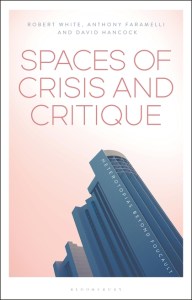
9781350021112Spaces of Crisis and Critique: Heterotopias Beyond Foucault, edited by Anthony Faramelli, David Hancock, Robert G. White – Bloomsbury 2018. Unfortunately only hardback and expensive e-book.

In Of Other Spaces Foucault coined the term “heterotopias” to signify “all the other real sites that can be found within the culture” which “are simultaneously represented, contested, and inverted.” For Foucault, heterotopic spaces were first of all spaces of crisis, or transformative spaces, however these have given way to heterotopias of deviation and spaces of discipline, such as psychiatric hospitals or prisons.

Foucault’s essay provokes us to think through how spaces of crisis and critique function to open up disruptive, subversive or minoritarian fields within philosophical, political, cultural or aesthetic discourses. This book takes this interdisciplinary and international approach to the spatial, challenging existing borders, boundaries, and horizons; from Claire Colebrook’s chapter unpacking the heterotopic spaces of America and Mexico that lie

View original post 47 more words

‘Now the critique of knowledge I would propose does not in fact consist in denouncing what is continually – I was going to say monotonously – oppressive under reason, for after all, believe me, insanity (déraison) is just as oppressive. Nor would this political critique of knowledge consist in flushing out the presumption of power in every truth affirmed, for again, believe me, there is just as much abuse of power in the lie or error. The critique I propose consists in determining under what conditions and with what effects a veridiction is exercised, that is to say, once again, a type of formulation falling under particular rules of verification and falsification.’

Michel Foucault, (2008) [2004]. The Birth of Biopolitics. Lectures at the Collège de France, 1978- 1979. Tr. Graham Burchell. Houndmills and New York: Palgrave Macmillan, p. 36

stuartelden's avatarProgressive Geographies

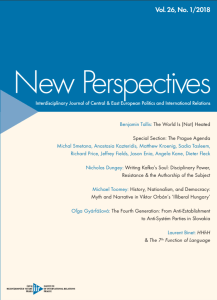
12018-740x1024New Perspectives Issue 1/2018

Editorial

  1. The World Is (Not) Heated

Benjamin Tallis

Special Section

  1. The Prague Agenda

Michal Smetana, Anastasia Kazteridis, Matthew Kroenig, Sadia Tasleem, Richard Price, Jeffrey Fields, Jason Enia, Angela Kane, Dieter Fleck

Research articles

  1. Writing Kafka’s Soul: Disciplinary Power, Resistance & the Authorship of the Subject

Nicholas Dungey

  1. History, Nationalism, and Democracy: Myth and Narrative in Viktor Orbán’s ‘Illiberal Hungary’

Michael Toomey

  1. The Fourth Generation: From Anti-Establishment to Anti-Systém Parties in Slovakia

Oľga Gyárfášová

Cultural Cut

  1. HHhH & The 7th Function of Language

Laurent Binet

View original post