Foucault News

News and resources on French thinker Michel Foucault (1926-1984)

Special issue on Foucault in Iran
Iran Namag Volume 3, Number 2, Summer 2018

English Verso

Foucault and Iran Reconsidered: Revolt, Religion, and Neoliberalism
Michiel Leezenberg

French Secular Thought: Foucault and Political Spirituality
Brian Turner

Risking Prophecy in the Modern State: Foucault, Iran, and the Conduct of the
Corey McCall

Foucault and Epicureanism of the Iranian Revolution
Yadullah Shahibzadeh

What is at the heart of the dispute? Reflections on the Foucault Controversy Forty Years Later 
Kevin Gray and Rida Faisal

Iranian Conditions: Metaphors of Illness in Iranian Fiction and Film
Babak Elahi

Iranian Conditions: Metaphors of Illness in Iranian Fiction and Film
Babak Elahi

In Memoriam: Heshmat Moayyad, 1927-2018
Franklin Lewis

Persian Reverso

A Thunderbolt Out of the Blue: The Iranian Revolution in Foucault’s Thought
Behrooz Ghamari-Tabrizi

Possibilities and Limitations in Writing the History of the Present: Foucault and the Iranian Revolution
Ata Mohamed Tabriz

Foucault’ Accounts of the Iranian Revolution in Light of Islamic Historiography
Mahdi Shafieyan

Foucault and Iran
Daniel Defert

Michael Foucault’s 1979 Interview
Farès Sassine

stuartelden's avatarProgressive Geographies

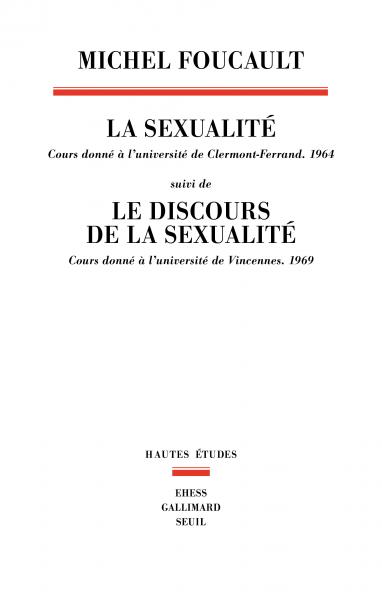
140113_couverture_Hres_0Michel Foucault, La Sexualité. Cours donné à l’université de Clermont-Ferrand (1964) suivi de Le Discours de la sexualité. Cours donné à l’université de Vincennes (1969) – EHESS/Gallimard/Seuil 2018

The first volume of Foucault’s pre-Collège de France courses is due for publication in October 2018. I’ve mentioned this before, but the official description is now up at the Seuil site.

Michel Foucault avait engagé le projet d’une histoire de la sexualité dès les années 1960, et lui avait notamment consacré deux cours, jusqu’ici inédits.
Le premier, donné à Clermont-Ferrand en 1964, s’interroge sur les conditions d’apparition, en Occident, d’une conscience problématique et d’une expérience tragique de la sexualité, ainsi que de savoirs qui la prennent pour objet. Partant d’une réflexion sur l’évolution du statut des femmes et du droit du mariage, ce cours aborde l’ensemble des savoirs sur la sexualité, de la biologie ou l’éthologie à la psychanalyse.
Le second…

View original post 179 more words

Diiple

Our story began when Kai, an adjunct professor of sociology, became enthusiastic about the new idea of academic streetwear. Once he met Eva, an award-winning fashion designer with similarly oriented thoughts, the idea began to take off. Diiple was founded in Helsinki, Finland, in the summer of 2016.

Dispositif teeshirt

We like to think that Diiple – a name that breathes Nordic spirit with its double i’s (think about the word skiing!) – is not only a lifestyle brand but also an academic community. At least this is what we are striving for! Although our slogan says that we are passionate about academic streetwear, we also see ourselves as part of a larger celebration of nonconformist, radical, and original thought.

We especially celebrate some of the rare individuals who created their own values and concepts to get a better understanding of our contemporary condition. It is our intention to create a growing set of examples so we can examine some of the most iconoclastic achievements in the different fields of theory and culture. Please visit our Studies section to read about our reasoning and analyses for choosing these particular individuals.

Governmentality teeshirt

We see ourselves as unique, and we do not expect to please everyone. However, when it comes to our products, we refuse to compromise on quality. We hope to become the natural first choice in academic streetwear – a name we invented. To become a true community, however, we need your help. Together we can create a superb site largely based on your suggestions for new products as well as new studies.

Kind regards, Kai and Eva
Contact us

See also this post on Diiple’s blog: Trials and errors in Academic Streetwear

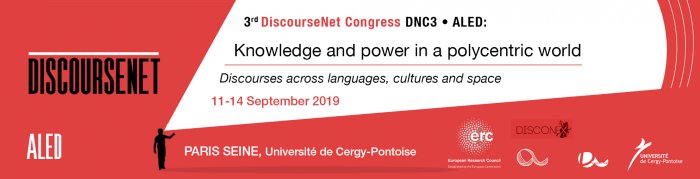
Click on the following links for the English, French, Spanish, Portuguese, German and Russian versions of the DNC3-ALED Congress. Please sign up here now to receive the latest information!

Congress theme

The legitimacy of “Europe” and “the West” as identifiable territorial and imagined entities is in crisis. The awareness has grown of a world becoming more polycentric. At the same time,  the field of Discourse Studies is growing at a dazzling rate across the globe. Discourse Studies is known for theoretical orientations and methodological tools that account for meaning production as a social practice mobilizing languages, media and technologies. It is thus uniquely placed to observe and analyse the shifting conceptions of a post-colonial, post-Eurocentric, post-west-and-the-rest world. The different understandings of the intersection of language and society, in the range of specific schools, theories and approaches within Discourse Studies promise to inspire conflicting analyses of the world today.

The focus of Discourse Studies also varies according to the specific national or regional contexts in which issues of power and language, subjectivity and inequality, language and context are being problematized. For instance, Anglophone, French-, German-, Spanish-, Portuguese-, and Russian-speaking communities of discourse analysts and theorists are marked by dynamic debates, terminologies and approaches that are not always well known outside each language community. The third DiscourseNet Congress, which is co-organized with ALED, aims to be a site of dialogue and reflection across and about different linguistic and national traditions in Discourse Studies.

DiscourseNet is an interdisciplinarynetwork of discourse researchers who have organized more than 25 conferences in Europe over the past ten years. The Asociación LatinoAmericana de Estudios del Discurso was formed in 1995 to promote the development of Discourse Studies inLatin America. ALED has organised 12 International Congresses and about 11 national events for each country member. A joint initiative of DiscourseNet and ALED, DNC3 – ALED invites specific approaches to shifting conceptions of, for instance, “Europe”, “the global South”, “the West”… Within the overarching frame of our contemporary entangled world, we invite discourse analysts from around the world to take stock of contemporary developments in Discourse Studies.

DNC3-ALED
  • is open to discourse researchers from all disciplines,
  • welcomes presentations in the many languages in which discourse research is being done today,
  • aims to create and develop non-hierarchical and open spaces for dialogue and exchange.

We welcome papers which re-examine existing discourse theoretical frameworks, articulate new approaches from different fields and schools,study social phenomena empirically and reflect on the critical potential of Discourse Studies. We also invite contributions that deal with theoretical and/or methodological challenges in Discourse Studies, preferably with a focus on the nexus of knowledge and power.

Researchers may focus on a wide variety of topics. We encourage contributions that seek to develop novel approaches to, for instance:  subjectivity in contemporary society, discursive epistemology, indexicality,  ideology, knowledge and hegemony,  governmentality in the knowledge economy, protest and activism, materiality of/and discourse, critique and reflexivity, bi-, multi- and translingual communication, language policy, discourse and gender, class, migration, racism, populism, (neo-)fascism, discrimination, argumentation and rhetorics, social cognition, institutional discourse, workplace communication, practices and identities in the workplace, multimodal interaction and discourse analysis, online media formats and digital culture, materialism and discourse, digital humanities, cross-cultural interaction, multimodality, corpus and computer-aided analysis, conversation and interaction…

Keynote speakers

DNC3-ALED will be opened by Johannes Angermuller and Dominique Maingueneau. The speakers will reflect a range of backgrounds and include

  • Caterina Carta, Canada (in English)
  • Patrick Charaudeau, France (in French)
  • Laura Pardo, Argentina (in Spanish)
  • Viviane Resende de Melo, Brazil (in Portuguese)

The conference webpage is http://dnc3aled.discourseanalysis.net, where you will find more information on the programme, the registration, the venue, the publications and the organization team in English, French, German, Spanish, Portuguese and Russian. For more information, please contact dnc3aled@gmail.com.

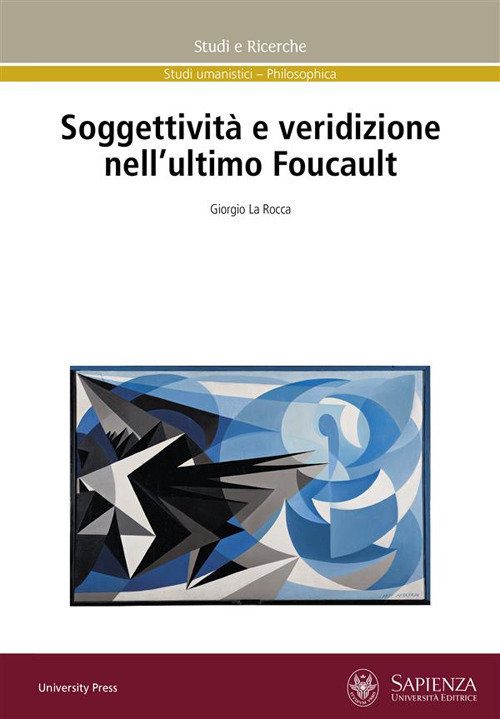
Giorgio La Rocca, Soggettività e Veridizione nell’ultimo Foucault, Sapienza Università Editrice, 2018

L’opera analizza il tema della soggettività e della veridizione negli ultimi quattro corsi tenuti da Michel Foucault al Collège de France, con particolare riferimento agli ultimi due dedicati al governo di sé e degli altri.

L’idea è di leggere tutti questi argomenti attraverso il filtro del carattere, di per sé, tema non foucaultiano. Eppure, proprio nell’ultimo Foucault, sembra che si possa rintracciare un’attenzione a tale questione.

Si giunge così a presentare l’estetica dell’esistenza come un’epifania del carattere, mettendone in rilievo le affinità e le consonanze con la teoria e l’etica delle virtù, secondo una valenza autonoma e senza inclinare necessariamente a una teoria del bene esterna alla sua stessa dimensione.

Benché l’opera si concentri sugli aspetti etici del soggetto, del dir-il-vero e della parrhesia, l’ambito politico – centrale nell’opera di Foucault – non è affatto mortificato se si accetta, aristotelicamente, che l’ethos è una dimensione della politica e non dell’etica, e che è il carattere, dunque, a risolvere il problema del soggetto nell’ambito del politico.

English
The work examines the theme of Subjectivity and veridiction in the last four lectures by Michel Foucault at the Collège de France, in particular those dedicated to “The Government of Self and others” (1982-1983), and to “The Courage of truth” (1984).

The proposition is to read these topics through the notion of character, normally not a foucaldian theme. You thus reach the present of the “aesthetics of existence” as a epiphany and realisation of character, to remark the affinity and consonances with the theory and ethics of virtue.

Although the work focuses on ethical perspectives of Subject, of veridiction and parrhesia, the political setting, central in the Foucault’s work, is not neglected at all, because according to Aristotle, the ethos is first of all a political and not an ethical dimension. So, it’s the character that resolves the problem of Subject in the political range.

Pourya Asl, M.
Fabrication of a desired truth: the oblivion of a Naxalite woman in Jhumpa Lahiri’s The Lowland
(2018) Asian Ethnicity, 19 (3), pp. 383-401.

DOI: 10.1080/14631369.2018.1429892

Abstract
Jhumpa Lahiri’s The Lowland (2013) explores effects of the 1967 Communist Naxalbari uprising in West Bengal India. Irrespective of the glowing reviews the author earned for her truthful representations, the novel presents the pro-Communist uprising in a particular discursive regime that establishes a particular way of remembering and forgetting. Drawing on Foucault’s notion of ‘subjugated knowledges,’ this essay seeks to examine the epistemic hegemonies and mainstream perspectives of the novel that have confined particular experiences and memories of the movement to the margins and rendered them unworthy of epistemic respect in the battle among power/knowledge frameworks. The novel reconstitutes a gendered history of the movement in which women’s story of engagement is spatiotemporally erased and reformulated. I argue that the genealogy of this particular oversight is rooted in the heteronormative capitalist ideology of the States that exercises discursive power over individuals to fabricate a desired truth. © 2018 Informa UK Limited, trading as Taylor & Francis Group.

Author Keywords
capitalism; Communism; female subjectivity; Naxalbari; subjugated knowledges

Daniele Lorenzini, Rhetoric Lecture – The Emergence of Desire: Notes toward a Political History of the Will in Foucault’s “Aveux de la Chair”

2 October 2018
5:00 pm to 7:00 pm

The Department of Rhetoric
3335 Dwinelle Hall
University of California
Berkeley, CA 94720-2670

In this paper on Foucault’s fourth volume to The History of Sexuality, Les aveux de la chair (Gallimard, 2018), I argue that desire, conceived as a central and permanent dimension of the human subject, is the condition of possibility of the emergence of both the modern experience of sexuality and the mechanisms of power that produced, organized, and exploited it. This condition of possibility, as Foucault points out, was historically constituted. Thus, the objective of this paper is both to critically reconstruct the way in which Foucault accounts for the progressive emergence of desire as a principle of subjectivation/objectivation of sexual acts in the Greco-Roman and Christian worlds, and to emphasize the socio-political relevance of these early chapters of his history of sexuality—an often downplayed relevance that is connected to what I call a political history of the will.

Daniele Lorenzini is a Marie Skłodowska-Curie ‘Move-in Louvain’ Postdoctoral Fellow at the Centre Prospéro (Université Saint-Louis – Bruxelles) and a Postdoctoral Fellow at the Center for Contemporary Critical Thought (Columbia University). Starting in Fall 2019, he will be Assistant Professor of Philosophy at the University of Warwick. He is the author of Jacques Maritain e i diritti umani [Jacques Maritain and Human Rights] (Brescia: Morcelliana, 2012), Éthique et politique de soi [Ethics and Politics of the Self] (Paris: Vrin, 2015), and La force du vrai [The Force of Truth] (Lormont: Le Bord de l’Eau, 2017). He is the editor, with Henri-Paul Fruchaud, of Michel Foucault’s lectures About the Beginning of the Hermeneutics of the Self (Chicago: The University of Chicago Press, 2015), Qu’est-ce que la critique? suivi de La culture de soi (Paris: Vrin, 2015; English edition forthcoming with The University of Chicago Press); Dire-vrai sur soi-même (Paris: Vrin, 2017; English edition forthcoming with The University of Chicago Press), Discourse and Truth (Chicago: The University of Chicago Press, 2019).

Foth, T., & Holmes, D. (2018). Governing through lifestyle—Lalonde and the biopolitical management of public health in Canada. Nursing Philosophy, 0(0), e12222.

doi:10.1111/nup.12222

“In 1974, the Liberal government of Pierre Trudeau released a “green paper” known as the Lalonde Report, after the health minister at that time. The report formulated perspectives on health and the main concepts and ideas developed in it, particularly the concept of “lifestyle,” which became the foundation of public health policies in many different European countries and the United States. The concept of “lifestyle” connected personal behaviour and habits to the individual health condition; people were not dying due to a lack of access to medical care but because they lived a life prone to personal risk taking. Furthermore, what is seldom discussed is that this report not only propagated the (neo)liberal view of citizens as autonomous rational actors (homo oeconomicus), with personal responsibility for their health, but it was a first step in the transformation of Medicare and went far beyond the question of health promotion. Health was no longer something that happened to a person but was created through personal choice and, therefore, one had to assume responsibility for one’s behaviour. Using Foucault’s definition of government as the “conduct of conduct,” we will demonstrate that the Lalonde report must be understood as a specific “technology of government” and contributed to a neoliberal transformation of health care despite the fact that the Canadian system of Medicare was based on the idea of universality, meaning citizens had equal access to health care independent of their socio‐economic situation. As we will demonstrate, the Lalonde report undermined this foundation and initiated a profound reorientation, not only of the healthcare system, but even more importantly, it radically changed the way we think about our behaviour around health‐related issues. We will also discuss how the making of the report contributed to the redefinition of politics and demonstrated a lack of concern with liberal‐democratic decision‐making processes.”

Rushton, C., Edvardsson, D.
Reconciling conceptualizations of ethical conduct and person-centred care of older people with cognitive impairment in acute care settings
(2018) Nursing Philosophy, 19 (2), art. no. e12190, .

DOI: 10.1111/nup.12190

Abstract
Key commentators on person-centred care have described it as a “new ethic of care” which they link inextricably to notions of individual autonomy, action, change and improvement. Two key points are addressed in this article. The first is that few discussions about ethics and person-centred are underscored by any particular ethical theory. The second point is that despite the espoused benefits of person-centred care, delivery within the acute care setting remains largely aspirational. Choices nurses make about their practice tend to comply more often with prevailing norms than those championed by person-centred care. We draw on elements of work by moral philosopher Løgstrup and Foucault to provide insight into nurses’ ethical conduct and ask why nurses would want to act otherwise, when what they think and do is viewed as normal, or think and act otherwise if doing so is seen within the organization as transgressive? To address these more specific questions, we discuss them in relation to the following constructs: the ethical demand, sovereign expressions of life and parrhêsia. We conclude by arguing that a ethical theoretical framework enables nurses to increase their perceptibility and appreciation of the ethical demand particularly those emanating from incommensurability between organizational norms and the norms invoked by person-centred care. We argue that nurses’ responses to the ethical demand by way of parrhêsia can be an important feature of intra-organizational reflexivity and its transformation towards the delivery care that is more person-centred, particularly for older people with cognitive impairment. We conclude the article by highlighting the implications of this for nursing education and research. © 2017 John Wiley & Sons Ltd

Author Keywords
acute care; cognitive impairment; ethical conduct; older person; parrhêsia

Index Keywords
aged, cognitive defect, concept formation, ethics, human, intensive care nursing, medical ethics, nursing, patient care, philosophy; Aged, Cognitive Dysfunction, Concept Formation, Critical Care Nursing, Ethics, Nursing, Humans, Patient-Centered Care, Philosophy, Nursing

Hickey, C., Mooney, A.
Challenging the pervasiveness of hypermasculinity and heteronormativity in an all-boys’ school
(2018) Australian Educational Researcher, 45 (2), pp. 237-253.

DOI: 10.1007/s13384-017-0249-4

Abstract
There is a rich, albeit chequered, history around single-sex schooling providing an educational option for nurturing the particular educational interests and needs of boys. While all-boys’ schools continue to position themselves at the forefront of contemporary masculine endeavour, they are simultaneously forced to fend off accusations that they are proverbial hot beds for the reproduction of gendered hegemony. Whereas some boys’ schools appear content with their ‘masculine’ profile, others appear more eager to present themselves as projecting tolerant and inclusive environments wherein respectful gender relations are actively encouraged. Situated within a wider case study, this paper examines how one all-boys’ school sought to foster gender inclusivity through a strategic initiative to increase the number of female teaching staff and the appointment of a female deputy principal. The data presented here focus on qualitative research interviews undertaken with key members of staff around 5 years after the initiative was introduced to the school. Our interpretation of the data draws largely on selected works of Michel Foucault to explore the discourse-power relations that sustain enduring hypermasculine and heteronormative values within the school. This lens provides a framework to interrogate how gendered constructions of professional identity are framed within such a context, and the spaces that exist for them to be challenged. © 2017, The Australian Association for Research in Education, Inc.

Author Keywords
Boys’ schooling; Culture change; Heteronormativity; Hypermasculinity