Foucault News

News and resources on French thinker Michel Foucault (1926-1984)

Hutta, J.S.
From sovereignty to technologies of dependency: Rethinking the power relations supporting violence in Brazil
(2019) Political Geography, 69, pp. 65-76.

DOI: 10.1016/j.polgeo.2018.11.008

Abstract
Discussions in geography and cognate disciplines have considered how contemporary formations of power and politics support and give rise to violence in a range of contexts. Often, these discussions have invoked Foucault’s and Agamben’s analyses of sovereignty as well as governmentality to show how violence is legitimized by state and non-state actors. Focusing on the Brazilian context, the paper argues that this strand of research, though opening up productive analytic pathways, has largely eclipsed a set of powerful technologies that are structured around dependencies. Such issues of dependency have been particularly pronounced in writings that have proposed an ‘embedded’ approach to violence in Latin American urban contexts. Importantly, whereas Foucault- and Agamben-inspired writings have focused largely on how violence is justified and legitimized, studies emphasizing its embeddedness have brought into relief how violence is concealed and removed from systems of accountability. To describe the dependencies enabling such concealment, though, studies of embedded violence have often relied on the notion of ‘political clientelism’. Interrogating the epistemological assumptions associated with this notion, the paper suggests re-framing relations of dependency as constituted through situated technologies that operate, for instance, through performances of benevolence, racialized and gendered discourses or practices of concealment. This, it is argued, opens the view towards other combinations of power than those of sovereignty, discipline and biopolitics that have commonly been focused in the wake of Agamben and Foucault. © 2018 Elsevier Ltd

Author Keywords
Agamben; Brazil; Clientelism; Dependency; Foucault; Sovereignty; Violence

Sforzini, A. (2019). Michel Foucault va au cinéma / Foucault at the Movies. Le Foucaldien, 5(1), 1.

DOI: http://doi.org/10.16995/lefou.56

Abstract
This article reviews the book Foucault at the Movies, published in French in 2011 and translated into English by Clare O’Farrell in 2018. The author first discusses the general structure and aims of the volume. The article then summarizes the two main essays composing the book, and finally examines its philosophical relevance for contemporary Foucauldian studies.

Keywords: Foucault , cinema , history , event , body , experience

Elden, S.
Review: Michel Foucault, Histoire de la sexualité 4: Les aveux de la chair
(2018) Theory, Culture and Society, 35 (7-8), pp. 293-311.

DOI: 10.1177/0263276418800206

Abstract
In February 2018 the fourth volume of Michel Foucault’s History of Sexuality was finally published. Les aveux de la chair [Confessions of the Flesh] was edited by Frédéric Gros, and appeared in the same Gallimard series as Volumes 1, 2 and 3. The book deals with the early Christian Church Fathers of the second to fifth centuries. This essay reviews the book in relation to Foucault’s other work, showing how it sits in sequence with Volumes 2 and 3, but also partly bridges the chronological and conceptual gap to Volume 1. It discusses the state of the manuscript and whether it should have been published, given Foucault’s stipulation of ‘no posthumous publications’. It outlines the contents of the book, which is in three parts, on the formation of a new experience, on virginity and on marriage. There are also some important supplementary materials included. The review discusses how it begins to answer previously unanswered questions about Foucault’s work, and offers some suggestions about how the book might be received and discussed. © The Author(s) 2018.

Tonner, P.
Heidegger, heterotopic dwelling and prehistoric art: An initial indication of a field of research
(2018) Religions, 9 (12), art. no. 405.

DOI: 10.3390/rel9120405

Open access

Abstract
This paper begins to develop an interpretation of European cave art based on Martin Heidegger’s account of artistic production and ‘dwelling’ so as to indicate a potentially rich area for future research. The paper will also draw on Foucault’s account of heterotopic space and will engage with one of the key researchers on the archaeology of cave art, Randall White. The role of a work of art for Heidegger is to hold open a world. Art enables a decision to be made by a group regarding how things are going to matter for, and to, them as dwellers in their world. Works of art, on Heidegger’s account, put up for decision what will count as the highest values (the gods) for a group while determining what will prove essential for human dwelling in a world. With reference to Foucault, it will be suggested that caves are a good candidate for a heterotopic space. Caves are uncanny, numinous spaces and because of this, I suggest, they enable human beings to produce art as a world-opening event. I suggest that there is something significant about human experience in caves and I attempt to make a connection between heterotopic space, dwelling, and the art of the last Ice Age in Europe in order to point towards a novel field of research: dwelling and prehistoric art. © 2018 by the authors. Licensee MDPI, Basel, Switzerland.

Author Keywords
Anxiety; Art; Cave; Dwelling; Heterotopia; Liminal; Numinous; Phenomenology; Uncanny; Underscape

Patrick Gamez,
The place of the Iranian Revolution in the history of truth: Foucault on neoliberalism, spirituality and enlightenment
(2019) Philosophy and Social Criticism, 45 (1), pp. 96-124.

https://doi.org/10.1177/0191453718794751

Abstract
In this article I want to argue that Foucault’s engagement with the Iranian Revolution was neither romantic fascist atavism nor does it presage any sort of transformation of his thought. Indeed, Foucault’s investigations of neoliberalism and subsequent work on spirituality, truth-telling and ethics are fully continuous with his critical genealogy of power. This is an important point, as we shall see, insofar as Foucault’s journalism on the Iranian Revolution occurs in the midst of his Collège de France lectures on biopolitics and governmentality. Foucault’s enthusiasm for the Revolution might indicate, albeit very indirectly, directions for thought that might resist neoliberalism. I will argue that Foucault was engaged in a very specific telling of the ‘history of truth’, emphasizing a partisan and agonistic form of truth-telling and transformation through struggle and ordeal, as opposed to the pacifying, neutralizing and normalizing forms of modern Western power. The ‘political spirituality’ Foucault witnessed on the streets of Tehran was a reactivation of this agonism, and– I will claim – a literal embodiment of what Foucault calls the ‘ethos of critique’. © The Author(s) 2018.

Author Keywords
biopolitics; critique; genealogy; liberal governmentality; politics of truth

Whelan, G.
Born Political: A Dispositive Analysis of Google and Copyright
(2019) Business and Society, 58 (1), pp. 42-73.

DOI: 10.1177/0007650317717701

Abstract
Google is a complex and complicated political beast with a significant, and often confusing, interest, in copyright matters. On one hand, for example, Google is widely accused of profiting from piracy. On the other, Google routinely complies with what is rapidly approaching a billion copyright takedown requests annually. In the present article, Foucault, neo-Gramscians, and Deleuze and Guattari are utilized to help construct a 32 dispositive analysis framework that overlaps three dispositive modalities (law, ethical, utilitarian) and perspectives (apparatus, articulation, assemblage). In applying the framework to the Google–copyright relationship, the article shows how Google was “born political”: in that it was, and still is, disposed by an apparatus comprised of copyright laws, Silicon Valley culture, and broad advances in digitization. Moreover, the article shows how Google continuously acts where “politics is born”: as it significantly shapes copyright considerations by disposing of (non-)human and organizational phenomena through articulations and assemblages. © The Author(s) 2017.

Author Keywords
copyright; dispositive; Foucault; Google; politics

O’Toole, J.
Crafting weight stigma in slimming classes: A case study in Ireland
(2019) Fat Studies, 8 (1), pp. 10-24.

DOI: 10.1080/21604851.2019.1534463

Abstract
The persistence of dominant social and cultural representations of weight loss renders it as normative and necessary, especially for women. One setting in which the goal of weight loss is relentlessly pursued is the slimming class. Drawn from the analysis of the ethnographic data from a larger one-year narrative inquiry study in four slimming classes in Ireland, this article demonstrates that while slimming is narrated as a positive intervention in the “care of the self,” the crafting of weight stigma is central to the dominant weight loss storyline constituted in the classes. Theoretically, the study weaves insights from the feminist expansion of Foucault’s work on disciplinary power and governmentality, Goffman’s concept of stigma, and narrative inquiry. Three main findings are discussed: the construction of slimming as a quest, slimmer identity, and the overt stigmatizing of fatness. The quest narrative produces a limited set of narrative resources (stories/characters/temporality) that make it very difficult to speak outside the narrative of weight loss. In an Irish context, where the historical circumscription of women’s bodies was pervasive, the findings illustrate aspects of the contemporary mechanisms through which such bodily circumscription endures. © 2018, © 2018 Taylor & Francis.

Author Keywords
Critical weight studies; dieting; fat phobia; Irish women; narrative inquiry; slimming classes; stigma

Editor: I usually pass over this kind of material, but Jordan Peterson, a clinical psychologist and professor of psychology at the University of Toronto has become an influential celebrity in the last few years with a large following. I am posting this in order to draw attention to the increasing volume and popularity of certain politically motivated “critiques” of the work of Foucault and his contemporaries.

For a useful background article on Peterson’s activities, views and celebrity see:
Dorian Lynskey, How dangerous is Jordan B Peterson, the rightwing professor who ‘hit a hornets’ nest’?, The Guardian, 8 February 2018

See also this essay review of Peterson’s book 12 rules for life:
Shuja Haider, Postmodernism Did Not Take Place: On Jordan Peterson’s 12 Rules for Life, Viewpoint Magazine, January 23, 2018

stuartelden's avatarProgressive Geographies

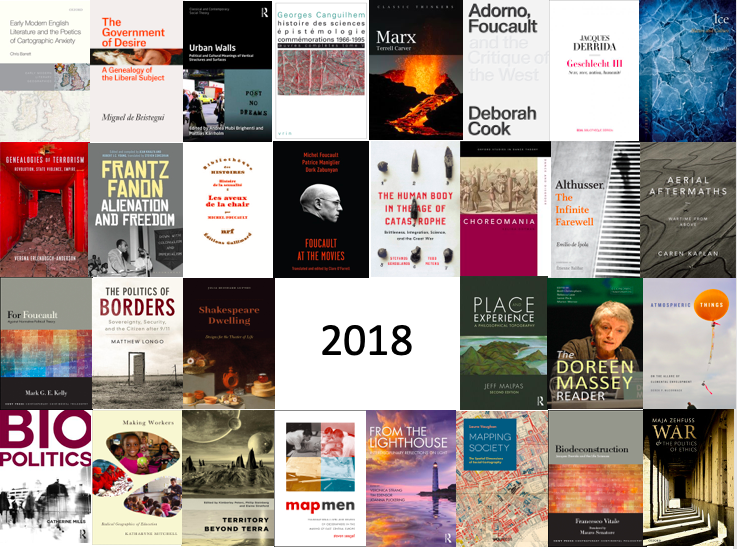
My favourite academic books of 2018. As with previous years – 2013, 2014, 2015, 2016, 2017 – these are shaped by my interests, books that are sent to me, ones from publishers I review for, etc. etc. I’ve not read all the 2018 books I’ve bought or been sent, so while there are doubtless many other good books published this year, I can at least say that these are all worth reading.

books of 2018.png

  1. Chris Barrett, Early Modern English Literature and the Poetics of Cartographic Anxiety (OUP)
  2. Miguel de Beistegui, The Government of Desire: A Genealogy of the Liberal Subject (Chicago)
  3. Andrea Mubi Brighenti and Mattias Kärrholm (eds.) Urban Walls: Political and Cultural Meanings of Vertical Structures and Surfaces (Routledge) – which I endorsed
  4. Georges Canguilhem, Œuvres complètes Tome V : Histoire des sciences, épistémologie, commémorations 1966-1995, edited by Camille Limoges (Vrin)
  5. Terrell Carver, Marx (Polity)
  6. Deborah…

View original post 370 more words

Special Issue: Processes of Subjectivation: Biopolitics and the Politics of Literature, Comparative Literature and Culture 20.4 (2018)_ Issue 20.4 (December 2018)
Ed. Azucena G. Blanco

 
The Eventualization of Political Thinking: From the Arab Revolutions to the Trump Era
Oscar Barroso

The Composition of History: a Critical Point of View of Michel Foucault’s Archaeology
Javier Gálvez Aguirre

“The Politics of Literature in Michel Foucault: Veridiction, Fiction and Desire”
Azucena G. Blanco

From Biopolitics to Biopoetics: a Hypothesis on the Relationship between Life and Writing
Julieta Yelin

Jewish Mysticism from Borges to Cirlot: a Transatlantic Approach to the Possibility of a Non-Subject Subjectivity
Erika Martínez

Literature of the Self in Foucault: Parrhesia and Autobiographical Discourse
Álvaro Luque

From Subjection to Dispossession: Butler’s Recent Performative Thought on Foucault’s Latest Work
Elisa Cabrera

Regaining the Subject: Foucault and the Frankfurt School on Critical Subjectivity
Miguel Alirangues

Of the Processes of Subjectivation as a Subspecies of the Event: the Deleuzian Reading of the Later Foucault
Francisco J. Alcalá

Foucault and the Recommencement of Philosophy
Javier de la Higuera

Courage and Passion in the Reading of the Later Foucault of the Cynics
Inmaculada Hoyos Sanchez