Foucault News

News and resources on French thinker Michel Foucault (1926-1984)

Gálvez Aguirre, Javier. “The Composition of History: a Critical Point of View of Michel Foucault’s Archaeology.” CLCWeb: Comparative Literature and Culture 20.4 (2018):

DOI:10.7771/1481-4374.3359

Abstract:
In “The Composition of History: a Critical Point of View of Michel Foucault’s Archaeology” Javier Gálvez discusses a very specific aspect within the work of Foucault: the role of the philosophies of history in the composition of historical discourse. The philosophies of history of pre-revolutionary Europe were able to show a discursive continuity that does not tally with the discontinuities that are sought in Foucault’s archaeological and genealogical project. The question that is asked following the analyses of these discourses does not fully escape from the analyses of the knowledge-power apparatuses: how is it possible that the practical-political nature of the philosophy of history discourses has remained effectively silenced in political practice? After elucidating a barely bounded concept of “history” in Foucault from the discontinuities of the epistemological fields of “Order” and “History,” the indecision of this rupture in philosophical-historical discourse will be shown, taking Turgot and Vico as examples.

Danny Sullivan, What Foucault Can Teach Us About the Schismatic Growth of Comicon Culture | Seattle Weekly, Wednesday, March 1, 2017

[…]

Philosopher Michel Foucault identified the dangers that face any group as knowledge of its subject matter grows. His The Archaeology of Knowledge (1972) is an attempt to discover the systems of thought that govern any field. Though he addresses most explicitly the scientific community, he extends his ideas to communities whose interests center around fiction.

His basic claim is that groups are defined by sharing a discourse—a set of ideas and points of reference that in turn define what knowledge is for the group. As he puts it, “A discursive practice may form … the basis of which coherent (or incoherent) propositions are built up, more or less exact descriptions developed, verifications carried out, theories deployed. They form the precondition of what is later revealed and which later functions as an item of knowledge or an illusion, an accepted truth or an exposed error.” In other words, the ways groups talk about common topics help determine the conclusions they arrive at and change their understanding of it on the deepest level.

Reading this today brings to mind fan theories, those elaborate constructions that often seek to “solve” stories by imposing their own logic onto them. Fan theorizing has exploded in popularity in recent years as a result of the growth of discourse that encourages a granular, analytical approach that seeks to test and pinpoint plot holes rather than achieve a thematic understanding.

Read more

Daniele Lorenzini
Benjamin/Foucault : histoire, discontinuité, utopie, Phantasia, Volume 7 – 2018

Résumé
Cet article se propose de montrer qu’un dialogue « à distance » entre Benjamin et Foucault peut être construit à partir d’au moins trois thèmes. Premièrement, leur conception du moment présent, ou plus précisément, du rapport vertical que le présent institue avec le passé, et donc leur intérêt non pas tant pour une histoire des discontinuités, mais pour une vision de l’histoire comme discontinuité, dont la portée est explicitement éthico-politique. Deuxièmement, leur attention pour les – et leur volonté de donner voix aux – opprimés et aux infâmes. Troisièmement, leur vision hétérotopique ou contre-utopique de l’histoire, qui définit l’attitude messianique ou critico-expérimentale de l’historien-philosophe dont ils parlent. Nous soutenons enfin que Benjamin et Foucault ont choisi l’un et l’autre d’écrire l’histoire de façon telle qu’elle puisse produire des effets réels dans le présent, en équipant les lecteurs d’armes en vue de leur lutte contre l’oppression.

Index de mots-clés : Benjamin – Foucault – histoire – discontinuité – utopie – événement – révolution

Abstract
This paper aims to show that a dialogue “at a distance” between Benjamin and Foucault can be constructed starting from at least three themes. First, their conception of the present moment, or more precisely, of the vertical relation that the present establishes with the past, and therefore their interest not so much in a history of discontinuities, but in a concept of history as discontinuity, whose value is explicitly ethical and political. Second, their attention for – and their willingness to give voice to – the oppressed and the infamous. Third, their heterotopic or counter-utopic way of conceiving of history, which defines the messianic or critico-experimental attitude of the historian-philosopher they talk about. Finally, I argue that both Benjamin and Foucault chose to write history in a way that allows to produce real effects in the present, providing the readers with weapons they can use in their fight against oppression.

Index by keyword : Benjamin – Foucault – history – discontinuity – utopia – event – revolution

Tim Christiaens, Financial Neoliberalism and Exclusion with and beyond Foucault, Theory, Culture & Society, December 22, 2018

DOI: 10.1177/0263276418816364

Abstract
In the beginning of the 1970s Michel Foucault dismissed the terminology of ‘exclusion’ for his projected analytics of modern power. This rejection has had major repercussions on the theory of neoliberal subject-formation. Many researchers disproportionately stress how neoliberal dispositifs produce entrepreneurial subjects, albeit in different ways, while minimizing how these dispositifs sometimes emphatically refuse to produce neoliberal subjects. Relying on Saskia Sassen’s work on financialization, I argue that neoliberal dispositifs not only apply entrepreneurial norms, but also suspend their application for groups that threaten to harm the population’s profitability. Neoliberal dispositifs not only produce entrepreneurial subjects but also surplus populations that are expelled from the overall population to maintain its productivity. Here, the concept of ‘exclusion’ is appropriate if understood in Agamben’s sense of an inclusive exclusion. The surplus population is part of neoliberal dispositifs, but only as the element to be abandoned.

Keywords exclusion, finance, Foucault, neoliberal subjectivity, neoliberalism, Sassen

On Colin Wilson’s facebook page

Associated literature!
Panopti-claus: Foucaultian social control for the kiddies, Savage Minds Blog, 24 December 2014

Adrienne LaFrance, Santa Claus and the Surveillance State, The Atlantic, 17 December 2014

With all the best wishes of the festive season to everyone. Here’s a decidedly dodgy mug to aid in foucauldian festivities for sale from Cafe Press

Appel à Communications/Call for Papers

5èmes Journées d’études sur l’Épistémologie Historique

La philosophie des sciences du vivant. Biologie et médecine au prisme de l’épistémologie historique.

Paris, 16-17-18 mai 2019

École doctorale de Philosophie ED 280
Université Paris 1 Panthéon-Sorbonne

Institut d’Histoire et de Philosophie des Sciences et des Techniques
(UMR 8590, Paris 1/CNRS)

Centre de Philosophie Contemporaine de la Sorbonne,
Institut des Sciences Juridique et Philosophique de la Sorbonne (UMR 8103, Paris 1)

[ENGLISH BELOW]

Depuis plusieurs années, les questions que la biologie et la médecine posent à la philosophie ont connu un net regain d’intérêt à l’échelle internationale. Les sciences biomédicales sont ainsi (re)devenues des objets d’investigation privilégiés au sein de traditions de recherche aussi différentes que l’épistémologie historique et la philosophie analytique. Si l’intérêt pour les vivants et la vie a toujours existé du côté de l’épistémologie historique, comme en témoignent par exemple les œuvres d’Auguste Comte ou de Georges Canguilhem, il est en revanche bien plus récent pour la philosophie d’orientation analytique. Dans un tel contexte, l’essor, depuis les années 1980, de la philosophie de la biologie n’en est que plus spectaculaire.

Un aspect particulièrement saillant de ces nouveaux travaux sur la biologie et la médecine est leur ambition d’intervenir le plus directement possible dans certaines dimensions des débats scientifiques contemporains. Comme si les développements de la science – et en particulier ceux de la biologie moléculaire et de la théorie de l’évolution – appelaient à questionner à nouveau certaines catégories traditionnelles comme celle d’organisme, d’individu, d’espèce, ou d’autres plus récentes, au premier rang desquelles les concepts de gène ou de cellule.

La position épistémologique particulière de la biologie explique aussi qu’elle constitue un lieu privilégié pour toute réflexion sur la normativité et le statut des normes, leur définition entre nature et société. Il n’est dès lors pas surprenant que les avancées de la biologie soient autant de nouvelles questions adressées à la société sur les plans éthiques et politiques. L’impressionnant développement des techniques médicales et des biotechnologies n’en finit pas d’interroger des notions de sens commun comme celles de « vie », « santé » ou « maladie ». De leur côté, les progrès des neurosciences, en particulier dans la localisation cérébrale des fonctions mentales, posent à la philosophie le défi d’une réflexion sans cesse à reprendre sur le « moi » et l’identité personnelle. La clarification ces notions et des enjeux attenants intéresse au premier chef l’espace public de nos sociétés contemporaines.

Enfin, la réflexion philosophique rencontre aussi très directement le problème des conditions de possibilité d’une authentique science des vivants. Cette question a traversé une part importante de l’histoire de la philosophie, depuis Kant jusqu’à Rheinberger et Müller-Wille, en passant par Bergson et Canguilhem. L’ancienne alternative entre mécanisme et vitalisme demande aujourd’hui à être retravaillée, à la faveur notamment de perspectives plus organicistes étroitement liées pour certaines à l’essor de la biologie des systèmes ou biologie intégrative.

Ce sont ces thématiques qui seront au cœur des cinquièmes Journées d’étude sur l’Epistémologie Historique. Comme les années précédentes, nous souhaitons que le sujet retenu soit l’occasion d’une rencontre entre des philosophes et historiens des sciences aux options méthodologiques variées. Nous désirons donc recevoir des propositions adoptant dans des proportions diverses une approche historique et/ou analytique appliquée à la clarification critique de certains des concepts les plus centraux des sciences biomédicales. Une nouvelle fois, une attention particulière sera donnée aux interventions qui proposent de discuter la distinction ainsi que les possibles rapports ou échanges entre épistémologie historique et tradition analytique, c’est-à-dire en l’occurrence entre « philosophie biologique » et « philosophie de la biologie ».

Les propositions d’interventions (max 500 mots, plus une courte présentation du candidat) sont à nous faire parvenir, avant le 11 février 2019 (date de réponse le 1 mars), en format word ou pdf à epistemologiehistorique@gmail.com. Les deux langues des journées seront le français et l’anglais.

Call for papers

5th International Workshop on Historical Epistemology
The Philosophy of the Life Sciences.
Biology and Medicine Through the Prism of Historical Epistemology

Paris, 16-17-18 May 2019
École doctorale de Philosophie ED 280
Université Paris 1 Panthéon-Sorbonne

Institut d’Histoire et de Philosophie des Sciences et des Techniques
(UMR 8590, Paris 1/CNRS)

Centre de Philosophie Contemporaine de la Sorbonne,
Institut des Sciences Juridique et Philosophique de la Sorbonne (UMR 8103, Paris 1)

For a few decades, the questions raised by biology and medicine have taken a central place in the philosophical reflection at the international scale. The bio-medical sciences have become (once again) a privileged object of study within different research traditions such as historical epistemology and analytic philosophy. If the interest for living beings and for life itself has always been part and parcel of historical epistemology, as is testified by the works of Auguste Comte or Georges Canguilhem, this interest is on the contrary a more recent interest for analytically-oriented philosophy. Against this background, the emergence, since the 1980s, of philosophy of biology is even more remarkable.

A particularly relevant aspect of these new researches on biology and medicine is their ambition to intervene as directly as possible in the latest scientific debates. It is as if the development of science – and in particular that of molecular biology and of the theory of evolution – renewed the need to question traditional categories, such as that of “organism”, “individual” and “species”, or of more recent ones, more prominently those of “gene” and “cell”.

This particular position of biology is the reason why it is at the crossroad of many areas of research concerning normativity and the status of norms (including meta-ethics), including debates over the respective roles of nature and social forces in defining these norms. It is thereby no surprise that the developments of biology continue to represent new ethical and political challenges for societies. The impressive development of medical and bio-medical technologies

Finally, the identity of the bio-medical sciences is confronted directly with the problem of the possibility of an authentic science of the living. This question has crossed a good part of the history of philosophy, from Kant to Rheinberger and Müller, through Bergson and Canguilhem. The old alternative between mechanism and vitalism demands today to be reworked, especially under the light of the organic perspectives directly connected, according to some, to the emergence of systematic or integrative biology.

These are the themes that will be at the center of the 5th Workshop on historical epistemology. Like in the previous years, we would like the theme to be an occasion of encounter between philosophers and historians of science with different methodological approaches. In other terms, we would like to receive propositions adopting, in different proportions, historical and/or analytical approaches to the critical clarification of some of the most central concepts of the bio-medical sciences. Once again, particular attention will be given to those interventions proposing a discussion of the distinction as well as of the possible exchanges between historical epistemology and the analytical tradition, that is, in the case at stake, between a “philosophical biology” and a “philosophy of biology”.

Proposals (500 words plus a short presentation of the candidate) must be sent by 11 February 2019 (notification of acceptance or refusal by 1st March), in Word or .pdf formats, to epistemologiehistorique@gmail.com. Proposals by graduate students and early career researchers will be privileged. The languages of the workshop will be French and English.

Organizing committee
Matteo Vagelli, Ivan Moya Diez, Laurent Loison (coordinateurs)
Caroline Angleraux, Marcos Camolezi, Victor Lefèvre.

Scientific committee
Christian Bonnet, Professeur, CHSPM Paris 1
Jean-François Braunstein, Professeur, PhiCo Paris 1
Cristina Chimisso, Professeur, Open University, UK
Arnold I. Davidson, Professeur, Universiy of Chicago
Moritz Epple, Professeur, Frankfurt Am Main
Pierre Wagner, Professeur, IHPST Paris 1


Cadernos Nietzsche
versão impressa ISSN 1413-7755versão On-line ISSN 2316-8242
Cad. Nietzsche vol.39 no.2 São Paulo maio/ago. 2018
http://dx.doi.org/10.1590/2316-82422018v3902cer

Open access

Nietzsche, a genealogia, a história: Foucault, a genealogia, os corpos
Carlos Eduardo Ribeiro

Professor da Universidade Federal do ABC (UFABC), São Bernardo do Campo, SP, Brasil.

RESUMO
Este artigo analisa as quatro primeiras partes do trabalho de Foucault Nietzsche, a genealogia, a história (1971), demonstrando que há três ênfases elaboradas sobre o procedimento genealógico. Elas são determinantes da própria práxis genealógica do pensador francês. Proponho dois momentos de análise: uma retomada e uma avaliação de aspectos da “leitura” que Foucault faz da genealogia para, a partir deste parti pris: desenvolver a consequência mais importante: ao substituir o corpo como instinto pelo sujeito como função, a genealogia foucaultiana encontra sua originalidade como genealogia de corpos históricos.

Palavras-chave genealogia; história; corpos; origem

ABSTRACT
This article analyses the first four parts of Foucault’s work Nietzsche, genealogy, history (1971), demonstrating that there are three elaborate emphases on genealogical procedure. They are determinants of the genealogical praxis of the French thinker. I propose two moments of analysis: a resumption and an evaluation of aspects of Foucault’s “reading” of genealogy to develop the most important consequence from this parti pris: replacing the body as an instinct by the subject as a function, Foucault’s genealogy finds its originality as genealogy of historical bodies.

Keywords genealogy; history; bodies; origin

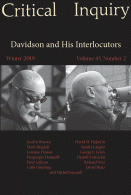
New issue of Critical Inquiry: Davidson and His Interlocutors
Volume 45, Number 2 | Winter 2019

Open access

Articles in this issue include amongst others

David Halperin, Queer Love

Daniele Lorenzini, The Emergence of Desire: Notes Toward a Political History of the Will

Michel Foucault, Structuralism and Literary Analysis

Aaron Hanlon, Postmodernism didn’t cause Trump. It explains him. The Washington Post, 31 August 2018

Postmodern theory may be the most loathed concept ever to have emerged from academia. Developed within literature and philosophy departments in the 1970s, it supposedly told us that facts were debatable, that individual perspectives mattered most, that shared meaning was an illusion and that universal truth was a myth.

The right quickly identified these notions as a danger to the very foundations of society and spent decades flogging the university lefties who promoted them. In “Tenured Radicals,” Roger Kimball accused academic theorists of trying to redefine the traditional humanities as “a species of political grievance-mongering” for which virtue equals “whatever sexual, feminist, Marxist, racial, or ethnic agenda to which the particular critic has declared his allegiance.” Norman Podhoretz believed that postmodernism was an attack on moral order. More recently, Victor Davis Hanson faulted postmodernism for President Barack Obama’s handling of health care legislation, writing, “In the gospel of postmodern relativism, what did it matter if the president of the United States promised that Obamacare would not alter existing health-care plans when it was clear that it would?”

Later, centrists and liberals searching for a culprit behind the ascent of Donald Trump and the war on fact that surrounds him joined the conservative crusade. Michiko Kakutani, the cultural critic and author of “The Death of Truth,” blames the relativism that facilitated Trump’s rise on “academics promoting the gospel of postmodernism.”

[…]

Kakutani’s suggestion that we can trace the roots of Trump-era post-truth politics to postmodernism is similar to an argument in Lee McIntyre’s recent book, “Post-Truth.” “Even if right-wing politicians and other science deniers were not reading Derrida and Foucault,” writes McIntyre, “the germ of the idea made its way to them.”

In each of these cases, the writers invoke postmodernism to describe not a contested set of observations about the state of knowledge and culture but a committed belief system that forms the basis of partisan political calculations. Kakutani’s choice of words — “the gospel of postmodernism” — conjures such a system.

[…]

it’s clear that the real enemy of truth is not postmodernism but propaganda, the active distortion of truth for political purposes. Trumpism practices this form of distortion on a daily basis. The postmodernist theorists we vilify did not cause this; they’ve actually given us a framework to understand precisely how falsehood can masquerade as truth.

Read more…