
Foucault News

News and resources on French thinker Michel Foucault (1926-1984)

Michael A. Peters and Danilo Taglietti, Deleuze’s rhizomatic analysis of Foucault: Resources for a new sociology?
(2019) Educational Philosophy and Theory

https://doi.org/10.1080/00131857.2018.1551831

Abstract
This paper analyses and examines Deleuze’s Foucault as a means of investigating intellectual resources for a new sociology–one that, in Foucault’s name, is neither foundationalist nor representationalist but genuinely other than the modernist discourse with which the discipline began and grew up. The paper begins with a brief historiography of sociology in order to broach the relationship between Deleuze and Foucault, and then focuses on Deleuze’s book on Foucault as a means of moving ‘from the archive to the diagram’ and to a topology of ‘thinking otherwise’. Finally, the paper moves to reformulate a new vocabulary no longer anchored in modernist categories to a non-dialectical reconfiguration of explanation and comprehension. © 2018, © 2018 Philosophy of Education Society of Australasia.

Author Keywords
Deleuze; Foucault; sociology
Koopman, C. Information before information theory: The politics of data beyond the perspective of communication
(2019) New Media and Society, . Article in Press.

DOI: 10.1177/1461444818820300

Abstract
Scholarship on the politics of new media widely assumes that communication functions as a sufficient conceptual paradigm for critically assessing new media politics. This article argues that communication-centric analyses fail to engage the politics of information itself, limiting information only to its consequences for communication, and neglecting information as it reaches into our selves, lives, and actions beyond the confines of communication. Furthering recent new media historiography on the “information theory” of Shannon and Wiener, the article reveals both the primacy of communication in midcentury information theory, and also a striking resonance between these postwar communication theories and Habermas’s more recent communicative theory of democracy. To achieve a critical perspective beyond communication, the article proposes a media genealogy of the politics of subjects as a methodology for developing an analysis of how information formats us as subjects of data. © The Author(s) 2019.

Author Keywords
Communication; data; formats; Foucault; Habermas; infopower; information; Shannon; Wiener

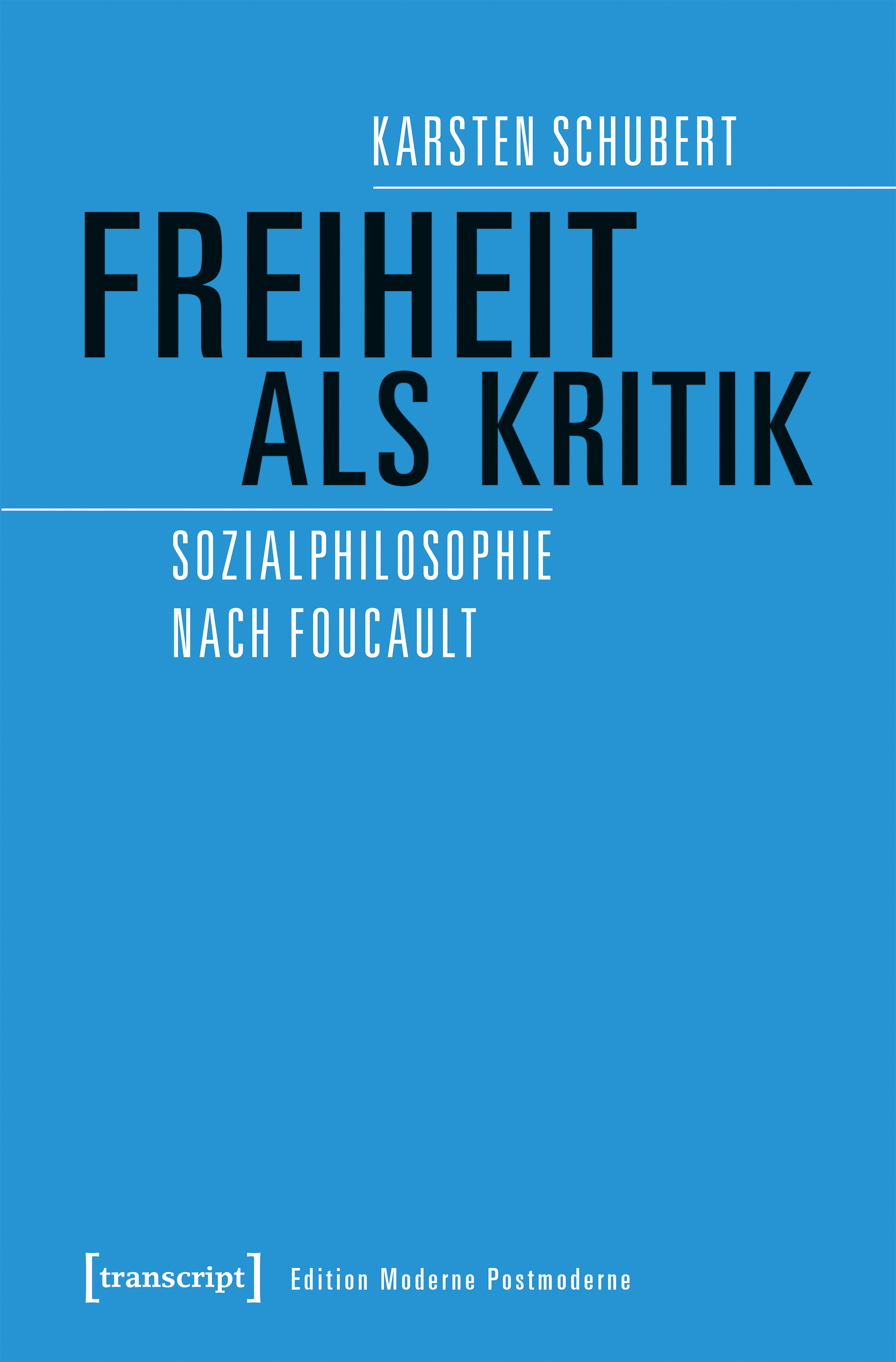
Karsten Schubert Freiheit als Kritik. Sozialphilosophie nach Foucault, Bielefeld: transcript 2018

Leseprobe (PDF)

Wie können Freiheit und Widerstand innerhalb von Foucaults Theorie der Macht und Subjektivierung konzipiert werden? Karsten Schubert liefert die erste systematische Rekonstruktion der sozialphilosophischen Debatte um Freiheit bei Foucault und eine neue Lösung für das Freiheitsproblem: Freiheit als die Fähigkeit zur reflexiven Kritik der eigenen Subjektivierung – kurz: Freiheit als Kritik – ist das Resultat von freiheitlicher Subjektivierung in politischen Institutionen. Der Band zeigt so die Konsequenzen von Foucaults Freiheitsdenken für die Demokratietheorie und die allgemeine sozialphilosophische Freiheitsdiskussion auf.

English
Freiheit als Kritik. Sozialphilosophie nach Foucault. Bielefeld: transcript 2018 (Freedom as Critique. Social-Philosophy After Foucault)
How can we conceptualize freedom and resistance in Foucault’s theory of power and subjectification? Karsten Schubert presents the first systematic reconstruction of the social-philosophical debate about freedom in Foucault’s works and a new solution to the problem of freedom: Freedom as the capability to critically reflect on one’s own subjectification – in short: freedom as critique – is the result of free subjectification through political institutions. The book thereby shows the consequences for Foucault’s thinking of freedom for theories of democracy and the general social-philosophical discussion about freedom.

Karsten Schubert (Dr. phil.), geb. 1985, ist PostDoc-Fellow bei der Bremen International Graduate School of Social Sciences an der Universität Bremen. Er promovierte 2017 in Philosophie an der Universität Leipzig, zuvor war er Visiting Scholar an der Cardozo Law School und der New School for Social Research in New York und lehrte als wissenschaftlicher Mitarbeiter politische Theorie am Institut für Politikwissenschaft der Universität Duisburg-Essen. Seine Forschungsschwerpunkte sind zeitgenössische Sozialphilosophie und politische Theorie, Rechtsphilosophie sowie Queerund Intersektionalitätstheorie.

Borderlands, Issue 17.2, 2018 Migration and Mobility Politics
Open access.

The contributions from Richie Wyver, Steven Farry, Fabiane Ramos, Mahmoud Kesharvarz and Eric Snodgrass, and Lewis Rarm, shine light upon the complex production of otherness both within and across the borders of the contemporary nation-state. The authors employ a range of critical tools, from Bhabha’s mimicry to Foucault’s theories of racism and biopolitics, and ethnographic methods to reveal how constructed borders, national, cultural, and economic, are a form of violence that can dehumanise, remove citizenship rights, and impoverish mobile subjects. This issue is very much in the experimental spirit of Borderlands, which aims to critically work at the intersections of economics, philosophy, law, everyday cultural life, film and media.

Mingjie Tang, L’usage de la subjectivité : Foucault, une archéologie de la relation, L’Harmattan. Collection: Quelle drôle d’époque ! Philosophie Sciences Humaines

Les travaux de Foucault sur l’histoire de la subjectivité analysent la manière dont s’est formé et a fonctionné le concept d’homme : comment il a agrégé des éléments hétérogènes pour imposer son évidence dans notre modernité. La subjectivité s’établit dans le rapport à sa propre vérité comme « noeud » de la véridiction, de la gouvernementalité et de la spiritualité. C’est dans ce « jeu de la connaissance individuelle » que se mettent en place les dispositifs du sujet et leurs conditions, c’est dans l’archéologie de la relation avec la vérité, le pouvoir et le soi que l’on retrouve, peut-être, l’usage de notre subjectivité.

Mingjie Tang est docteure en philosophie et a soutenu sa thèse intitulée Cogito, sujet et subjectivité chez Foucault en 2015 à l’université Paris-I Panthéon-Sorbonne. Elle est actuellement chercheuse à l’Institut de philosophie de l’Académie chinoise des sciences sociales (CASS) en Chine. Son domaine de recherche a trait, notamment, à l’histoire et la philosophie des sciences humaines, aux problématiques du sujet, du discours et des extra-discursivités.

PDF of flyer

Pariseau-Legault, P., Holmes, D., Murray, S.J. Understanding human enhancement technologies through critical phenomenology (2019) Nursing Philosophy, 20 (1), art. no. e12229

DOI: 10.1111/nup.12229

Abstract
Human enhancement technologies raise serious ethical questions about health practices no longer content simply to treat disease, but which now also propose to “optimize” human beings’ physical, cognitive and psychological abilities. These technologies call for a reassessment of our relationship to health, the human body and the body’s organic, identity and social functions. In nursing, such considerations are in their infancy. In this paper, we argue for the relevance of critical phenomenology as a way to better understand the ethical issues related to human enhancement technologies (HET). In so doing, we seek to problematize HET and assess their influence on the future development of nursing science and practice. It is difficult to anticipate the concrete effects of HET, we suggest, because these practices reconfigure the meaning of normativity and disorient our conventional ethical landscape. In this context, we argue that the later work of Martin Heidegger and Michel Foucault invites a critical perspective into how techno-scientific discourses modify our relationship to care, to health and to our own social and corporeal identities. Despite the traditional philosophical opposition between phenomenology and critical theory, we maintain that a hybrid critical phenomenological approach opens new ways to assess the integration of technology and practice. Our analysis understands HET as a process of “hybridization” between technological objects and human subjects. Critical phenomenology thus effectively questions anthropocentric definitions of technology, challenges the dichotomy between curative treatment and enhancement and, finally, prompts valuable reflection on the implications of HET for nursing theory and practice. © 2018 John Wiley & Sons Ltd

Author Keywords
Foucault; Heidegger; phenomenology; technology; the self

Michel Agier, Camps, Encampments, and Occupations: From the Heterotopia to the Urban Subject (2019) Ethnos, 84 (1), pp. 14-26.
https://doi.org/10.1080/00141844.2018.1549578

Abstract
This article aims to understand the main principles that design a worldwide landscape of precarious spaces. I argue that the increasing and more constraining policies of exclusion provoke the repeated creation of limits and ‘outsides’ and that this represents a major aspect of contemporary urban and world governance. Contemporary ‘out-places’ [‘hors-lieux’] or concrete ‘heterotopias’ (Foucault) are linked to one another by policies of exclusion, organisation and control, subjective experiences, and routes. The formation and proliferation of heterotopias as an ensemble of margins and precarious spaces, turn visible as a global political fact the question of (in)equality. © 2018, © 2018 Informa UK Limited, trading as Taylor & Francis Group.

Author Keywords
Camps; encampments; favelas; places; urban margins

Gunawan, M. Navigating human and non-human animal relations: Okja, foucault and animal welfare laws (2018) Alternative Law Journal, 43 (4), pp. 263-268.

DOI: 10.1177/1037969X18802459

Abstract
This article draws upon a Foucauldian analysis of power to conceptualise the human and non-human animal relations throughout the Netflix film Okja. The article examines how ‘super-pig’ Okja’s experiences (and subjectivities) are deeply shaped by the ‘apparatuses’ within which Okja is situated. As the power relationships and practices of ‘domination’ portrayed in Okja highlight, the legal categorisation of animals and their foundations within mainstream discourses reflect, and perpetuate, society’s understanding of the moral significance of animals. Okja’s transformation throughout the film, as well as her very existence as a hybrid ‘super-pig’, confuses the legal categorisation of non-human animals and highlights a double standard in the law. © The Author(s) 2018.

Author Keywords
Animal law; Animal rights; Art; Arts and entertainment; Arts and law; Critical legal theory

Bennett, C. Drugs, moral panics and the dispositive (2018) Journal of Sociology, 54 (4), pp. 538-556.

DOI: 10.1177/1440783317727877

Abstract
The concept of ‘moral panics’ continues to be used as a framework for analysing the causes, structures and functions of social and political crises. Nonetheless, as an analytical tool, such a framework is limited in its capacity to explain the ongoing and interconnected relationships between drugs and society. Drawing first on an interdiscursive and intertextual framework, the field of analysis is broadened to consider how recent drug panics in Australia depend upon, signify and condense wider social and historical anxieties around drugs and other social problems. However, such an approach also has its limitations given that the play of intertextuality is conditioned by relations of power at the level of what Foucault calls a ‘dispositive’, a historically contingent configuration that strategically orientates our responses to the problem. Three dispositional drug-related prototypes are considered and how they work together to shape, reinforce and condition the drug problem and our responses to it. © The Author(s) 2017.

Author Keywords
convergence; dispositive; drugs; Foucault; interdiscursivity; intertextuality; moral panic