Foucault News

News and resources on French thinker Michel Foucault (1926-1984)

Bailey, A.J., Drbohlav, D., Salukvadze, J.
Migration and pastoral power through life course: Evidence from Georgia
(2018) Geoforum, 91, pp. 97-107.

DOI: 10.1016/j.geoforum.2018.02.023

Abstract
This article advances critical migration theory by exploring how pastoral power works through relational life courses. Extending governmentality accounts, we posit and trace the circulation of use, exchange, and surplus values across the life courses of migrants from the former Soviet republic of Georgia. Field evidence shows how practices of migration, remitting, and familyhood are associated with dependent social relations and concealment, and negotiated through tests of truth of prayer, biographical management, and family remitting. This conduct of everyday life simultaneously invokes life courses as registers of resources and possibilities and subjects of the multiple governmentalities associated with recent discourse and European and Georgian migration policy initiatives, including “Safe Migration” and migration management systems. We conclude that studying how pastoral power works through relational life courses expands understanding of migration and, in the case of Georgia, highlights the importance of gender, family, and religious organisations for contemporary migration issues. © 2018 Elsevier Ltd

Author Keywords
Foucault; Georgia; Governmentality; Life course; Migration; Religion

stuartelden's avatarProgressive Geographies

Return to Foucault’s “What is an Author” – Gordon Hull at New APPS

I’m teaching a Foucault seminar this term, and one of the things I’m trying to do is get better on the doxography of his essays.  That led me to a discovery about “What is an Author” that I’m going to share on the (hopefully not hubristic) assumption that other folks didn’t know it either.  The essay has been of interest to me for a while, largely because of my work on intellectual property.  There, the link between copyright and the juridico-political function of authorship Foucault identifies is fairly clear, and has been ably explored in the context of trademark by Laura Heymann.

What I didn’t know is that Foucault’s essay was originally presented as a seminar (Feb. 1969) – with responses from the likes of Lucien Goldmann and Lacan.  The version translated into English and that makes…

View original post 146 more words

Call for chapters: Interrupting Globalisation: Heterotopia in the Twenty-First Century

Deadline for submissions:September 15, 2018

Simon Ferdinand, Irina Souch and Daan Wesselman (the University of Amsterdam)

Contact: heterotopics@gmail.com

Confirmed contributors:

Kevin Hetherington (the Open University), author of Badlands of Modernity: Heterotopia and Social Ordering
Lieven De Cauter (Catholic University of Leuven), editor of Heterotopia and the City: Public Space in a Postcivil Society
Christoph Lindner (University of Oregon), author of Imagining New York City: Literature, Urbanism, and the Visual Arts

Editors: Simon Ferdinand, Irina Souch and Daan Wesselman (the University of Amsterdam)

Keywords: heterotopia, globalisation, discourse, space, art, literature, film, popular culture

Can heterotopia help us make sense of globalisation? A heterotopia, in Michel Foucault’s initial formulations, describes the spatial articulation of a discursive order, manifesting its own distinct logics and categories in ways that refract or disturb prevailing paradigms. As part of the “reassertion of space” or “spatial turn” that has gathered pace in the humanities and social sciences from the 1980s onwards (Soja 1989; Warf and Arias 2009), the concept of heterotopia has enjoyed broad critical appeal across literary studies, visual culture and cultural geography (Dehaene and De Cauter 2008). Allowing critics to grasp how discourse and space fold together in the construction of enclosed or discrepant domains, the term has been applied to an enormous variety of real and imagined cultural spaces, ranging from Hashima Island to Melville’s Pequod, Ramadan festival to Kowloon Walled City. And yet, despite its popularity, the concept of heterotopia stands in tension with other critical approaches and spatial terms in cultural theory. If heterotopias are marked off by virtue of the discursive difference they embody, current concepts of world systems, planetarity and above all globalisationemphasise “the widening, deepening and speeding up of worldwide interconnectedness” (Held, McGrew and Goldblatt 1999, 2). Twenty-first century globalisation is often characterised by a tumultuous undifferentiation of cultural spaces, in which formerly integral identities bleed into one another, diverse polities are commonly exposed to ecological risks, and sovereign territories fade amid shifting new configurations.

If globalising flows and planetary precarities might first seem to flatten heterotopian difference, they also constitute novel forms of heterotopia in that globalisation preconditions clashes among once distant discursive realms. This volume calls on scholars and critics across disciplines to explore the contrary dynamics through which heterotopian practices not only persist but proliferate amid twentieth-first century globalisation. What are the new forms assumed, and new spaces produced, by heterotopian imaginations today? How does heterotopian form interrupt or problematise dominant spaces, practices and policies, not least those of neoliberal globalisation and environmental governance? How have established heterotopias been reconfigured or remediated in the global present? What is at stake, for instance, in the transition from graveyard to mobile cryogenic storage units as a social mode of being-toward-death; from the fascist rally to the alt-right blog as the expression of political reaction? In the move from the elite boarding school to U.S. child migrant internment facilities as a passage to adulthood; from water-going vessels to interplanetary ships and stations as a means of traversing inhospitable spaces?

In addressing these and other questions pertaining to heterotopia and globalisation, contributors are invited to submit abstracts for chapters exploring heterotopian forms and expressions in film, literature, art, music, television and socio-political practice, relating to any genre, medium or geographical context. Possible topics might include (but are not limited to):

—applications of heterotopia to diverse new political, social, cultural and ecological realities;

—progressive and/or reactionary manifestations of heterotopia in global cultures;

—both representations of heterotopias and heterotopian social practices;

—either pre-eminently spatial or pre-eminently discursive heterotopian forms;

—digital manifestations of heterotopia;

—the presence of more-than-human agents in heterotopias;

—cosmopolitan, sub- or post-national forms of heterotopia.

Submission

Please submit abstracts (max. 300 words) for a full chapter, together with a short academic CV (max. 200 words), to heterotopics@gmail.com by 15 September 2018. Once contributors have been selected, we will send a book proposal to Palgrave Macmillan and Bloomsbury Academic. Provisionally, we envisage the following schedule:

15 Oct 2018 confirmation of selected authors

1 Mar 2019 submission of draft chapters

1 Aug 2019 submission of revised chapters

1 Sep 2019submission of full manuscript to Publisher

References

Dehaene, Michiel and Lieven de Cauter (eds.), Heterotopia and the City: Public Space in a Postcivil Society (London: Routledge, 2008)

Held, David,  Anthony McGrew, David Goldblatt and Jonathan Perraton, Global Transformations, Politics, Economics and Culture (Stanford: Stanford University Press, 1999)

Warf, Barney and Santa Arias (eds.), The Spatial Turn: Interdisciplinary Perspectives(London: Routledge, 2009)

Soja, Edward, Postmodern Geographies: The Reassertion of Space in Critical Social Theory (London: Verso, 1989)

Dashtipour, P., Rumens, N.
Entrepreneurship, incongruence and affect: Drawing insights from a Swedish anti-racist organisation
(2018) Organization, 25 (2), pp. 223-241.

DOI: 10.1177/1350508417720022

Abstract
In recent years, entrepreneurship has been reconceptualised as social change. Understood as such, entrepreneurship can be viewed to disrupt and disturb the social order. We argue in this article that Foucault’s notion of heterotopia and Lacan’s concepts of the real and anxiety help us to conceptualise the disturbing aspect of entrepreneurship as social change and understand why the latter may encounter social resistance. Our contribution to critical entrepreneurship literature is to, first, emphasise that entrepreneurship instigates social change by introducing incongruence and, second, to highlight that this process can be affective: it can create anxiety. This article uses an illustrative historical case example of a Swedish anti-racist commercial magazine (Gringo) to elucidate these points. We conclude by pointing out that anxiety may be necessary for the provocation of social transformation. © 2017, © The Author(s) 2017.

Author Keywords
Affect; anxiety; critical entrepreneurship studies; heterotopias; social change; the real

Lida Maxwell, The politics and gender of truth-telling in Foucault’s lectures on parrhesia. Contemporary Political Theory 18, 22–42 (2019).
https://doi.org/10.1057/s41296-018-0224-5

Abstract
This essay challenges dominant interpretations of Foucault’s lectures on parrhesia as affirming an ethical, non-political conception of truth-telling. I read the lectures instead as depicting truth-telling as an always political predicament: of having to appear distant from power (to achieve credibility), while also having to partake in some sense of political power (to render one’s truth significant). Read in this way, Foucault’s lectures help us to understand and address the disputed politicality of truth-telling – over who counts as a truth-teller, and what counts as the truth – that his ethical interpreters tend to neglect. Yet the essay also shows that Foucault’s depiction of the predicament of truth-tellers is problematically gendered: focused on the masculine problem of moving in and out of the public sphere, rather than on the experience of the dispossessed, who are excluded from political power altogether. The essay mobilizes an alternative reading of one of Foucault’s key texts – Euripides’ Ion – to draw out an alternative, more democratic model of the predicament of truth-telling: of having to constitute power that can lend significant to truth-telling, while speaking from a position of powerlessness. © 2018 Macmillan Publishers Ltd., part of Springer Nature

Author Keywords
ethics; Euripides; feminist theory; Foucault; Ion; parrhesia; truth and politics

stuartelden's avatarProgressive Geographies

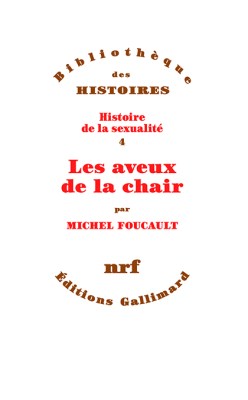
BHI_Foucault_Le_souci_Plat.inddAlexandre Gefen briefly reviews Foucault’s Les Aveux de la Chair at the Critical Inquiry blog. Thanks to Michael O’Rourke for the link.

A roundup of news stories and other pieces – mostly in French and some in English is here. My review essay is on the Theory, Culture and Society blog (open access), and is forthcoming in the journal.

View original post

Michel Foucault : “Je me suis demandé si l’analyse que j’avais faite sur la prison ne pouvait pas être transposée à la sexualité”
France Culture, podcast, 07/01/2018

1977 C’était dans un “Après-midi de France Culture dont Michel Foucault était l’invité, à l’occasion de la parution de La volonté de savoir, premier tome de son Histoire de la sexualité. Comme il était annoncé en début d’émission, cette Histoire devait initialement comporter six volumes, mais seulement trois paraîtront entre 1976 et 1984 année de la disparition de Michel Foucault. En 2018 viendra s’y ajouter un quatrième avec la parution des Aveux de la chair.

Je n’ai pas voulu écrire l’histoire des comportements sexuels dans les sociétés occidentales, mais traiter une question plus sobre et plus limitée : comment ces comportements sont-ils devenus des objets du savoir ?” C’est ce qu’écrivait, en 1977, Michel Foucault dans la préface à une édition allemande de La volonté de savoir. Le projet de cet ouvrage, il en raconte la genèse et en expose ici les ambitions au micro de Paula Jacques.

Ainsi, il expliquait :

Je me suis demandé si cette analyse en terme tactique, stratégique et positif du pouvoir, que j’avais fait à propos de la prison, si cette analyse on ne pouvait pas la transposer à propos de la sexualité. Et si à propos de la sexualité il ne fallait pas poser plutôt le problème : mais qu’est-ce qu’on fait avec la sexualité ? Qu’est-ce qu’on fait quand on en parle ? Quand on s’intéresse à elle ? A quoi ça sert de s’y intéresser ? De sorte que le problème de l’interdit ne doit pas être le problème premier.

  • Production : Paula Jacques
  • Extrait : Les après-midi de France Culture – Michel Foucault à propos de La volonté de savoir, tome I de “Histoire de la sexualité”
  • 1ère diffusion : 11/01/1977
  • Indexation web : Documentation sonore de Radio France
  • Archives Ina-Radio France

‘I don’t think there is actually a sovereign founding subject, a universal form of subject that one might find everywhere. I am very skeptical and very hostile towards this conception of the subject. I think on the contrary, that the subject is constituted through practices of subjection, or, in a more autonomous way, through practices of liberation, of freedom, as in Antiquity, starting of course, from a number of rules, styles and conventions that can be found in the cultural setting.’

Michel Foucault. (1996) [1984]. An Aesthetics of Existence. In Foucault Live. collected Interviews, 1961-1984. Sylvère Lotringer (Ed.). New York: Semiotext(e), p. 452. Translation modified.

Mike Gane, The New Foucault Effect, Cultural Politics
Volume 14, Issue 1, March 2018, pp. 109-127

This review article considers two lecture courses by Michel Foucault (1972–73, 1979–80) and two books relating to the whole series of lectures (1970–84) by Stuart Elden. Foucault’s lecture courses can be divided into three phases, the first focused on the difference between sovereign and disciplinary power; the second on biopower, security, and liberalism; and the third on the government of the self and others. Foucault in 1976–79 altered his earlier frame by introducing the concept of governmentality and security dispositif and identified a missing, fourth type of power-governmentality called “socialism,” around which his concerns revolved for the remaining courses. Today there is a new Foucault effect, which has arisen around the courses on governmentality, neoliberalism, and biopower. The two courses by Foucault are situated in relation to the complete set of courses, and Elden’s books are welcomed critically as throwing light on the background to the lectures and Foucault’s main publications in this period but are problematic with respect to Foucault’s theoretical framework.

Leask, I.
Was there a theological turn in phenomenology?
(2018) Philosophy Today, 62 (1), pp. 149-162.

DOI: 10.5840/philtoday201837205

Abstract
This article examines the possibility that phenomenology was “always already” a theological enterprise, by outlining some of the foundational criticisms levelled by Michel Foucault and Louis Althusser. For both thinkers, the phenomenological stress on “lived experience” grants an undue primacy to the realm of “interiority”; as a result, subjectivity is left, not just reified, but also deified. By contrast, both Foucault and Althusser will argue for understanding the subject as constituted rather than constitutive; philosophy’s task, accordingly, is to delineate the broader structures (economic, ideological, discursive, linguistic, etc.) that create “lived experience,” rather than to hypostatize the subject as the privileged bearer of logos. As well as outlining the contours of this critique, however, the article indicates some of the shortcomings entailed in a total disavowal of “lived experience.” © 2018. Philosophy Today, Volume 62, Issue 1 (Winter 2018).

Author Keywords
” anti-humanism; “theological turn; Althusser; Foucault; Phenomenology; Spinoza