Foucault News

News and resources on French thinker Michel Foucault (1926-1984)

Vatter, M.
“Only a God Can Resist a God.” Political Theology between Polytheism and Gnosticism
(2019) Political Theology, 20 (6), pp. 472-497.

DOI: 10.1080/1462317X.2019.1618597

Abstract
Sovereignty – based on a claim to irresistible authority – and “speaking truth to power” (or parrhesia) are evidently opposed and yet they seem to have a strange affinity with one another, at least if one follows Foucault’s last lectures on this motif of political philosophy. This article revisits Hans Blumenberg’s reconstruction of the meeting between the German poet Goethe and the French emperor Napoleon as an example of a parrhesiastic encounter between philosophy and tyranny. The article situates Blumenberg’s discussion of Goethe’s pantheism and polytheism in the context of his ongoing polemic with Schmitt’s conceptions of sovereignty and political theology. It argues that while both Blumenberg and Schmitt seek to offer responses to the Gnostic rejection of worldly power, a reading of Goethe in light of the discourse on parrhesia or frank speech lately revived by Foucault allows for the articulation of republican response to Gnosticism. © 2019, © 2019 Informa UK Limited, trading as Taylor & Francis Group.

Author Keywords
Blumenberg; Foucault; Gnosticism; Goethe; parrhesia; polytheism; Schmitt
Maher, R., Valenzuela, F., Böhm, S.
The Enduring State: An analysis of governance-making in three mining conflicts
(2019) Organization Studies, 40 (8), pp. 1169-1191.

DOI: 10.1177/0170840619847724

Abstract
This article investigates the profound ambiguity of the state in the organization of contemporary business–society relations. On the one hand, there has been a decisive shift from government to governance, encouraging private actors, such as corporations, communities and NGOs, to address social and environmental concerns themselves, i.e. without the state’s involvement. On the other hand, however, the continued importance and relevance of the organized state is difficult to ignore. In this article we examine the role of the state in three cases of mining conflicts in Chile, one of the world’s most important mining countries. Through longitudinal, qualitative research of conflictive mining governance relations between state organizations, large corporations and local communities, we show that the modes of influence conducted by the Chilean state oscillate between direct, central steering (‘cathedral’) and indirect, dispersed vouching (‘bazaar’). Elaborating on Foucault’s concept of governmentality, we offer a hybrid theory of state organization, where the dematerialization of the state’s responsibility is seen not as the norm but rather as a particular mode of governance that sits alongside the underestimated, yet enduring, material involvement of the state. © The Author(s) 2019.

Author Keywords
Chile; extractive industries; governmentality; multistakeholder governance; political CSR; resistance; state

Stimilli, E.
Religion and the spontaneous order of the market: Law, freedom, and power over lives
(2019) European Journal of Social Theory, 22 (3), pp. 399-415.

DOI: 10.1177/1368431018803705

Abstract
This article focuses on a religious structure that is intrinsic to the contemporary mechanisms that have enabled the global domination of economic power: faith in the market. Following Foucault’s transition from biopolitics to governmentality, this article articulates the mechanism that generates the ability for human beings to give shape and value to their lives. Through a reading of Schmitt and Hayek, as well as an updated reading of Weber’s thesis on the origin of capitalism, this article argues that we must turn our attention to the Christian motifs that shape our contemporary understanding of the ‘economy’. © The Author(s) 2018.

Author Keywords
biocapital; Christianity; economic theology; governmentality; neoliberalism; political theology

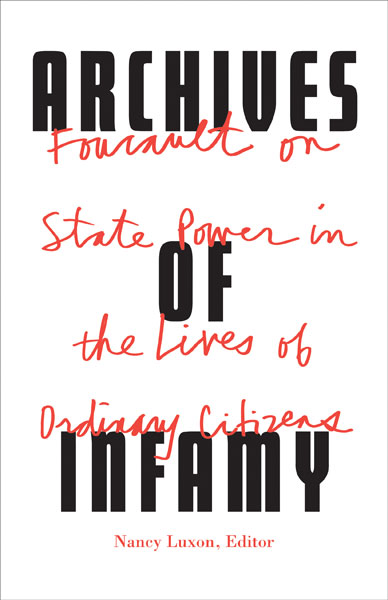
Nancy Luxon, Editor, Archives of Infamy. Foucault on State Power in the Lives of Ordinary Citizens, University of Minnesota Press, 2019.
Translated by Thomas Scott-Railton

Expanding the insights of Arlette Farge and Michel Foucault’s Disorderly Families into policing, public order, (in)justice, and daily life

What might it mean for ordinary people to intervene in the circulation of power between police and the streets, sovereigns and their subjects? How did the police come to understand themselves as responsible for the circulation of people as much as things—and to separate law and justice from the maintenance of a newly emergent civil order? These are among the many questions addressed in the interpretive essays in Archives of Infamy.

Crisscrossing the Atlantic to bring together unpublished radio broadcasts, book reviews, and essays by historians, geographers, and political theorists, Archives of Infamy provides historical and archival contexts to the recent translation of Disorderly Families by Arlette Farge and Michel Foucault. This volume includes new translations of key texts, including a radio address Foucault gave in 1983 that explains the writing process for Disorderly Families; two essays by Foucault not readily available in English; and a previously untranslated essay by Farge that describes how historians have appropriated Foucault.

Contributors
André Béjin, Centre national de recherche scientifique; Roger Chartier, Collège de France; Stuart Elden, U of Warwick; Arlette Farge, Centre national de recherche scientifique; Michel Foucault (1926–1984); Jean-Philippe Guinle, Catholic Institute of Paris; Michel Heurteaux; Lynne Huffer, Emory University; Pierre Nora, École des Hautes Études en Sciences Sociales; Michelle Perrot; Michel Rey (1953–1993); Elizabeth Wingrove, U of Michigan.

Nancy Luxon is associate professor of political science at the University of Minnesota. She is author of Crisis of Authority: Politics, Trust, and Truth-Telling in Freud and Foucault and editor of Disorderly Families (Minnesota, 2016).

Thomas Scott-Railton is a freelance French–English translator. He translated Disorderly Families by Arlette Farge and Michel Foucault (Minnesota, 2016).

Gordon Hull, Lessons from Agre on Privacy as Capture (Part 2): Can Foucault Get Past Panopticism?, New APPS: Art, Politics, Philosophy, Science, 5 August 2019

A couple of weeks ago, I noted my newly discovered appreciation for Philip Agre’s “Surveillance and Capture” and outlined why I think his development of capture (and retreat from surveillance) is particularly applicable to the privacy concerns surrounding big data.  Here, I’d like to suggest that Agre’s distinction is also helpful in understanding a frequently remarked limitation in Foucault.  The limitation is this: a Foucauldian model of disciplinary power treats Bentham’s panopticon as its ideal image.  That image, and the model it subtends, has come under sustained critique over the last twenty years in a scholarship inspired by Deleuze.  Let me start with a review before getting to what capture can tell us about Foucault and surveillance.

[…] Read more

Weili Zhao (2019) China’s making and governing of educational subjects as ‘talent’: A dialogue with Michel Foucault, Educational Philosophy and Theory

DOI: 10.1080/00131857.2019.1646640

Abstract
As an imprint of Confucian culture, China’s education intersects state governance in making and governing educational subjects as ‘talent’, an official translation of the Chinese term ‘rencai’ (literally, human-talent). Whereas the English word ‘talent’ itself denotes ‘[people with] natural aptitude or skill’, ‘talent’ is currently mobilized in China not only as a globalized discourse that speaks to the most aspired educational subjects for the 21st century but also as a re-invoked cultural notion that relates to Confucian wisdom. Drawing upon Foucault’s biopower hypothesis and Confucian thought, this paper leverages upon China’s unique manipulation of ‘talent’ as certain skills and human subjects, both cultivable through education, to problematize China’s talent making and governing in two dimensions. First, it unpacks the various technologies of power entangled in China’s talent making and governing within its ‘state governance’ paradigm. Second, it unpacks Confucian thought as an archaeological prototype for China’s present talent appeal, meanwhile explicating their divergences in defining ‘human’, ‘talent’, and the human-talent interpellation. In so doing, this paper makes two arguments. First, the linguistic notion of ‘talent’ functions as a Foucauldian apparatus of biopower, making (up) new kinds of people and normalizing a certain population as the objective/object of China’s state governance. Second, CPC’s re-invocation of Confucian talent discourses is more of a rhetorical strategy than an authentic cultural renaissance gesture.

Keywords: Educational subjects, talent making and governing, biopower, state governance, technologies of power, Confucian wisdom

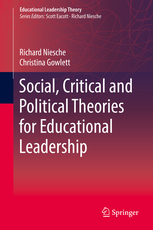
Richard Niesche, Christina Gowlett, (2019) Social, Critical and Political Theories for Educational Leadership. Series: Educational Leadership Theory. Springer, Singapore

This book makes the case for the continued and expanded use of social, critical and political theories in the field of educational leadership. It helps readers understand educational leadership by introducing them to a wide variety of theoretical and philosophical approaches and positions. The book incorporates a rich blend of ideas and concepts, and compares and contrasts the approaches discussed.

Table of contents (7 chapters)

Why Use Social, Critical and Political Theories in Educational Leadership?

Critical Perspectives in Educational Leadership: A New ‘Theory Turn’?

Michel Foucault and Discourses of Educational Leadership

Using Judith Butler to Queer(y) Educational Leadership

Bernard Stiegler: Technics and Educational Leadership as a Form of Psycho-Power

Entangling Karen Barad with/in Educational Leadership

The Inescapable Connection Between Theory and Practice

stuartelden's avatarProgressive Geographies

9782711628988Michel Foucault, Folie, Langage, Litterature, edited by Henri-Paul Fruchaud, Daniele Lorenzini and Judith Revel, Vrin, September 2019

The latest collection of pieces from the archive, with an introduction by Judith Revel.

La folie, le langage et la littérature ont longtemps occupé une place centrale dans la pensée de Michel Foucault. Quels sont le statut et la fonction du fou dans nos sociétés « occidentales », et en quoi se différencient-t-ils de ce qu’ils peuvent être dans d’autres sociétés? Mais également : quelle étrange parenté la folie entretient-elle avec le langage et la littérature, qu’il s’agisse du théâtre baroque, du théâtre d’Artaud ou de l’œuvre de Roussel? Et, s’il s’agit de s’intéresser au langage dans sa matérialité, comment l’analyse littéraire s’est-elle elle-même transformée, en particulier sous l’influence croisée du structuralisme et de la linguistique, et dans quelle direction évolue-t-elle?
Les conférences et les textes, pour la plupart inédits, réunis ici illustrent la manière…

View original post 69 more words

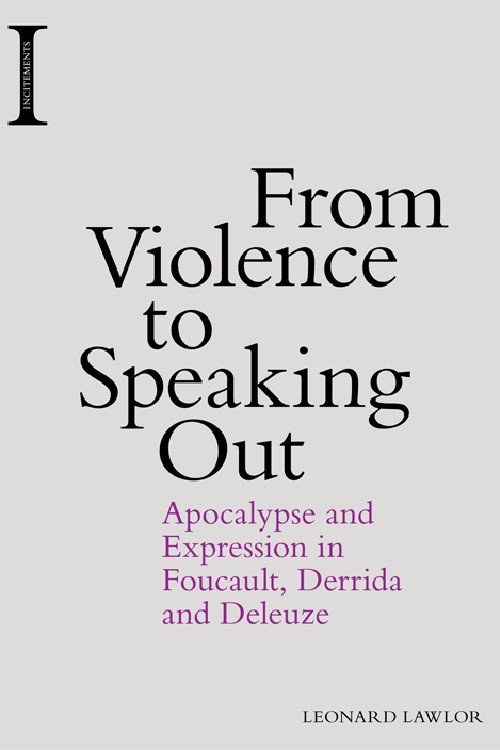
Leonard Lawlor, From Violence to Speaking Out. Apocalypse and Expression in Foucault, Derrida and Deleuze, Edinburgh University Press, 2019

Review by Jeffrey A. Bell

Develops the Derridean idea of the worst violence and creates new ways of speaking out against it

Leonard Lawlor’s groundbreaking book draws from a career-long exploration of the French philosophy of the 1960s in order to find a solution to ‘the problem of the worst violence’. The worst violence is the reaction of total apocalypse without remainder. It is the reaction of complete negation and death. It is nihilism.

Lawlor argues that it is not just transcendental violence that must be minimised: all violence must itself be reduced to its lowest level. He then offers new ways of speaking which will best achieve the least violence which he creatively appropriates from Foucault, Derrida and Deleuze and Guattari as ‘speaking-freely’, ‘speaking-distantly’ and ‘speaking-in-tongues’.

Contents

Introduction: From Violence to Speaking Out

Part I: On Transcendental Violence

1. A New Possibility of Life: The Experience of Powerlessness as the Solution to the Problem of the Worst Violence

2. What Happened? What is going to happen? An Essay on the Experience of the Event

3. Is it happening? Or the Implications of Immanence

4. The Flipside of Violence, or Beyond the Thought of Good enough

Part II: Three Ways of Speaking

5. Auto-Affection and Becoming: Following the Rats

6. The Origin of Parrēsia in Foucault’s Thinking: Truth and Freedom in The History of Madness

7. Speaking out for Others: Philosophy’s Activity in Deleuze and Foucault (and Heidegger)

8. ‘The Dream of an Unusable Friendship’: The Temptation of Evil and the Chance for Love in Derrida’s Politics of Friendship

9. Three Ways of Speaking, or ‘Let others be Free’: On Deleuze’s ‘Speaking-in-Tongues’; Foucault’s ‘Speaking-Freely’; and Derrida’s ‘Speaking-Distantly’

Conclusion: Speaking out against Violence

Nicholas de Villiers. Porno Cultures Podcast, July 10, 2019. Interview with Brandon Arroyo.

facebook.com/AcademicSex

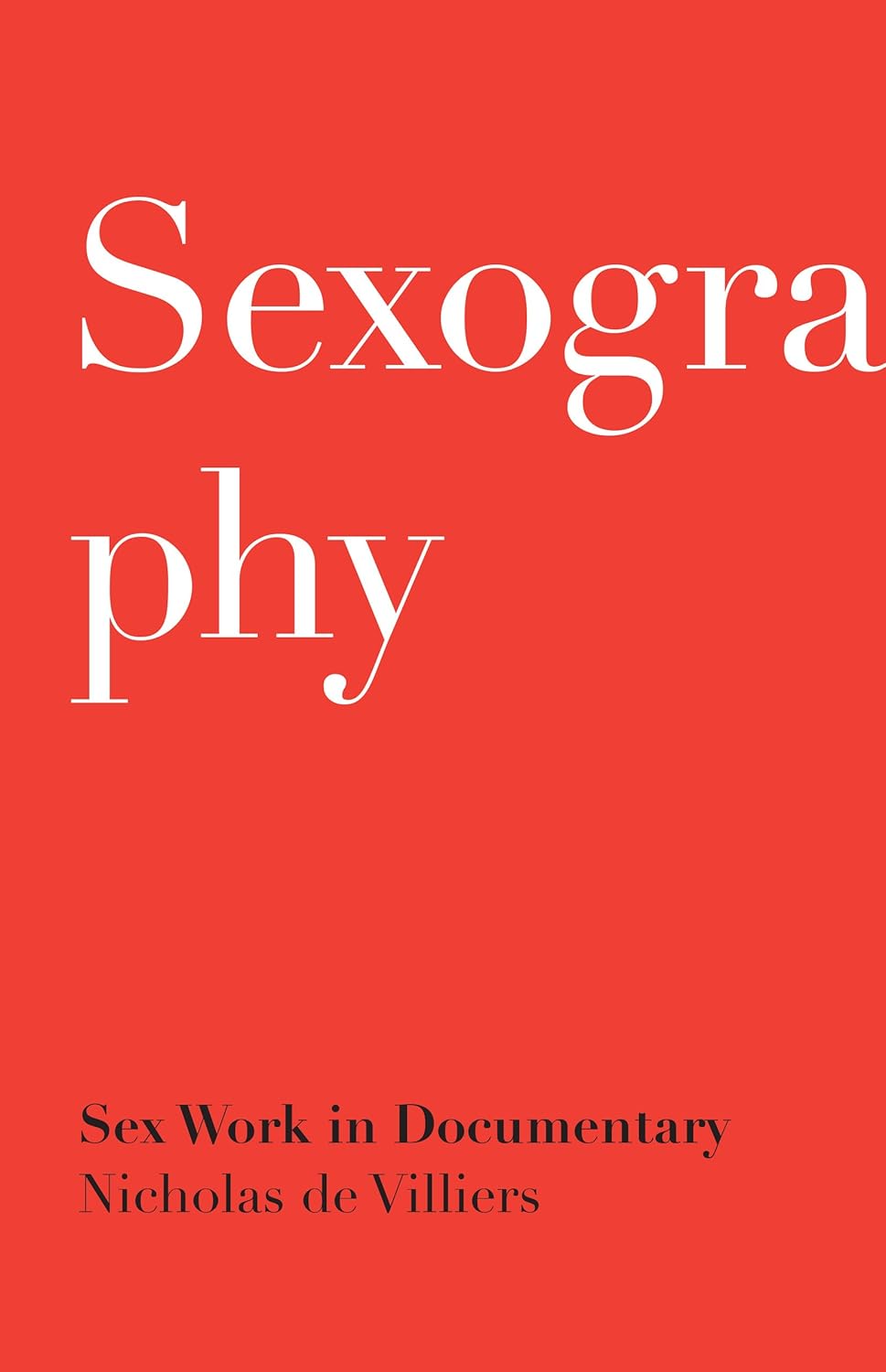
When we think about the rhetoric around sex workers it’s often easier to hear or read opinions advocating for the abolishment of sex work coming from politicians or “concerned citizens” who are not sex workers, or have never bothered to speak to a sex worker. The degree to which the voices of sex workers are suppressed in mainstream outlets throughout the West speaks to how dangerous their voices are considered. What on earth can sex workers be saying that so many people feel the need to speak for them instead of letting them speak for themselves? Well, that’s one of the primary issues that Nicholas de Villiers looks to solve in Sexography: Sex Work in Documentary (University of Minnesota Press, 2017).

Sexography analyzes a series of films centered around interviewing sex workers. These films represent some of the few instances where sex workers are actually allowed to speak for themselves. Of course, these films are not without their own tensions. Many of the films are directed by non-sex workers and some of the portrayals of sex work in these films is quite negative. This is where de Villiers’ dynamic analysis of these films through a queer perspective helps us think about the nature of sex work, the interview, documentary aesthetics, and the concept of “truth” in new and interesting ways.

Sexography is an exploration of how we can go about reading for, and exploring the sexual practices of, not only sex workers, but our own ideas about sexuality as well. How can the financial aspects of sex work help us understand the power dynamics of our own sexual relationships? What can sex workers teach us about sex and pornographic literacy? What is the relationship between sex work, pornography, and drag performance? And how can the work of Foucault help us think about the contemporary nature of sexual practice? These are just some of the questions explored in this wide-ranging interview. De Villiers is one of the most interesting and bold queer theorists working today, so you’re not going to want to miss out on his compelling analysis of these films or his thoughts on contemporary sexuality!

More work from Nicholas de Villiers
Opacity and the Closet: Queer Tactics in Foucault, Barthes, and Warhol
Nicholas’ appearance on the Critical Theory podcast discussing Opacity and the Closet
“Afterthoughts on Queer Opacity”

“FBI Seized 23 Tor-hidden Child Porn Sites, Deployed Malware from Them”
“How the FBI Became the World’s Largest Distributor of Child Sex Abuse Imagery”
“Transgender, at War and in Love”
“What Teenagers are Learning from Online Porn”
Paris is Burning (1990)
Love Meetings (1964)
Not Angels But Angles (1994)
Body Without Soul (1996)
Tales of the Night Fairies (2002)