Foucault News

News and resources on French thinker Michel Foucault (1926-1984)

Editor: After the terrible news of the fire and because the banner of Foucault News is an image of Le Stryge, one of the chimera on top of Notre-Dame, I am reposting the photo below which appeared on the Facebook page of La Cinémathèque française. This article on the BBC news site lists what has survived and what hasn’t.

Update 2/5/19. It would appear the chimera, notably Le Stryge in the banner, didn’t survive – but a Dutch company has already put together a 3D print.

Claude Mauriac in his memoir Le Temps Immobile describes watching Maurice Clavel, the journalist, playwright and author lecturing on Foucault at Notre-Dame, praising his anti-humanist Kantian stance in The Order of Things. (David Macey, The Lives of Michel Foucault, Penguin Random House, p.192)

Donations are already flooding in to rebuild the cathedral.
Déjà plus de 750 millions d’euros de dons pour reconstruire Notre-Dame, L’Obs, 16 April 2019

An interesting and beautifully written philosophical and moral reflection with the signature ‘Un curé de campagne en visite à Paris’, provoked by the experience of being in Paris during the fire.
Sauvons la cathédrale du cœur. Pour un autre usage de Notre-Dame-de-Paris, Lundimatin, 16 April 2019.

What interested me in the article below was not so much the account of Donald Trump’s latest exploits as the description of the technical expertise needed to fight the fire.
Experts deride Trump’s Notre Dame firefighting advice as ‘risible’, The Guardian, 17 April 2019.
Guillermo Rein, professor of fire science at Imperial College in London, praised the work of the French firefighters.

“The fire brigade had to be aggressive fighting the big roof fire with the aerial ladders designed for high-rise buildings, but at the same time be gentle with the vulnerable structure of the stone vaults and walls. They did a fine job, and how they tackled this fire will probably be studied in the years ahead.”

With thanks to Luca Paltrinieri for posting the three informative links above on his Facebook page.

For a photo of the chimera looking down on the fire, see the ‘about’ page on this blog.

Charles Laughton in The Hunchback of Notre Dame (1939)

stuartelden's avatarProgressive Geographies

books.jpg

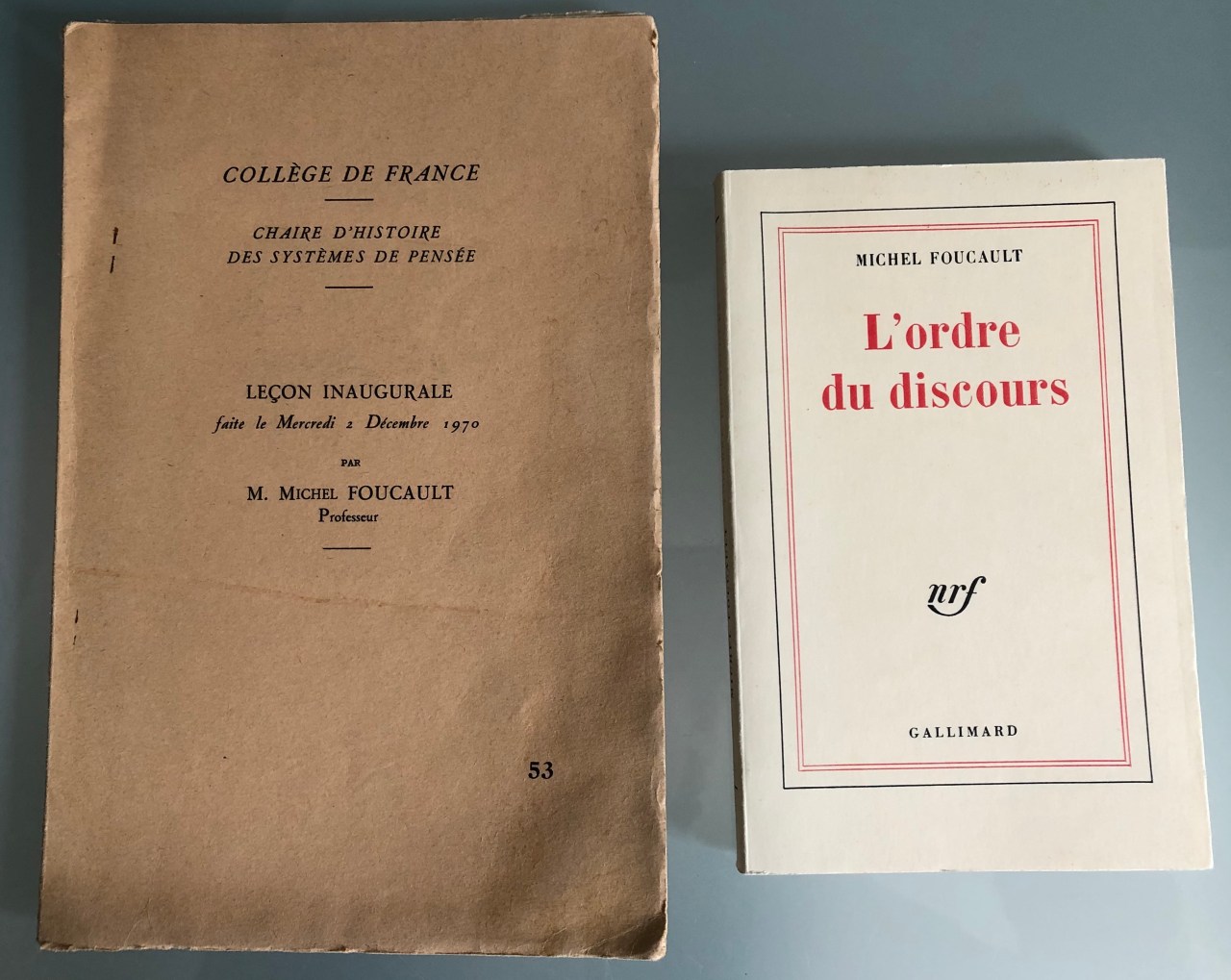
Bruno Latour’s Où atterrir?, Mariana Valverde’s study of Michel Foucault, now in paperback, and Ernst Kantorowicz, Oeuvres – which i mainly got for the biography by Alain Boureau. Also in the pile is a second-hand copy of Foucault’s L’ordre du discours – and the Collège de France publication of that lecture. I had no idea that the latter actually existed until recently, when I was alerted to differences between the versions. The original is very hard to find. I plan to make a systematic comparison of the two texts – which is why I’ve bought a copy of the Gallimard version to mark up. When I do, I’ll post about it here – previous such textual comparisons can be found here.

L'ordre du discours.jpg

View original post

Miller, E.R., Gkonou, C. Language teacher agency, emotion labor and emotional rewards in tertiary-level English language programs (2018) System, 79, pp. 49-59.

DOI: 10.1016/j.system.2018.03.002

Abstract
Research on language teacher agency and language teacher emotions has demonstrated that both are central components of teacher identity and practice. However, few researchers have explored the co-constitutive effects of agency and emotion for language teachers or the role of emotion labor in producing emotional rewards. This article addresses these underexplored components of language teaching through reporting on the findings of a qualitative study with language teachers in tertiary settings in the U.K. and the U.S. The study drew on language teachers’ questionnaire (n = 30) and semi-structured interview (n = 25) responses in identifying the most common emotions experienced by these teachers and how their relationships with students engendered emotion labor as well as emotional rewards. We consider these aspects of teacher experience in terms of discourses of teaching-as-caring and Foucault’s (1983) concept of ethical self-formation. © 2018 Elsevier Ltd

Author Keywords
Emotion labor; Ethical self-formation; Teacher agency; Teaching-as-caring

Danielle Ringer, Courtney Carothers, Rachel Donkersloot, Jesse Coleman, Paula Cullenberg,For generations to come? The privatization paradigm and shifting social baselines in Kodiak, Alaska’s commercial fisheries (2018) Marine Policy, 98, pp. 97-103.
https://doi.org/10.1016/j.marpol.2018.09.009

Abstract
This paper presents results from a study that explored a key threat to fisheries sustainability in Alaska – the graying of the commercial fishing fleet. In the Kodiak Archipelago region this research utilized a political ecology framework and mixed methods ethnography, including 70 semi-structured interviews and participant observation, to further understand this problem. Study results suggest that opportunities for young rural fishermen are increasingly constrained by interrelated socioeconomic and cultural barriers, which have created systemic equity and sustainability concerns. Furthermore, research indicates that the privatization paradigm of fisheries access is a major catalyst of change that has created and amplified barriers, transformed opportunity, and generated lasting inequities and social conflict. Foucault’s concept of governmentality is used to describe how some fishermen are internalizing and normalizing privatization discourses to advance further regulatory change. Pauly’s concept of shifting baseline syndrome is evoked to argue that current structures of degraded access and equity in the human fishery system are mistakenly assumed to be a natural state, rather than a result of a specific history of public policy choices. Due to the suite of challenges facing fishing people and communities, it is increasingly important to acknowledge the privatization of access as a key threat to sustainable coastal fishing futures. © 2018 The Authors

Author Keywords
Alaska; Fisheries privatization; Governmentality; Individual transferable quotas (ITQs); Kodiak; Shifting baseline syndrome

Index Keywords
baseline conditions, commercial activity, fishery economics, fishery management, future prospect, governance approach, privatization, quota system, sustainability; Alaska, Kodiak Island, United States

P is for Power (Michel Foucault) Theoretical puppets
Michel Foucault from A to Z. Foucault is working on his biceps. Watch the video to find out if this has something to do with his concept of power!

Critical Work

Columbia Center for Contemporary Critical Thought (CCCCT)
Friday, April 19 12:15-2:15 pm

Join the CCCCT and affiliated scholars on April 19th from 12:15-2:15 to hear about recent and on-going work in the field of critical theory. Scholars at the forefront of such research will present their current projects and discuss with other participants.

RSVP here

This event will include presentations from:
Clécio Lemos, Ph.D. of Law, Pontifícia Universidade Católica do Rio de Janeiro (PUC-Rio)
“The Third Foucault and His Possible Impacts on Criminology”

Daniele Lorenzini, Assistant Professor of Philosophy, University of Warwick & Fellow of the CCCCT,
“On Possibilizing Genealogy”

Dr Jacopo Martire, Senior Lecturer in Legal Theory, University of Bristol School of Law
“A Foucauldian Interpretation of Modern Law”

Michaela Soyer, CUNY Hunter College
“Lost Childhoods: Poverty, Trauma, and Violent Crime in the Post-Welfare Era”

Ahlqvist, T. Dynamic elements in regional development: an explorative genealogical analysis of the region of Southwest Finland
(2018) European Planning Studies, 26 (12), pp. 2427-2447.

DOI: 10.1080/09654313.2018.1530198

Abstract
The paper suggests an explorative interpretative approach for conceptualizing regional change based on Foucault’s theory of genealogy. The theoretical outline is built on two key concepts of Foucault’s genealogy, (descent) and (emergence). The paper conceptualizes the heuristic notion of ‘adaptive element’ on the basis of descent, and the notion of ‘disruptive element’ on the basis of emergence. The paper demonstrates the use of these concepts in a brief case study of Southwest Finland from 1985 to 2001. © 2018, © 2018 Informa UK Limited, trading as Taylor & Francis Group.

Author Keywords
descent; emergence; Foucault; Genealogy; regional change; regional development

Index Keywords
conceptual framework, genealogy, regional development, theoretical study, twentieth century; Finland

Delacampagne But don’t the public expect the critic to provide them with precise assessments as to the value of a work?
Foucault I don’t know whether the public do or do not expect the critic to judge works or authors. Judges were there, I think, before they were able to say what they wanted. It seems that Courbet had a friend who used to wake up in the night yelling: “I want to judge, I want to judge.” It’s amazing how people like judging. Judgment is being passed everywhere, all the time. Perhaps it’s one of the simplest things mankind has been given to do. And you know very well that the last man, when radiation has finally reduced his last enemy to ashes, will sit down behind some rickety table and begin the trial of the individual responsible.

I can’t help but dream about a kind of criticism that would not try to judge, but bring an oeuvre, a book, a sentence, an idea to life; it would light fires, watch the grass grow, listen to the wind, and catch the sea-foam in the breeze and scatter it. It would multiply, not judgments, but signs of existence; it would summon them, drag them from their sleep. Perhaps it would invent them sometimes – all the better. All the better. Criticism that hands down sentences sends me to sleep; I’d like a criticism of scintillating leaps of the imagination. It would not be a sovereign or dressed in red. It would bear the lightning of possible storms.

Michel Foucault. (1997) [1980]. ‘The Masked Philosopher’. In J. Faubion (ed.). Tr. Robert Hurley and others. Ethics: Subjectivity and Truth. The Essential Works of Michel Foucault 1954-1984. Volume One. Harmondsworth, Middlesex: Penguin, Allen Lane, p. 323 . [trans. mod]

Short commentary on this passage on my personal writing blog

Vinge, H. Farmland conversion to fight climate change? Resource hierarchies, discursive power and ulterior motives in land use politics
(2018) Journal of Rural Studies, 64, pp. 20-27.

DOI: 10.1016/j.jrurstud.2018.10.002

Abstract
In December 2013, local politicians celebrated with a champagne toast as the municipality of Trondheim received permission from the Ministry of Local Government and Modernisation to develop 110 ha (272 acres) of high quality farmland for housing and business. The primary reason for this decision was the promotion of a more climate-friendly city. The land in question had been singled out as especially important for agriculture in previous planning processes. Based on documents, media texts and interviews, this article utilises situational analysis to scrutinise this puzzling political decision. It emphasises the importance of discourse in local decision making regarding scarce resources. Local interests and global issues are connected and made sense of in what Foucault (1972) called a “system of meaning”, which allows powerful economic interests and climate change mitigation measures to justify the permanent loss of farmland. As food production is invisible on the local political agenda, the re-implantation of multifunctional urban agriculture in the local food system could be a viable approach to slow further conversion of high quality farmland on the urban fringe. © 2018 Elsevier Ltd

Index Keywords
agricultural land, climate change, decision making, land use change, politics; Norway, Sor Trondelag, Trondheim

Centre Michel Foucault

Présentation
Le Centre Michel Foucault est une association fondée le 31 mai 1986 à l’initiative de chercheurs internationaux qui ont accompagné le développement du travail et de la pensée de Michel Foucault.

Initialement créé pour rassembler documents, archives et travaux liés à l’œuvre de Foucault, pour faciliter et coordonner des recherches se rapportant à sa pensée ou s’inspirant de ses orientations et de ses méthodes, et pour développer les échanges internationaux autour de cette œuvre, le Centre Michel Foucault a également accompagné durant les trois dernières décennies la publication des Dits et écrits puis des cours au Collège de France, en lien avec des activités de recherche menées à partir des archives déposées à l’Institut Mémoires de l’édition contemporaine et, depuis 2013, à la Bibliothèque nationale de France.

Le Centre Michel Foucault continue à ce jour d’accompagner la publication de cours, conférences et matériaux inédits, notamment la série « Foucault inédit » chez Vrin et la série « Cours et travaux antérieurs au Collège de France » chez Seuil-Gallimard.

Activités
Le Centre Michel Foucault s’est fixé comme objectif, depuis sa création, de soutenir et de promouvoir les recherches en cours sur l’œuvre de Michel Foucault.

Cette mission principale comporte plusieurs volets :

  • Rencontres doctorales
  • Bourse de recherche
  • Financements ponctuels