Foucault News

News and resources on French thinker Michel Foucault (1926-1984)

de Bilbao Fabienne, « Le diagnostic comme symptôme », Cliniques méditerranéennes, 2019/2 (n° 100), p. 103-115.
DOI : 10.3917/cm.100.0103

La maladie d’Alzheimer est une maladie organique : tel est le dogme positiviste actuellement dominant. Cependant, le manque de fiabilité du diagnostic et les échecs répétés à trouver des traitements efficaces incitent à remettre en question l’hégémonie de ce dogme. Ceci est d’autant plus urgent qu’un dépistage de masse s’organise pour poser des diagnostics de plus en plus précocement. Ici, l’hypocrisie serait de se dire que c’est toujours pour le bien du patient qu’il est diagnostiqué. En accord avec la thèse foucaldienne sur la circularité propre au savoir et au pouvoir, le diagnostic, comme pratique discursive, constitue l’exercice d’un pouvoir qui produit des effets cliniques. Ces effets participent à la constitution d’un savoir qui renforce en retour ce pouvoir. Un discours qui créerait les conditions favorables à faire exister ce qu’il affirme. Sous couvert d’une rationalité emprunte de moralité, ce savoir-pouvoir, dont on devine l’impact mortifère, revêt des allures de sacrifice : celui du sujet inconscient. Il serait un partenaire actif du refoulement. C’est à ce titre que nous envisagerons l’acte diagnostic comme le symptôme du clinicien.

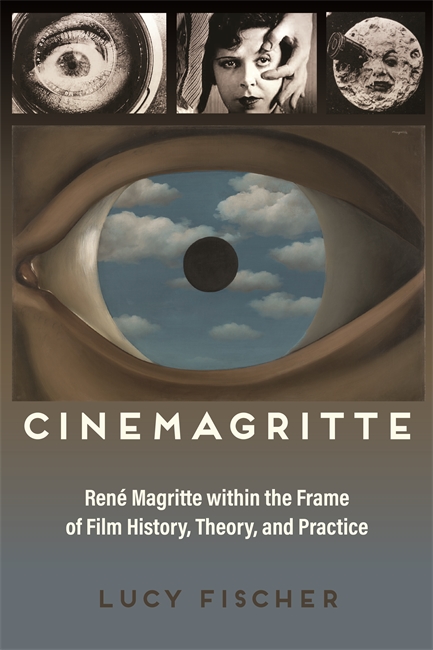
Lucy Fischer, Cinemagritte. René Magritte within the Frame of Film History, Theory, and Practice, Wayne State University Press, 2019.

Cinemagritte: René Magritte within the Frame of Film History, Theory, and Practice investigates the dynamic relationship between the Surrealist modernist artist René Magritte (1898–1967) and the cinema—a topic largely ignored in the annals of film and art criticism. Magritte once said that he used cinema as “a trampoline for the imagination,” but here author Lucy Fischer reverses that process by using Magritte’s work as a stimulus for an imaginative examination of film.

While Fischer considers direct influences of film on Magritte and Magritte on film, she concentrates primarily on “resonances” of Magritte’s work in international cinema—both fiction and documentary, mainstream and experimental. These resonances exist for several reasons. First, Magritte was a lover of cinema and created works as homages to the medium, such as Blue Cinema (1925), which immortalized his childhood movie theater. Second, Magritte’s style, though dependent on bizarre juxtapositions, was characterized by surface realism—which ties it to the nature of the photographic and cinematic image. Third, Magritte shares with film a focus on certain significant concepts: the frame, voyeurism, illusionism, the relation between word and image, the face, montage, variable scale, and flexible point of view. Additionally, the volume explores art documentaries concerning Magritte as well as the artist’s whimsical amateur “home movies,” made with his wife, Georgette, friends, and Belgian Surrealist associates. The monograph is richly illustrated with images of Magritte’s oeuvre as well as film stills from such diverse works as The Eternal Sunshine of the Spotless Mind, Eyes Without a Face, American Splendor, The Blood of a Poet, Zorns Lemma, The Island of Dr. Moreau, The Draughtsman’s Contract, and many more.

Cinemagritte brings a novel and creative approach to the work of Magritte and both film and art criticism. Students, scholars, and fans of art history and film will enjoy this thoughtful marriage of the two.

Lucy Fischer is Distinguished Professor Emerita of Film and Media Studies at the University of Pittsburgh. She is the author/editor of twelve scholarly books and has worked in curatorial positions at The Museum of Modern Art (NYC) and the Carnegie Museum of Art (Pittsburgh). She is the former president of the Society for Cinema and Media Studies and is the recipient of fellowships from the National Endowment for the Arts and for the Humanities.

Zhao, W. ‘Observation’ as China’s civic education pedagogy and governance: an historical perspective and a dialogue with Michel Foucault, Discourse
Volume 40, Issue 6, 2 November 2019, Pages 789-802

DOI: 10.1080/01596306.2017.1404444

Abstract
This paper examines China’s civic education discourses from a historical and cross-cultural perspective. It unpacks observation as a political–cultural–spatial pedagogy, underpinning Confucius’ educational envisioning, Mao’s domination in the Cultural Revolution Movement, and Xi’s China/ese Dream propaganda. Drawing upon Foucault’s provocation of the Western gaze, this paper historicizes Confucius, Mao, and Xi’s discourses to explicate a Chinese observation diagram. With Confucius, observation works as an onto-hermeneutic principle, grounding China’s cosmology and sovereign-subject governance. With Mao, observation becomes a panoramic domination-surveillance mechanism, which, coupled with a Confucian punitive shame, empowers the proletarian mass in excluding-purging the bourgeois as class enemies. With Xi, observation turns into a symbolic governing technology of self, subjecting its citizenry to re-branded Confucian values toward realizing a participatory China/ese Dream. In so doing, this paper shows the parallels and contradistinctions between the Chinese observation and the Western gaze in historically and structurally ordering knowledge production and social-educational governance.

KEYWORDS: Observation, civic education, Foucault’s gaze, Confucius’ vision, Mao’s Cultural Revolution Movement, China/ese Dream

Lorenza Mezzapelle Making a case for research-based art, The Concordion, November 5, 2019

[Editor: Update 26 February 2026. Link above is to the archived page on the Wayback Machine]

The Empty S(h)elf is on display at Artexte, at 2 Ste-Catherine St. E, Suite 301, Montreal, Quebec, Canada, until Jan. 25, 2020. The gallery is open Wednesday to Friday from 12 to 7 p.m., and Saturday from 12 to 5 p.m.

Angela Grauerholz explores the significance of the artists’ book
“Culture is linked to the book.” This set of words stands alone in a vibrant red font against a vast white wall. The phrase is broad, it can be interpreted in many ways. The words are small and the gallery space at Artexte, in downtown Montreal, appears empty.

The Empty S(h)elf is the first part of a new series by Angela Grauerholz, a Montreal-based graphic artist and designer, and co-founder of Artexte. The works create a dialogue surrounding the purpose of books and research in relation to the artist’s relationship with books and libraries.

The title The Empty S(h)elf refers at once to two notions: the empty library, one of Grauerholz’s fears for the future in an increasingly digital age; and the empty self, the idea of the “inner void.”

[…]
References attributed to renowned novelists and philosophers Umberto Eco, Jorge Luis Borges, Marshall McLuhan, Michel Foucault and Aristotle are among the gathered writings and documents. Through these, Grauerholz explores the creation of the text and a foundation for visual art.
[…]

stuartelden's avatarProgressive Geographies

foucault1.jpgI’ve updated the chronology of audio and video recordings of Foucault online. There are some additional ones here, and I’ve tried to fix any broken links. Please let me know if any are broken – videos seem to disappear, especially from YouTube, and some online repositories change their links but don’t make it easy to find things in the new ordering.

The only one I think is missing a live link in this list is the interview with Umberto Eco and Enzo Melandri. If anyone has the link for this, I’d be grateful.

I’d also appreciate links for any that I haven’t spotted.

There are lots more Foucault resources on this site – bibliographies, audio and video files, some textual comparisons, some short translations, etc.

View original post

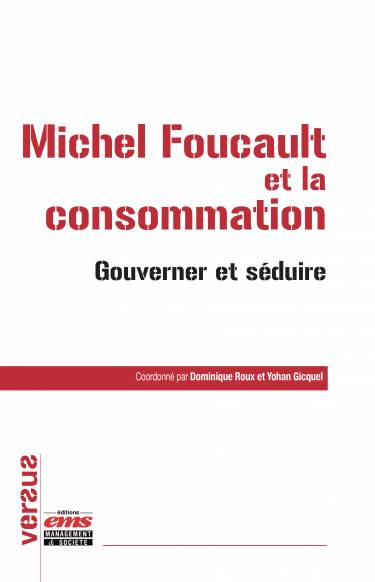
Dominique Roux, Yohan Gicquel, (dir.) Michel Foucault et la consommation. Gouverner et séduire, Versus 2018

Si Michel Foucault est l’un des plus grands philosophes du XXe siècle, et aussi le plus cité au monde, en quoi sa pensée peut-elle éclairer notre compréhension de la consommation à laquelle il n’a apporté aucun éclairage direct ?

Alors que son œuvre fait l’objet d’interprétations et d’usages multiples dans une grande variété de domaines – psychiatrie, sociologie, littérature, sciences politiques, éducation –, comment Michel Foucault peut-il nous aider à questionner la consommation, ses évolutions et son encadrement par le marketing ou la gestion ?

Voici les questions posées dans cet ouvrage où le lecteur, familier ou non de la pensée de Michel Foucault, trouvera de nombreuses voies de réflexions. Organisées autour de sept chapitres, celles-ci abordent soit des outils et méthodes (l’approche historique, la production discursive et le rôle des dispositifs), soit des concepts (la gouvernementalité, la discipline, la résistance, les hétérotopies, etc.) développés par Michel Foucault et appliqués à des cas concrets et d’actualité (la pauvreté, le sida, le glanage, Internet, etc.).

L’ouvrage s’adresse donc aux praticiens, aux étudiants et aux chercheurs intéressés par une mise en perspective de la pensée de Michel Foucault dans l’appréhension de problématiques contemporaines de la consommation.

Coordonné par Dominique Roux et Yohan Gicquel, cet ouvrage comprend les contributions de Søren Askegaard, Eric J. Arnould, Christian Barrère, Vivien Blanchet, Stéphane Borraz, Laurent Busca, Jean-Paul Domin, Hélène Gorge et Lionel Sitz.

Barker, C. How to tell the political truth: Foucault on new combinations of the basic modes of veridiction, Contemporary Political Theory
Volume 18, Issue 3, 1 September 2019, Pages 357-378

DOI: 10.1057/s41296-018-0253-0

Abstract
This article pays close attention to Michel Foucault’s theory that political regimes are enlightened through courageous free speech. A Foucaultian enlightenment occurs not when philosophical reason completely replaces superstition and enthusiasm in the public sphere, but instead when the parrhesiast partially organizes competing claims to know and to speak the truth. While much of the recent scholarly literature on Foucault’s later lectures emphasizes the political importance of the parrhesiast, less attention has been paid to the overlap and/or incompatibility between parrhesia and the other modes of truth-telling. Below, I explain Foucault’s analysis of the basic modes of philosophical truth-telling: prophesy, philosophy, teaching, and parrhesia. I provide examples of speakers working within these modes in the ancient and modern world. I explain the overlap and tension between these modes, and I analyze Foucault’s partial organization of them through the image of the parrhesiast. I briefly compare Foucault’s position to the agonistic democratic theory of Chantal Mouffe and distinguish Foucault’s view from consensus-based views of public reason. Finally, I provide practical and theoretical examples of parrhesiastic activity in the contemporary world.

Ahmad, J. Serving the same interests: The Wood Green ricin plot, media–state–terror relations and the ‘terrorism’ dispositif, Media, War and Conflict
Volume 12, Issue 4, 1 December 2019, Pages 411-434

DOI: 10.1177/1750635218810922

Abstract
This article analyses the representations of terrorism that arise out of the BBC’s coverage of the Wood Green ricin plot (2003), the first instance of al-Qaeda-related activity in the UK during the ‘war on terror’. Inspired by the work of Michel Foucault, the article suggests that the BBC’s representations form part of an emergent ‘terrorism’ dispositif, or apparatus, which draws together seemingly disparate and antagonistic groups into a strategic, mutually-sustaining alliance. The analysis focuses on two weeks of BBC ‘News at Ten’ bulletins, alongside speeches and press releases issued by the Prime Minister and statements released by al-Qaeda’s leadership. In particular, the article suggests that the BBC’s representations inadvertently work to the advantage of elements within al-Qaeda and the British executive due to the fact that they portray the Wood Green events in ways that are tactically useful to both groups. As such, the article not only provides substantive new empirical insights into the way representations of terrorism were mobilized in the build-up to the 2003 invasion of Iraq, but also shows how Foucauldian concepts can provide creative and innovative analytical tools for understanding the dynamics of the contemporary media–state–terrorism relationship. © The Author(s) 2018.

Jeroen Stevens and Bruno De Meulder, On Allotopia: The Spatial Accumulation of Difference in Bixiga (São Paulo, Brazil), Space and Culture
Volume 22, Issue 4, 1 November 2019, Pages 387-404

https://doi.org/10.1177/1206331218760772

Abstract
This article will unfold a longe durée spatial biography of the urban area of Bixiga (São Paulo, Brazil) to probe the particular role of space in the conflation of different cultural practices and territorial claims. The extended case study bridges indigenous, colonial, and postcolonial urbanization as they amalgamated an intricate assemblage of material and cultural strata. Combined historical urban analysis and fieldwork allow to uncover how the resulting urban milieu integrates discrepant urban worlds, perpetually iterating between centrality and marginality, innovation and degradation, oppression and resistance. Building on Foucault’s (1984) conception of heterotopia, Bixiga will surface as an allotopia, a place that accommodates, cumulates, and celebrates a multitude of differences. It sheds light, this way, on more insurgent histories of urbanism, where urban space is piecemeal forged through contentious struggles over space in the city. © The Author(s) 2018.

Ori Rotlevy, Askesis, Critique, and Tradition: Foucault and Benjamin.

Lecture on Soundcloud, October 2019.
Editor: Update 24 Feb 2026. No longer available. An article was published in 2022 with the same content as this lecture. See

Ori Rotlevy, (2022). Askesis and Critique: Foucault and Benjamin. Foucault Studies, (32), 28–53.
https://doi.org/10.22439/fs.vi32.6702

Abstract
While Foucault referred to Benjamin just once in his entire corpus, scholars have long noticed affinities between the two thinkers, mainly between their conceptions of history: their emphasis on discontinuity, their historiographical practices, and the role of archives in their work. This essay focuses, rather, on their practice of critique and, more specifically, on their conception of the relation of this practice to exercise or askesis. I examine the role of askesis as a self-transformative exercise in Foucault’s late work and how this concept reverberates throughout his idea of critique as the exercise of an ethos demanding arduous work. Against this background, the role of exercise (Übung) in Benjamin’s Origin of the German Traeurspiel, his interest in ascetic kinds of exercise or schooling, and its ties to critique are discerned. This comparison reveals significant similarities in Foucault’s and Benjamin’s conception of philosophy, as well as different emphases in their inheritance of the Kantian critical project: critique as an exercise of an attitude attentive to possibilities for transformation in the present vs. critique as involving an attitude-transforming exercise; critique as a modern ethos that needs to be reactivated vs. critique as propaedeutic, as a preparation for a modern tradition.

Keywords: Michel Foucault, Walter Benjamin, Immanuel Kant, Pierre Hadot, Spiritual Exercise, Critical Theory

Lecture abstract

Consortium for Interdisciplinary Research at the University of California, Berkeley

A central concept in Foucault’s later work is Askesis: an exercise of oneself, related to self-mastery and self-transformation. The concept of “ascetic schooling” in the foreword to Benjamin’s Origin of the German Trauerspiel has a similarly significant role, much neglected by scholarship. Both Foucault’s askesis and Benjamin’s “ascetic schooling” relate to the transformation of the subject through arduous work as fundamental for philosophy. At the same time, their considerations of askesis/asceticism illuminate the complex relations between the different models of critique they promote – the reactivation of an attitude alien to doctrine and tradition (Foucault), versus a change of attitude as propaedeutic for their presentation (Benjamin).

Ori Rotlevy is a postdoctoral fellow at the Franz Rosenzweig Minerva Research Center at the Hebrew University of Jerusalem. He teaches philosophy in Tel Aviv University, where he also co-directs a research group in the Minerva Humanities Center on “Tradition: Transmission, Canon and Critique”.