Foucault News

News and resources on French thinker Michel Foucault (1926-1984)

Achille Mbembe, Necropolitics, Duke University Press, 2019

n Necropolitics Achille Mbembe, a leader in the new wave of francophone critical theory, theorizes the genealogy of the contemporary world, a world plagued by ever-increasing inequality, militarization, enmity, and terror as well as by a resurgence of racist, fascist, and nationalist forces determined to exclude and kill. He outlines how democracy has begun to embrace its dark side—what he calls its “nocturnal body”—which is based on the desires, fears, affects, relations, and violence that drove colonialism. This shift has hollowed out democracy, thereby eroding the very values, rights, and freedoms liberal democracy routinely celebrates. As a result, war has become the sacrament of our times in a conception of sovereignty that operates by annihilating all those considered enemies of the state. Despite his dire diagnosis, Mbembe draws on post-Foucauldian debates on biopolitics, war, and race as well as Fanon’s notion of care as a shared vulnerability to explore how new conceptions of the human that transcend humanism might come to pass. These new conceptions would allow us to encounter the Other not as a thing to exclude but as a person with whom to build a more just world.

Contents
Introduction. The Ordeal of the World 1
1. Exit from Democracy 9
2. The Society of Enmity 42
3. Necropolitics 66
4. Viscerality 93
5. Fanon’s Pharmacy 117
6. This Stifling Noonday 156
Conclusion. Ethics of the Passerby 184

Achille Mbembe is Research Professor in History and Politics at the Wits Institute for Social and Economy Research, University of the Witwatersrand, Johannesburg. He is author of Critique of Black Reason and coeditor of Johannesburg: The Elusive Metropolis, both also published by Duke University Press.

via Progressive Geographies

Michel Foucault, Penal Theories and Institutions. Lectures at the Collège de France, 1971-1972, Translated by Graham Burchell, Palgrave Macmillan, 2019

“What characterizes the act of justice is not resort to a court and to judges; it is not the intervention of magistrates (even if they had to be simple mediators or arbitrators). What characterizes the juridical act, the process or the procedure in the broad sense, is the regulated development of a dispute. And the intervention of judges, their opinion or decision, is only ever an episode in this development. What defines the juridical order is the way in which one confronts one another, the way in which one struggles. The rule and the struggle, the rule in the struggle, this is the juridical.”

– Michel Foucault

Penal Theories and Institutions is the title Michel Foucault gave to the lectures he delivered at the Collège de France from November 1971 to March 1972.

In these lectures Michel Foucault presents for the first time his approach to the question of power that will be the focus of his research up to the writing of Discipline and Punish (1975) and beyond. His analysis starts with a detailed account of Richelieu’s repression of the Nu-pieds revolt (1639-1640) and then goes on to show how the apparatus of power developed by the monarchy on this occasion breaks with the system of juridical and judicial institutions of the Middle Ages and opens out onto a “judicial State apparatus”, a “repressive system”, whose function is focused on the confinement of those who challenge its order.

Michel Foucault systemizes the approach of a history of truth on the basis of the study of “juridico-political matrices” that he had begun in the previous year’s lectures (Lectures on the Will to Know) and which is at the heart of the notion of “knowledge-power”.

In these lectures Foucault develops his theory of justice and penal law.

The appearance of this volume marks the end of the publication of the series Foucault’s courses at the Collège de France (the first volume of which was published in 1997).

Foucault at Warwick,
17 January 2020, 5pm,
University of Warwick, UK
Alison Downham Moore, Lisa Downing, Stuart Elden, Daniele Lorenzini and Federico Testa
PDF of poster

Internet et libertés publiques : qu’est ce qui a changé depuis Snowden ? France Culture, 20/09/2019

Podcast

Les révélations d’Edward Snowden ont-elles provoqué plus qu’une prise de conscience? Que nous disent-elles de l’utopie déchue d’internet? Félix Tréguer, co-fondateur de la Quadrature du net, nous en parle dans L’utopie déchue (Fayard, 2019).

Alors qu’internet devait permettre l’émergence d’une société plus libre et plus démocratique, c’est, dit-il, tout l’inverse qui s’est produit. Chercheur associé au Centre Internet et Société du CNRS, membre fondateur de l’association La Quadrature du Net, qui défend les libertés numériques en France, Félix Tréguer déplore la chute de l’utopie émancipatrice et révolutionnaire que représentait l’Internet des origines.

Il nous en parle dans L’utopie déchue (fayard, 2019), une contre-histoire qui, dans la lignée des travaux de Michel Foucault, revient sur la question des libertés et montre que celle-ci dépasse le cadre de l’informatique et du web. Il montre ainsi que, de l’invention de l’imprimerie au XVème siècle aux usages actuels de la technologie, les gouvernements ont toujours su s’approprier les communications pour contrôler les individus.

suite

L’utopie déchue. Une contre-histoire d’Internet XVe-XXIe siècle, Félix Tréguer | Fayard, 2019

À travers une histoire croisée de l’État et des luttes politiques associées aux moyens de communication, Félix Tréguer montre pourquoi le projet émancipateur associé à l’Internet a été tenu en échec et comment les nouvelles technologies servent à un contrôle social toujours plus poussé.

Ce livre est écrit comme un droit d’inventaire.

Alors qu’Internet a été à ses débuts perçu comme une technologie qui pourrait servir au développement de pratiques émancipatrices, il semble aujourd’hui être devenu un redoutable instrument des pouvoirs étatiques et économiques. Pour comprendre pourquoi le projet émancipateur longtemps associé à cette technologie a été tenu en échec, il faut replacer cette séquence dans une histoire longue : celle des conflits qui ont émergé chaque fois que de nouveaux moyens de communication ont été inventés.

Depuis la naissance de l’imprimerie, les stratégies étatiques de censure, de surveillance, de propagande se sont sans cesse transformées et sont parvenues à domestiquer ce qui semblait les contester. Menacé par l’apparition d’Internet et ses appropriations subversives, l’État a su restaurer son emprise sous des formes inédites au gré d’alliances avec les seigneurs du capitalisme numérique tandis que les usages militants d’Internet faisaient l’objet d’une violente répression.

Après dix années d’engagement en faveur des libertés sur Internet, Félix Tréguer analyse avec lucidité les fondements antidémocratiques de nos régimes politiques et la formidable capacité de l’État à façonner la technologie dans un but de contrôle social.

Au-delà d’Internet, cet ouvrage peut se lire comme une méditation sur l’utopie, les raisons de nos échecs passés et les conditions de l’invention de pratiques subversives. Il interpelle ainsi l’ensemble des acteurs qui luttent pour la transformation sociale.

Félix Tréguer est chercheur associé au Centre Internet et Société du CNRS et post-doctorant au CERI-Sciences Po. Il est membre fondateur de La Quadrature du Net, une association dédiée à la défense des libertés à l’ère numérique.

Foucault Studies, Vol 1 No 27 (2019): Number 27, December 2019

The editors of Foucault Studies are pleased to publish this issue of Foucault Studies containing seven original articles and three book reviews. Among the themes highlighted in the seven original articles are: norms, normalization, normativity, law and rule; genealogy and the diagnosis of the present; regimes of truth and truth-telling; ethics, ethical invention and transformation; the Panopticon and surveillance; as well as the relationship between Foucault and Deleuze, and Sartre and Foucault.

Editorial
Sverre Raffnsøe et al.

Articles
What’s In a Norm? Foucault’s Conceptualisation and Genealogy of the Norm
Mark Kelly

Foucault, Normativity, and Freedom: A Reappraisal
Giovanni Mascaretti

Re-thinking Thought: Foucault, Deleuze, and the Possibility of Thinking
Wendyl Luna

Foucault as an Ethical Philosopher: The Genealogical Discussion of Antiquity and the Present
Dimitrios Lais

Ethical Invention in Sartre and Foucault: Courage, Freedom, Transformation
Kimberly Engels

Sirens in the Panopticon: Intersections Between Ainslean Picoeconomics and Foucault`s Discipline Theory
Yevhenii Osiievskyi, Maksym Yakovlyev

The Paradoxes in the Use of the Panopticon as a Theoretical Reference in Urban Video-surveillance Studies: A Case Study of a CCTV System of a Brazilian city
Iafet Leonardi Bricalli

Book Reviews
Colin Koopman: “How We Became Our Data: A Genealogy of the Informational Person”
Leonard D’Cruz

Tom Boland: “The Spectacle of Critique: from Philosophy to Cacophony”
Stephanie Martens

Rosi Braidotti and Maria Hlavajova: “Posthuman Glossary”
Asker Bryld Staunæs, Mads Rosendahl Thomsen

Machiel Karskens, Het regime van de bekentenissen. Foucaults Histoire de la sexualité 4: Les aveux de la chair, Tijdschrift voor Filosofie, 81, 3, 2019, 559-581

DOI: 10.2143/TVF.81.3.3287040

Article in Dutch. Title and abstract below in English

The Regimen of the Confessions: Critical Review of Foucault’s “History of Sexuality 4: The Confessions of the Flesh”

Abstract
The Confessions of the Flesh, once announced as the nearly fit to print part IV of Michel Foucault’s History of Sexuality, actually is a set of manuscripts, written in 1980-1981. The main manuscript is composed as a treatise of early Christian truth and life practices; the purport of the argument is that they follow the ‘regimen’ of the existing pagan practices, and constitute within these practices the Christian ‘experience’ of (original) sin, paradise and salvation in living with Christ. In doing so, the practices of telling truth about oneself are turned into avowal (aveu), being a profession of faith, public showing of sins and most of all self-examination and spiritual struggle, under the obliging direction (which is not a command) of a pastor/priest. The crux of avowal is self-transforming self-denial or self-sacrifice, and we argue that this is a continuation of parrhesia, the art of self-transformation by openly speaking the truth. Foucault argues, in the second and third part of the manuscript, that in doing so sexual practices are ‘subjectivated’, turning sex from a partnership relation into the scrutinous examination of one’s own concupiscence. In the end, so is his final point, this will turn the self-examining subject into a legal subject, dominated by Law. We argue that this subjectivation is in line with the self-transforming practices of truth-telling in non-Christian Antiquity.

KEYWORDS: manifestation of truth as self-avowal, spiritual struggle, self-examination, self-transformation, subjectivation, sexual intercourse, concupiscence.

Installation view from one of two entrances into the series of interlocking rooms. (Courtesy Greene Naftali)

Peter Halley’s Heterotopia II explored the relationship between painting, architecture, and image
LEILAH STONE • December 24, 2019, The Architect’s Newspaper

Peter Halley’s Heterotopia II, a candy-colored shrine to geometric abstraction closed on December 20 at Greene Naftali gallery in Chelsea (Manhattan). The exhibition, which embodied the relationship between painting and architectural space, brought visitors into a disorienting, hyperreal world collaged out of references to science fiction, modernist architecture, and mass media—all painted in fluorescent hues. The installation was both a fortress and a stage set and brought to mind the importance of creating alternative worlds and ways of seeing while also probing the ties between architecture, art, and image.

[…]

Creating paintings that depicted both social isolation and connectivity, the artist’s work has often looked to geometry as a metaphor for society. A heterotopia can be defined as institutions that are in opposition to the utopia, spaces that are different and that operate outside of societal norms (prisons, temples, cemeteries, and brothels are some of the examples Michel Foucault outlined in his essay “Of Other Spaces: Utopias and Heterotopias”). At the same time, heterotopias often reveal as much as they conceal, acting as a mirror that reflects back the values of the dominant culture. Halley’s Heterotopia II is a labyrinthian universe that highlighted visitors’ relationship to and perception of color in the built environment whether applied to a canvas, a wall, or pixels of a photo uploaded to social media. In today’s terms, the installation is “Instagrammable,” to say the least.

[…]

Godrej, Farah. “The neoliberal yogi and the politics of yoga.” Political Theory 45, no. 6 (2017): 772-800.

DOI: 10.1177/0090591716643604

Abstract
Can the theory and practice of the yogic tradition serve as a challenge to dominant cultural and political norms in the Western world? In this essay I demonstrate that modern yoga is a creature of fabrication, while arguing that yogic norms can simultaneously reinforce and challenge the norms of contemporary Western neoliberal societies. In its current and most common iteration in the West, yoga practice does stand in danger of reinforcing neoliberal constructions of selfhood. However, yoga does contain ample resources for challenging neoliberal subjectivity, but this requires reading the yogic tradition in a particular way, to emphasize certain philosophical elements over others, while directing its practice toward an inward-oriented detachment from material outcomes and desires. Contemporary claims about yoga’s counterhegemonic status often rely on exaggerated notions of its former “purity” and “authenticity,” which belie its invented and retrospectively reconstructed nature. Rather than engaging in these debates about authenticity, scholars and practitioners may productively turn their energies toward enacting a resistant, anti-neoliberal practice of yoga, while remaining self-conscious about the particularity and partiality of the interpretive position on which such a practice is founded.

Keywords
yoga, neoliberalism, biopolitics, Bhagavad-Gīta, Yōga-Sūtras, Patanjali, authenticity

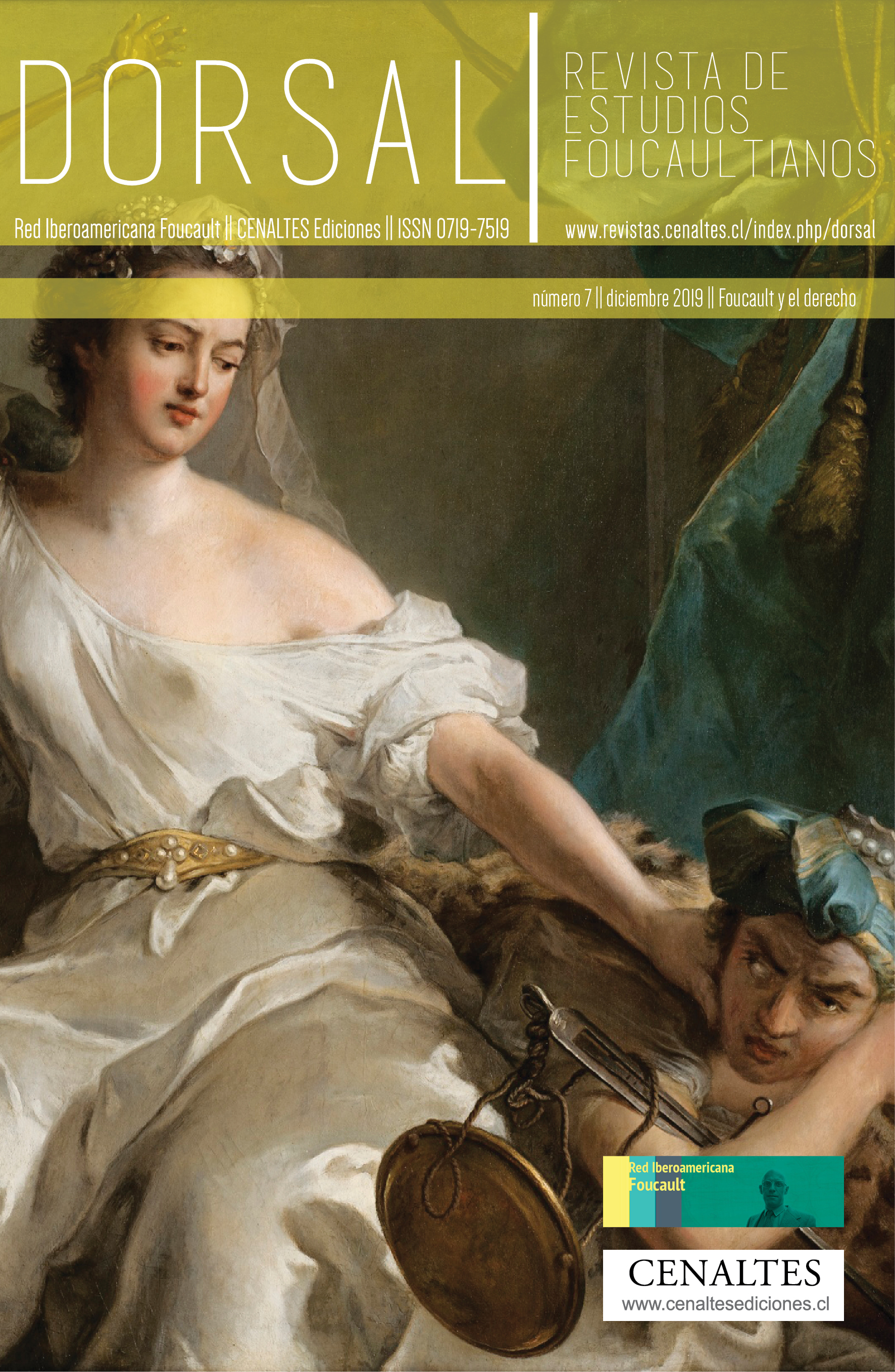
Dorsal. Revista de Estudios Foucaultianos
Foucault y el derecho. Núm. 7 (2019)

Artículos
Poder, libertad y derecho a partir del último Foucault: consideraciones sobre la noción de “gobierno de sí”
Marco Díaz Marsá

«Derechos del hombre/derechos humanos» versus «derechos de los gobernados»: un análisis de la producción de derechos en el pensamiento de Michel Foucault
Marcelo Raffin 33-52

Razón punitiva, razón gubernamental, razón jurídica. El derecho en la obra de Michel Foucault
Beatriz Dávilo 53-78

Derecho de los gobernados y disidencia moral en Foucault
Luis Diego Fernández 79-101

A sociedade de segurança segundo Michel Foucault: Os limites da efetividade do direito no paradigma da governamentalidade
Lorena Martoni de Freitas 103-122

Sobre la concepción foucaulteana del derecho: claves para pensar el debate anglosajón
Luciana Álvarez 123-151

Foucault e a era do direito. Colonização das práticas judiciárias em face à sociedade da normalização
Jefferson Martins Cassiano 153-178

Dossier
Subjetivación del discurso racista. Análisis de dos novelas mexicanas
Sol Tiverovsky Scheines 181-202

El Holocausto chino. Biopolítica y racismo de Estado en México (1896-1934)
José Jorge Gómez Izquierdo 203-226

Las malas madres. La subjetivación en las mujeres del poder-saber jurídico psiquiátrico en Puebla
Miriela Sánchez Rivera 227-248

Reseñas
Reseña de: Michel Foucault et le Droit. Márcio Alves da Fonseca. Paris, L’Harmattan, 2014.
Paula Aguadero Ruiz 250-251

Reseña de: Foucault y la cuestión del derecho. Jose Luís Pardo y Marco Díaz Marsá (eds.). Madrid, Guillermo Escolar Editor, 2017.
José Ramón Suárez Villalba 252-258

Reseña de: Georges Canguilhem. Vitalismo y Ciencias humanas. Francisco Vázquez García. Cádiz, Editorial UCA, 2018. PDF
Luis Roca Jusmet 258-261

Reseña de: El sujeto anárquico. Reiner Schürmann y Michel Foucault. Simón Royo. Madrid, Editorial Arena Libros, 2019.
Rosa Jiménez Asensio