Foucault News

News and resources on French thinker Michel Foucault (1926-1984)

Michel Foucault Audio Archive
The most comprehensive collection to date of online audio recordings of lectures and courses by the renowned French philosopher and historian, Michel Foucault.

Held by Berkeley Library, University of California

The most comprehensive collection to date of audio recorded lectures and courses by the renowned French philosopher and historian, Michel Foucault. The English language collection features two lecture series delivered at UC Berkeley in the 1980’s on Truth and Subjectivity and Parrhesia. The French language collection offers five complete semester length courses, covering such quintessentially Foucauldian concepts as Parrhesia, governmentality, neoliberalism, security, biopolitics, and sovereignty. The collection includes recordings spanning two decades of thought and instruction, including Foucault’s final 1984 course at the Collège de France.

This collection was generously donated to the Media Resources Center by Paul Rabinow, Professor of Social Cultural Anthropology and digitized, corrected and arranged by Gisèle Tanasse in 2009.

Recordings in English
Howison Lectures, 1980
Discourse & Truth: Parrhesia
Rabinow Seminar & Recordings

Recordings in French
“Il faut défendre la société,” 1976
Sécurité, territoire, population, 1978
Naissance de la biopolitique, 1979
Gouvernement de soi et des autres, 1983
Courage de la vérité, 1984


Patrick G. Stefan, The Power of Resurrection. Foucault, Discipline, and Early Christian Resistance, Lexington Books / Fortress Academic, Rowman & Littlefield, 2019

How did the early Christian movement grow so quickly, and did the idea of resurrection have anything to do with its growth? Patrick G. Stefan offers an answer to both of these questions by searching at the intersection of the investigation of Christian origins and Continental philosophy. He documents the rise of the disciplined subject with the emergence of Christianity and argues that the early success of the Christian movement was due, in part, to the activation and deployment of what Michel Foucault calls disciplinary mechanisms of power. This activation took place through the instantiation of the idea of resurrection in early Christian material and textual existence. The activation of these mechanisms created a sub-class of disciplined individuals with the ability to envision life outside of the sovereign power of Caesar.

By building on Foucault’s methodology of examining how material conditions shape and create individual subjects, this book takes as its point of departure Foucault’s unexplored observation that “[Christianity] proposed and spread new power relations throughout the ancient world.” From this departure point, Stefan seeks to demonstrate that these new power relations were connected to an idea (resurrection) and formed the early history of disciplinary power.

With all best wishes for Christmas and the festive season from Foucault News!

For sale at Cafe Press

Foucault bot on Twitter that joined in November 2019 and automatically retweets all tweets that mention Foucault

See also this human Foucault bot that ran from October 2014 to October 2015

Gilles Deleuze sur le masochisme,
03 avril 1963, Site INA, Émission. Recherche de notre temps

Gilles DELEUZE questionné par Michel FOUCAULT donne la définition du contenu apparent du mot masochisme (association de la douleur et du plaisir sexuel) : SACHER MASOCH qui vécut en Galicie dans la seconde moitié du XIXè Siècle ; – Les conditions formelles aptes à définir le masochisme : la douleur doit apparaître comme une punition ; l’attitude passive de la douleur reçue et attendue ; l’importance que doivent prendre les fantasmes de rêveries ; “le masochiste gagne en imagination ce qu’il perd en action” ; le masochiste a réglé lui-même les détails de la scène au cours de laquelle il se fait passif et souffrant : c’est pourquoi les masochistes passent de véritables contrats avec la femme aimée (exemple) ; – Les 4 conditions formelles du masochisme : la punition comme principe de la douleur – la passivité comme attitude dolorifère – le fantasme comme valeur autonome – le contrat comme condition préalable ; commentaires et exemples pris dans l’oeuvre de SACHER MASOCH.

Theoretical puppets version (2019)

You can do a search on Foucault for some interesting articles. For example this excellent 1987 one by Vincent Descombes (he makes it clear in a letter that he did not choose the unfortunate title of this article)

stuartelden's avatarProgressive Geographies

The London Review of Books has a new website and content is open access for one month:

For a full calendar month, there won’t be a paywall of any kind anywhere on the site. This means that not only all 24 of this year’s issues, but also our entire archive, dating back to 25 October 1979 and containing almost 17,500 articles, will be free to read, for everyone, without limits, until midday on Wednesday 15 January. Merry Christmas!Where to start? Why not on our new subject hub pages, where you’ll find selections of some of the best pieces we’ve published, as well as other curated collections of brilliant articles linked by particular themes.

View original post

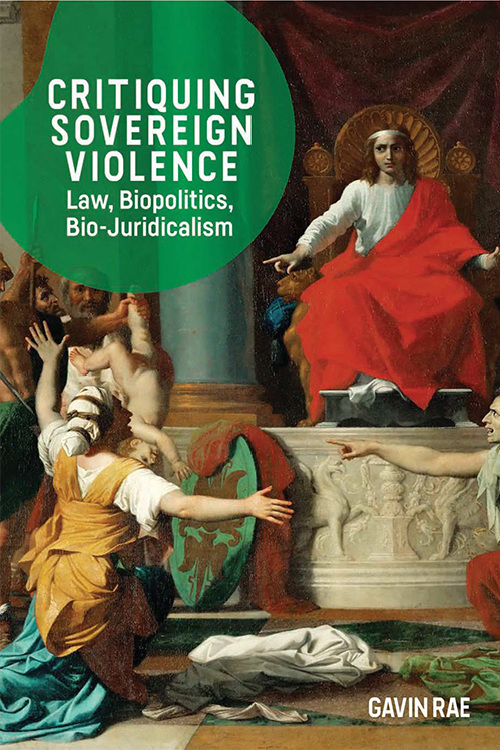
Gavin Rae,Critiquing Sovereign Violence. Law, Biopolitics, Bio-Juridicalism Edinburgh University Press, 2019

Critiques the historically dominant classic–juridical model of sovereign violence and defends a bio-juridical model instead

  • Works across the disciplines of critical theory, political theory, biopolitical theory, poststructuralism and deconstruction
  • Develops three models – radical-juridical, biopolitical, and bio-juridical – to understand contemporary debates
  • Situates current thinking in relation to the classic–juridical model, thereby linking contemporary debates to historical ones
  • Moves beyond the dominant biopolitical model to a bio-juridical paradigm

Gavin Rae offers an original approach to sovereign violence by looking at a wide range of thinkers, which he organises into three models. Benjamin, Schmitt, Arendt, Deleuze and Guattari form the radical-juridical perspective; Foucault and Agamben the biopolitical; Derrida the bio-juridical – which Rae argues produces the most nuanced account.

Angela Oels(2005) Rendering climate change governable: From biopower to advanced liberal government?,Journal of Environmental Policy & Planning,7:3,185-207,DOI: 10.1080/15239080500339661

Abstract
This article generates a theoretical framework for analysing the politics of climate change on the basis of Michel Foucault’s concept of governmentality. Foucault does not limit the exercise of power to sovereignty, but introduces discipline, biopower, liberal and advanced liberal government as alternative configurations of state and power. The article argues that the ways in which climate change is rendered a governable entity are best understood before the background of a shift from biopower to advanced liberal government. It will be argued that climate change was first rendered governable by biopower, which justified global management of spaceship Earth in the name of the survival of life on Earth. Since the mid-1990s, climate change has been captured by advanced liberal government, which articulates climate change as an economic issue that requires market-based solutions to facilitate cost-effective technological solutions. A governmentality analysis asks which visibilities, fields of knowledge, practices and identities this ‘global climate regime’ is actually producing, rather than assuming that what it does or is supposed to do is known. In that way, the ways in which programme failure has already been built into the very formation of the Framework Convention on Climate Change and the Kyoto Protocol can be identified.

Keywords: Governmentality, neoliberalism, climate change, constructivism, power

Levon, E., Milani, T.M.
Israel as homotopia: Language, space, and vicious belonging
(2019) Language in Society, 48 (4), pp. 607-628.

DOI: 10.1017/S0047404519000356

Open access

Abstract
Israel has recently succeeded in presenting itself as an attractive haven for LGBT constituencies. In this article, we investigate how this affective traction operates in practice, along with the ambiguous entanglement of normativity and antinormativity as expressed in the agency of some gay Palestinian Israelis vis-à-vis the Israeli homonationalist project. For this purpose, we analyze the documentary Oriented (2015), produced by the British director Jake Witzenfeld together with the Palestinian collective Qambuta Productions. More specifically, the aim of the article is twofold. From a theoretical perspective, we seek to demonstrate how Foucault’s notion of heterotopia provides a useful framework for understanding the spatial component of Palestinian Israeli experience, and the push and pull of conflicted identity projects more generally. Empirically, we illustrate how Israel is a homotopia, an inherently ambivalent place that is simultaneously utopian and dystopian, and that generates what we call vicious belonging. (Code-switching, heterotopia, homonationalism, normativity, pinkwashing, sexuality, space)

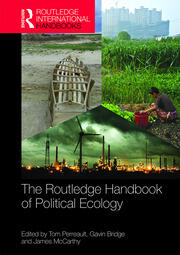
Gabriela Valdivia, “Eco-Governmentality” In The Routledge Handbook of Political Ecology. Edited By Tom Perreault, Gavin Bridge, James McCarthy, Routledge, 2015

Abstract
“Eco-governmentality” is a Foucaultian-inspired power analytic that political ecologists use to examine nature–society relationships. Since its early days, political ecologists have used Marxist-inspired critique to explain environmental domination and oppression (Watts 1983; Blaikie and Brookfield 1987; Hecht and Cockburn 2010; Peluso 1992). As Foucault’s work became more broadly accessible and translated into English in the 1990s, it challenged some aspects of how political ecologists thought about history, change, and power (Bryant 1998). In some respects, Foucault’s analytics parallel Marxist critiques of power, for example, like historical materialism, Foucault takes social practices as transitory and intellectual formations as connected with power and social relations. Things we consider universal, contends Foucault, are the result of very precise historical changes. In other respects, Foucault deviates from Marxist thought, moving away from “modes of production” as the site of social critique and towards “modes of information” (Poster 1984): how power works to produce structures of domination (and resistance) in modern society. His aim was to see power everywhere and in everything, not only in economic activity, and to investigate the microphysics of power rather than focusing on the macro-perspective of the state, or on class struggle as the venue for social change (Foucault 1980b). Doing so, Foucault argued, enabled recognizing the historical contingency of taken-for-granted concepts (e.g., madness, sickness, sexuality, class); the role of social practices in truth regimes; and how authorities and institutions that manage, rule, and control social life are socially produced.