Foucault News

News and resources on French thinker Michel Foucault (1926-1984)

stuartelden's avatarProgressive Geographies

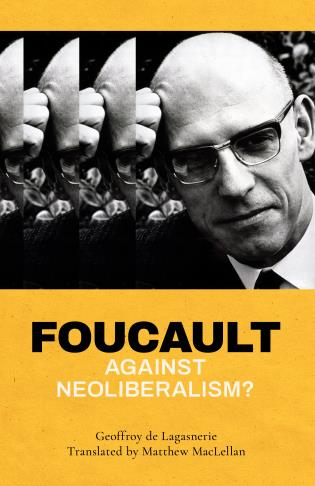
9781786615275Geoffroy de Lagasnerie, Foucault against Neoliberalism? translated by Matthew Maclellan – Rowman, June 2020

In the late 1970s, Michel Foucault dedicated a number of controversial lectures on the subject of neoliberalism. Had Foucault been seduced by neoliberalism? Did France’s premier leftist intellectual, near the end of his career, turn to the right? In this book, Geoffroy de Lagasnerie argues that far from abandoning the left, Foucault’s analysis of neoliberalism was a means of probing the limits and lacunae of traditional political philosophy, social contract theory, Marxism, and psychoanalysis. For Lagasnerie, Foucault’s analysis was an attempt to discover neoliberalism’s singularity, understand its appeal, and unearth its emancipatory potential in order to construct a new art of rebelliousness. By reading Foucault’s lectures on neoliberalism as a means of developing new practices of emancipation, Lagasnerie offers an original and compelling account of Michel Foucault’s most controversial work.

View original post

Laena Maunula, “The pandemic subject: Canadian pandemic plans and communicating with the public about an influenza pandemic.” Healthcare policy/Politiques de santé vol. 9, Spec Issue (2013): 14-25.
https://pubmed.ncbi.nlm.nih.gov/24289936/

Open access

Abstract
In this paper, I examine the goals for pandemic public communication as outlined in two Canadian plans for pandemic planning and infection control. I critique these strategies by drawing on Foucault’s notions of governmentality and biopower. My argument is that the public health communication campaign goals reviewed rest upon a particular conceptualization of health in the context of pandemic planning as an individual/family duty, and that scientific/medical expert knowledge is most appropriate for guiding pandemic planning. This study contributes to a sociological understanding of how pandemic preparedness and infection control are represented in Canadian pandemic plans, how public health shapes pandemic communication messages in Canada, and the implications of those messages for subjectivity and notions of citizenship.

stuartelden's avatarProgressive Geographies

In the last update, I mentioned the work I’d been doing in Paris and Tübingen, and said I’d agreed to write a book on Foucault in the 1960s, again for Polity, with the working title of The Archaeology of Foucault immediately after I’ve finished this one on the 1950s.

Since then I’ve been back in Paris, mainly working through the Bibliothèque nationale collection of Foucault’s papers from the 1940s and 1950s. There are all sorts of fascinating things here, and if I was writing a biography I would doubtless do a lot more with it. I’m interested in the intellectual side of his life only, and so it’s letters from people like Ludwig Binswanger and Georges Dumézil that hold most interest. There is also some important correspondence about his posts in Lille and Uppsala, as well as some concerning early publications, including some contracts. These really help with…

View original post 1,004 more words

mghamner's avataraffecognitive

  In May, 1969, three years after the publication of Les Mots et les Choses, and a year after the upheavals of May 1968, Foucault presided over a colloquium at the University of Paris’s Institute of the History of Sciences and Technologies celebrating the bicentennial of Georges Cuvier’s birth (1769-1832). I read this colloquium as part of my daily plunge into Dits et Écrits; Lynne Huffer has beautifully translated the presentation and proceedings for us in Foucault Studies (No. 22, pp. 208-237).

I wish for more time (of course)–time to reach back to The Order of Things and forward to “L’ordre du discours”, but I’ll settle for a short note on the status of the individual. The backdrop for me, here, is actually Marx, specifically the Marx of the Manifesto (1848) and the Eighteenth Brumaire (1852).

In turning to Cuvier, Foucault looks for the epistemological seeds of Darwin…

View original post 563 more words

Call for papers
6th International Workshop on Historical Epistemology
Historical Epistemology and Epistemology of History
Paris, 4-5-6 June 2020

The workshop is organized by
Épistémologie historique. Research Network on the History and the Methods of Historical Epistemology
With the support of

École doctorale de Philosophie – ED 280 (Paris 1)
IHPST (UMR 8590, Paris 1/CNRS)
PhiCO/ISJPS (UMR 8103, Paris 1)

République des Savoirs (USR 3608, ENS/ Collège de France/CNRS)
École doctorale Lettres, Arts, Sciences humaines et sociales
ED 540 (ENS) – EUR Translitteræ (PSL)

Maison d’Auguste Comte

Study of the relationship between historical epistemology and history immediately reveals a paradox: on the one hand, the very idea of historical epistemology assigns a central role to history, proposing to connect philosophical reflection on the sciences with acknowledgement of their historicity. Yet, on the other hand, one cannot fail to notice that historical epistemology as a field has concerned itself very little with the discipline of history as such. As a result, it has not yet developed an epistemology of history.

We can locate the origin of this paradox in the texts of Gaston Bachelard, which laid out the basic notions about history still characterizing historical epistemology. Recognizing the history of science as distinct from traditional history, Bachelard conceived history of science to oppose point-by-point the needs of traditional historiography – including its emphasis on rigorous description and concern for avoiding anachronism. The resulting history of scientific progress he presented was resolutely retrospective and normative.

Bachelard did not acknowledge any form of historicity other than the one made possible by overcoming the threshold of scientificity. He thus asked whether the discipline of history should be understood to have a history comparable to that of physics or mathematics or if it should be understood as closer to the ahistoricity of the pre-scientific. The plural heritages of Bachelardian epistemology that gathered around this question are characterized by their different ways of responding to or reformulating this question. Some authors have tried to apply the concepts and methods of historical epistemology to history itself. That is the case for Louis Althusser, who presents the emergence of historical materialism as the overcoming of an ideological notion of history and ascension of a science of history. Historical epistemology would therefore be interested in history to the extent that the latter is capable of accessing a level of scientificity comparable to that of the natural sciences. A somewhat different attempt to reinforce the links between historical epistemology and general history is put forward by Foucault’s Archaeology of Knowledge, which is inspired by Bachelard’s epistemology and by the history of the Annales and aims to elaborate a new historiographic manifesto. Foucault invites us to modify the initial categories of historical epistemology in order to ask a more general question about the emergence of discursive formations –a question which applies to the sciences as well as to other discursive phenomena. This Foucauldian precedent notwithstanding, one may ask whether the presuppositions underwriting Bachelardian historiography are not among the main factors explaining the weak relationship between the history of science and the history of mentality.

Authors like Gilles-Gaston Granger, whose influence on Paul Veyne is well known, have tried to justify the fact that historical epistemology has not taken the discipline of history as an object by putting forward different claims that history is not a science. Examining the status given to history in various arguments allows us to analyse the degree to which the move to deny history a form of scientificity marginalizes or renders precarious forms of historical epistemology that rely on the history of science. It also enables us to analyse the arguments of authors that, despite questioning whether history is a science in the same sense as the natural sciences, nonetheless refuse to consider it as closer to common knowledge: this is the case for Jean-Claude Passeron, who, while drawing on historical epistemology, sees a radical difference between the regime of scientificity of the historical sciences and that of the experimental sciences and argues that this difference affects the types of progress and of discontinuity these sciences instantiate. Exploring such arguments will make it possible for us to return to Bachelard’s distinction between the history of science and general history by remarking on differences between the histories of the different scientific disciplines. These questions are relevant not only for the discipline of history itself but also for other sciences that claim to be “historical” to the extent that they bear on events that have taken place in the past – from the human and social sciences to geology or the biology of evolution, just to mention some examples. Are all these sciences “historical” in the same sense? In what sense can a discipline consider itself “historical”? In what way is the historicity of a science linked to the historicity of its objects and its methods?

There are three axes we would like to analyse for this year’s workshop:

Axis 1: What is specific about the history of science in relation to other historical methodologies?
Axis 2: What would it mean to move towards an historical epistemology of history?
Axis 3: How can we characterize and distinguish the historicity of scientific objects in formal knowledge, the life sciences, the sciences of matter, and the human and the social sciences?
As in previous years, we would like this theme to represent an occasion for encounter among philosophers and historians of science with different methodological approaches. In other terms, we would like to receive proposals adopting a range of historical and/or analytical approaches to critical clarification of the central concepts of the “historical sciences,” understood in the widest sense as spanning from history as such to the social and life sciences.

Proposals (500 words plus a short presentation of the candidate) must be sent by 15 March 2020 (notification of acceptance or refusal by 1 April) in Word or .pdf formats to epistemologiehistorique@gmail.com. Proposals by graduate students and early career researchers will be prioritized. The languages of the workshop will be French and English.

Confirmed Keynotes
Sophie Roux (ENS)
Paul A. Roth (California)

Comité d’organisation

Matteo Vagelli (coordinateur)
Ivan Moya Diez (coordinateur)
Caroline Angleraux
Marcos Camolezi
Lucie Fabry
Victor Lefèvre

Comité Scientifique
Christian Bonnet, CHSPM Paris 1
Jean-François Braunstein, PhiCo Paris 1
Hasok Chang, Cambridge University
Cristina Chimisso, Open University, UK
Arnold I. Davidson, Université de Chicago
Moritz Epple, Université de Francfort
Pierre Wagner, IHPST Paris 1

Appel à Communications
6èmes Journées d’études sur l’Épistémologie Historique
Épistémologie historique et épistémologie de l’histoire

Paris, 4-5-6 juin 2020
(English in Separate post)

Les journées d’études sont organisées par
Épistémologie Historique. Research Network on the History and the Methods of Historical Epistemology
avec le soutien de

École doctorale de Philosophie – ED 280 (Paris 1)
IHPST (UMR 8590, Paris 1/CNRS)
PhiCO/ISJPS (UMR 8103, Paris 1)

République des Savoirs (USR 3608, ENS/ Collège de France/CNRS)
École doctorale Lettres, Arts, Sciences humaines et sociales ED 540 (ENS) – EUR Translitteræ (PSL)

Maison d’Auguste Comte

L’étude des rapports que l’épistémologie historique entretient avec l’histoire révèle un paradoxe : d’un côté, la notion même d’épistémologie historique confère à l’histoire un rôle essentiel, en proposant de lier entre elles la réflexion philosophique sur les sciences et la prise en compte de leur historicité. Mais, d’un autre côté, force est de constater que l’épistémologie historique s’est très peu intéressée à la discipline historienne en tant que telle. Ainsi l’épistémologie historique n’a-t-elle pas développé, du moins à l’origine, une épistémologie de l’histoire.

On peut trouver l’origine de ce paradoxe dans les textes de Gaston Bachelard qui ont posé les jalons de l’historiographie propre à l’épistémologie historique. En affirmant que l’histoire des sciences ne pouvait être une histoire comme les autres, Bachelard y opposait point par point les exigences de l’historiographie traditionnelle — la rigueur descriptive et le souci d’éviter les anachronismes — et celles de l’histoire des sciences qu’il souhaitait promouvoir, qu’il présentait comme une histoire du progrès scientifique, résolument rétrospective et normative.

Dans la perspective de Bachelard, qui ne reconnaît d’autre forme d’historicité que celle de l’accès à la scientificité, on peut ainsi poser la question de savoir si la discipline historienne possède elle-même une histoire comparable à celle de la physique ou des mathématiques, ou si elle se rapproche davantage de l’anhistoricité du préscientifique. Les héritages pluriels de l’épistémologie bachelardienne que l’on a pu rassembler sous la notion d’épistémologie historique se sont caractérisés par différentes manières de répondre à cette question ou de la reformuler. Certains auteurs ont tenté d’appliquer les concepts et les méthodes de l’épistémologie historique à l’histoire elle-même. C’est le cas de Louis Althusser, qui présente l’émergence du matérialisme historique comme le dépassement d’une histoire idéologique et l’accès à une science de l’histoire. L’épistémologie historique s’intéresserait alors à l’histoire dans la mesure où celle-ci est capable d’accéder à une scientificité comparable à celle des sciences de la nature. Une tentative un peu différente de resserrer les liens entre l’épistémologie historique et l’histoire générale est proposée par L’Archéologie du savoir, qui s’inspire de l’épistémologie bachelardienne et de l’histoire des Annales pour élaborer un nouveau manifeste historiographique. Foucault nous inviterait alors à modifier les catégories initiales de l’épistémologie historique, pour poser la question plus générale du découpage des formations discursives, question qui s’appliquerait aussi bien à la science qu’aux autres phénomènes discursifs. Malgré ce précédent foucaldien, on peut se demander si les présupposés de l’historiographie bachelardienne ne font pas partie des facteurs qui pourraient expliquer la faible intensité des relations entre l’histoire des sciences et l’histoire des mentalités, que l’on a régulièrement déplorée.

Des auteurs comme Gilles-Gaston Granger, dont on connaît l’influence sur Paul Veyne, ont plutôt cherché à justifier le fait que l’épistémologie historique n’ait pas pris pour objet la discipline historienne, en avançant différents arguments pour montrer que l’histoire n’est pas une science. On pourra interroger, dans cette perspective, le statut qui est alors conféré à la démarche historienne, et se demander si le fait de refuser à l’histoire la scientificité ne vient pas, en retour, fragiliser subrepticement une épistémologie historique qui s’appuie sur l’histoire des sciences. On pourra finalement étudier des auteurs qui, tout en remettant en cause l’idée que l’histoire puisse être une science au même titre que les sciences de la nature, ont cependant refusé de la rapprocher de la connaissance commune : c’est ainsi le cas de Jean-Claude Passeron qui, tout en s’inspirant de l’épistémologie historique, revendique l’existence d’une différence radicale entre le régime de scientificité des sciences historiques et celles des sciences expérimentales, et montre que cette différence affecte les types de progrès et de discontinuités dont ces sciences sont susceptibles. On pourra ainsi se demander s’il n’est pas utile de revenir sur la distinction bachelardienne entre histoire des sciences et histoire générale en remarquant les différences entre les histoires des différentes disciplines scientifiques. La question, en effet, ne concerne pas seulement la discipline historienne en tant que telle, mais toutes les sciences qui se veulent “historiques” dans la mesure où elles portent sur des événements ayant eu lieu dans le passé et qui vont des diverses sciences humaines et sociales à la géologie ou à la biologie de l’évolution, pour ne citer que des exemples. Ces sciences sont-elles toutes historiques dans le même sens ? Dans quel sens et dans quelle mesure une discipline peut-elle se dire “historique” ? De quelle manière l’historicité d’une science est-elle liée à l’historicité de son objet et de ses méthodes ?

Trois sont donc les axes que nous voudrions analyser à l’occasion de ces journées :

Axe 1 : Quelle est la spécificité de l’histoire des sciences par rapport à d’autres démarches historiennes ?
Axe 2 : Vers une épistémologie historique de l’histoire ?
Axe 3 : La pluralité des rapports entre historicité et objets scientifiques dans les savoirs formels, sciences de la vie, sciences de la matière, sciences humaines et sociales.

Comme les années précédentes, nous souhaitons que le sujet retenu soit l’occasion d’une rencontre entre des philosophes et historiens des sciences aux options méthodologiques variées. Nous désirons donc recevoir des propositions adoptant dans des proportions diverses une approche historique et/ou analytique appliquée à la clarification critique de certains des concepts les plus centraux des sciences “sciences historiques” au sens large, allant de l’histoire historienne aux sciences sociales et aux sciences de la vie.

Les propositions d’interventions (max 500 mots, plus une courte présentation du candidat) sont à nous faire parvenir, avant le 15 mars 2020 (date de réponse le 1 avril), en format word ou pdf à epistemologiehistorique@gmail.com. Les deux langues des journées seront le français et l’anglais.

Confirmed Keynotes
Sophie Roux (ENS)
Paul A. Roth (California)

Comité d’organisation

Matteo Vagelli (coordinateur)
Ivan Moya Diez (coordinateur)
Caroline Angleraux
Marcos Camolezi
Lucie Fabry
Victor Lefèvre

Comité Scientifique
Christian Bonnet, CHSPM Paris 1
Jean-François Braunstein, PhiCo Paris 1
Hasok Chang, Cambridge University
Cristina Chimisso, Open University, UK
Arnold I. Davidson, Université de Chicago
Moritz Epple, Université de Francfort
Pierre Wagner, IHPST Paris 1
Alan McKinlay (2009) Foucault, plague, Defoe, Culture and Organization, 15:2, 167-184
https://doi.org/10.1080/14759550902925336

Abstract
For Foucault, the experience of plague is a vital moment in the development of new techniques of power and ways of thinking about the social world. Plague compels city or state authorities to take extreme measures to control disease. Quarantine, of the home, the city, and the nation forces assessments of issues of state power, individual liberty and medical knowledge. The most important study of plague during this period was provided by Daniel Defoe’s (1722) A journal of the plague year. Defoe’s narrative style blurred the line between ‘fact’ and ‘fiction’, an authorial strategy similar to Foucault’s. If quarantine marks the turn towards disciplinary power and knowledge in the seventeenth and eighteenth centuries, then its failure to check the cholera epidemic of 1832 signalled the shift toward ‘biopower’, the assumption by the state of pastoral as well as disciplinary roles to public health. The state’s new role in preserving or improving the health of the population relied upon the steady accumulation of detailed empirical data. The administrator gradually displaced the author as the chronicler of disease, health and normality.

Keywords: Foucault, biopower, plague, surveillance, Defoe

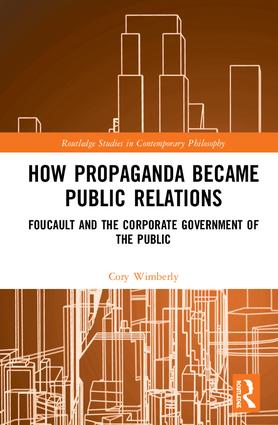
Cory Wimberly, How Propaganda Became Public Relations: Foucault and the Corporate Government of the Public (Routledge: New York, 2020).

How Propaganda Became Public Relations pulls back the curtain on propaganda: how it was born, how it works, and how it has masked the bulk of its operations by rebranding itself as public relations. Cory Wimberly uses archival materials and wide variety of sources — Foucault’s work on governmentality, political economy, liberalism, mass psychology, and history — to mount a genealogical challenge to two commonplaces about propaganda. First, modern propaganda did not originate in the state and was never primarily located in the state; instead, it began and flourished as a for-profit service for businesses. Further, propaganda is not focused on public beliefs and does not operate mainly through lies and deceit; propaganda is an apparatus of government that aims to create the publics that will freely undertake the conduct its clients’ desire.

Businesses have used propaganda since the early twentieth century to construct the laboring, consuming, and voting publics that they needed to secure and grow their operations. Over that time, corporations have become the most numerous and well-funded apparatuses of government in the West, operating privately and without democratic accountability. Wimberly explains why liberal strategies of resistance have failed and a new focus on creating mass subjectivity through democratic means is essential to countering propaganda.

This book offers a sophisticated analysis that will be of interest to scholars and advanced students working in social and political philosophy, Continental philosophy, political communication, the history of capitalism, and the history of public relations.

Contents
Introduction: From Propaganda to Public Relations

Chapter 1: What Does Propaganda Do?

Chapter 2: Propaganda Contra Liberalism

Chapter 3: The Art and Science of Controlling Minds: The Influence of Political Economy and French Royalism on Public Relations

Chapter 4: Governing Mr. and Mrs. Intelligence Quotient Minus: Lineages of Crowd Psychology in the Governmentality of Propaganda

Chapter 5: Crossing the Atlantic, Propaganda’s New Problematization for Corporate America

Chapter 6: Edward Bernays and the Interacting Forces That Govern Public Opinion

Chapter 7: Grappling With Propaganda Today

Author
Cory Wimberly is Associate Professor of Philosophy at the University of Texas Rio Grande Valley, USA

Razvan Amironesei and Caleb Scoville, Groundwater in California: From Juridical and Biopolitical Governmentality to a Political Physics of Vital Processes (2019) Theory, Culture and Society, 36 (5), pp. 133-157.
https://doi.org/10.1177/0263276419850277

Abstract
This article analyzes the emergence of a political rationality of groundwater in contemporary California. It contrasts a new government of nature that we call a ‘political physics of vital processes’, operative in the case of the Orange County Water District, with juridical and biopolitical rationalities of groundwater governance. To do so, we propose a genealogical account grounded in a reading of a key concept in Aristotle’s first book of Politics. The case is analyzed along the axes of subjectivity, space, and temporality, opening to a novel way of conceptualizing the relation between power and nature. © The Author(s) 2019.

Author Keywords
Aristotle; biopolitics; Foucault; government of nature; groundwater; political rationality; water

Gislason, M.K. (2013), West Nile virus: the production of a public health pandemic. Sociology of Health & Illness, 35: 188-199. doi:10.1111/j.1467-9566.2012.01535.x

open access

Abstract
The West Nile virus (WNV), as it was presented in the texts and discourses on the Public Health Agency of Canada’s (PHAC) website during its initial emergence, was an effect of the kinds of knowledge, techniques of power and disciplinary apparatuses that operate on that website and in society. With reference to Michel Foucault’s relations of power, this article offers an approach for translating theories of power into techniques and technologies of power that can be used to conduct a social construction discourse analysis, and gives examples from the use of surveillance, normalisation, exclusion and regulation in PHAC’s responses to the WNV epidemic in Canada. This study concludes with the assertion that shifting the ways in which social and political relations of power contour public health theories and practice is crucial. The present moment requires the development of global health responses to pandemics that are rooted less in the proliferation of apparatuses of control and more in epidemiological innovations and integrated, multi‐perspectival research approaches to infectious diseases research, and in the governance of pandemic control and prevention initiatives.