Foucault News

News and resources on French thinker Michel Foucault (1926-1984)

Matthew Hannah with Jan Simon Hutta and Christoph Schemann, Thinking Corona measures with Foucault, University of Bayreuth, 2020

The thoughts to follow have been formulated as a spur to discussion about some of the power relations manifested in state responses to the Covid-19 pandemic up to early April, 2020. While it touches themes covered by others, the essay is significantly longer and more detailed than most that have appeared at the time of writing. This is due to its pedagogical intent: it was conceived as a reading for a Masters seminar scheduled to take place in the summer of 2020. Its purpose is to introduce students to Foucault’s work in a tailored summary of his thinking on power relations, and to deploy Foucault’s ideas in a broad (and necessarily provisional) analysis of the current Corona crisis. Readers already familiar with Foucault’s analyses of power relations may wish to skip directly to Part II (page 16). In the interest of timely distribution, the essay has not been subjected to a comprehensive review process, only discussed internally by the three authors. Lacking complete access to notes and sources, the text is relatively thinly and unevenly sprinkled with citations to the academic literature. There is likewise no attempt to reference more than a handful among the hundreds of useful critical interventions that have been proliferating rapidly in recent weeks. Finally, it includes almost no specific citations of current reporting on the Corona situation. Familiarity with the unfolding of current events is simply assumed. All errors and omissions are the responsibility of the lead author.

Editor: With thanks to Progressive Geographies for this link

Foucault on the Coronavirus, Biopolitics, and the “Apparatus of Security”, Apr 5, 2020

critinq's avatarIn the Moment

Daniele Lorenzini

In a recent blog post, Joshua Clover rightly notices the swift emergence of a new panoply of “genres of the quarantine.” It should not come as a surprise that one of them centers on Michel Foucault’s notion of biopolitics, asking whether or not it is still appropriate to describe the situation that we are currently experiencing. Neither should it come as a surprise that, in virtually all of the contributions that make use of the concept of biopolitics to address the current coronavirus pandemic, the same bunch of rather vague ideas are mentioned over and over again, while other—no doubt more interesting—Foucauldian insights tend to be ignored. In what follows, I discuss two of these insights, and I conclude with some methodological remarks on the issue of what it may mean to “respond” to the current “crisis.”

Exif_JPEG_PICTUREThe “Blackmail” of Biopolitics

The first point that I would…

View original post 2,067 more words

COVID-19 Essays TOPIA: Canadian Journal of Cultural Studies, March 23, 2020

Editorial Introduction: Writing in the Midst of the COVID-19 Pandemic: From Vulnerability to Solidarity

This is a rapid response collection of essays. In the evening on Sunday, March 15 we began contacting Canadian-based scholars working in the field of biopolitics to write a short, biopolitically-inspired essay that critically interrogates some aspect of the COVID-19 outbreak. We sent a skeletal proposal to the editors of Topia and University of Toronto Press the following day. Our contributors had a tight time-line. They were asked to submit a draft by noon on Thursday, March 19. Each author was also responsible for reviewing and copy-editing at least two other essays that same evening. Revisions were due on Friday, March 20. Over the weekend the papers were copy-edited and the entire collection was sent into production on Monday, March 23. This was an incredibly tight schedule. A few of our contributors who joined us mid-week had even less time.

We ask the reader to bear with us—there may be mistakes, half-thoughts, even contradictory statements. The point of this exercise was to provide alternative perspectives on what is unfolding and to do so while early in the throes of an unfolding pandemic. We were writing in the midst of the event itself. Just like everyone else, we were totally immersed, captivated, fearing and panicking, and feeling vulnerable. None of our contributors purport to understand what is happening—it hasn’t fully happened yet—and we are all struck by a sense of uncertainty. But each has sought to uncover patterns, feelings, structures, even boxes, that are emerging in the human response to this pandemic. It will take much more time for us to figure out what has taken place, and will continue to take place, in the name of this pandemic, but this doesn’t mean that we should set aside our critical gazes. In fact, in a period of heightened panic the critical gaze is even more essential. Power structures are being radically re-arranged in our society right now and if we lose our capacity to criticize the future may be beset by new, even more damning ones.

Finally, given the context that we are not only writing about but also living this pandemic, it is important to note that the tight schedule we used led to a number of people having to decline our offer, at least for now. Not everyone has the luxury, social conditions, even frame of mind, that would enable them to participate in this project at this point in time. Many scholars do not have the privilege to immediately sweep clear a significant portion of their days to embark on a last-minute and time-consuming writing project. This is to say, we know there are important voices missing here, and it is our hope that, as the dust settles, we will be able to include them in our future efforts to interrogate the significance of this pandemic. The rapid production of essays also placed extra burdens on the editors of Topia and for the production staff at University of Toronto Press. For this, we are thankful, as they opened up a space for an experiment in critical response that has, we hope you find, borne important, if preliminary and provisional, fruit.

While acknowledging the realities of those who could not participate, we do not wish to negate the efforts of our contributors, or our editorial labours, because producing a collection of essays within such a short period of time is hard work under the best conditions. We weren’t writing under these conditions. Everyone who participated in this collection genuinely contributed and collaborated to produce the final product and the conversation it represents. Different skills were deployed for different tasks. We were all involved in different ways. Significantly, in undergoing this project together, we have been able to forge a sense of solidarity. What we have produced in this solidarity is what we offer to you here, reflections on the COVID-19 pandemic that attempt to make sense of it. We are not offering concrete policy solutions or practical advice about how to manage a pandemic. For our society is already exhausted by official and expert discourse. Rather, we consider what might be lost in this pandemic, but also what could be carried forth into the future, especially the traces of our current vulnerability.

Greg Bird & Penelope Ironstone
Monday, March 23, 2020

Essays:

1. Being in Common at a Distance by Elettra Stimilli

2. In the Distance by Philippe Theophanidis

3. Biopolitical Economies of the COVID-19 Pandemic by Jon Short

4. On Ways of Living in the Midst of the COVID-19 Global Pandemic (Three Brief Meditations) by John Paul Ricco

5. Crisis, Critique, and the Limits of What We Can Hear by Stuart J. Murray

6. The Pandemic is (Extra) Ordinary by Penelope Ironstone

7. The Biopolitics of Numbers by Victor Li

8. Uncanny Convergences: Mobility and Containment in the Time of Coronavirus by Roberta Buiani

9. Biomedical Apparatuses or Conviviality? by Greg Bird

10. Government-in-a-Box, or Understanding Pandemic Measures as Biopolitics by Neil Balan

Editor: I will be back to posting regularly soon.

Like most of the world, Australia is in its own version of national lock down. Conditions in Australia, and in particular in sub-tropical Queensland where I am located, are very easy in comparison to many other places around the globe. The government has acted fast in getting the disciplinary quarantine state (see Foucault) into gear and trying to mitigate the disastrous impact on people’s incomes and livelihoods and these measures are generally proving effective so far. (The current crisis is another very good argument for a universal basic income in my view.) The physical conditions of life here are also good (weather and space).

Nonetheless my own personal adjustments to the new situation (eg needing to source computer equipment to work and teach effectively from home and changing routines, etc) have led to some delays in posting news. Thank you to those of you who have sent me material. It will be up online soon. Please keep sending on your news!

In the meantime, although this is not directly related to Foucault’s work, I would like to link to some advice offered by Aisha S. Ahmad, an assistant professor of Political Science at the University of Toronto. This advice, although offered to fellow academics is useful to others as well.

Why You Should Ignore All That Coronavirus-Inspired Productivity Pressure, The Chronicle of Higher Education, 27 March 2020. (PDF in case you can’t access it)

I will be posting regularly again shortly. If anything, Foucault’s work is even more apposite in the current environment.

I wish all the readers of this blog health and safety in a difficult world.

Clare O’Farrell

Davies, H.M.
Living with asthma in 19th-century France: The doctor, Armand Trousseau, and the patient, Emile Pereire
(2020) Journal of Medical Biography, 28 (1), pp. 15-23.

DOI: 10.1177/0967772017741763

Abstract
Major advances in the French medical system following the French Revolution have stimulated a rich historiography of which Michel Foucault’s Naissance de la clinique: une archéologie du regard médical (1963) and Erwin H. Ackerknecht’s Medicine at the Paris Hospital, 1794–1848 (1967) are of lasting significance. Changes in the organisation and structure of hospitals accompanied the development and availability of new medical technologies and procedures and encouraged a more intense study of the aetiology and pathology of disease. Theories about asthma and its treatment profited from this dynamic environment as Classical Greek doctrines about the effect of the humours on bodily imbalance gave way to an increasingly more precise understanding of the nature and cause of asthma. The clinician and teacher, Armand Trousseau (1801–1867), who held the chair of Clinical Medicine at the Hôtel-Dieu in Paris and was himself an asthmatic, promoted new theories about the illness and developed innovative ways of dealing with its effects. Among his patients was the banker and financier, Emile Pereire (1800–1875), a lifelong asthmatic. Based on the Pereire Family Archives (hereafter AFP), the case of Emile Pereire provides a preface to the later case of that other, more famous, asthmatic, Marcel Proust. © The Author(s) 2018.

Author Keywords
Asthma; history; Pereire; Trousseau

Jones, D.R., Patton, D.
An academic challenge to the entrepreneurial university: the spatial power of the ‘Slow Swimming Club’ (2020) Studies in Higher Education, 45 (2), pp. 375-389. 

DOI: 10.1080/03075079.2018.1534093

Abstract
The entrepreneurial university is a vague notion that has evolved by applying the concepts of enterprise and entrepreneurship to a university context. The blurring of enterprise with entrepreneurship has allowed the entrepreneurial university to be increasingly underpinned by a managerialist discourse, typified by functionalisation and marketisation; culminating in academic disempowerment, dissatisfaction and subsequent disengagement. In response to such dissatisfaction, this paper reflects on a playful space, called the Slow Swimming Club (SSC), produced by several academics. The research takes a collective auto-ethnographic approach and employs Foucault’s heterotopology, as a conceptual frame, to understand the collective impact of this SSC entrepreneuring space. We relate the disconnection of the SSC to the process of critically connecting academics, back to their universities and consider whether such academic resistance, rooted in play, corporeal sensibility and emancipation, has the potential to enact social change and enhance entrepreneurial potential.

Author Keywords
Academic management;  British higher education;  entrepreneurial architectures;  ethnography research;  liminal spaces

Editor: Many thanks to Mauro Bertani for alerting me to this compendium of links on the La Scuola di filosofia di Trieste site.

Speciale Coronavirus

Segnaliamo qui una serie di articoli interessanti che riflettono sulla situazione che stiamo vivendo in questi giorni.

Furman, C.E.
Interruptions: Cultivating Truth-Telling as Resistance with Pre-service Teachers
(2020) Studies in Philosophy and Education, 39 (1)

DOI: 10.1007/s11217-019-09681-0

Abstract
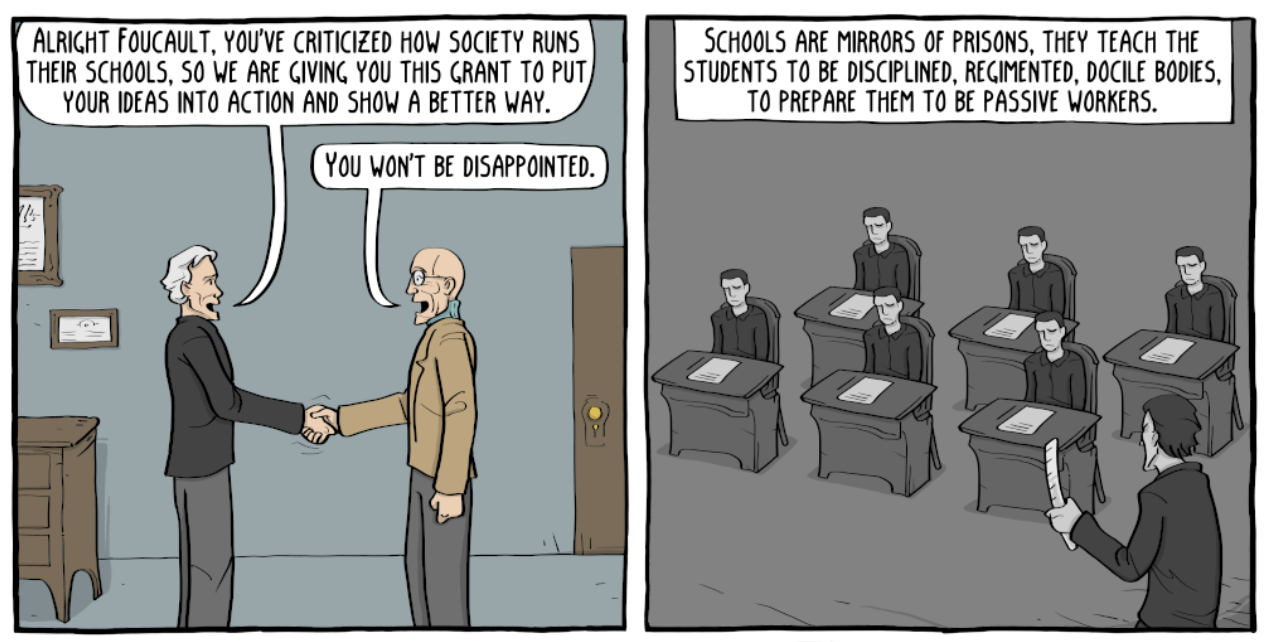
As ethical agents, teachers regularly must decide whether compliance to rules and norms is in the best interest of their students. Yet, teachers in the United States are educated to be passively obedient. In this paper, I argue that part of pre-service teacher education ought to learn ways of resisting. I describe one approach to verbal resistance, what Michel Foucault calls Truth-Telling. Building on a qualitative self-study with pre-service teachers, I explain how a form of team-teaching called Interruptions can promote Truth-Telling. © 2019, Springer Nature B.V.

Author Keywords
Foucault; Interruptions; Resistance; Teacher education; Truth-Telling

Editor: A very useful – and growing – list of references put together by Stuart Elden on the Progressive Geographies blog. I have now added a new “Pandemic” category to Foucault News.

Geographers, sociologists, philosophers etc. on covid-19

Several A few pieces by geographers, sociologists and philosophers – presented without commentary.

First posted 24 March 2020; last updated 27 March 2020. Thanks to those who have sent additional ones, especially Michael O’Rourke.

A much more extensive, chronologically ordered, and five-language list is available from The Thomas Project.

[…]