Foucault News

News and resources on French thinker Michel Foucault (1926-1984)

From Citizens to Patients: A Threat to Resist.
Pandemic Lectures at the the International University College of Turin- Ugo Mattei & Federico Soldani,
May 4, 2020

The decline of law as a tool for social control and its supplanting by technological, mental, and medical management aimed at preventing deviant behavior, with nary a concern for such substitution’s deleterious effects.

Other interesting lectures in the series can be found here

Matthew G. Hannah, Jan Simon Hutta and Christoph Schemann, Thinking Through Covid-19 Responses With Foucault – An Initial Overview, Antipode online, 5 May 2020 (Department of Geography, University of Bayreuth)

Open access

This intervention originally appeared as the second half of a longer essay intended as a basis for discussion in a Masters seminar at our university (original essay available here). It has been revised and updated for publication on AntipodeOnline.org The first part of the longer essay is an extended overview of Foucault’s analyses of power relations. As this background is not included in what follows, readers lacking a basic familiarity with the concepts of “sovereignty”, “discipline”, “biopower”, “biopolitics” and “governmentality” as these have been understood in the literature building on Foucault’s work are encouraged to consult Part I of the original version (or any of the numerous excellent book-length overviews of Foucault’s thoughts on power relations such as Dean 1999; Deleuze 2006; Elden 2017; Lemke 2019).

Over the last months, there has been a true explosion of critical scholarly contributions aimed at making sense of the political responses to the Covid-19 pandemic. Not only is the multiplicity of interventions and contributions that have been made at a global scale increasingly hard to track, writing during a pandemic also risks illuminating pre-established theoretical frameworks more than the unfolding events themselves. This is especially true where theorists use the pandemic as “raw material for metaphysical speculation”, as Warwick Anderson (2020) has pointed out with respect to authors such as Giorgio Agamben and Slavoj Žižek. It is our conviction that some of the ideas of Michel Foucault, whose methodology has always been oriented towards differentiated empirical and historical analysis rather than abstract theorization, can avoid this danger while illustrating possibilities for making detailed sense of ongoing events.

read more

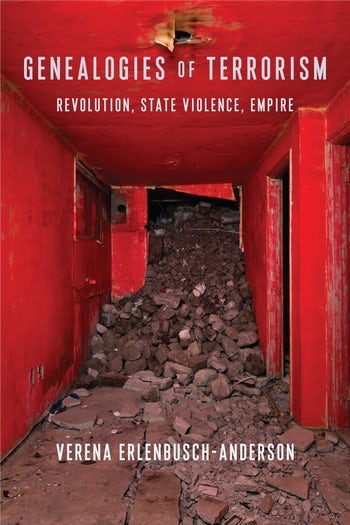
Verena Erlenbusch-Anderson, Genealogies of Terrorism: Revolution, State Violence, Empire (New Directions in Critical Theory), Columbia University Press (July 31, 2018), 296pp, ISBN-13: 978-0231187275

What is terrorism? What ought we to do about it? And why is it wrong? We think we have clear answers to these questions. But acts of violence, like U.S. drone strikes that indiscriminately kill civilians, and mass shootings that become terrorist attacks when suspects are identified as Muslim, suggest that definitions of terrorism are always contested. In Genealogies of Terrorism, Verena Erlenbusch-Anderson rejects attempts to define what terrorism is in favor of a historico-philosophical investigation into the conditions under which uses of this contested term become meaningful. The result is a powerful critique of the power relations that shape how we understand and theorize political violence.

Tracing discourses and practices of terrorism from the French Revolution to late imperial Russia, colonized Algeria, and the post-9/11 United States, Erlenbusch-Anderson examines what we do when we name something terrorism. She offers an important corrective to attempts to develop universal definitions that assure semantic consistency and provide normative certainty, showing that terrorism means many different things and serves a wide range of political purposes. In the tradition of Michel Foucault’s genealogies, Erlenbusch-Anderson excavates the history of conceptual and practical uses of terrorism and maps the historically contingent political and material conditions that shape their emergence. She analyzes the power relations that make different modes of understanding terrorism possible and reveals their complicity in justifying the exercise of sovereign power in the name of defending the nation, class, or humanity against the terrorist enemy. Offering an engaged critique of terrorism and the mechanisms of social and political exclusion that it enables, Genealogies of Terrorism is an empirically grounded and philosophically rigorous critical history with important political implications.

ABOUT THE AUTHOR
Verena Erlenbusch-Anderson is assistant professor of philosophy at Syracuse University.

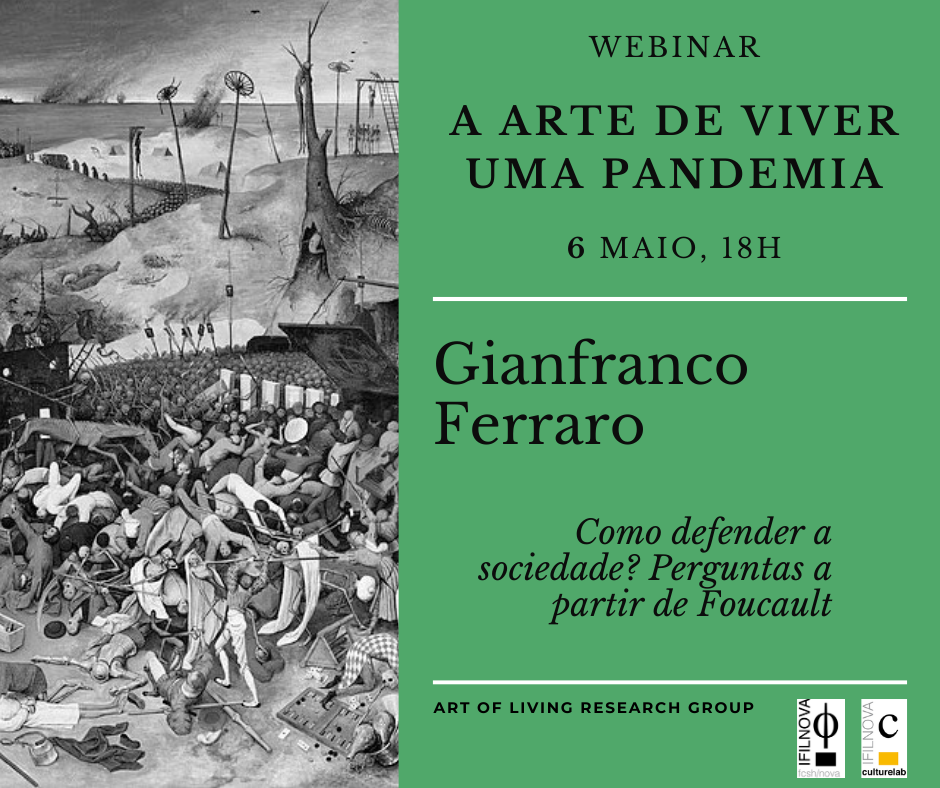
An “Art of living research group” event at the New University of Lisbon, focusing on a foucaultian perspective on the pandemic will take place at 18:00h on 6 May 2020.

The webinar” is free and available after registration at: art.of.living.researchgroup@gmail.com

stuartelden's avatarProgressive Geographies

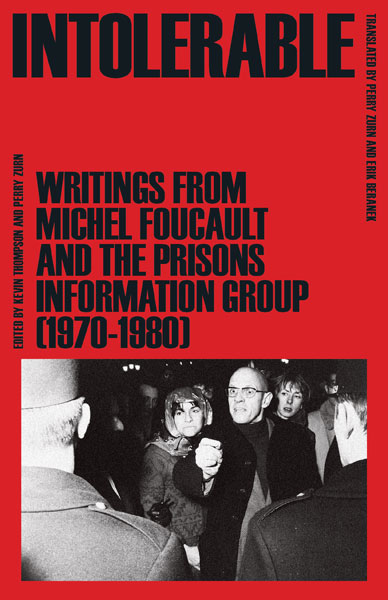
imageIntolerable: Writings from Michel Foucault and the Prisons Information Group (1970–1980), edited by Kevin Thompson and Perry Zurn, University of Minnesota Press, December 2020

Founded by Michel Foucault and others in 1970–71, the Prisons Information Group (GIP) circulated information about the inhumane conditions within the French prison system. Intolerable makes available for the first time in English a fully annotated compilation of materials produced by the GIP during its brief but influential existence, including an exclusive new interview with GIP member Hélène Cixous and writings by Gilles Deleuze and Jean Genet.

These archival documents—public announcements, manifestos, reports, pamphlets, interventions, press conference statements, interviews, and round table discussions—trace the GIP’s establishment in post-1968 political turmoil, the new models of social activism it pioneered, the prison revolts it supported across France, and the retrospective assessments that followed its denouement. At the same time, Intolerable offers a rich, concrete exploration of Foucault’s…

View original post 65 more words

Anne Sauka (2020). The Nature of Our Becoming: Genealogical Perspectives. Le Foucaldien, 6(1), 4.
https://doi.org/10.16995/lefou.71 [Note: In 2022, Le foucaldien relaunched as Genealogy+Critique.]

Open access

Abstract
In the light of Philipp Sarasin’s work in Darwin und Foucault: Genealogie und Geschichte im Zeitalter der Biologie, the article delineates a genealogically articulated naturally produced culture and a cultured nature and discusses the genealogical implications of a carnal, becoming self in a world that could rightly be justified “as an aesthetical phenomenon.” The article demonstrates the historicity and processual materiality as a conceptual platform for a combination of the notions of experienced carnality and a socially constructed body, demonstrating such a historically embedded carnal body as a binding agent for the “social constructivist” and “biologist” approaches in sciences. Thus, the article builds a framework for the articulation of senseful, processual materiality on the backdrop of a nature-culture continuum via genealogy, suggesting the necessity for change of tone in the communication of human and life sciences via the understanding of a culturally endowed biology.

Keywords: genealogy, nature, culture, carnal body, becoming

stuartelden's avatarProgressive Geographies

Elden-10The second part of my interview with Jonas Knatz and Anne Schult for the Journal of History of Ideas blog is now available – “Foucault Was Always Much More Circumspect”: Stuart Elden on Foucault’s Politics and the Rediscovery of His Early Years

In this part I discuss Foucault’s political activism, the relation of lecture courses and notes to his publications, his collaborative research projects, working with archives and how I use this blog. The final chapter discusses the research for The Early Foucault. Part 1 of the interview is here.

View original post

Daniele Lorenzini and Martina Tazzioli, Critique without ontology Genealogy, collective subjects and the deadlocks of evidence, Radical Philosophy, 2.07 (Spring 2020)

Open access

In the past few years, the number of migrant deaths in the Mediterranean Sea has dramatically increased due to the strengthening of border controls and a deliberate politics of migration containment put into place by the EU in cooperation with third countries. In 2018, according to UN Refugee Agency [UNHCR] estimations, an average of six migrants died at sea every day, trying to cross the Mediterranean from Libya. These figures do not take into account the so-called ‘ghost shipwrecks’, that is, the number of people who died in ships that simply sank without being detected by the authorities. During these years, the Mediterranean Sea as a space of governmentality has been the object of multiple readjustments.

[…]

Our aim in this paper is to defend, develop and redeploy this specific, Nietzschean-Foucauldian mode of critique. In fact, the idea that (debunking) critique is pointless and that it should be replaced by the task of bringing evidence, with a view to describing (and possibly denouncing) things as they are, risks, we argue, obscuring the crucial role that critique can still play in contemporary society as a movement of contestation of the regimes of truth that govern us – and of transformation of the truth-power-subjects nexus on which they rely.

[…]

Editor: I’m constantly surprised by the contexts in which Foucault’s name pops up.

Sailing as an essential activity
Published on April 30th, 2020
by Darrell Nicholson, Practical Sailor, Scuttlbutt Sailing news (Florida, USA)

Let’s take away all the boats. Not the ships engaged in essential commerce, not the barges hauling goods, not the net boats catching fish. Keep those. And the Navy, of course, keep that. But all the rest can go.

Now, imagine as we look out over the waterfront we see no skiffs on the bay, no dinghies along the shore, no sloops or schooners on a sunset sail. This arrangement, if it persists, could have dire consequences—at least if you believe French philosopher Michel Foucault:

“In civilizations without boats, dreams dry up, espionage takes the place of adventure and the police take the place of pirates.”

Some, like Pompey the Great (as quoted by Plutarch), put sailing above even life itself. “To sail is necessary; to live is not.”

[…]

As summer fast approaches and COVID-19 persists as a threat, coastal communities, sailing clubs, schools, and camps around the country are asking the same question: Must our boating activities be curtailed, and if they are to continue, what measures are necessary to ensure public health?

The situation is changing, but at the time of this writing, the boat ramps around our homeport in Sarasota, Florida were opening up again. All state municipalities have banned gatherings of boaters on sandbars and on-the-water events that might draw a crowd—although some impromptu two-boat “regattas” will likely spring up (as they tend to do whenever another sail appears on the horizon).

[…]