
Foucault News

News and resources on French thinker Michel Foucault (1926-1984)

Foth, T. (2020). Humanitarian reason and the movement for overdose prevention sites: The NGOization of the Opioid “Crisis”. Nursing Philosophy, First published: 11 August 2020
doi:10.1111/nup.12324

Abstract
In August 2017, a group of activists erected in Ottawa’s downtown a tent as a first overdose prevention site as a response to what the public and the activists perceived as an epidemic—a devastating wave of opioid and fentanyl overdoses in Canada. The Ontario premier was urged to declare an emergency that would provide increased funding for harm reduction and also send a message to survivors and families that the lives of their loved ones mattered. Thus, the discourses around the so‐called opioid crisis used a language of moral sentiments to legitimate political action. This “new humanitarianism” is considered a priori as good, but in this article, I ask what is politically at stake if we base our actions on the logic of humanitarian reason. The new universalism of humanitarian organizations is based on the individualism of human rights and thus on a moral imperative that replaces the political. Initiatives like the OPS movement often fill the gaps in social services in the absence of the state and address social problems as emergencies and public health issues, thereby transforming them into medical problems—performing the medicalization of sociopolitical problems. This is what I call the NGOization of the opioid crisis. This form of humanitarianism is a universalism of the temporal present without any universal promise for a better future or the amelioration of human conditions—it is a humanitarianism of emergency. What characterizes new humanitarianism is that it responds to situations of suffering that are the result of increasing inequality and injustices without addressing the root causes of this suffering. Not addressing these causes means to be complicit in perpetuating the inequalities and to restrict visions of possible alternatives.

Gillespie, L.
Laws of Inclusion and Exclusion: Nomos, Nationalism and the Other (2020) Law and Critique, 31 (2), pp. 163-181.

DOI: 10.1007/s10978-020-09264-w

Abstract
This article explores how and why contemporary nationalist ‘defence leagues’ in Australia and the UK invoke fantasies of law. I argue these fantasies articulate with Carl Schmitt’s theory of ‘nomos’, which holds that law functions as a spatial order of reason that both produces and is produced by land qua the territory of the nation. To elucidate the ideological function of law for defence leagues, I outline a theory of law as it relates to (political) subjectivity. Drawing on the work of Foucault, Agamben and Brown, I demonstrate how subjects form and are formed by historically contingent relationships to law in the contemporary neo-liberal moment. Turning to Lacan, I show how nationalistic invocations of law provide nationalists with a fantasy that the nation’s law represents them and holds them together (as the nation itself). Similarly, I argue that nationalists imagine that the other has their own law as well, which not only corresponds to the other, but functions as a legible index of the other’s otherness—a metonym for the threatening uncertainty and radical difference that the other represents. Drawing on Lacan’s concept of the big Other, I ultimately argue that nationalists aggressively (re)assert law not only to defend the nation, but to ensure their own symbolic and ontological security therein. © 2020, Springer Nature B.V.

Author Keywords
Defence nationalism; Foucault; Lacan; Law; Neo-liberalism; Nomos

Kester, J.
Security in transition(s): The low-level security politics of electric vehicle range anxiety
(2019) Security Dialogue, 50 (6), pp. 547-563. Cited 1 time.

DOI: 10.1177/0967010619871443

Abstract
By drawing on critical security studies in the context of a sociotechnical transition, this article calls for more attention to the presence and sometimes alternative use of mostly unobserved security practices in the materialization of everyday consumer goods and services. This call is illustrated through a discussion of the phenomenon of range anxiety and the intra-action between drivers of electric vehicles (EVs), designers, and algorithms that observe, estimate and nudge the remaining range of an EV. Inspired by Foucault and Barad, the range-anxiety discussion offers four alternative security insights. First, it supports an argument to include stress as an embodied instance of insecurity. Second, it draws attention to a security apparatus that is based on a constantly expanding assemblage around range estimates. Third, it shows how this apparatus rests on a novel algorithm that has a continuous instead of a binary output and is governed by a distributed sovereignty: where the driver simultaneously is the object of measurement, subject of governance for more efficient driving and the ultimate sovereign who decides on the trip. Lastly, the discussion highlights how range estimates not only mediate the materialization of EVs and their automobility but also (re)perform epistemological or ontological forms of uncertainty. © The Author(s) 2019.

Author Keywords
Algorithm; electric vehicles; insecurity; observation; range anxiety; security apparatus

Sarah Pedigo Kulzer & Ryan Phillips, Those Who Must Die: Syrian Refugees in the Age of National Security (2020) Human Rights Review, 21 (2), pp. 139-157.
https://doi.org/10.1007/s12142-020-00582-1

Abstract
The purpose of this study is to deconstruct the language used in President Trump’s Facebook posts while on the campaign trail, and the subsequent comments which reiterate and reify this rhetoric, to understand how Syrian refugees are labeled as a dangerous population unworthy of asylum. By utilizing the theoretical groundwork of Foucault (1980), Agamben (2005), and Mbembe (Public Culture 15: 11–40, 2003), this qualitative content analysis will explore how Syrian refugees, as depicted by Facebook comments, represent a “disposable population.” We conclude that by reducing Syrian refugees to a sub-human status and representing them as the dangerous and unworthy other, both President Trump who initiated this rhetoric, and those who responded in a way which legitimized his views, effectively labeled Syrian refugees as a dangerous population unworthy of asylum within the USA. © 2020, Springer Nature B.V.

Author Keywords
Biopolitics; Blowback; Disposable population; State of exception

Craig Wight, A.
Visitor perceptions of European Holocaust Heritage: A social media analysis (2020) Tourism Management, 81, art. no. 104142.

DOI: 10.1016/j.tourman.2020.104142

Abstract
This study presents a netnographic discourse analysis of social media content generated around three high profile European Holocaust heritage sites: Ann Frank’s House in Amsterdam, The Auschwitz-Birkenau Memorial and Museum in Poland, and the Jewish Museum in Berlin, Germany. It identifies four salient discourses under the headings of Holocaust heritage as social memory, reactions to Holocaust heritage, obligation and ritual, and transgressive visitor behaviour which frame the values, existential anxieties, emotions, priorities and expectations of visitors. The findings will be of interest to stakeholders involved in the planning and management of Holocaust heritage since they provide unique access to a synthesis of unmediated visitor feedback on European Holocaust heritage experiences. © 2020

Author Keywords
Dark tourism; Discourse analysis; European holocaust heritage; Foucault; Netnography; Social media

Index Keywords
heritage tourism, museum, perception, social media, tourism development, tourism management; Berlin, Germany

Bhattacharya, S.
Monsters in the dark: the discovery of Thuggee and demographic knowledge in colonial India
(2020) Palgrave Communications, 6 (1), art. no. 78.

DOI: 10.1057/s41599-020-0458-8

Open access

Abstract
The thugs have been one of the most lasting images in the portrayal of India in Western imagination. Although several scholars have questioned the authenticity of the information contained in the thug archive, that is, the corpus of colonial knowledge about the thugs, Martine van Wœrkens and Tihanyi (The strangled traveler: colonial imaginings and the thugs of India. University of Chicago Press, Chicago, 2002) and Macfie (Rethinking Hist 12(3):383–397, 2008) argue that the very phenomenon as it was known to the British, was an orientalist construct. However, though the orientalist and romantic genesis of the thug imagery has been well established, the precise nature, reasons, and implications of the same largely remain “terra incognita”. This article examines the discovery of the thugs and analyzes parts of the thug-archive through the concept of the monster as elaborated by Mary Douglas (Purity and danger: an analysis of concepts of pollution and taboo. Routledge, New York, 1966), Victor Turner (“Betwixt and between: the liminal period in rites de passage”. The forest of symbols. Ithaca, NY: Cornell University Press, 1967) and Michel Foucault et al. (Abnormal: lectures at the Collège de France, 1974–1975. Picador, New York, 2003), and establishes the thug as an epistemological monster emerging from the cracks and gaps in colonial information gathering mechanisms that arose as a result of the changing nature of the Indian “state” and the employment of alien categories for demographic knowledge production. The key question here is: how can we explain the sudden appearance of thugs in the colonial archive in the 1830s and the disproportionate interest of the administration in eradicating them? This article analyzes the journalistic and legal discourse surrounding the thugs in the nineteenth century and tries to demonstrate how the notion of the “monster” can act as a methodological tool in explaining the efforts of the Thug Department. The argument is then concluded through an investigation into the implications of the discovery of the thugs for the teleology of Indian history and the consequence of “othering” tribal and other anomic populations in the new Weberian state that the colonial and post-colonial regimes envisioned to establish.

stuartelden's avatarProgressive Geographies

Two interesting reviews of my books in Thesis ElevenMitchell Dean reviews Foucault’s Last Decade and Ben Golder’s Foucault and the Politics of Rights; and Peter Beilharz reviews Foucault: The Birth of Power. Both reviews require subscription, unfortunately.

FLD coverDean is generous in his praise, but also points out some things the book does not do. A couple of passages should give an indication of both arguments:
A condition of answering these questions is that we should know what he said. Stuart Elden’s book presents itself as a detailed intellectual history of his project of a history of sexuality that occupied much, but not all, of his last decade. It is an exhaustive and dense account of everything Foucault said and wrote during this time, including material still unpublished, and is based on prodigious research. As a kind of advanced intellectual primer, it works very well, particularly for the…

View original post 576 more words

Danisha Jenkins, Dave Holmes, Candace Burton, Stuart J. Murray, ‘This Is Not a Patient, This Is Property of the State’: Nursing, ethics, and the immigrant detention apparatus (2020) Nursing inquiry, p. e12358.
https://doi.org/10.1111/nin.12358

Abstract
This paper opens with first-hand accounts of critical care medical interventions in which detainees, in the custody of U.S. Immigration and Customs Enforcement (ICE), are brought to the emergency department for treatment. This case dramatizes the extent to which the provision of ethical and acceptable nursing care is jeopardized by federal law enforcement paradigms. Drawing on the scholarship of Michel Foucault and Giorgio Agamben, this paper offers a theoretical account of the power dynamics that inform the health care of patients who find themselves caught in the custodial scaffolding of a vast immigration and detention apparatus. It offers an analysis of the display of sovereign and biopolitical power over the lives (and deaths) of detainees (Foucault), as well as the ways these individuals are reduced to “bare life” under the political pretext of an emergency or “state of exception” (Agamben). Our purpose here is both theoretical and practical: to better understand the often hidden agency or impersonal “will” exercised by the immigrant detention system, but also to equip clinicians in these and cognate facilities (e.g., prisons) with the critical tools by which they might better navigate incommensurable paradigms (i.e., care vs. custody) in order to deliver the best care while upholding their ethical duties as a care provider. This is all the more pressing because hospitals are not sanctuaries and given the incursion of federal law enforcement agents, nurses may find themselves conscripted as de facto agents of the state. © 2020 John Wiley & Sons Ltd.

Author Keywords
critical theory; ethics; foucault; politics; professional issues

Garrett, P.M.
Faulty ‘tools’? Why social work scholarship needs to take a more critical approach to Michel Foucault
(2020) Journal of Social Work, 20 (4), pp. 483-500.

DOI: 10.1177/1468017319830538

Abstract
Summary: Having outlined Foucault’s articulation of power and governmentality, the article critically explores attempts to translate the philosopher’s theorisation into social work. Findings: After briefly referring to Jacques Donzelot’s work and that of other writers, it is argued that Foucault’s conceptual ‘tools’ are problematic for those seeking to promote critical approaches within the field of social work. Those influenced by Foucault’s complex contributions may amplify a defective understanding of power which unduly emphasises ‘soft’ power and neglects the continuing significance of hierarchical and coercive power. This is reflected in Foucault’s analysis of the state and, at a micro level, his remarks on sexualised interactions involving adults and children. Efforts to ‘apply’ Foucauldian reasoning within social work may also risk promoting politically passive forms of theory and practice. Applications: Contributing to the discipline’s literature on Foucault, the article maintains the social work scholarship has much to gain by engaging with work, but this engagement might aspire to become more critical. © The Author(s) 2019.

Author Keywords
critical social theory; Foucault; governmentality; power; Social work

Index Keywords
adult, article, child, human, human experiment, male, neglect, social work, sociological theory

stuartelden's avatarProgressive Geographies

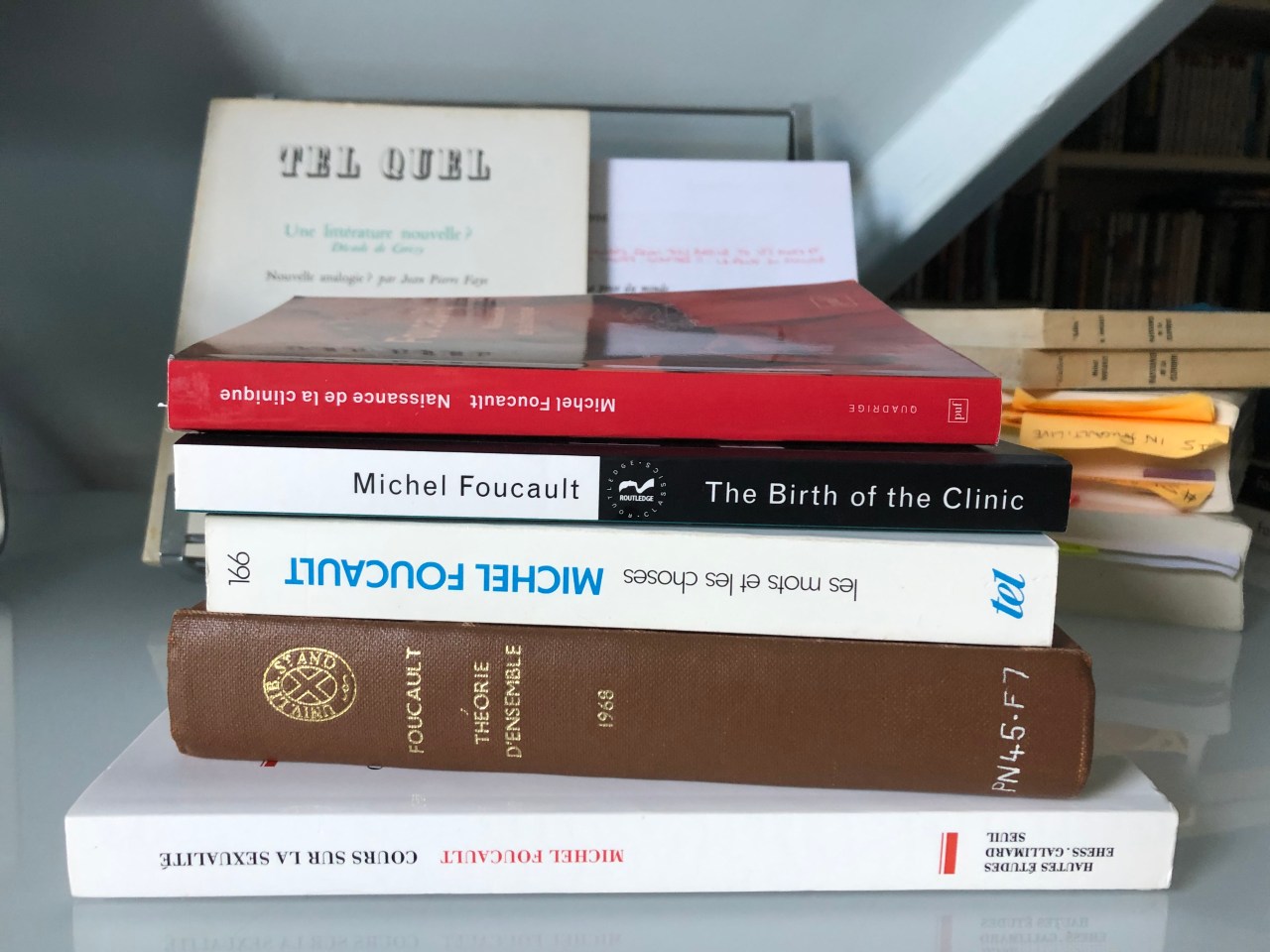
IMG_3457.jpg

While I continue to find focus a challenge as the world lurches from one crisis to another, I’ve been doing various bits of work for this book on Foucault’s work in the 1960s.

I continued work on the comparison of the first and second editions of Naissance de la clinique. I now have a completely annotated version of the text, with all the changes, large and small, marked up. The next stage was working through the English translation The Birth of the Clinic, seeing how Sheridan got from the French to the English. This is not yet a question of how he translated, but of what he translated. Given that Sheridan switches between editions, without any obvious reason, there are places where his English matches neither text published by Foucault. But in doing this initial comparison I realised that the most recent edition of the English translation…

View original post 1,054 more words