
Foucault News

News and resources on French thinker Michel Foucault (1926-1984)

Lee, S. F. (2020) Governing ‘disadvantage’ through funded early years places and reconfigured spaces. Journal of Early Childhood Research, Online December 11

DOI: 10.1177/1476718X20971322

Abstract:
This article examines how the policy of funded early years places for ‘disadvantaged’ 2-year-olds (FNP) in England reconfigures spaces within early childhood and care (ECEC) in new ways of working with young children. Using practitioners’ interview data from early years settings in London, this article uses Foucauldian technologies of governmentality to shed light on how FNP responds to the problem of ‘disadvantage’ as new mobile modes of governance. The paper explores how practitioners reconfigure their established spaces to incorporate provision and practice suitable for 2-year-olds and the challenges practitioners face in implementing the policy. The analysis considers ‘space as assemblage’ by focusing on three key themes: dividing spaces through split rationality, dividing practices through othering and the reconfiguration of established ways of working. The themes trace how policy-driven technologies re-interpret ECEC in narrow and alternative ways by making a set of practices possible, engendering new pedagogical relationships. This article highlights the complex conditions of (im)possibility for ‘doing’ ECEC under austerity. When viewed in the broader context, policy reforms are increasingly reaching into ECEC as strategic spaces for new modes of governing, sustained by a global agenda in neoliberal education reforms.

Keywords
2-year-olds, early childhood education and care, educational disadvantage, Foucault, funded nursery places, governmentality, policy, technology
Moore, Alison Downham (2020), Foucault’s Scholarly Virtues and Sexuality Historiography. History, 105: 446-469.

DOI: 10.1111/1468-229X.13015

Abstract
This article looks at why many historians of sexuality appear dissatisfied with the level of theoretical precision in the field by considering the reception of Foucault’s approach and why some parts of it have been more difficult to assimilate within the historical discipline than others. It proposes that Foucault has been only partially understood by most historians of sexuality, with the result that the properties of his unique disciplined ascesis have been under‐considered. The article argues that Foucault shared many of the critical and ethical goals that are inherent to certain types of historical writing, noting where he diverged from them in ways that have problematised his reception among sexuality historians. It argues that Foucault’s own ascesis or ‘transformation of self’ as an intellectual might be better appreciated as a unique set of scholarly virtues expressed in his concerns about teleology, presentism, and the critical practice of ‘history of the present’ that characterise his work on sexuality.

Michel Foucault, Interview with Madeleine Chapsal, The Journal of Continental Philosophy Translated by Mark G. E. Kelly, Volume 1, Issue 1, 2020, Pages 29-35
https://doi.org/10.5840/jcp2020876

Open access

Abstract
In this 1966 interview, published here in English translation for the first time, Michel Foucault positions himself as a representative of a ‘generation’ of French thinkers who turned towards the analysis of ‘structures’ and away from the phenomenological approaches that had previously dominated French philosophy. In this, Foucault claims inspiration not only from older French scholars—namely Georges Dumézil, Jacques Lacan, and Claude Lévi-Strauss—but also from the science of genetics.

Asl, M.P.
Spaces of change: Arab women’s reconfigurations of selfhood through heterotopias in Manal Al-Sharif’s daring to drive
(2020) Kemanusiaan, 27 (2), pp. 123-143.

DOI: 10.21315/KAJH2020.27.2.7

Open access

Abstract
Stereotypically depicted as unresisting and passive victims of oppressive power, Saudi women are generally considered as unable to effect changes to the patriarchal sociopolitical status quo. This article studies the Saudi woman life writer Manal al-Sharif’s Daring to Drive (2017) to demonstrate the various ways in which the subjugated women instigate social transformations by resisting against the prevailing male dominated system. To this end, Michel Foucault’s theories on “other spaces” are employed to examine the function of spatial modalities in the workings of the dynamics of power. It is argued that the portrayed female subjects re-construct, re-experience and re-utilise different spaces to re-invent new identities and galvanise alternative ways of life. The analysis reveals that within the emancipatory space of the Internet, Saudi women produce heterotopias of transgressions, resistance and utopianism to unsettle the prescribed boundaries of male-female relations, protest against the impositions of gender performance in public spheres and creatively re-imagine an alternative, desirable order of things. Hence, the study arrives at two conclusions: first, Saudi women’s individual urgency for self-transformation have generated major social changes and ideological reconfigurations, resulting in many of the recent democratic developments in the country; second, space is not merely a normalised and rationalised construct, but can function as a normalising and transformative force at the same time. © 2020 Penerbit Universiti Sains Malaysia. All rights reserved.

Author Keywords
Heterotopia; Manal al-Sharif; Michel Foucault; Saudi women; Transformation

Abtahi, Y., Barwell, R.
Who are the actors and who are the acted-ons? An analysis of news media reporting on mathematics education (2020) Mathematics Education Research Journal

DOI: 10.1007/s13394-020-00358-3

Open access

Abstract
While there are several studies analysing how mathematics education is portrayed in news media discourses, there has been little examination of the construction of different stakeholders (e.g. teachers, parents, curricula). In this paper, we report our analysis of a corpus of Canadian newspaper reports on mathematics education, focusing on the underlying construction of different stakeholders. Drawing on Foucault’s notion of regimes of truth, we show how news media construct a “truth” that portrays different stakeholders as either actors or acted-ons working for or against individual or national mathematical performance. We explain these findings with reference to the general media framing of mathematics education in the corpus. © 2020, The Author(s).

Author Keywords
Acted-ons; Actors; Foucault; Mathematics education; News media

Eloise Govier, Power and all its guises. Environmental determinism and locating ‘the crux of the matter’ (2020) Archaeological Dialogues, 27 (2), pp. 173-176.
https://doi.org/10.1017/S1380203820000215

Abstract
Can we theorize the relationship between discourses that antagonize each other? In a recent article, Arponen et al. demonstrate the tension between two different research models, and spotlight the compelling impact these methods have on archaeological interpretation. In response to their observations, this paper theorizes how we can understand the position of the researcher in relation to the events they analyse. Using Michel Foucault’s approach to the ‘discursive formation’ and Karen Barad’s theory of agential realism, in this reaction I argue that focusing on a single and most important point (the crux) is problematic, and theoretically outline how creating conceptual space for polymorphous causality can aid the analysis of a ‘dispersion of events’. © 2020 The Author(s). Published by Cambridge University Press.

Author Keywords
agential realism; Causality; discourse; discursive formation; environmental determinism; rupture

Index Keywords
archaeology, conceptual framework, power relations, research work, theoretical study

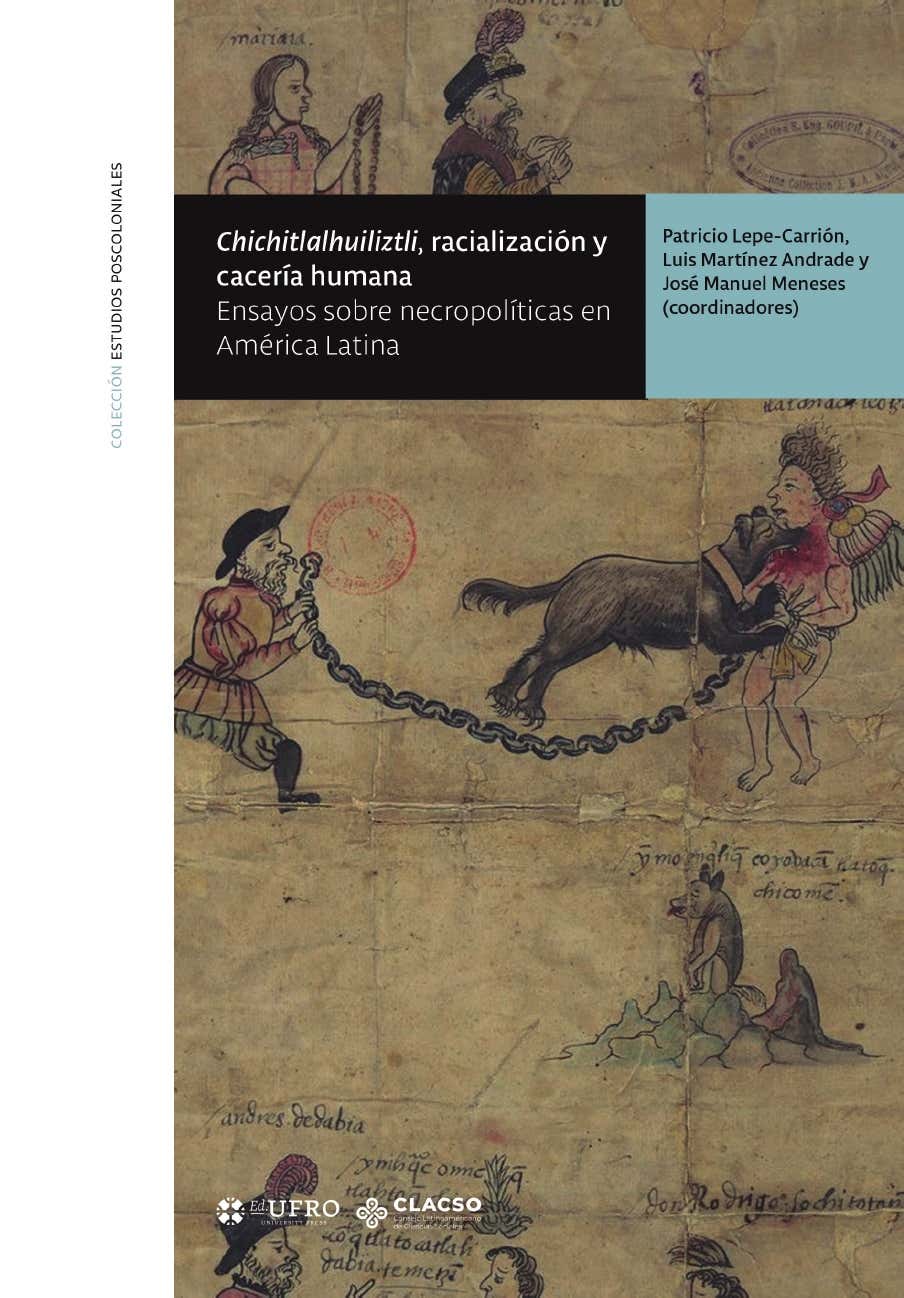
Lepe-Carrión, P.; Martínez Andrade, L.; Meneses, José M. (2020). “Chichitlahuiliztli, racialización y cacería humana. Ensayos sobre necropolíticas en América Latina”. Ediciones Ufro-CLACSO, 2020

Open access

Prológo
Cuando iniciamos el proyecto de este libro, nos dimos cuenta de que en los países con un pasado colonial la violencia se dice de muchas formas, las cuales como carne y cicatriz han quedado inscritas tanto en el registro histórico como en el pulso del presente. Ocultas en la lejanía del pasado, e inscritas en la naturalidad del presente, suelen presentarse como independientes de toda causalidad histórica y de toda articulación sistemática, carentes de unidad y sin posibilidad de encontrar la lógica y la racionalidad que las promueve. Como si se tratara de acontecimientos aislados, propios de las condiciones económicas y sociales que determinan a nuestros países y fueran resultado del comportamiento y las acciones, siempre insuficientes, de nuestra gente. Ya pasado un tiempo, y luego de una serie de eventos sociales, políticos, pero también personales que ralentizaron el proceso editorial, hemos sido testigos en América Latina (y en el mundo entero) de los procesos históricos más intensos de las últimas décadas. Paradójicamente, donde las políticas de la muerte han hecho su aparición de la forma más grotesca. Nos entristece, en cierta forma, dar curso a un trabajo académico como este, en un contexto donde las condiciones vitales de gran parte de la humanidad están siendo vulneradas; pero, por otro lado, sentimos cada vez más necesario que el trabajo intelectual sea un fiscalizador y denunciante permanente de las prácticas de gobierno que establecen los marcos de la excepcionalidad.

Consideramos que podemos rastrear —en parte— la complejidad de las causas que provocan las mil formas de la muerte, a través de un pensamiento crítico, que indaga y cuestiona, desde su núcleo, a la modernidad/colonialidad y sus consecuencias.

Para denunciar la vigencia de la necropolítica, nos dimos a la tarea de reunir diversas lecturas acerca de la obra del pensador camerunés Achille Mbembe, como punto de partida para emprender un trabajo de esta naturaleza. Así pues, el ejercicio que nos ocupa lleva al aparato conceptual del filósofo a confrontarse con diversas latitudes; su fuerza nos permitirá analizar —como insinúa el título de este libro—desde el mordisco histórico de los perros en el México de la conquista (chichitlalhuiliztli = aperreamiento) y los asesinatos de mujeres olvidadas en el desierto hasta las desapariciones y el terrorismo de Estado, las masacres y los genocidios, pasando por la omisión política, el olvido, el silencio y el abandono. A pesar de todo, nuestro trabajo no se limita a una simple ubicación geográfica, sino que responde a una voluntad sistemática de dar la muerte que se hizo y se sigue haciendo concreta, en múltiples territorios y en innumerables víctimas.
[…]

Palabras clave:
Governmentality, Race and Racism, Necropolitics, Colonialism, Ethnic and Racial Studies, Feminism, Racism, Michel Foucault, Biopolitics, Racialization, Feminismo, State of exception, Biopolitica, Biopolítica, State sovereignty, Achille Mbembe, Governmentality Studies, Latin American feminisms, Necropolítica, Biopolitics/Necropolitics

The Telos Press Podcast: Mark G. E. Kelly on Michel Foucault and the Politics of Language Today, December 1, 2020

In today’s episode of the Telos Press Podcast, Camelia Raghinaru talks with Mark G. E. Kelly about his article “Foucault and the Politics of Language Today,” from Telos 191 (Summer 2020). An excerpt of the article appears below. If your university has an online subscription to Telos, you can read the full article at the Telos Online website.

From Telos 191 (Summer 2020):
Foucault and the Politics of Language Today
Mark G. E. Kelly

We find ourselves today in a conjuncture where the use of language has become an object of political concern to a perhaps unprecedented extent, or at least in unprecedented ways. In particular, the words used to refer to individuals and to groups, down to the use of pronouns, have come into intense question, as have the ways in which groups are represented in the media and in positions of power. In light of this situation, I want to bring the analytical tools of a thinker peculiarly concerned with the nexus of language and politics, Michel Foucault, to bear in order critically to analyze recent developments. This recent mutation of the politics of language has occurred mostly in the four decades since Foucault’s main writings on power and knowledge appeared, during a period in which Foucault’s name has become ubiquitous in academic discourse. Yet for all the ubiquity of references to Foucault, it seems to me that there has been precious little real thinking through of the implications of his analytic of power relations, and that there has been a failure to do this in relation to the use of language in politics in particular.
[…]

Kyungmee Lee (2020). Michel Foucault in technology-enhanced learning: An analytic review of 10 Foucauldian studies on online education. Studies in Technology Enhanced Learning, 1(1).
https://doi.org/10.21428/8c225f6e.6ff53517

Abstract
This paper aims to introduce Foucault’s theoretical ideas to researchers of Technology-Enhanced Learning (TEL), particularly researchers who are interested in online educational provisions. This paper explains some of Foucault’s key ideas that may, if rigorously applied, exert disruptive and constructive power on TEL scholarship. The explanation is grounded on the author’s close reading of 10 journal articles that used Foucault’s theory to better understand social subjects and issues related to online education. Using Foucault’s ideas will enable TEL researchers to do the following: 1) to be more critical, challenging taken-for-granted assumptions that often prevent their knowledge progression; 2) to see the big picture, making sense of complex power relations embedded in their practices; and 3) to establish a historical and developmental perspective on the present, which is required to develop a better future. The paper concludes with a rather cautionary comment that researchers must use Foucault’s theory only when it clearly has something to contribute.

Keywords: Foucault; online education; open education; Discourse; subjectification

See also in the same issue
Lee, S., & Lee, K. (2020). Liberating teachers from the dominant theories and the unquestioned mission: Towards ‘disruptive theories’ in technology enhanced learning research. Studies in Technology Enhanced Learning, 1(1).

DOI:10.21428/8c225f6e.9eeaf52e

La Carrera de Licenciatura en Filosofía invita a la Segunda Clase Abierta de Antropología Filosófica, con el tema “El hombre es un rostro sobre la arena”.

Expositor invitado: Dr. Patricio Lepe Carrión – UFRO