Foucault News

News and resources on French thinker Michel Foucault (1926-1984)

Moore, Alison Downham (2019). The Historicity of Sexuality: Knowledge of the Past in the Emergence of Modern Sexual Science. Modern Intellectual History, 1-24.

DOI:10.1017/S147924431900026X

Open access

Abstract
From the very moment the concept of sexuality emerged in nineteenth-century European medical and psychiatric thought, it became a topic of historicization. This historicization formed a consistent habit of thought in many of the medical and psychiatric texts that first enunciated sexuality as a distinct field of meaning. Dialogue between doctors and the first historians of sexuality informed the emergence of both sexology and of the historiography of sexuality. This dialogue suggests a need to rethink the origins of sexual historiography, situating current historians within a continuous genealogy, rather than as transcendental observers marked by epistemological rupture from earlier biological theories of sexual evolution.

stuartelden's avatarProgressive Geographies

This was an exceptionally difficult term – probably the hardest I can remember in twenty-five years of working in universities. It was very hard to make any progress on this manuscript – the fourth and final book in this sequence of studies of Foucault’s career and writings, this time looking at 1962-69. 

As I mentioned in thelast updatesome of the work in Wales in the last days of summer was making a long list of things to check when home, back online, with my books and limited access to libraries. This gave a number of small things which I could tick off the list in relatively short periods of time, which does give some sense of progress, however small, when more consolidated periods of writing are harder to get. Warwick’s library was reopened for term, after a long period of closure, although you could order books late in…

View original post 1,069 more words

GLOBAL BIOPOWER MARKET RESEARCH REPORT WITH OPPORTUNITIES AND STRATEGIES TO BOOST GROWTH- COVID-19 IMPACT AND RECOVERY
Industry Research, 27-Oct-2020

Biopower is a term coined by French scholar, historian, and social theorist Michel Foucault. It relates to the practice of modern nation states and their regulation of their subjects through “an explosion of numerous and diverse techniques for achieving the subjugations of bodies and the control of populations”.

Based on the Biopower market development status, competitive landscape and development model in different regions of the world, this report is dedicated to providing niche markets, potential risks and comprehensive competitive strategy analysis in different fields. From the competitive advantages of different types of products and services, the development opportunities and consumption characteristics and structure analysis of the downstream application fields are all analyzed in detail. To Boost Growth during the epidemic era, this report analyzes in detail for the potential risks and opportunities which can be focused on.

In Chapter 2.4 of the report, we share our perspectives for the impact of COVID-19 from the long and short term.
In chapter 3.4, we provide the influence of the crisis on the industry chain, especially for marketing channels.
In chapters 8-13, we update the timely industry economic revitalization plan of the country-wise government.

Dominic Hewson, ‘All the time watched’: an analysis of disciplinary power within the Irish Direct Provision system (2020) Journal of Ethnic and Migration Studies
https://doi.org/10.1080/1369183X.2020.1844001

Abstract
Initially launched as a temporary measure, Direct Provision is two decades old and home to 7,400 asylum seekers. Since inception, it has been the target of internal and external criticisms along with academic scrutiny documenting the system’s functions and failings. This article builds on these analyses to examine the crucial role fulfilled by disciplinary power in maintaining the system and conducting its residents. It draws upon Michel Foucault’s ideas regarding the application of power in carceral institutions to examine common experiences of observation, normalisation, hierarchisation and examination as related by Direct Provision residents. Their testimonies detail aspects and effects of a complex system reliant on discipline to conduct conduct at the ‘street level’, while also working alongside other modalities of power to influence broader strategies of population management and governance.

Author Keywords
Asylum seeker; Direct Provision; Foucault; Migration; Power

Harvey, S.D.L., Gearity, B.T., Kuklick, C.R.
Just keep swimming: setting the stage for disrupting the sports coaching épistémè
(2020) Sports Coaching Review

DOI: 10.1080/21640629.2020.1848330

Abstract
Despite attempts to decrease mental illness in the United States, mental illness and death by suicide are still prevalent in the sports community. The most significant barrier to athletes seeking help is stigma produced through the social construction of normal subjectivity. We drew upon Michel Foucault’s concepts of discourse and power to problematise the current state of effective sports coaching, coach education, and how stigma is produced in a particular coaching context. Using an autoethnographic approach, we delve into the lived experiences of a former collegiate-level swimmer with depression and suicidal ideation, who would later as a coach, manage a non-fatal suicide attempt from an athlete he coached. We conclude with a critical reflection on the narrative and discursive relations of power, as well as implications for athlete mental health and wellbeing, which include the need for critical coach education on coaching discourses, practices, and the current sports coaching épistémè. © 2020 Informa UK Limited, trading as Taylor & Francis Group.

Author Keywords
autoethnography; coaching; Foucault; mental health; narrative; stigma

stuartelden's avatarProgressive Geographies

On 2 December 1970, Michel Foucault delivered his inaugural lecture at the Collège de France. He was 44 years old. My thanks to Marcelo Hoffman for alerting me to this anniversary. Had this not been such a crazy term, it would have been nice to commemorate this event a bit more, but I did at least want to mark the date.

The text was first published in the series of inaugural lectures by the Collège itself as Leçoninauguralefaite le Mercredi 2 Décembre 1970. It was then published as a short book by Gallimard in February 1971 asL’ordre dudiscours: Leçoninaugurale au Collège de France prononcée le 2 décembre 1970. Although Foucault notes in the Gallimard edition that it is not quite the same as the spoken text, I didn’t know about the Collège de France publication. When the lecture was reprinted in the Pléiade Œuvres the Gallimard version…

View original post 475 more words

Moore, Alison Downham “Temporal Layering in the Long Conceptual History of Sexual Medicine: Reading Koselleck with Foucault”, Journal of the Philosophy of History (2019): 1-23

doi: 10.1163/18722636-12341428

Abstract
This paper reflects on the challenges of writing long conceptual histories of sexual medicine, drawing on the approaches of Michel Foucault and of Reinhart Koselleck. Foucault’s statements about nineteenth-century rupture considered alongside his later-life emphasis on long conceptual continuities implied something similar to Koselleck’s own accommodation of different kinds of historical inheritances expressed as multiple ‘temporal layers.’ The layering model in the history of concepts may be useful for complicating the historical periodizations commonly invoked by historians of sexuality, overcoming historiographic temptations to reduce complex cultural and intellectual phenomena to a unified Zeitgeist. The paper also shows that a haunting reference to ‘concepts’ among scholars of the long history of sexual medicine indicates the emergence of a de facto methodology of conceptual history, albeit one in need of further refinement. It is proposed that reading Koselleck alongside Foucault provides a useful starting-point for precisely this kind of theoretical development.

Daniele Lorenzini reviews Critique and Praxis
Bernard E. Harcourt. Critique and Praxis: A Radical Critical Philosophy of Illusions, Values, and Actions. New York: Columbia University Press. 696 pp.

Review by Daniele Lorenzini, Critical Inquiry, 16 December 2020
Open access

If there is one dogma that most political philosophers and critical thinkers alike have shared in the past two centuries, it is the idea that we need a road map if we want to understand how to change the world and make it a better, more just place to live. This road map need not take the form of a perfectly worked-out theory relying on unshakable normative foundations—we could also figure it out “as we go along.”[1] But this is only possible, we are told, once critique has successfully liberated us from our cognitive dependence on a given (misguided and/or oppressive) representation of the world. Thus, critical theory—broadly construed to encompass ideology and genealogy critique as well as discourse ethics—invariably falls prey to the idea that theory must precede practice, either because one needs to know what exactly to change before beginning to change it, or because one cannot possibly transform the world into a better place without first emancipating oneself from a certain (false or restricted) representation of it.

[…]

stuartelden's avatarProgressive Geographies

Stuart Elden, ‘Foucault as Translator of Binswanger and von Weizsäcker‘ –

The video abstract for this open access article is now available:

Foucault’s Introduction to a translation of Ludwig Binswanger’s essay ‘Dream and Existence’ was published in late 1954. The translation was credited to Jacqueline Verdeaux, with Foucault acknowledged for the notes. Yet Verdeaux herself indicates the intensely collaborative nature of their working process and the translation. In 1958, Victor von Weizsäcker’s Der Gestaltkreis was published in French as Le Cycle de la structure, translated by Foucault and Daniel Rocher. Foucault went on to translate and introduce Immanuel Kant’s Anthropology as his secondary doctoral thesis. His engagement with Kant and Binswanger’s ideas has been discussed in the literature, but his role as translator has generally been neglected. His engagement with von Weizsäcker is almost never mentioned. This article critically discusses Foucault’s role in the Binswanger and von…

View original post 45 more words

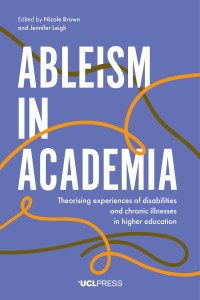
Ableism in Academia, Theorising experiences of disabilities and chronic illnesses in higher education
Edited by Nicole Brown and Jennifer Leigh

Open access

Rather than embracing difference as a reflection of wider society, academic ecosystems seek to normalise and homogenise ways of working and of being a researcher. As a consequence, ableism in academia is endemic. However, to date no attempt has been made to theorise experiences of ableism in academia.

Ableism in Academia provides an interdisciplinary outlook on ableism that is currently missing. Through reporting research data and exploring personal experiences, the contributors theorise and conceptualise what it means to be/work outside the stereotypical norm. The volume brings together a range of perspectives, including feminism, post-structuralism, such as Derridean and Foucauldian theory, crip theory and disability theory, and draw on the width and breadth of a number of related disciplines. Contributors use technicism, leadership, social justice theories and theories of embodiment to raise awareness and increase understanding of the marginalised; that is those academics who are not perfect. These theories are placed in the context of neoliberal academia, which is distant from the privileged and romanticised versions that exist in the public and internalised imaginations of academics, and used to interrogate aspects of identity, aspects of how disability is performed, and to argue that ableism is not just a disability issue.

This timely collection of chapters will be of interest to researchers in Disability Studies, Higher Education Studies and Sociology, and to those researching the relationship between theory and personal experience across the Social Sciences.

Contents
Preface
Nicole Brown and Jennifer Leigh

Introduction: Theorising ableism in academia
Nicole Brown
1. The significance of crashing past gatekeepers of knowledge: Towards full participation of disabled scholars in ableist academic structures
Claudia Gillberg
2. I am not disabled: Difference, ethics, critique and refusal of neoliberal academic selves
Francesca Peruzzo
3. Disclosure in academia: A sensitive issue
Nicole Brown
4. Fibromyalgia and me
Divya Jindal-Snape
5. A practical response to ableism in leadership in UK higher education
Nicola Martin
6. Autoimmune actions in the ableist academy: A crip response
Alice Andrews
7. ‘But you don’t look disabled’: Non-visible disabilities, disclosure and being an ‘insider’ in disability research and ‘other’ in the disability movement and academia
Elisabeth Griffiths
8. Invisible disability, unacknowledged diversity
Carla Finesilver, Jennifer Leigh and Nicole Brown
9. Imposter
Jennifer Rode
10. Internalised ableism: Of the political and the personal
Jennifer Leigh and Nicole Brown
11. From the personal to the political: Ableism, activism and academia
Kirstein Rummery
12. The violence of technicism: Ableism as humiliation and degrading treatment
Fiona Kumari Campbell
13. A little bit extra
El Spaeth

Concluding thoughts: Moving forward
Nicole Brown and Jennifer Leigh
Afterword
Jennifer Leigh and Nicole Brown
Index

Nicole Brown is Lecturer in Education and Academic Head of Learning and Teaching at UCL Institute of Education. Nicole’s research interests relate to identity and body work, physical and material representations and metaphors, the generation of knowledge, and advancing learning and teaching within higher education. @ncjbrown @FibroIdentity @AbleismAcademia

Jennifer Leigh is Senior Lecturer at the Centre for the Study of Higher Education, University of Kent. She initially trained as a chemist, teacher, and somatic movement therapist. Her research interests include embodiment, phenomenological and creative research methods, academic practice, educational development, and ableism in higher education. @drschniff @AbleismAcademia
