Foucault News

News and resources on French thinker Michel Foucault (1926-1984)

Genealogies of Philosophy: Lynne Huffer. Interviewed by Sidra Shahid and Jeremy Bendik-Keymer.
Part One 5 March 2021
Part Two 2 April 2021

Jeremy Bendik-Keymer and I sat down to talk to Lynne Huffer, who brings literary theory, French studies, queer theory, and philosophy to her work on Foucault. In her most recent book, Foucault’s Strange Eros, Lynne reads Foucault through a Sapphic lens, delivering an ethics of wonder and with it alternative possibilities for thinking and feeling.

In this first part of the interview, I wanted to understand Lynne’s path – how she arrived at her dazzlingly original reading of Foucault across her trilogy (Mad for Foucault, Are the Lips A Grave, and Foucault’s Strange Eros). Here Lynne tells us about the kind of ethics she finds in Foucault, the relationship between modes of writing and modes of thinking, what genealogy means for subjectivity, and how working with fragmentation and discontinuity can generate original possibilties for thinking and being.
[…]

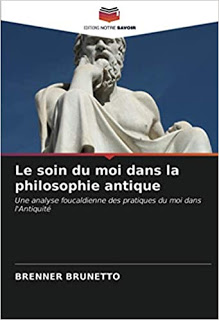
Brenner Brunetto : Le soin du moi dans la philosophie antique. Une analyse foucaldienne des pratiques du moi dans l’Antiquité, Notre Savoir, 2021

On peut dire que la philosophie antique, plus précisément celle de la période postérieure à la philosophie naturelle, c’est-à-dire la philosophie dite classique, est née avec la célèbre phrase delphique ” connais-toi toi-même “(gnōthi seautón), phrase qui, à son tour, a été connue grâce à Socrate d’Athènes.Pour Michel Foucault, cette phrase n’était que la partie émergée d’un iceberg qui contenait un fond plus robuste et plus volumineux désigné par Foucault comme epiméleia heautou, ou, plus précisément, comme soin de soi. Avec cette idée, le philosophe français arrive à sa théorie connue sous le nom d’Esthétique de l’existence, dans laquelle l’agent éthique est, en même temps, artiste et œuvre de lui-même. Ce soin du moi, qui présentait quelques différences d’une école à l’autre, ou, plus précisément, d’une période à l’autre, à savoir : 1) la période socratique/platonicienne ; 2) la période hellénistique et ; 3) la période chrétienne.Ainsi, l’objectif de ce texte est de faire une brève analyse de ces périodes.

Webb, S.
Philosophy as a feminist spirituality and critical practice for Mary Astell
(2020) Metaphilosophy, 51 (2-3), pp. 280-302.

DOI: 10.1111/meta.12411

Abstract
The question of how gender might inflect and affect philosophy as a way of life has been somewhat neglected, as has the role of philosophical modes of living for historical female philosophers. This essay draws on Michel Foucault’s multifaceted, Hadot-inspired conception of philosophy to show how transformative philosophical practices of the self function as feminist praxis in the work of the early modern feminist philosopher Mary Astell. Philosophy in Astell’s texts, the essay argues, is a spiritual practice of the self that at the same time functions as a feminist critique both of sexist social structures and of the self that undertakes the practice. It facilitates women in achieving internal freedom. Finally, the essay discusses potential feminist concerns about Astell’s proposed philosophical way of living, before suggesting that it may have value for women today. © 2020 Metaphilosophy LLC and John Wiley & Sons Ltd

Author Keywords
critique; early modern; feminism; Mary Astell; Michel Foucault; philosophy as a way of life; practices of the self; spirituality

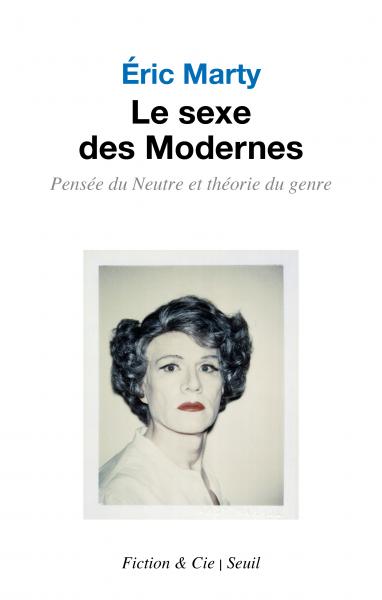
Eric Marty : Le Sexe des Modernes. Pensée du Neutre et théorie du genre, Seuil, 2021

Disjoindre le sexe et le genre est un geste éminemment moderne, théoriser cette dissociation l’est plus encore.

Ce livre est d’une certaine manière l’histoire de ce geste. Il nous mène des grandes entreprises déconstructrices de la Modernité des années 1960-1980 jusqu’au triomphe contemporain de la théorie du genre : de Sartre, Lacan, Deleuze, Barthes, Derrida ou Foucault jusqu’à Judith Butler.

Pourtant, parce qu’il s’agit d’un objet aussi fuyant que précieux, le sexe des Modernes est aussi un révélateur. Loin d’être tout à fait commun aux deux espaces intellectuels que sont l’Europe et les États-Unis, il est peut-être témoin de leurs divisions : disputes, équivoques, héritages détournés, et guerres silencieuses ou avouées…

Il s’agit ici non seulement d’éclairer des doctrines récentes que la confusion des temps travaille à obscurcir, mais d’explorer ce qui s’est déplacé au tournant des XXe et XXIe siècles entre le continent européen et le continent américain. Transmission ou au contraire fracture ?

Car le moment est venu d’interroger le partage du sexe et du genre sous l’angle de son histoire puisque cette histoire est la nôtre, et sans doute plus que jamais.

Zitcer, A.
Making Up Creative Placemaking
(2020) Journal of Planning Education and Research, 40 (3), pp. 278-288.

DOI: 10.1177/0739456X18773424

Abstract
Creative placemaking is an increasingly prevalent form of planning practice that invokes arts and culture as tools for revitalization. Planners, policymakers, funders, and practitioners are engaged in a discursive struggle to define what is meant by creative placemaking and what value it holds for cities. Using frameworks developed by Foucault and Hacking, I analyze the emergence and ongoing contestation of this term, contrasting the way creative placemaking is understood and enacted by actors in Philadelphia with definitions employed by national funders. I argue that practitioner and community voices deserve amplification in the unfinished work of creative placemaking as urban practice. © The Author(s) 2018.

Author Keywords
arts; arts economic development; creative placemaking; discourse; Philadelphia

Muhamedin Kullashi, Foucault et Lefort. Regards croisés sur la modernitéInvention des disciplines ou invention de la démocratie moderne ?, L’Harmattan, 2020

Le croisement des conceptions de Foucault et celles de Lefort sur la modernité s’accompagne, dans cet ouvrage, d’une analyse des différences entre l’image d’une société travaillée par les technologies disciplinaires et celle marquée par l’émergence de la démocratie moderne, comme mutation symbolique profonde. La problématisation des relations entre le pouvoir et le corps, des comportements et des actions des individus, chez Foucault, s’articule autour de l’examen, chez Lefort autour des différences des formes de sociétés et des principes générateurs des relations que les hommes entretiennent entre eux et avec le monde. Un point de convergence important apparaît toutefois chez les deux penseurs : la question des foyers disséminés de contestation, des résistances et des conditions de la liberté, comme réel enjeu de nos sociétés contemporaines.

Muhamedin Kullashi a enseigné au Département de philosophie à l’Université de Paris 8 entre 1992 et 2017. Il fut ambassadeur de la République du Kosovo à Paris.

stuartelden's avatarProgressive Geographies

The new translation of Jean Cavaillès, On Logic and the Theory of Science, some second-hand books by Eliade, a collective volume on Vincennes, the reedition of Foucault’s first two Collège de France courses, a special issue of the Carceral Notebooks on ‘Foucault and the Politics of Resistance in Brazil’, and Derrida’s Donner le temps II.

Carceral Notebooks 13: Foucault and the Politics of Resistance in Brazilwas kindly sent to me by Marcelo Hoffman, who edited the volume. The essays are available open access here, though it’s nice to have a physical copy.

The Foucault lecture courses are the new editions. There is an interesting editorial note about this new edition, which notes that there is a difference in how the first courses published differ from the later ones. The initial courses (‘Society Must Be Defended’ and Abnormal, for instance) made limited use of the…

View original post 176 more words

Steven G. Ogden, Violence, Entitlement, and Politics. A Theology on Transforming the Subject, Routledge, 2022

Review by Matthew S. Beal, in Reading Religion, September 23, 2025

Book Description
This book is an exercise in political theology, exploring the problem of gender-based violence by focusing on violent male subjects and the issue of entitlement. It addresses gender-based violence in familial and military settings before engaging with a wider political context. The chapters draw on sources ranging from Michel Foucault, Judith Butler, and Étienne Balibar to Rowan Williams and Elisabeth Schüssler Fiorenza. Entitlement is theorized and interpreted as a gender pattern, predisposing subjects toward controlling behaviour and/or violent actions. Steven Ogden develops a theology of transformation, stressing immanence. He examines entitled subjects, predisposed to violence, where transformation requires a limit-experience that wrenches the subject from itself. The book also reflects on today’s pervasive strongman politics, where political rationalities foster proprietorial thinking and entitlement gender patterns, and how theology is called to develop counter-discourses and counter-practices.

Table of Contents
1 The problem of gender-based violence

2 Theorizing violence, entitlement, and strongman politics

3 Entitlement predisposing subjects toward controlling behaviour and violent actions

4 Diverging trajectories: From Foucault and confession to transformation

5 A theology of transformation

6 Transforming the subject

7 6 January 2021: An epiphany of entitlement and the promise of transformation

Author
Steven G. Ogden is an adjunct Lecturer in Theology, and Research Fellow of the Public and Contextual Theology Research Centre, Charles Sturt University, Australia, and formerly Dean of St Peter’s Cathedral Adelaide, and Principal St Francis Theological College Brisbane. His publications include The Church, Authority and Foucault: Imagining the Church as an Open Space of Freedom (2017) and The Presence of God in the World: A Contribution to Postmodern Christology based on the Theologies of Paul Tillich and Karl Rahner (2007).

Lucia Ozorio : La praxis du commun dans la production de la connaissance. Afrique, Amérique du Sud et Europe, L’Harmattan – Avril 2021

Cet ouvrage interpelle qui entend repenser et éclairer le commun dans le champ des sciences humaines. Il s’inscrit dans la lignée d’A. Negri, M. Hardt et, avant eux, de Deleuze, Guattari et Foucault. Porteurs de savoirs universitaires, ces chercheurs et praticiens, réfutant le partage entre théorie et pratique, ont voulu créer un espace commun construit sur l’altérité. Ici la connaissance émerge, « jaillit » du terrain de recherche, de la multiplicité des vies et des subjectivités étudiées. Les expériences menées se veulent des réponses concrètes à portée d’action. À travers la multiplicité des textes et des disciplines, le lecteur entrevoit différents modes de résister sur trois continents. Car la question est bien celle de la construction d’un monde plus égalitaire et plus humain grâce à la praxis du commun, principe dynamique qui conteste l’ordre établi.

Lúcia Ozório est docteure en sciences de l’éducation, post-docteure en psychologie sociale, professeure, psychanalyste et chercheuse associée aux laboratoires Experice (Univ. Paris 8-Paris 13) et Lipis (Univ. PUC, Brésil).

‘What I am trying to do is the history of the relationship that thought maintains with truth, the history of thought insofar as it is thought about the truth. All those who say that for me truth doesn’t exist are simple-minded.’

Michel Foucault. (1996) [1984]. The concern for truth. In Foucault Live. collected Interviews, 1961-1984. Sylvère Lotringer (Ed.). New York: Semiotext(e), p. 456. DE IV, no.350 p.669. Translation modified.