
Foucault News

News and resources on French thinker Michel Foucault (1926-1984)

Barashkov, V.V., Begchin, D.A., Davidov, I.P.
Modern European philosophy of symbolic forms of religious and artistic consciousness
(2021) Voprosy Filosofii, 2021 (6), pp. 74-84.

DOI: 10.21146/0042-8744-2021-6-74-84

Abstract
The article deals with the philosophical issues in the field of religious art. The revision of the theories of secularization in the late 20th – early 21st centuries allowed philosophers speak not only about the autonomy of art in relation to religion, but also about the dialogue between these two “symbolic forms of consciousness” (according to E. Cassirer) and the fields of culture. The aim of this article is to offer an analysis of the corpus of selected texts of both Russian and foreign specialists of the last quarter of the 20th – early 21st centuries who worked in related fields (iconology, spatialization, semiotics of culture and art, philosophy of culture, and theology). The subject matters of the article is the philosophical, religious, cultural, art history, semiotic, theological, and anthropological theories of authors whose works were in the representative sample of this study. The literature can be divided into several categories: 1) publications that discuss the relationship between the “secular” and “sacred” in modern culture; 2) publications that describe the essential features of modern temple construction and give a broad interpretation of the concept of “sacred spaces”; 3) publications that describe and analyse specific manifestations of the dialogue between art and religion. The main methods are the method of description and the method of complex philosophical and religiological analysis. The originality of the research lies in the attempt to systematize various points of view on the place and role of religion and art in a post-secular society. The goal is to offer a wide panorama of modern theories of the interaction of religion, architecture, and fine art. Tthe main tasks are complex analysis, classification and qualification of research approaches of the authors under consideration.

Author Keywords
Ernst Cassirer; Henri Lefebvre; Heterotopia; Iconics; Iconology; Michel Foucault; Philosophy of religious art; Religious studies; Sacred spaces; Spatialisation; Temenology; “iconic turn”; “re-enchantment of art”; “sacred transfer”; “spiritual art”
CAVALCANTI, R.C.T., SOUZA-LEÃO, A.L.M., MOURA, B.M.
Hipsters versus posers: Fannish split in the indie music world
(2021) Revista de Administracao Mackenzie, 22 (3)

DOI: 10.1590/1678-6971/ERAMG210202

Abstract
Purpose: Web 2.0 technologies have enhanced relational dynamics in fan communities. Indie music fans significantly identify themselves with the genre and participate in these communities within a music industry reinvention scenario. Based on the Foucauldian perspective, by sharing knowledge about media products, fans manifest truths capable of expressing subjectivities – parrhesia, a way of mutually affecting different truths. Thus, the aim of the present study is to analyze how parrhesia is operated in interactions among indie music fans.

Originality/value: The present research expands an important theoreticalinvestigative path in the consumer culture theory (CCT) field by adopting Michel Foucault’s later theoretical cycle, which addresses the construction of subjectivities.

Design/methodology/approach: Netnography of interactions among indie music fans was carried out in one of the largest online discussion forums on the topic. Findings: Heated discussions observed in the investigated community often create a split that shows a dispute focused on defining what being an indie music fan means. Based on disruptive parrhesia anchored in moral backgrounds associated with erudition and collectivism versus hedonism and individuality, self-declared true fans and those who seek fun establish alter-subjectivities as hipsters and posers.

Author Keywords
Fans; Indie music; Netnography; Parrhesia; Subjectivity

Book Review Symposium
Book Symposium: Critique And Praxis, British Journal of Sociology
Volume 72, Issue 3, June 2021

Open access

Critique and Praxis
Rebecca Elliott

Critique & Praxis is nothing short of a colossal achievement, which will be discussed for years to come
Miguel de Beistegui

Lonely and beyond truth? Two objections to Bernard Harcourt’s Critique & Praxis
Frieder Vogelmann

On the unity and dissonance of Critique and Praxis
Seyla Benhabib

An “illuminati” and its acolytes: Critical theory in the text and in the world: Being a commentary on Bernard Harcourt’s Critique and Praxis
Biodun Jeyifo

Ultimately, every insignificant event that took place in the heart of the countryside is still in some way inscribed in the bodies of twentieth-century urban inhabitants. There is a tiny element of the peasantry, an obscure drama from the fields and the forest, the barn, that is still inscribed somewhere, has marked our bodies in a certain way, and still marks them in an infinitesimal way.
[…]

That’s what the unconscious of history is, not some kind of grand force or life-and- death instinct. Our historical unconscious is made up of these millions, billions of small events, which little by little, like drops of rain, erode our bodies, our way of thinking.
[…]

Film allows you to have a relation to history, to establish a mode of historical presence, a sense of history that is very different from what you can achieve through writing. Let’s take Moatti’s series Le pain noir. Its success and importance depended on the fact that, far more so than a novel, it was related to a history that everybody had some memory of, namely, our grandmothers’ lives. Our grandmothers lived that history. It’s not at the level of what we know but at the level of our bodies, the way we act, the way we do things, think, and dream.
[…]

Michel Foucault (2018). The return of Pierre Rivière. In Foucault, M. Patrice Maniglier, Dork Zabunyan. Foucault at the Movies. Translated and edited by Clare O’Farrell, New York: Columbia University Press, pp. 162, 163, 167

Michel Foucault from A to Z. Here is why Foucault had a life-long fascination with the Rorschach test and how this relates to Deleuze’s notion that thinking means folding…

Découvrez cette exposition en vous promenant Jardin de l’ancienne maison de la famille Foucault Saint-Martin-la-Pallu

Découvrez cette exposition en vous promenant Jardin de l’ancienne maison de la famille Foucault, 19 septembre 2021-19 septembre 2021, Saint-Martin-la-Pallu.

Profitez de cette exposition-promenade composée de panneaux, de tableaux-citations, de montages sonores et vidéo. Venez découvrir le jardin de l’ancienne maison de la famille Foucault et l’exposition qui s’y trouve. Un récent ouvrage réalisé par l’association « Michel Foucault, côté jardin. Paroles » sera proposé au public.

Gratuit. Entrée libre.

Profitez de cette exposition-promenade composée de panneaux, de tableaux-citations, de montages sonores et vidéo.

Jardin de l’ancienne maison de la famille Foucault, 17 route de Poitiers, 86380 Vendeuvre-du-Poitou Saint-Martin-la-Pallu Vendeuvre-du-Poitou Vienne, France

Oolite Arts Announces Summer Exhibition: “Where There is Power”
MIAMI BEACH, Florida, USA, Artfix Daily, July 13, 2021

This summer starting July 21, Oolite Arts presents “Where There is Power”, an exhibition about the many ways that artists access, spy upon, expose, memorialize, and occasionally trouble the machinations of power.

Where there is power is co-organized by Amanda Bradley, programs manager at Oolite Arts, and Réne Morales, chief curator at Pérez Art Museum Miami. “When I was first invited to do the show last summer, the world really felt like it was on fire,” said Réne Morales. “Between the pandemic, the movement for Black lives, ongoing trauma from the last administration and election, and crises at the border, the societal powers that structure and regulate our lives were clearly becoming unstable. So, we wanted to put together a show that would respond to the political instability and volatility of the times.” The exhibition’s title refers to a famous quote by the philosopher Michel Foucault: “Where there is power, there is resistance.”

The Miami-based artists featured in the exhibition include José Álvarez, Asif Farooq, Edny Jean Joseph, Francisco Masó, Yucef Merhi, Reginald O’Neal, Rodolfo Peraza, Chire Regans, Tony Vázquez-Figueroa, Judi Werthein, Agustina Woodgate, Antonia Wright and Ruben Millares.
[…]

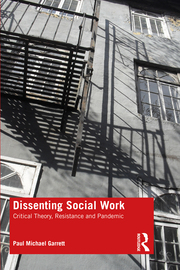
Paul Michael Garrett, Dissenting Social Work. Critical Theory, Resistance and Pandemic, Routledge, 2021

Book Description
This book, from one of international social work’s leading radical educators, provides a richly compelling argument for the profession to become more critical and dissenting.

Addressing the troubled times in which we find ourselves, Garrett’s book examines a broad range of theoretical frameworks and draws on diverse writers, such as Marx, Foucault, Brown, Zuboff, Rancière, Wacquant, Arendt, Levinas, Fanon and Gramsci. The author’s panoramic vision encompasses Ireland, the United Kingdom, the United States, Algeria, Israel/Palestine and China. Timely, lively and accessible, this book speaks directly to some of the main preoccupations of our era. Readers will be encouraged to relate developments in social work to key themes circulating around migration, the threat of neo-fascism, surveillance culture, colonialism, the Black Lives Matter movement and the COVID-19 pandemic. Imbued with a sense of hope for a brighter future, this book encourages a new generation of social work students to recognise and examine the importance of critical theory for understanding the structural forces shaping their lives and the lives of those with whom they work and provide services.

This book is vital, indispensable and essential reading for social work students and other readers, throughout the world, seeking to make the connection between social work, social theory and sociology.

Table of Contents
Preface and acknowledgements

Chapter 1. Introduction

Chapter 2. Questioning the world of ‘appearances’: Karl Marx

Chapter 3. Neoliberalism, human capital and biopolitics: Michel Foucault and Wendy Brown

Chapter 4. Surveillance capitalism: Shoshana Zuboff

Chapter 5. Equality NOW: Jacques Rancière

Chapter 6. Critical Scholarship and neoliberal penality: Loïc Wacquant

Chapter 7. Dissenting with the arch-contrarian: Hannah Arendt

Chapter 8. Remembering that African, Asian and Palestinian lives matter: Emmanuel Levinas

Chapter 9. It is becoming ‘impossible to breathe’: Frantz Fanon

Chapter 10. Social work’s Chinese future?: Antonio Gramsci

Chapter 11. Conclusion

Hillier, Jean, and Jason Byrne. “Is Extermination to Be the Legacy of Mary Gilbert’s Cat?” Organization 23, no. 3 (May 2016): 387–406. https://doi.org/10.1177/1350508416629455.

Abstract
Once imported to Australia as rodent controllers, cats are now regarded as responsible for a second wave of mammal extinction across the continent. Utilising the Foucauldian concept of biopolitics, we investigate critically the institutional field of cat regulation in Australia, exemplified by the Western Australian Cat Act 2011 and the Federal Environment Minister’s 10-year campaign to eradicate feral cats. Analysis of the biopolitical dispositif of ferality, and its elements of knowledge, subjectivation and objectivation and power processes, illustrates the dispositions through which what might be regarded as felicide has become organisational practice. We propose alternative practices emphasising the productive potentialities of biopolitics.

Keywords
Animals, biopolitics, cats, feral, management, regulation

stuartelden's avatarProgressive Geographies

Now that marking is complete, and the end of term is here,it’s been great to regain time and focus forthis work. Some of the nice comments I had aboutThe Early Foucaulthelped to encourage this. I’m not tired of this book, but I am impatient to move it forward, at least to get it to a point where all that remains is archival work once travel becomes possible again without periods of self-isolation.

I had some productive days at the British Library in June, across a couple of visits. The length of the visits means that I’m largely using the time to check small details or survey works which I might need to read in more detail. Some of this work was looking at the books Foucault reviewed or otherwise referenced.

I continue to work on Foucault’s literary essays in the first half of the 1960s, along…

View original post 1,378 more words