Foucault News

News and resources on French thinker Michel Foucault (1926-1984)

Pennington, M. Foucault and Hayek on public health and the road to serfdom. Public Choice (2021).
https://doi.org/10.1007/s11127-021-00926-6
Open access

Abstract
This paper draws on the work of Michel Foucault and Friedrich Hayek to understand threats to personal and enterprise freedom, arising from public health governance. Whereas public choice theory examines the incentives these institutions provide to agents, the analysis here understands those incentives as framed by discursive social constructions that affect the identity, power, and positionality of different actors. It shows how overlapping discourses of scientific rationalism may generate a ‘road to serfdom’ narrowing freedom of action and expression across an expanding terrain. As such, the paper contributes to the growing literature emphasising the importance of narratives, stories and metaphors as shaping political economic action in ways feeding through to outcomes and institutions.

Gordon Hull, Foucault, Marx and Prophecy Part 3: On Bureaucrats, New Apps, 12 July 2021

In a previous post, I noted that Foucault strongly implies in a 1978 interview that his communist detractors are bureaucrats, and tied that to an earlier interview with Maoists in which he suggests that structuring populist tribunals on the model of bourgeois courts would fail to break with the power structure of the bourgeois court system: the model of impartiality is intrinsically bourgeois, and so importing that model into communist popular tribunals would iterate the very power structures that were to be replaced. Here I want to flesh out a little more some of the resonances of an accusation of bureaucracy in the context of 1970s Marx debates in France. I should say in advance that these are notes more than a complete assessment, designed to pick out highlights. The back and forth polemics of Marxists are byzantine, and we should all be grateful that Foucault sets it as a rule not to engage in them. Here I will mainly draw from Trotsky’s critique of Stalin and Lenin, with a closing gesture to a representative text of the French far-left that emerged in the aftermath of the 1968 student uprisings.
[…]

CALL FOR PAPERS
The twentieth annual meeting of the Foucault Circle

Emory University
Atlanta, GA
May 13-15, 2022

We seek submissions for papers on any aspect of Foucault’s work, as well as studies, critiques, and applications of Foucauldian thinking.

Paper submissions require an abstract of no more than 750 words. All submissions should be formatted as a “.doc” or “.docx” attachment, prepared for anonymous review, and sent via email to the attention of program committee chair Lynne Huffer (lhuffer@emory.edu) on or before December 17, 2021,Indicate “Foucault Circle submission” in the subject heading. Program decisions will be announced during the week of January 21, 2022.

We expect that the conference will begin Friday afternoon and will conclude around lunch time on Sunday morning. Presenters will have approximately 40 minutes for paper presentation and discussion combined; papers should be a maximum of 3500 words (20-25 minutes reading time).

Logistical information about lodging, transportation, and other arrangements will be available after the program has been announced.

For more information about the Foucault Circle, please see our website, or contact our Coordinator, Edward McGushin emcgushin@stonehill.edu

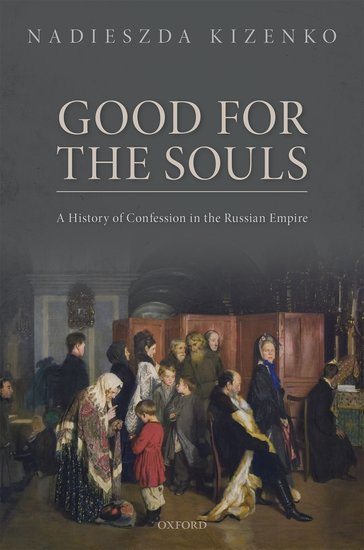
Nadieszda Kizenko, Good for the Souls, A History of Confession in the Russian Empire, OXFORD UNIVERSITY PRESS 2021

Audio interview with the author on the New Books Network

From the moment that Tsars as well as hierarchs realized that having their subjects go to confession could make them better citizens as well as better Christians, the sacrament of penance in the Russian empire became a political tool, a devotional exercise, a means of education, and a literary genre. It defined who was Orthodox, and who was ‘other.’ First encouraging Russian subjects to participate in confession to improve them and to integrate them into a reforming Church and State, authorities then turned to confession to integrate converts of other nationalities. But the sacrament was not only something that state and religious authorities sought to impose on an unwilling populace. Confession could provide an opportunity for carefully crafted complaint. What state and church authorities initially imagined as a way of controlling an unruly population could be used by the same population as a way of telling their own story, or simply getting time off to attend to their inner lives.

Good for the Souls brings Russia into the rich scholarly and popular literature on confession, penance, discipline, and gender in the modern world, and in doing so opens a key window onto church, state, and society. It draws on state laws, Synodal decrees, archives, manuscript repositories, clerical guides, sermons, saints’ lives, works of literature, and visual depictions of the sacrament in those books and on church iconostases. Russia, Ukraine, and Orthodox Christianity emerge both as part of the European, transatlantic religious continuum-and, in crucial ways, distinct from it.

Nadieszda Kizenko is Professor of History and Director of Religious Studies at the University at Albany. She is the author of the prize-winning book A Prodigal Saint: Father John of Kronstadt and the Russian People, numerous articles on Orthodox Christianity including The Feminization of Patriarchy? Women in Contemporary Russian Orthodoxy (winner of Best Article, Association for the Study of Eastern Christianity), and several translations.

La poudre. Épisode 79 – Paul B. Preciado (2021), Podcast Artis 19, 10/08/2020

Paul B. Preciado, philosophe et auteur révolutionnaire, est l’invité du 79e épisode de La Poudre. Avec Lauren Bastide, ils ont parlé de corps, de monstre et de joie.

L’édito de Lauren :

La Poudre est un lieu qui a été pensé en non-mixité pour parler des mécanismes sexistes à travers le vécu des personnes les subissant. Jusqu’ici n’y ont résonné que les voix de femmes, cis ou trans. Il va de soi que l’expérience des personnes non binaires et de toutes les personnes trans y trouvent leur place. La pensée, le travail et les écrits de Paul B. Preciado sont essentiels pour comprendre le mouvement féministe actuel et questionner les représentations genrées, comme La Poudre le fait depuis quatre ans. C’est un grand honneur qu’il vienne clôturer cette saison, avant que l’émission ne prenne un nouveau visage à la rentrée.

Résumé de l’épisode :

Paul B. Preciado est l’un des plus grands penseurs de notre époque. En tant qu’homme trans refusant tout schéma binaire, il est aussi le premier invité de La Poudre (05:40). À la veille du confinement, il démarrait un cycle de conférences au Centre Pompidou reprenant l’histoire de la sexualité de Michel Foucault pour en proposer une relecture féministe et décoloniale (11:44). Il y a senti une pulsion révolutionnaire (07:50) qu’il engage tous et toutes à retrouver, à vivre, à embrasser (14:28). Né le 11 septembre 1970 à Burgos, dans l’Espagne franquiste (18:41), il tire une droite ligne entre ces années et sa sensibilité aux marques du fascisme étatique qu’il retrouve dans les agissement du gouvernement français actuel (24:00). Dès l’enfance, il met en place des stratégies d’évitement pour échapper aux injonctions de genre (29:00), un exercice quotidien de plasticité politique qu’il pratique encore (35:55). Docteur en philosophie, il est l’auteur de plusieurs livres explorant le concept du genre. Son dernier, “Je suis un monstre qui vous parle”, lui permet de parler depuis cette monstruosité, plaquée par le système hétéropatriarcal et raciste sur les corps jugés “autres”. Lui-même au centre de l’expérience du corps trans, il est familier de l’emploi du “je” dans ses écrits (40:04), la seule possibilité selon lui pour échapper au supposé universalisme de la philosophie occidentale. Sans écriture située, impossible de dépasser les barrières du système (45:15). Il appelle de tous ses vœux la sortie du régime de la différenciation sexuelle (59:28) grâce au pouvoir de l’imagination collective. Sa joie et son optimisme dans l’avènement de la révolution sont communicatifs et vous pourrez les retrouver à l’automne 2020 au Centre Pompidou (01:05:21).

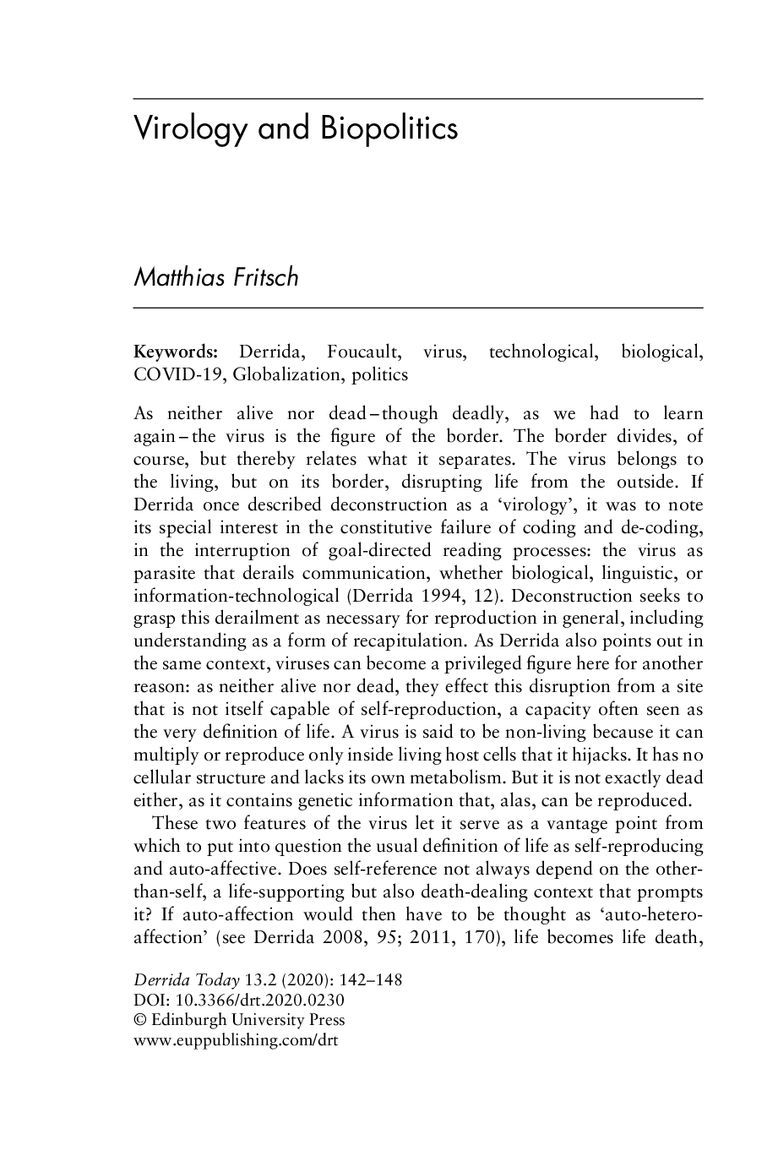
Fritsch, M. Virology and biopolitics (2020) Derrida Today, 13 (2), pp. 142-148. DOI: 10.3366/DRT.2020.0230

Author Keywords Biological; COVID-19; Derrida; Foucault; Globalization; Politics; Technological; Virus

stuartelden's avatarProgressive Geographies

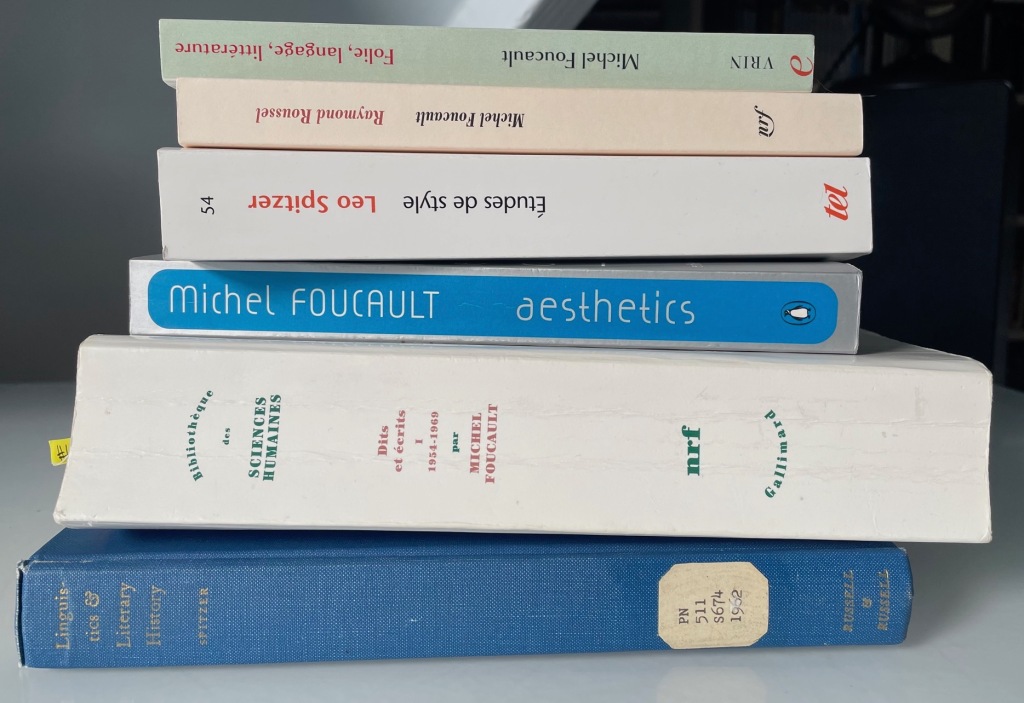
Thismanuscriptis slowly coming together. I’ve continued working on the linguistics and literary analysis texts inFolie, langage, littérature.For space reasons, I’ve had to keep the discussion of these down, though in many respects they reinforce or supplement points made in the other, fuller texts. I also wrote a long discussion of the “What is an Author?” lecture, with some discussion of the changes between the 1969 Paris and 1970 Buffalo version, and a little on the Paris discussion (on the textual issues seehere). The last part of this chapter is a discussion of the translation of the translation Foucault made of Leo Spitzer, with some discussion ofthe question about its dating, which continues to bother me. This chapter is now in pretty good shape.

I have developed the Coda a bit more, with somediscussion of the other Buffalo lectures on Flaubert and Balzac…

View original post 1,169 more words

Eli B. Lichtenstein (2021) Foucault’s Analytics of Sovereignty, Critical Horizons, 22:3, 287-305 
DOI: 10.1080/14409917.2021.1953750

Abstract
The classical theory of sovereignty describes sovereignty as absolute and undivided yet no early modern state could claim such features. Historical record instead suggests that sovereignty was always divided and contested. In this article I argue that Foucault offers a competing account of sovereignty that underlines such features and is thus more historically apt. While commentators typically assume that Foucault’s understanding of sovereignty is borrowed from the classical theory, I demonstrate instead that he offers a sui generis interpretation, which results from the application of his general strategic conception of power to sovereignty itself. In construing sovereignty through a “matrix” of civil war, Foucault thus deprives it of the absoluteness traditionally attributed to it. Instead, he views sovereignty as constituted by conflictual and mobile power relations, a precarious political technology that deploys violence to restore its authority. I also motivate Foucault’s contention that popular sovereignty remains fundamentally continuous with the absolutist sovereignty it succeeds, insofar as it masks and thereby perpetuates unequal power relations in conditions of social conflict. According to Foucault, sovereignty is not a fact of power but a contestory claim, a discourse whose mutability helps to explain its persistence today

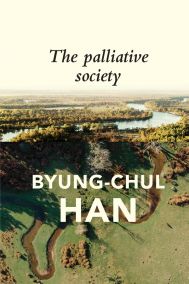
Byung-Chul Han, The Palliative Society. Pain Today Byung-Chul Han, Translated by Daniel Steuer, Polity Press, 2021

Our societies today are characterized by a universal algophobia: a generalized fear of pain. We strive to avoid all painful conditions – even the pain of love is treated as suspect. This algophobia extends into society: less and less space is given to conflicts and controversies that might prompt painful discussions. It takes hold of politics too: politics becomes a palliative politics that is incapable of implementing radical reforms that might be painful, so all we get is more of the same.

Faced with the coronavirus pandemic, the palliative society is transformed into a society of survival. The virus enters the palliative zone of well-being and turns it into a quarantine zone in which life is increasingly focused on survival.

And the more life becomes survival, the greater the fear of death: the pandemic makes death, which we had carefully repressed and set aside, visible again. Everywhere, the prolongation of life at any cost is the preeminent value, and we are prepared to sacrifice everything that makes life worth living for the sake of survival.This trenchant analysis of our contemporary societies by one of the most original cultural critics of our time will appeal to a wide readership.

Charles E. Snyder (2021) Foucault and the Historiography of Early Hellenistic Philosophy, Critical Horizons

DOI: 10.1080/14409917.2021.1953749

ABSTRACT
In his 1981–82 lectures The Hermeneutics of the Subject, Michel Foucault claims that a significant portion of the modern historiography of ancient philosophy tends to discredit the ethical framework of epimeleia heautou (“care of the self”). The thematic analysis of knowledge in the historiography of ancient philosophy overshadows the theme of care of the self. Taking Foucault’s claim as a point of departure, the aim of this paper is twofold. First, the paper provides a genealogy of the early Hellenistic Academy, from Polemo to Arcesilaus. Second, the paper demonstrates that for Arcesilaus, the alleged pioneer of what modern historiography has designated the Academy’s epistemological scepticism, philosophy is not restricted to a continual search for knowledge at a theoretically rarefied level of challenging arguments or discursive statements. This paper situates Arcesilaus’ opposition to early Stoic epistemology within the framework of Academic epimeleia heautou, and defends the thesis that under Arcesilaus the Hellenistic Academy undergoes a shift in the practice of care of the self.

KEYWORDS: Foucault care of the self knowledge Hellenistic philosophy the Academy Socrates