Foucault News

News and resources on French thinker Michel Foucault (1926-1984)

Capocchi, A., Orlandini, P., Pierotti, M., Amelio, S.
The nature, roles, uses, and impacts of accounting systems in the Real Liceo of Lucca in the nineteenth century
(2022) Accounting History Review

DOI: 10.1080/21552851.2021.2025113

Abstract
This study aims to advance the literature by examining how accounting systems were used in the management of the Real Liceo in Lucca during the nineteenth century. It considers rare documents, statutes, and accounting books concerning the administration of the Real Liceo from 1819 to 1848. Focused on the importance of academic and educational organisation at the individual and societal levels, in line with Foucault’s works and theories, this research critically analyses the social and technical practice of accounting within the context of the Real Liceo, especially the nature, roles, uses, and impacts of accounting information in allocating resources and evaluating accountability. © 2022 Informa UK Limited, trading as Taylor & Francis Group.

Author Keywords
accountability; accounting; control; Education; governance; Tuscany

Dombrowsky, T.
Independent Thinking in Nursing: An Archaeology of Knowledge Perspective
(2022) The Journal of nursing education, 61 (1), pp. 12-18.

DOI: 10.3928/01484834-20211201-01

Abstract
BACKGROUND: The topic of thinking was not widely discussed in nursing literature until the 1960s. At that time, the nursing process entered nursing literature, and later, in the 1980s, critical thinking began to be examined. Critical thinking had been talked about in fields other than nursing since at least the time of educational philosopher John Dewey.
METHOD: Using Foucault’s Archaeology of Knowledge as a model, this article explores how and why thinking became an object of nursing discourse.
RESULTS: Modern nursing discourse emphasizes independent thinking in contrast to the discussion of comportment, attitudes, and observation found in the early nursing literature.
CONCLUSION: The emergence of thinking discourse in nursing was a response to changes in health care that began in the period after World War II and although this discourse ostensibly serves to liberate nurses’ thinking, it can actually serve to regulate the thinking of students and nurses. [J Nurs Educ. 2022;61(1):12-18.].

Index Keywords
archeology, human, nursing student, thinking; Archaeology, Humans, Students, Nursing, Thinking

McCormick, W.
Polarities of the Human and Divine: Aquinas and Schmitt on Political Theology
(2022) American Journal of Political Science, 66 (1), pp. 93-105.

DOI: 10.1111/ajps.12608

Abstract
The investigations of Carl Schmitt yielded an influential but partial recovery of the term “political theology.” In this article, I consider Schmitt’s tendentious reduction of political theology to a justifying or legitimizing function. I then turn to Aquinas to demonstrate that Christian political theology also offers robust criticism of political life. After laying out three such standards for criticism, I account for why Christian political theology exhibits this deep ambivalence toward political life. The traditions of political theology, I argue, can be understood as attempts to harmonize polar tensions with those traditions. Whereas thinkers like Schmitt and Foucault emphasize one set of polarities against another, Aquinas effects a genuine synthesis. This synthesis should be the task of political theology. I close with notes toward the renewal of political theology. © 2021, Midwest Political Science Association

Sara Raimondi, Method to the madness: Reading Foucault between geometry and brackets. Contemporary Political Theory (2022).
https://doi.org/10.1057/s41296-022-00549-6
Open access

Essay review
Lynne Huffer, Foucault’s Strange Eros, Columbia University Press, New York, 2020, xii+265pp., ISBN: 978- 0-2311-9714-4
Gregg Lambert, The Elements of Foucault, University of Minnesota Press, Minneapolis, 2020, 143pp., ISBN: 978-1-5179-0877-5

It is a prolific and crucial age for Foucault studies, at a time when the name of the French author continues to be present not only in scholarly contributions but also in public debates. The publication, in early 2021, of the English translation of the fourth volume of the History of Sexuality, Les aveux de la chair (Confession of the Flesh), has already sparked new academic endeavours in the study of Foucault’s ongoing engagement with questions of subjectivity and sexuality and of his long-lasting interest in religion and early Christianity. Yet, such scholarly effervescence is balanced, if not counteracted, by the cropping up of Foucault’s name in some less likely circles of political discourse, such as the UK former minister for women and equality Liz Truss’ (2020) reference to Foucault in a speech where the French author is presented as the pioneering figure of a post-modernist philosophy that puts power structures ahead of individuals and where ‘truth and morality are all relative’.

In such a time of diverse interest in Foucault, Gregg Lambert’s The Elements of Foucault and Lynne Huffer’s Foucault Strange Eros appear as two meaningful attempts to contribute to the ever-growing pile of ‘tiny grains of sands’ (Lambert, pp. 1–2) that constitute the commentary on the ‘discourse of Foucault’.
[…]

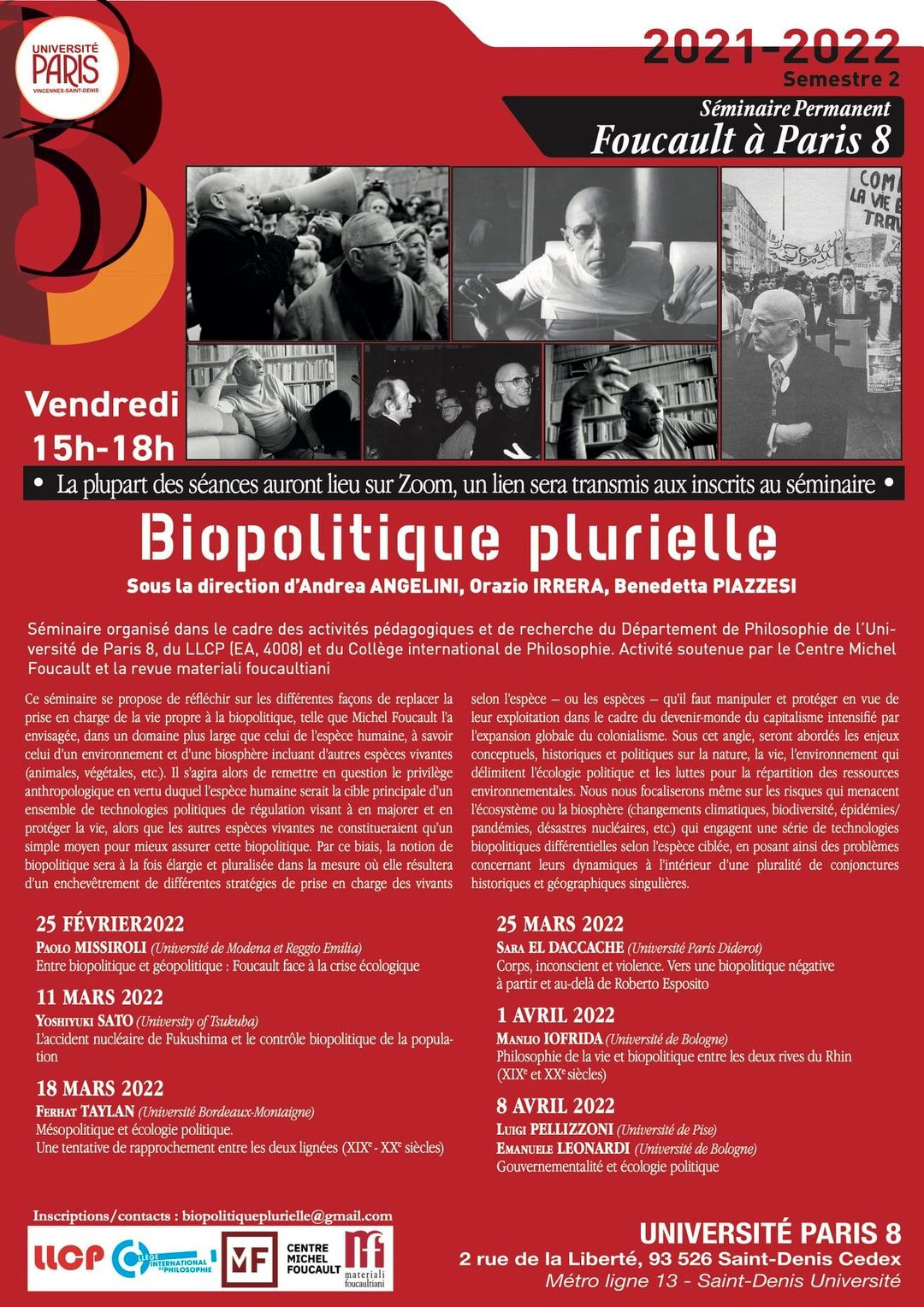
Séminaire Biopolitique plurielle
Sous la direction d’Andrea ANGELINI, Orazio IRRERA, Benedetta PIAZZESI
Université Paris 8 | Semestre 2 | vendredi 15h-18h
(Certaines séances auront lieu sur Zoom, un lien sera transmis aux inscrits au séminaire)

Inscriptions / contacts : biopolitiqueplurielle@gmail.com
NB : Inscriptions ouvertes jusqu’au 22 février 2022

Séminaire organisé dans le cadre des activités pédagogiques et de recherche du Département de Philosophie de l’Université de Paris 8, du LLCP (EA, 4008) et du Collège international de Philosophie. Activité soutenue par le Centre Michel Foucault et la revue materiali foucaultiani.

Ce séminaire se propose de réfléchir sur les différentes façons de replacer la prise en charge de la vie propre à la biopolitique, telle que Michel Foucault l’a envisagée, dans un domaine plus large que celui de l’espèce humaine, à savoir celui d’un environnement et d’une biosphère incluant d’autres espèces vivantes (animales, végétales, etc.). Il s’agira alors de remettre en question le privilège anthropologique en vertu duquel l’espèce humaine serait la cible principale d’un ensemble de technologies politiques de régulation visant à en majorer et en protéger la vie, alors que les autres espèces vivantes ne constitueraient qu’un simple moyen pour mieux assurer cette biopolitique. Par ce biais, la notion de biopolitique sera à la fois élargie et pluralisée dans la mesure où elle résultera d’un enchevêtrement de différentes stratégies de prise en charge des vivants selon l’espèce – ou les espèces – qu’il faut manipuler et protéger en vue de leur exploitation dans le cadre du devenir-monde du capitalisme intensifié par l’expansion globale du colonialisme.

Sous cet angle, seront abordés les enjeux conceptuels, historiques et politiques sur la nature, la vie, l’environnement qui délimitent l’écologie politique et les luttes pour la répartition des ressources environnementales. Nous nous focaliserons même sur les risques qui menacent l’écosystème ou la biosphère (changements climatiques, biodiversité, épidémies/pandémies, désastres nucléaires, etc.) qui engagent une série de technologies biopolitiques différentielles selon l’espèce ciblée, en posant ainsi des problèmes concernant leurs dynamiques à l’intérieur d’une pluralité de conjonctures historiques et géographiques singulières.

Programme :
25 février – Paolo MISSIROLI (Université de Modena et Reggio Emilia)
Entre biopolitique et géopolitique : Foucault face à la crise écologique.
11 mars – Yoshiyuki SATO (University of Tsukuba)
L’accident nucléaire de Fukushima et le contrôle biopolitique de la population.
18 mars – Ferhat TAYLAN (Université Bordeaux-Montaigne)
Mésopolitique et écologie politique. Une tentative de rapprochement entre les deux lignées (XIXe – XXe siècles).
25 mars – Sara EL DACCACHE (Université Paris Diderot)
Corps, inconscient et violence. Vers une biopolitique négative à partir et au-delà de Roberto Esposito.
1 avril – Manlio IOFRIDA (Université de Bologne)
Philosophie de la vie et biopolitique entre les deux rives du Rhin (XIXe et XXe siècles).
8 avril – Luigi PELLIZZONI (Université de Pise) et Emanuele LEONARDI (Université de Bologne)
Gouvernementalité et écologie politique.

Chipango, E.F.
Political ecologies of energy poverty in Zimbabwe
(2022) GeoJournal

DOI: 10.1007/s10708-021-10566-4

Abstract
Studies that attribute energy poverty to a lack of technical resources abound in Zimbabwe. However, such line of reasoning falls short of giving a rigorous analysis of the existing political-economic factors and scalar politics. These include power dynamics, gender relations, class, historic patterns of dominance and marginalisation at different geographical scales and the discourse on energy poverty. Accordingly, a political ecology framework can address these theoretical gaps given its expansive scope. Using a qualitative approach, a political ecology analysis of the Zingondi Resettlement Area in Zimbabwe illuminates the interaction between these factors. Furthermore, it extends the argument through a Foucauldian view on apparatus of security in order to understand how the state uses its calculated power to address energy poverty. It concludes that energy poverty is a processual outcome, which is socially constructed. Therefore, there is need to pay attention to the complex and diverse nature of rural development. This includes embracing a development with and for the people approach, which takes into account pertinent aspects of the intended beneficiaries’ contexts. © 2021, The Author(s), under exclusive licence to Springer Nature B.V.

Author Keywords
Foucault; Political ecology; Political economy; Power; Socially constructed

Index Keywords
Factor analysis, Regional planning; Economic factors, Energy poverties, Foucault, Political ecology, Political economy, Power, Rigorous analysis, Socially constructed, Technical resources, Zimbabwe; Ecology

Cos, J.C.C.G.
Space___Between: Remnants of a city as catalysts for change
(2021) Cidades, (43), pp. 22-33.

DOI: 10.15847/cct.24114

Abstract
It all starts with a question… Or perhaps too many. What can be done with the remnants of any given city? Can they be transformed to create a shared, cohesive, and productive urban environment? Understanding that the city is an unfinished, ever-productive, ever-dynamic and ever-changing project, it cannot be ignored that, while transforming specific zones in a city, other zones get abandoned in the developing process for an undefined period of time. These urban slivers are often seen as negative spaces rather than positive ones; I will focus on the important indeterminacy and uncertainty that they possess.

This research project will centre on these unoccupied, abandoned, or underutilized places within the city, analysing different dynamics of reintegration into the city’s fabric while incorporating Michael Foucault’s heterotopias, as well as some case studies in Gordon Matta-Clark’s œuvre to the discourse. Specifically, I argue that terrain vagues, a term first coined by Ignasi de Solà-Morales i Rubió, and related terms should be seen as site-specific tools for critique and creativity. In order to positively take over any urban void, I address the issue of property, social attachment, and identity to the place, intertwined with the dynamics of architecture and urbanism. I propose to incorporate the concepts of memory and time inherent to these dynamics in order to develop a profound reading of any given site; generate a reinterpretation that can trigger a longstanding change to attain the reinstatement of public property with creative and straightforward approaches; and, then, perform a temporal or permanent, architectonic or artistic intervention, aiming for a new sense of social meaning. In conclusion, this paper sheds new light on the necessity to embrace the opportunities provided by these urban voids. Art and architecture can act as key elements to link people and spaces within a sociocultural context and thus create catalysts for change endowed with meaning. 2021 (Cos, J.C.C.G.)

Author Keywords
Heterotopias as counterspaces; Remnants of a city; Terrain vague; Urban void appropriation

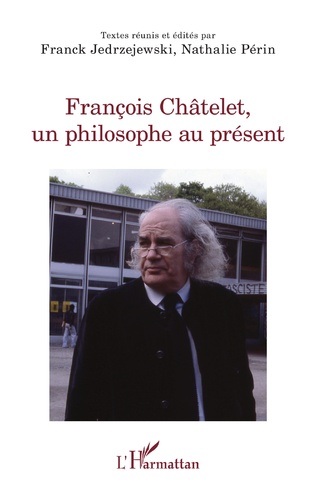
François Châtelet, un philosophe au présent
Textes réunis et édités par Franck Jedrzejewski et Nathalie Périn, L’Harmattan, 2022

Philosophe hors du commun, François Châtelet (1925-1985) a profondément marqué le paysage intellectuel français du XXe siècle. Cofondateur, avec Michel Foucault et Gilles Deleuze, du département de philosophie du Centre universitaire expérimental de Vincennes, aujourd’hui Université Paris VIII, il a dirigé ce département jusqu’à sa mort. Les textes réunis ici se composent de quatre articles de François Châtelet devenus introuvables et une série de textes de philosophes qui mettent en valeur, tant ses talents d’historien de la philosophie, de pédagogue que de philosophe engagé. C’est tout un ensemble de souvenirs d’un philosophe médiatique qui est donné à lire, luttant par l’histoire des concepts contre l’orthodoxie marxiste. François Châtelet fut le cofondateur avec Jacques Derrida, Jean-Pierre Faye et Dominique Lecourt du Collège international de philosophie. Il militait pour la pratique d’une philosophie ouverte et populaire et n’a eu de cesse de décloisonner la philosophie et de l’ouvrir pour la mettre en commun.

Franck Jedrzejewski, ancien directeur de programme au Collège international de philosophie, a publié une vingtaine d’ouvrages. Il mène des recherches multidisciplinaires entre musique, philosophie et mathématiques sur le sens, les catégories, l’atonalité et l’avant-garde musicale russe. Il enseigne à l’INSTN et à l’Université de Paris-Saclay.

Nathalie Périn est actuellement co-présidente du Collège international de philosophie et directrice de programme de cette même institution dans l’intersection philosophie/ éducation. Docteure en philosophie, sa thèse porte sur François Châtelet. Professeure au lycée, elle est également chargée de cours à l’Université Paris VIII en philosophie et en sciences de l’éducation.

[Editor: François Châtelet supervised my DESU thesis when I was at Paris VIII in the early 1980s. It’s great to see this volume.]

stuartelden's avatarProgressive Geographies

Although I’ve been teaching this term, I have also been working hard on the manuscript of The Archaeology of Foucault, in particular completing one chapter for which I had some draft material before. It’s the first chapter of the book, on madness and medicine, but I’ve ended up finishing it last. Part of the reason for this is that it is reliant on archival sources.

The chapter begins with a discussion ofBirth of the Clinic. This is an interesting book – it seemed to receive limited attention at the time, compared toHistory of Madnessbefore andThe Order of Thingsafterwards. A bit of hunting around uncovered only two reviews. For a related piece and another account, see the discussionhere. Its quite specific historical and geographical focus makes it one of Foucault’s most compelling books, though relatively little read. Even this 1963 text is…

View original post 891 more words

Neha Patel, The Function of Train Travel in Books, Book Riot, Jan 14, 2022

[…]
Trains are incredible because its passengers either forget about them entirely or have a moment or two immortalized in their memories. But trains themselves are liminal. The term’s Latin roots come from “limen,” which roughly translates to “threshold.” As such, a liminal space is a transition point from what has happened to what will happen next. In literature, this can be tricky to relay, and trains make for a perfect metaphor when authors want to show characters at this transition point. I can’t tell you how many Hollywood (and Bollywood) movies I’ve watched with characters staring forlornly out of a train window after being dumped.

In “Of Other Spaces: Utopias and Heterotopias,” Michel Foucault says, “[A] train is an extraordinary bundle of relations because it is something through which one goes, it is also something by means of which one can go from one point to another, and then it is also something that goes by.” Of all the liminal spaces, a train is unique. The cabin itself is the same, but it is literally the vehicle propelling passengers to destinations old and new, making it the perfect place for contemplation and transition. In an odd way, even though trains are leading its passengers to sometimes unknown places, they themselves are supposed to be safe spaces.
[…]