Foucault News

News and resources on French thinker Michel Foucault (1926-1984)

Garðar Árnason, Foucault and the Human Subject of Science, Springer, 2018
Part of the book series: SpringerBriefs in Ethics

Analyses Foucault’s work on scientific discourses and their interplay with individuals and society
Outlines a Foucauldian approach to science criticism and ethical issues regarding research with human subjects
Discusses the ethical controversy over plans to construct a genetic database encompassing the entire Icelandic nation

About the author
​Garðar Árnason, Ph.D., studied philosophy at the University of Iceland and the University of Toronto. He is currently a researcher at the Institute of Ethics and History of Medicine, University of Tübingen. His main research interests include applied ethics (human and non-human research ethics, neuroethics, bioethics), free will, and the philosophy of science.

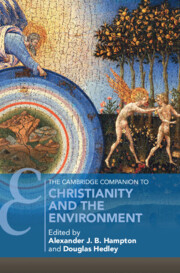
Hampton, Alexander J. B., and Douglas Hedley, eds. The Cambridge Companion to Christianity and the Environment, Cambridge Companions to Religion. Cambridge: Cambridge University Press, 2022.

Description
Christianity has understood the environment as a gift to nurture and steward, a book of divine revelation disclosing the divine mind, a wild garden in need of cultivation and betterment, and as a resource for the creation of a new Eden. This Cambridge Companion details how Christianity, one of the world’s most important religions, has shaped one of the existential issues of our age, the environment. Engaging with contemporary issues, including gender, traditional knowledge, and enchantment, it brings together the work of international scholars on the subject of Christianity and the Environment from a diversity of fields. Together, their work offers a comprehensive guide to the complex relationship between Christianity and the environment that moves beyond disciplinary boundaries. To do this, the volume explains the key concepts concerning Christianity and the environment, outlines the historical development of this relationship from antiquity to the present, and explores important contemporary issues.

  • Introduces the key concepts that have shaped the relationship between Christianity and the Environment
  • Offers a history of the relationship between Christianity and the Environment, with each period treated by an expert in the field
  • Engages with numerous key issues, such as gender, traditional knowledge, and enchantment

Heterotopic World Fiction. Thinking Beyond Biopolitics with Woolf, Foucault, Ondaatje
Lesley Higgins and Marie-Christine Leps

In the series Studies in Comparative Literature and Intellectual History, Academic Studies Press, 2022. De Gruyter
https://doi.org/10.1515/9781644699966

Interview with the authors on the New Books Network, 6 January 2023

About this book
This book demonstrates how world fiction by Woolf, Foucault, and Ondaatje counters biopolitics with aesthetic and political—biopoetic—strategies producing transhistorical, transnational experiences offered to the reader for collective responsibility. It defines and explores heterotopic processes fostering a slant perspective that is feminist, materialist, anti-racist, and anti-war.

Author information
Lesley Higgins, Professor of English at York University, specializes in late Victorian and modernist studies. Author of The Cult of Ugliness: Aesthetic and Gender Politics, she has also edited three volumes of Gerard Manley Hopkins’s prose. Research interests include world literature, feminist studies of modernism, textual studies, and poetry.

Marie-Christine Leps, Associate Professor of English at York University, is founding coordinator of the Graduate Diploma in World Literature. Author of Apprehending the Criminal: The Production of Deviance, she specializes in literary and cultural theory, world literature, and discourse analysis. Her current project focuses on world fictions of friendship.

Gullette, M. M. (2022). Reflections on the Turn to Ageism in Contemporary Cultural Discourse. Theory, Culture & Society
https://doi.org/10.1177/02632764221113732

Abstract
Distinguished gerontologists, ‘guardians of later life’ who had long kept age and ageism at the heart of their work, were asked by the author why the turn to ageism had not been able to raise age consciousness more effectively in the media or the public. Their frank responses constitute a valuable archive of reflections about how intersectional concepts and activist passions develop in an emerging and contentious multi-disciplinary field. The essay further situates their learned critiques in the history of age studies over the last 30 years. Among the sorrowful and galvanizing revelations provoked by the Eldercide of the COVID-19 era is this: ‘ageism’ has become widely recognized as a keyword not only good to think with but necessary to act on.

Extract
“Major intellectual and theoretical weaknesses got in the way of discovering ageisms wherever they lurked. Stuart Hall wrote that, thanks to Foucault and Gramsci, ‘the sense of the concrete historical instance . . . has always been one of culturalism’s principal strengths’ (2019: 67). But were enough people who considered themselves gerontologists or age critics well trained as ‘culturalists’ (in a broad sense that could include symbolic and material factors and power relations)?”

Foucault, M. (2022). Linguistics and Social Sciences. Theory, Culture & Society, First published online June 20, 2022
https://doi.org/10.1177/02632764221091549

Abstract
Written with the suppression of the Tunisian students by their own government in view, Michel Foucault’s March 1968 ‘Linguistics and Social Sciences’ opens up a new horizon of historical inquiry and epitomises Foucault’s abiding interest in formulating new methods for studying the interaction of language and power. Translated into English for the first time by Jonathan D.S. Schroeder and Chantal Wright, this remarkable lecture constitutes Foucault’s most explicit and sustained statement of his project to revolutionise history by transposing the analysis of logical relations into the history of knowledge.

Introduction to Michel Foucault’s ‘Linguistics and Social Sciences’
Translator’s note, Jonathan D.S. Schroeder

Shortly after the publication of The Order of Things (1966), Michel Foucault obtained a leave of absence from the University of Clermont-Ferrand to teach philosophy at the University of Tunis. He moved to Sidi Bou Saïd in September 1966, and he stayed in post until October 1968. This brief period proved wildly transformative: Foucault shaved his head and drafted The Archaeology of Knowledge; at the same time, he was radicalised by a series of anti-colonial and anti-imperial student protests, which began as a response to the Six-Day War of 1967, were exacerbated by Hubert Humphrey’s visit to Tunisia in early 1968 and culminated on 15 March 1968 when thousands of Tunisian students gathered outside of the University of Tunis. They accused the Tunisian government of supporting US imperialism, called for the end of the Vietnam War, condemned Zionism and called on the Tunisian government to investigate torture and corruption. Authorities responded with violence, arresting over 200 students, torturing many and holding all without trial until September of that year (Medien, 2020: 495–6). During these months, Foucault allowed students to use his apartment as an organising space, hid a printing press in his garden so activists could print posters detailing the names of imprisoned Tunisians, gave sanctuary to student leader Ahmed ben Othmani, donated money for his legal defence and provided deposition testimony at Othmani’s September hearing (Hendrickson, 2013: 89–90). At the same time, he read texts by Leon Trotsky, Rosa Luxembourg, and the American Black Panthers. ‘It wasn’t May of ‘68 that changed me’, Foucault recalled. ‘It was March of ‘68, in a Third World country’ (1991 [1981]: 136).
[…]

Petite philosophie du col roulé
Frédéric Manzini publié le 20 octobre 2022, Philosophie magazine

Quel est le point commun entre les Black Panthers, Bruno Le Maire, Emmanuel Macron et le philosophe Michel Foucault ? Le col roulé bien sûr ! Ce vêtement fait beaucoup parler ces derniers temps parce qu’il incarnerait l’effort de sobriété auquel les Français sont conviés. Mais c’est passer un peu vite sur toute la symbolique d’un vêtement plus emblématique qu’il n’y paraît : si l’habit ne fait pas le moine, que fait le col roulé ?
[…]

Le col roulé des philosophes
Certains philosophes, de fait, ont eux aussi adopté le col roulé. On pense notamment à Bruno Latour, qui le portait parfois encore récemment, à Simone de Beauvoir à Jean-Paul Sartre et surtout à Michel Foucault, qui l’arborait si régulièrement qu’il lui est associé dans l’imaginaire collectif. Michel Foucault, qui le portait volontiers moulant et blanc, osait d’ailleurs l’assortir d’un blouson de cuir noir qui n’était pas sans évoquer la tenue des Black Panthers américains. Et cela n’a sans doute rien de fortuit : il les avait rencontrés personnellement à l’occasion d’un voyage aux États-Unis en 1970 et il est établi que cette rencontre a joué un rôle décisif dans la prise de conscience politique du philosophe. Alors que durant les années 1960, il se positionnait essentiellement comme un historien des idées et des sociétés, Foucault devint dans les années 1970 un militant davantage engagé dans les luttes politiques. Son habillement rappelait, à sa manière, ceux qui ont contribué à l’inspirer.
[…]

Younès Ahouga, « L’Organisation internationale pour les migrations et la surveillance des populations de déplacés du Sud », Revue européenne des migrations internationales, , vol. 38 – n°3 et 4 | 2022,
DOI : https://doi.org/10.4000/remi.21420

Resumé

L’Organisation internationale pour les migrations (OIM) prône l’usage des données pour stabiliser les populations de déplacés du Sud. Durant les années 2010, elle développa et perfectionna trois technologies numériques les ciblant : la Matrice de suivi des déplacements, le système de surveillance des frontières MIDAS et l’application mobile MigApp. Cet article avance que ces technologies convergent en un agencement de surveillance qui disciplinerait les déplacés selon une rationalité biopolitique et la production technocratique des données. Cet agencement délimite des espaces cognitifs et physiques pour capturer et relâcher les déplacés et leurs données en cinq étapes de surveillance : observation, standardisation des données, application de mécanismes de sécurité, capture disciplinaire, capture responsabilisante. Bien qu’il produise des données à l’utilité incertaine et qu’il ignore les politiques de sécurisation des États du Nord, l’agencement légitime l’autorité de l’OIM dans un champ humanitaire qui ne relève pas de ses prérogatives historiques.

Mots-clés : déplacement de population, surveillance, biopolitique, numérique, humanitaire

Abstract
The International Organization for Migration (IOM) advocates for the use of data to stabilize the displaced populations of the global south. During the 2010s, it developed and enhanced three digital technologies targeting them: the Displacement Tracking Matrix, the border surveillance system MIDAS, and the mobile application MigApp. This article argues that these technologies converge into a surveillant assemblage that seeks to discipline displaced people according to a biopolitical rationality and the technocratic production of data. This assemblage delineates cognitive and physical spaces to capture and release displaced people and their data through a five-step surveillance: observation, standardization of data, application of security mechanisms, disciplinary capture, empowering capture. While the assemblage produces data of uncertain usefulness and ignores the securitization policies of the global north, it legitimizes the authority of the IOM within a humanitarian field that falls outside its historical prerogatives.

Keywords: population displacement, surveillance, biopolitics, digital, humanitarian

La Organización Internacional para las Migraciones (OIM) aboga por el uso de datos para estabilizar las poblaciones desplazadas del sur. Durante la década de 2010, desarrolló y perfeccionó tres tecnologías digitales dirigidas a los desplazados: la Matriz de seguimiento de desplazamiento, el sistema de vigilancia de fronteras MIDAS y la aplicación móvil MigApp. Este artículo sostiene que estas tecnologías convergen en un arreglo de vigilancia que disciplinaría a los desplazados de acuerdo con la racionalidad biopolítica y la producción de datos tecnocráticos. Este arreglo delimita los espacios cognitivos y físicos para capturar y liberar a los desplazados y sus datos en cinco etapas de vigilancia: observación, estandarización de datos, aplicación de mecanismos de seguridad, captura disciplinaria, captura empoderadora. Aunque produce datos de utilidad incierta e ignora las políticas de securitización de la migración de los estados del norte, el arreglo legitima la autoridad de la OIM en un campo humanitario que cae fuera de sus prerrogativas históricas.

Palabras claves: desplazamiento de población, vigilancia, biopolítica, digital, humanitaria

Polan, Dana, Review, H-France Review, Vol. 20 (August 2020), No. 149, pp.1-4.

Michel Foucault, Patrice Maniglier, and Dork Zabunyan, Foucault at the Movies, ed. and trans. Clare O’Farrell. New York: Columbia University Press, 2018

First, let’s get the issue of the title out of the way: Michel Foucault, it seems, was in his adult years actually not much of a moviegoer. (It appears, though, that young Michel was quite enamored of Disney’s Snow White and the Seven Dwarves, seeing it multiple times.) And beyond an entertainment realm of moving images (“movies”) that he really did not seem to have much to do with, Foucault doesn’t even appear to have fit the mold of that notorious intellectual figure that is the Parisian cinephile. Not only did he not go much to the movies, but Foucault wasn’t really centered on “cinema” (the French title has it as “Foucault va au cinéma”).

I should make clear that this is not so much a question of translation—indeed, neither “movies” nor “film” really could capture Foucault’s relation to visuality—as of the very idea of a book on Foucault and the motion picture. Indeed, the book’s translator, the eminent Foucault scholar Clare O’Farrell, does a great job with the material at hand. Her translator’s notes show, for instance, the adept and astute choices she has made along the way.
[…]
Read more

Théâtre « Herculine Barbin : archéologie d’une révolution ». Unidivers.fr

2023-05-09 20:30:00 – 2023-05-09

Et à partir du 15 novembre 2022 au Théâtre 14 Paris

7 17.5 EUR Dans une scénographie et des lumières splendides, deux comédiens exceptionnels incarnent un sujet hors normes, adapté du journal intime d’une hermaphrodite français.e du XIXème siècle.

Un siècle plus tard, le philosophe Michel Foucault, qui a révolutionné la question de la sexualité, retrouve et publie cet incroyable récit original.

On en sort bouleversés et saisis. Durée 1h30. Présenté par les Amis du Théâtre de Dax.

Dans une scénographie et des lumières splendides, deux comédiens exceptionnels incarnent un sujet hors normes : la question de la sexualité et le récit intime d’Hercule Barbin. Un très grand moment de théâtre, puissant et humain.
Durée 1h30. Présenté par les Amis du Théâtre de Dax.

+33 5 58 56 86 86

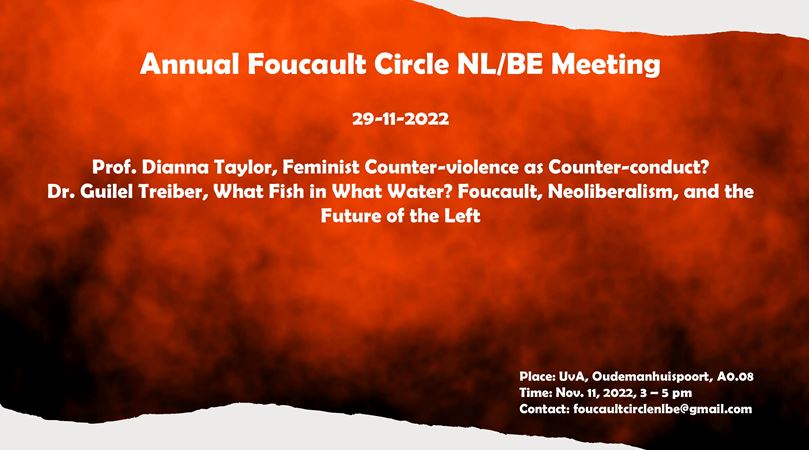
After a hiatus of more than two years due to COVID restrictions and other factors, we hope to meet all of you again at a live event on November 29th from 15.00-17.30 at the University of Amsterdam, with two keynote presentations followed by an annual meeting in which plans, projects and organizational matters can be briefly discussed.

We hope to welcome you all in Amsterdam!

Casper Verstegen
On behalf of the equipe Foucault Circle NL/BE
Karen Vintges / Michiel Leezenberg / Guilel Treiber / Casper Verstegen
Contact: foucaultcirclenlbe@gmail.com

Annual Meeting Foucault Circle NL/BE

29-11-2022

Universiteit van Amsterdam, Oudemanhuispoort, room A0.08, 15.00 – 17.15

***

Keynotes

15.00 – 15.30 Guilel Treiber, What Fish in What Water? Foucault, Neoliberalism, and the Future of the Left

15.30 – 16.30 Dianna Taylor, Feminist Counter-violence as Counter-conduct?

***

16.30 – 17.15 Annual Meeting

Drinks

=============

Guilel Treiber is a postdoctoral researcher at the Institute of Philosophy, KU Leuven. He teaches the history of philosophy and political theory in Amsterdam and Groningen and is the author of numerous articles emphasizing the radicality of Foucault’s political theory.

Abstract:
To the question can we criticize Foucault, we must respond with a resounding yes. Foucault is not a saint, and even saints should be criticized. Yet when we criticize him, it should be on firmer grounds than biographical conjectures and fallacious logical inferences. Some of Zamora and Dean’s critique of Foucault’s impact on the Left can be summed up as such. Yet when their critical account does work, they can be said to apply to Foucault the same reproach he applied to Marx in The Order of Things. There is nothing in Foucault’s work that can challenge neoliberalism. Foucault is like a fish in its entrepreneurial waters, he cannot be used to criticize it. His work is a product of what led to its rise and ended up nourishing it.
This more serious challenge seems to rest on a few mistaken moves which, if Foucault’s work is used correctly, could have been avoided while still criticizing him. Firstly, the reduction of govermentalities and powers to one overarching, hegemonic governmentality. Secondly, the assumption that limit experience has no emancipatory potential, let alone a collective one. Thirdly, the mixing up of the theological and the political. Fourthly, the minimization of the causes that led to the collapse of the ‘old’ left and a disregard to the massive emancipation of underrepresented communities since the 70s. Lastly, a reduction of the work to the vagueries of an individual existence. In this paper, I will demonstrate how one can criticize Foucault and show that instead of essentializing a rift in the Left by pitting Foucault against Marx, it would be better to work to construct a synthesis of Foucault and Marx.

Dianna Taylor is Professor of Philosophy at John Carroll University in Cleveland, Ohio, USA. She was Coordinator of the U.S. Foucault Circle from 2010-2016. Taylor is co-editor (with Karen Vintges) of Feminism and the Final Foucault (2004), editor of Foucault: Key Concepts (2014), and author of Sexual Violence and Humiliation: A Foucauldian-Feminist Perspective (Routledge 2020)

Abstract:
On 24 June, 2022, the U.S. Supreme Court issued its decision in the case, Dobbs v. Jackson Women’s Health Organization. Dobbs decision eradicated abortion as a constitutional right in the U.S., a right which had been established in Roe v. Wade (1973) and reasserted in Planned Parenthood of Southeastern Pennsylvania v. Casey (1992). The fact that Dobbs is the law of the land lends new significance to a question many feminists have been asking for a long time: can a legal system that is both grounded in and reasserts oppressive gendered relations of power ultimately provide conditions for the possibility of women’s freedom?
Increasingly, U.S. feminists are saying it cannot. They are therefore exploring extra-legal and more broadly non-institutionalized strategies and practices for countering current configurations of gender oppression. These feminist strategies and practices of resistance can be considered a form of what Foucault refers to as “counter-conduct.” Feminists have traditionally refrained from using violence, itself an embodied practice, to counter women’s oppression on the grounds that violence is merely a tool of oppressors. Judith Butler’s 2020 book, The Force of Non-violence, largely reflects this stance. Yet Butler still acknowledges that counter-violence may be needed to bring down oppressive regimes. Is normative gender an oppressive regime? If so, in what specific situations might counter-violence function as a form of feminist counter-conduct rather than merely reproducing the same oppressive conditions it seeks to combat? And what does a specifically feminist form of counter-violence look like?