Foucault News

News and resources on French thinker Michel Foucault (1926-1984)

Lodovica Braida, Anonymity in Eighteenth-Century Italian Publishing. The Absent Author, Palgrave-Macmillan, 2022

This book focuses on the different forms in which authorship came to be expressed in eighteenth-century Italian publishing. It analyses both the affirmation of the “author function”, and, above all, its paradoxical opposite: the use of anonymity, a centuries-old practice present everywhere in Europe but often neglected by scholarship. The reasons why authors chose to publish their works anonymously were manifold, including prudence, fear of censorship, modesty, fear of personal criticism, or simple divertissement. In many cases, it was an ethical choice, especially for ecclesiastics. The Italian case provides a key perspective on the study of anonymity in the European context, contributing to the analysis of an overlooked topic in academic studies.

The introduction focuses on the aim of the book: to analyse the development of the “author function” (defined as such by Michel Foucault in 1969) in Italian states during the eighteenth century, and, above all, its paradoxical opposite: the choice made by many authors to publish their works anonymously. This absence of the author’s name has its own historical, social and cultural relevance. However, despite the importance of this issue, there are still no studies on the Italian case. There are various reasons why authors chose to publish their works anonymously: the political and religious context in which a work is published, the personal needs of the author or the genre of the work. In this perspective, it is fundamental to study anonymity and the affirmation of authorship as two faces of the same coin, not only because the two possibilities coexist before and after the affirmation of copyright, but also because the same author may choose to publish some works using his name on the title page and others anonymously. A socio-cultural perspective allows us to take into account what a literary and author-centred perspective does not allow. It recounts the story of a proliferation of editions controlled neither by the first printer nor by the author, of a mobility of texts, transformed into different editions, sometimes merged with others. And, unlike the idealisation of texts assigned, in literary tradition, to an author, this perspective invites us to take into account the denial of intellectual responsibility. In other words, the silence of the author.

Lodovica Braida is Professor of History of the Book at the University of Milan, Italy. Her work is devoted to the history of written culture and reading practices in early modern Europe, particularly in Italy, in a perspective of sociocultural history that dialogues with bibliography, literary criticism, and intellectual history.
Foucault/Benjamin: storia, violenza, soggettivazione a cura di Valentina Moro
materiali foucaultiani, volume IX, numero 17-18 (gennaio-dicembre 2020)
(Backdated)

Open access

SOMMARIO

Foucault/Benjamin: storia, violenza, soggettivazione
a cura di Valentina Moro

Introduzione : Foucault/Benjamin. Genealogie et costellazioni concettuali (pp. 5-11)
Valentina Moro

Politicità e impoliticità del comune. Pensiero della comunità e filosofia della storia in Benjamin e Foucault (pp. 13-32)
Andrea Di Gesu

Storicizzare l’origine, pensare il discontinuo. Tentativi di archeologia del presente (pp. 33-50)
Arianna Lodeserto

What “Truly” Makes Us. Benjamin and Foucault on the Concept of Violence (pp. 51-80)
Guilel Treiber

Soggetti del capitale. Benjamin e Foucault lettori di Marx (pp. 81-102)
Alessandro Simoncini

Photography, Multiplicity, Promiscuity. Michel Foucault and Walter Benjamin (pp. 103-126)
Anton Lee

Saggi e interviste

La gouvernementalité et après. Entretien avec Colin Gordon (pp. 129-156)
William Walters & Martina Tazzioli

Foucault/Badiou : d’un événement à l’autre (pp. 157-185)
Norman Madarasz

“Capirci qualcosa” dell’amicizia. Note foucaultiane per una storia delle emozioni (pp. 187-216)
Lorenzo Petrachi

Russell-Mayhew, S., Estefan, A., Moules, N.J., Lefebvre, D., Morhun, J.M., Saunders, J.F., Wong, K., Myre, M.
The optics of weight: expert perspectives from the panopticon and synopticon (2022) Psychology and Health

DOI: 10.1080/08870446.2022.2117810

Abstract
Objective: That we all weigh something is a fact of life, yet the material reality of weight is refracted through multiple layers of surveillance revealing contradictions in experience and understanding, depending on one’s vantage point. We explored the complexities of weight with the specific aim of furthering understanding of this multifaceted surveillance.

Methods and Measures: We used hermeneutics, the philosophy and practice of interpretation, as the method of inquiry. Ten experts by experience and seven professional experts participated in interviews, which were audio- recorded, transcribed, and analyzed. Interpretations were developed through group discussions among the eight authors and reiterative writing.

Results: Using the metaphor of optics, we demonstrate how the interplay of the panopticon (the few watching the many) and synopticon (the many watching the few) help us gain a deeper understanding of weight through “fitting in,” being “captured by numbers,” “dieting: the tyrannic tower,” and “the male gaze.”

Conclusion: Monitoring and judging body weight have become so normative in Western society that “weight watching” practices are synonymous with good citizenship and moral character. This study offers insight about how weight is conceptualized in personal and professional contexts, with implications for body image, dieting, eating disorders, public health, and weight bias.

Author Keywords
Foucault; Gadamer; hermeneutics; panopticon; synopticon; weight

Alekseeva-Karnevali, O.A.
India’s Strategic Culture: In Search of a Systemic Element
(2022) Russia in Global Affairs, 20 (3), pp. 134-156.

DOI: 10.31278/1810-6374-2022-20-3-134-156

Abstract
India is emerging as a global power, but its strategic culture remains largely understudied. Expert literature calls into question the very existence of India’s own “systemic” strategic thinking. The article probes into the validity of this viewpoint, postulates that India has its own strategic culture, and highlights its key elements. With the help of Michel Foucault’s genealogical method, the genealogy of the concepts of ‘war’ and ‘power’ in Indian political philosophy is examined and, on this basis, the central conceptual elements of India’s military-political system are determined. This approach shows that India’s strategic culture is distinguished not only by its own systemic strategic thinking, but also by an original (different from the Western one) way of structuring and coding the conceptual space of ‘society,’ ‘politics,’ and ‘statehood.’ This gives an idea of how war and strategy were understood in Indian culture in the past and how they are seen today. The article offers a cautious forecast of what elements of India’s strategic thinking may persist in the long term, and what geopolitical implications this may have for the future of Russia-India relations. © 2022, Foreign Policy Research Foundation. All rights reserved.

Author Keywords
Code; Deconstruction; Geopolitics; India; Information war; Nonviolent resistance; Political philosophy; Power; Strategic culture; War


NIETZSCHE, LA POLITIQUE, L’HISTOIRE

Catégorie : conférence/cours/séminaire (spécialisé)
Date : 29/11/2022 09:30 – 30/11/2022 17:00
Lieu : UNamur – UCLouvain
Organisateur(s) : FNRS, Esphin & Arcadie (UNamur) et ISP (UCLouvain)
Contact : Nicolas Monseu, Jean Leclercq, Pieter De Corte, Vivien Giet – +32 (0)81 72 40 94 – vivien.giet@unamur.be

Programme

Jour 1 | 29 novembre 2022- Université de Namur – Salle académique

Ouverture du colloque

9h30 Nicolas Monseu (UNamur) :  Mots de bienvenue

Pieter De Corte (UCLouvain – Sorbonne Université) et Vivien Giet (UNamur – Université Paris 8) : Nietzsche face à l’histoire. Enjeux et problématiques d’une réception politique

Perspectives sur l’histoire

10h  Patrick Wotling (Université de Reims-Champagne-Ardenne) : La déraison instructive. Le rôle de l’histoire dans la tâche du philosophe selon Nietzsche

10h45 Paul Slama (FNRS – Bergische Universität Wuppertal): Psychologie et histoire chez Nietzsche et Weber

11h30 Pause

11h45 Jean-Claude Monod (École Normale Supérieure) : Quelle sortie des philosophies de l’Histoire ? Nietzsche et les religions de substitution

12h30 Pause midi

Critique et (post)modernité

14h Vivien Giet (UNamur – Université Paris 8) : Nietzsche, lecteur de Foucault et Deleuze : repenser la négativité en politique

14h45 Quentin Dubois (Université Paris 8) : Sémiotiques pulsionnelles : Klossowski, lecteur de Nietzsche 

15h30 Pause

15h45 Martine Prange (Tilburg University): Nietzsche and the Necessity of a new Truth Question in Post-Truth Times

16h30 Fin des travaux

Jour 2 | 30 novembre 2022 – Université catholique de Louvain – Sénat Académique

La politique nietzschéenne en question

10h Martin A. Ruehl (University of Cambridge): Nietzsche’s New Order: Towards a Post-Christian Politics

10h45 Vanessa Lemm (University of Melbourne – Universidad Complutense de Madrid): Nietzsche’s Agonistic Politics Reconsidered

11h30 Pause

11h45 Pieter De Corte (UCLouvain – Sorbonne Université) : Nietzsche et le « temps des constructions cyclopéennes ». L’âge démocratique comme époque de transition

12h30 Pause midi

Penser les mutations historiques

14h00 Antoine Daratos (Université Libre de Bruxelles) : Mouvements et contre-mouvements : la question des transformations politiques chez Nietzsche

14h45 Daniele Lorenzini (University of Pennsylvania): Nietzsche’s Genealogical Perfectionism

15h30 Pause

15h45 Carlotta Santini (EHESS – CNRS) : Révolution et Réaction : paradigmes historiques comparés entre Nietzsche et Burckhardt

Conclusion du colloque

16h30 Pieter De Corte (UCLouvain – Sorbonne Université) et Vivien Giet (UNamur – Université Paris 8) : Nietzsche, la politique, l’histoire : conclusions et perspectives

Mark Haugaard (2022): Foucault and Power: A Critique and Retheorization,
Critical Review,

DOI: 10.1080/08913811.2022.2133803

Abstract
From the perspective of sociological theory, Foucault’s concepts of power, power-knowledge, and discipline are one-sided. While Foucault contends that there is no center of power, his account of power remains top-down or structural, missing the interactive and enabling aspects of power. A more balanced view would suggest that all exercises of power include meaningful agency (the ability to do something); social structures (not simply as constraints but as interactive creations); social knowledge (including both reifying truth claims and enabling truth or knowledge); and social-ontological being-in-the-social-world (both as enabling and dominating).

Keywords:
Foucault agency domination power structure

Anton Lee, “Photography, Multiplicity, Promiscuity: Michel Foucault and Walter Benjamin,” Published in 2022 in a backdated volume (2020) of Materiali Foucaultiani, volume IX, numero 17-18 (gennaio-dicembre 2020)

This paper investigates the multiplicity of the photographic image theorized by Michel Foucault and Walter Benjamin in their respective writings on photography. To do so entails a set of comparisons and contrasts between the two thinkers with regard to their approaches to the historical, epistemological, and cultural specificities of photography. By putting Foucault and Benjamin side by side for the first time in regard to photography, the paper sheds light on the often-overlooked writings on the medium by Foucault, on the one hand, and puts forward a Foucauldian counterpart to Benjamin’s well-known treatise on the photographic reproducibility, on the other. In order to discuss their theories of photography on an equal footing, I first introduce and elucidate Foucault’s two essays on photography: “Photogenic Painting” (1975) and “Thought and Emotion” (1982). The synthesis of the two writings delineates a provocative understanding of photography, which argues for the transmedial, transformative, and transgressive potentials of the photographic image. Subsequently, I bring this Foucauldian theory of photography in conversation with the widely read essays on the medium by Benjamin, whose thoughts exhibit unmistakable differences from Foucault’s, even as they both agree on the significance of the photographic multiplicity. The paper locates three fronts of conflict between their approaches to photography: the specificity of the photographic medium, the relationship between photography and language, and lastly, the centrality of vision to the photographic experience.

Keywords: Michel Foucault, Walter Benjamin, Photography, Multiplicity, Reproducibility

Christensen, G.
Ethical Reflections On Ethnographic Exposure Of Exclusion in PBL-Group Learning
(2021) in Fox, A., Busher, H., & Capewell, C. (Eds.). (2021). Thinking Critically and Ethically About Research for Education: Engaging with Voice and Empowerment in International Contexts (1st ed.). Routledge.
, pp. 107-119.

DOI: 10.4324/9781003094722-9

Abstract
This chapter will address ethnographic exposure of exclusion in group learning: problem-based learning at Danish universities. The empirical data consists of qualitative interviews in groups and individually with students, teachers and administrators, a qualitative questionnaire, an ethnographic field study of students working in groups and a number of texts about small-group learning. The research project was founded on, firstly, a curiosity in what is actually going on when students are left to themselves in the PBL groups. Secondly, the project was inspired by Michel Foucault’s concepts of power, subjectification and critique in this case of the way groups are naturalised in the Danish pedagogical discourse as fundamentally good and unproblematic – which is far from the student’s experiences. Thus, the values were attached to doing critical research in a Foucauldian sense. Although conventional ethical principles and practices of informed consent, opportunities to withdraw and anonymisation were followed, on reflection the author is uncertain if the participants were directly empowered by the research. This chapter uses the concept of ethos, i.e. an obligation for the researcher to rethink the researcher role and, to paraphrase Foucault, what they are doing with what they are doing, which may be equivalent with giving the participants a voice. © 2022 selection and editorial matter, Alison Fox, Hugh Busher, Carmel Capewell; individual chapters, the contributors.

Jonasson, K., Eriksson, J.
Sovereign Surfing in the Society of Control: The Parkour Chase in Casino Royale as a Staging of Social Change
(2022) Social Sciences, 11 (8), art. no. 357

DOI: 10.3390/socsci11080357

Abstract
In “Postscript on Societies of Control”, French philosopher Gilles Deleuze proclaimed that “Everywhere surfing has replaced the older sports”. By this, he alluded to Foucault’s thoughts on older societal regimes and power diagrams of sovereignty and discipline, and that now such models have been supplemented with governance through control and allegations of increased freedom. This article has as its point of departure the potential of sports to reflect social change. Contemporaneously to the coining of Deleuze’s surfing sentence, a new sport emerges: parkour, in which practitioners “surf” the urban realm. This practice gained attention globally when it was featured in the 2006 James Bond film Casino Royale. The analysis in this article revolves around the different ways of moving in and through the environment in the renowned parkour chase in the beginning of the movie. How do different kinds of displacement in the parkour chase of Casino Royale relate to the transition between the societies described by Deleuze, and what new adaptations emerge and what old logics and models return? It is concluded that the older forms of power prevail and that the ideal of the society of control cannot be realised. © 2022 by the authors.

Author Keywords
control; discipline; Gilles Deleuze; James Bond; Michel Foucault; movement; parkour; social change; sovereignty; surfing

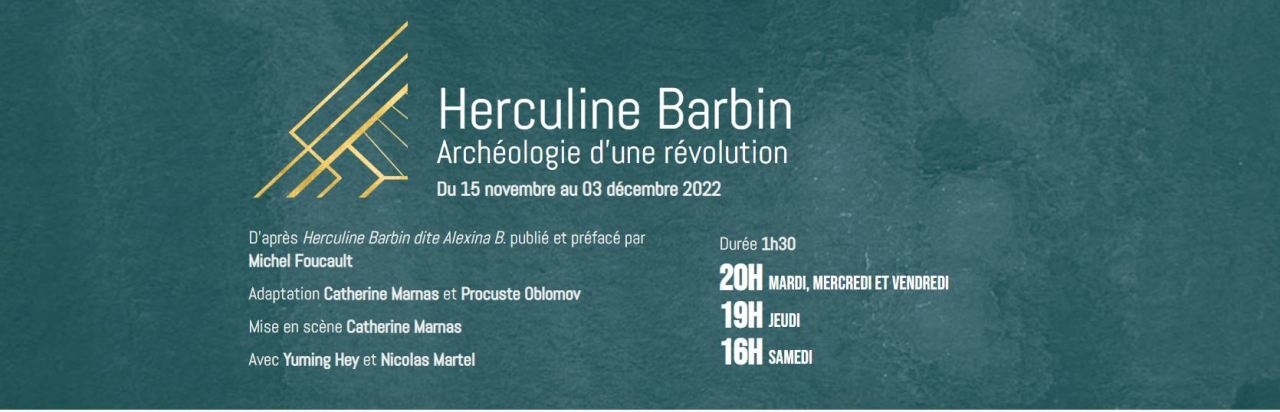
Herculine Barbin. Archéologie d’une révolution
Du 15 novembre au 03 décembre 2022

D’après Herculine Barbin dite Alexina B. publié et préfacé par Michel Foucault
Théâtre 14
20 avenue Marc Sangnier 75014 Paris

Adaptation Catherine Marnas et Procuste Oblomov
Mise en scène Catherine Marnas
Avec Yuming Hey et Nicolas Martel

Le projet
1868. Dans une mansarde sous les toits de Paris, le médecin légiste découvre le corps inanimé d’Abel Barbin, vingt‑huit ans, une lettre expliquant son suicide, et un manuscrit intitulé Mes souvenirs. C’est ce livre, aujourd’hui disparu, rarissime récit d’une personne intersexe, exhumé par Michel Foucault et identifié par certains chercheurs comme l’acte de naissance des gender studies, que Catherine Marnas adapte. Avec douceur, tendresse et empathie, elle redonne vie aux souvenirs d’abord heureux d’Herculine, et comme un album photo que l’on feuillette à l’envers, remonte le temps : une enfance pauvre, l’éducation des pensionnats religieux comme ascenseur social, la découverte du désir et la recherche de liberté dans une société qui en offre si peu aux femmes. Jusqu’au point où tout bascule. Brutalement déclarée de sexe masculin, elle est exclue de l’univers dans lequel elle a jusque-là évolué, puis lancée sans ménagement dans le monde des hommes.

La metteuse en scène s’appuie sur la fluidité de l’envoûtant acteur-performeur Yuming Hey pour incarner Herculine. À ses côtés, fondu dans les voiles légers et flous, qui sont comme autant de surfaces de projections mémorielles, Nicolas Martel joue les entremetteurs d’époques entre le xixe siècle et aujourd’hui. Entre les deux, le masculin vacille.