Foucault News

News and resources on French thinker Michel Foucault (1926-1984)

James, K., Elliott, S.
Student-Led Cricket Matches as a Product of Coaching/Mentoring An Autoethnographic Account (2023) Boyhood Studies, 16 (1), pp. 40-64.

DOI: 10.3167/bhs.2023.160104

Abstract
Using a historical, autoethnographic approach in this article, we discuss six student-led cricket matches that we organized in Perth, Australia, from 1979 to 1981. From a Foucauldian perspective, we present these games as a student-led resistance against the normalizing and disciplinary processes of official school and youth cricket. The original scoresheets and match summaries exist both then and now only as subjugated knowledges. As these matches’ two captains, we attribute the positive atmosphere, which encouraged such creative initiatives, as being partly due to one class teacher’s vision and ethos, which contrasted with the toxic hypermasculinity of the other men teachers. Through a look at our student-led cricket matches of 1979–1981, we recall memories of whiteness within a socially conservative and overall pro-British cultural context. © 2023 the Author(s)

Author Keywords
autoethnography; cricket; Foucault; negative effects of coaching; subjugated knowledges; youth sport

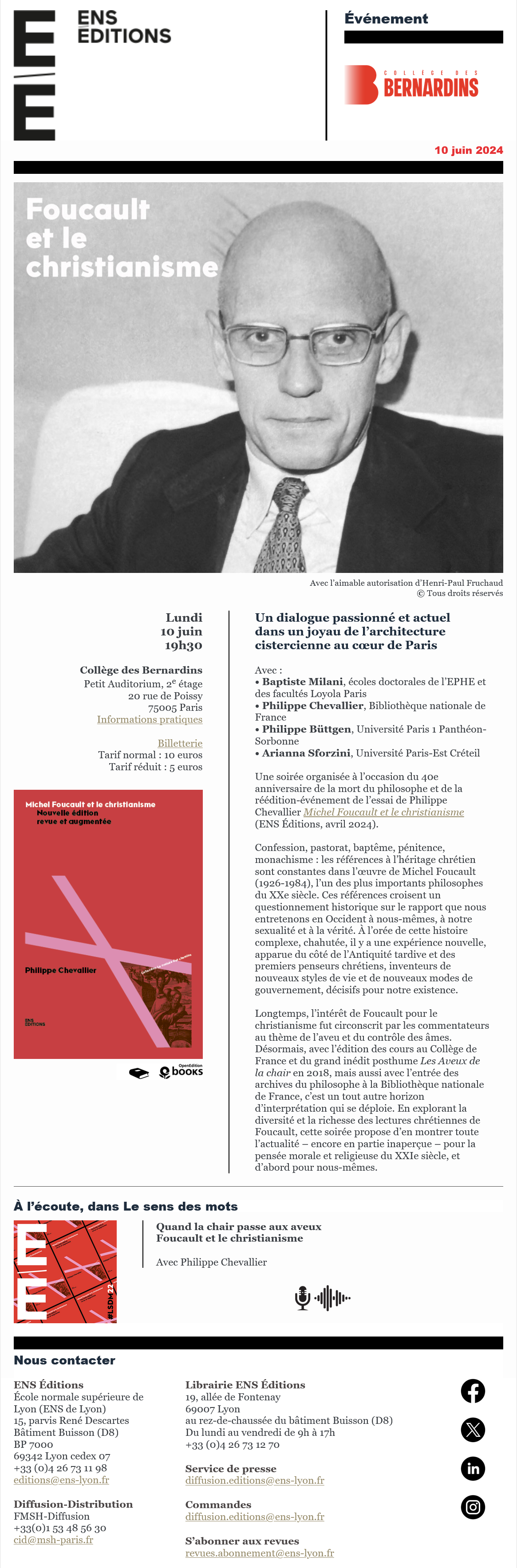
Michel Foucault et la théologie politique. Sous la direction de Agustín Colombo, Laval théologique et philosophique, Volume 79, numéro 3, 2023, p. 327-497, Diffusion numérique : 13 novembre 2023

Dossier

Liminaire — Michel Foucault et la théologie politique : un rapport problématique
Agustín Colombo et Jean Leclercq

Théologie politique et pouvoir pastoral : Foucault contre Agamben
Rodrigo Castro Orellana

Oikonomia et regimen : à propos d’une critique de M. Foucault par G. Agamben
Michel Senellart

Foucault, Cassien et le paradoxe monastique
Ostiane Lazrak

La spiritualité comme liberté : à propos du rapport entre expérience et action chez le dernier Foucault
Agustín Colombo

Articles hors thème

Agustín Colombo, Christianisme et subjectivité chez Michel Foucault, Hermann, 2023.

Quel est le rôle que Michel Foucault attribue au christianisme dans la formation de la subjectivité ? Faut-il conclure que, pour lui, le christianisme constitue exclusivement le noyau formateur des principales dynamiques de pouvoir qui gouvernent et façonnent la subjectivité contemporaine ? Ou peut-on, en revanche, saisir dans ses recherches une autre dimension du christianisme ? Pour répondre à ces questions, cet ouvrage interroge la valeur généalogique que Foucault accorde au christianisme vis-à-vis de la subjectivité, mais aussi le rôle central que celui-ci joue chez le philosophe en tant que champ d’élaboration de sa propre approche de la subjectivité. Pour déployer cette double ligne d’analyse, nous nous appuyons particulièrement sur le quatrième et dernier volume de l’Histoire de la sexualité, “Les Aveux de la chair”, consacré à l’étude des Pères de l’Église et publié de manière posthume en 2018.

Agustín Colombo (Auteur)
Agustín Colombo est docteur en philosophie (Université Paris 8) et en sciences sociales (Université de Buenos Aires). Il est actuellement enseignant-chercheur au Departamento de Filosofía y Sociedad de l’Universidad Complutense de Madrid. À partir des recherches de Michel Foucault, en particulier celles consacrées au christianisme, ses investigations visent à développer la critique de la subjectivité élaborée par la pensée française contemporaine.

Círculo de Estudios Foucaultianos. A new initiative based in Peru. Please contact Leonardo Banos for further details leonardo.banos@unmsm.edu.pe

¡Presentamos el Círculo de Estudios Foucaultianos!
Colectivo con la finalidad de estudiar y divulgar la obra de Michel Foucault, contribuyendo en el desarrollo de la comunidad hispanoamericana. Sigannos para mantenerse informados de nuestras actividades.

We are glad to present Foucauldian Studies Circle !
Colective with the purpose to study and spread the work of Michel Foucault, contributing in the development of the Hispanic American community. Follows us to keep up to date with our activities.

Présentation du Cercle d’études foucaldiennes !
Collectif ayant pour but d’étudier et de diffuser l’œuvre de Michel Foucault, en contribuant au développement de la communauté hispano-américaine. Suivez-nous pour être informé de nos activités.

Presentiamo il Circolo di Studi Foucaultiani!
Collettivo con l’obiettivo di studiare e diffondere l’opera di Michel Foucault, contribuendo allo sviluppo della comunità filosofica ispanoamericana. Seguici per rimanere informato sulle nostre attività.

Tilleczek, William. “On the Ownership of the Means of Training: Domination, Asceticism, and Capacities of Resistance.” Theory & Event 26, no. 4 (2023): 701-726. https://doi.org/10.1353/tae.2023.a909213.

Abstract:
This article argues that asceticism—understood in the etymological sense of “training”—can productively be incorporated into analyses of politics. It is of particular use in thinking through questions of inequality and domination. I first theorize askesis as dynamogenic, that is, productive of (political and ethical) capacities. Using case studies of Ancient Athens and twentieth century India, I then analyze askesis as a tool for producing and resisting domination, and suggest the political importance of taking control of “the means of training.” I conclude with reflections on the significance of this framework for understanding neoliberal ethics and rising fascist tendencies.

Dean, J.
From solidarity to self-promotion? Neoliberalism and left politics in the age of the social media influencer (2023) Capital and Class

DOI: 10.1177/03098168231199907

Abstract
The aim of this article is to map the contested intersections of influencer culture and left/progressive politics within the current conjuncture. Furthermore, drawing on a combination of Gramscian and Foucaultian insights, the article considers the implications of these intersections for how we theorise the relationship between neoliberalism and left politics. In so doing, my argument is threefold.

First, I suggest that social media influencers and influencer activists have turned to various forms of left politics as a means of establishing a distinctive personal brand, and heightening their social media clout. Second, I suggest that these developments have been met with something of a backlash among some left commentators, wary of the superficiality – and privileging of self-promotion over solidarity – that influencer activism entails, in keeping with a broader disaffection with what some consider to be the excessively individualistic flavour of contemporary forms of online ‘identity politics’. Third, I note that left critics of influencer activism often posit a distinction between ‘proper’ – that is, materialist, solidaristic – left politics, on one hand, and superficial, individualistic influencer activism, on the other. But, drawing on a conception of neoliberalism inspired by Foucault’s 1979 lectures, I suggest that, in a neoliberal digital capitalist context, this distinction becomes hard to sustain. This argument has two further implications. First, it becomes very difficult to extricate oneself from the imperatives of neoliberal digital culture, even if one is politically opposed to neoliberalism; and, second, the figure of the social media influencer, far from being exceptional or anomalous, is merely a more overt or extreme manifestation of logics that are already endemic in contemporary cultural and political life. © The Author(s) 2023.

Author Keywords
celebrity; identity politics; influencer culture; left politics; neoliberalism; social media

Schultz, Daniel J. Review of The History of Sexuality, Volume 4: Confessions of the Flesh, by Michel Foucault. The Comparatist 47 (2023): 413-424.
https://doi.org/10.1353/com.2023.a911953

Extract
When Volumes 2 and 3 of Michel Foucault’s The History of Sexuality appeared in 1984, a publisher’s insert announced the imminent arrival of a fourth volume, Confessions of the Flesh. The text was advertised as dealing “with the experience of the flesh in the first centuries of Christianity, and with the role played in it by the hermeneutic, and purifying decipherment, of desire” (vii). Foucault died in June 1984, and the promised fourth and final volume, scheduled to appear in October of that year, did not arrive. Daniel Defert, Foucault’s longtime partner, had the unfinished manuscript placed in a bank vault where it sat for over three decades. Until now. After its long repose in the vault, Histoire de la sexualité 4: Les aveux de la chair has seen the light of day; the unfinished French manuscript, edited by Frédéric Gros, was published by Gallimard in 2018. In 2021, Robert Hurley’s English translation was released: The History of Sexuality, Volume 4: Confessions of the Flesh (Pantheon). The English text is the subject of this review essay.

Stewart Clegg and Johan Ninan, Unravelling governmentality in project ecologies (2023) Project Leadership and Society, 4,

DOI: 10.1016/j.plas.2023.100099

Abstract
Under the rubric of project governance, governmentality has been defined as a general mode of governing people in projects, whether these projects are organized in an authoritarian, liberal, or neo-liberal mode in their approach to authority relations. We argue that governmentality is a specifically neo-liberal form of social integration, one that stresses the freedom of its subjects, and discuss how it extends governance beyond enforcing contracts and includes all stakeholders. Examples of governmentality in the modern era of projects are discussed as a proactive strategy conceptualized in five contexts in which the concept of governmentality, as governing through freedoms, has been applied in project ecologies. These include governance by contract, governance by alliancing, governance by influence, governance by co-optation, and governance by incorporation. The degree of governmentality in play increases through the sequence. © 2023 The Authors

Author Keywords
East Kimberley Clean Energy project; Foucault; Governmentality; Neo-liberal; Project governance; Rio Tinto

PDF Programa coloquio 2023

PDF Programa coloquio 2023

Michael, R., Donnar, G.
Crosshatch Fantasy: Unsettling Portals, Crisis Heterotopias, and Comings-of-Age
(2023) in Elana Gomel, Danielle Gurevitch (eds) The Palgrave Handbook of Global Fantasy, Palgrave, 2023, pp. 71-83.

DOI: 10.1007/978-3-031-26397-2_6

Abstract
This chapter introduces an intriguing concept of ‘crosshatch’ fantasy: another world that is superimposed upon consensus reality. Using Michel Foucault’s notion of heterotopia and examining two influential examples of coming-of-age crosshatch fantasy, The Dark is Rising (Susan Cooper 1973) and Elidor (Alan Garner 1965), their essay considers ‘crosshatch’ worlds as ‘counter-sites’ of crisis, transition, and maturation. In contrast to classic ‘portal’ fantasy, the heterotopic worlds in which these occur do not stay safely ‘over there’ in crosshatch fiction; they return to and irrevocably disrupt the ‘real’ world. This unsettling, transformative potential is equally true of the act of (re)reading itself. That is, entering the ‘portal’ of the fantasy text similarly constitutes a heterotopic space for the younger reader-especially when it comes to crosshatch fantasies. For protagonist and reader alike, crosshatch fantasy provides productive opportunities to come into power ‘out of sight’ before returning to a world changed ‘for ever and ever.’