Foucault News

News and resources on French thinker Michel Foucault (1926-1984)

Turnbull, M. Assembling the Crisis of COVID-19 in Australia: A Foucauldian Analysis of Prime Ministerial Press Conferences in March 2020
(2023) Genealogy, 7 (3)

DOI: 10.3390/genealogy7030066

Abstract
In this article, I present a Foucauldian analysis of the speeches made by the then Prime Minister of Australia (Mr. Scott Morrison) in March 2020. This analysis sets out to explore the political rationalities that assembled COVID-19 as a particular type of ‘problem’ that warranted unprecedented governmental intervention into the everyday lives of citizens. I believe that the insights provided by such an analysis are relevant to ongoing examination of governing in liberal democracies both during a crisis and afterwards. © 2023 by the author.

Author Keywords
Australia; COVID-19; Foucault; press conferences

CALL FOR PAPERS
The twenty-second annual meeting of the Foucault Circle
Emerson College
Boston, MA, USA
May 17-19, 2024

We seek submissions for papers on any aspect of Foucault’s work, as well as studies, critiques, and applications of Foucauldian thinking.

Paper submissions require an abstract of no more than 750 words. All submissions should be formatted as a “.doc” or “.docx” attachment, prepared for anonymous review, and sent via email to the attention of program committee chair Patrick Gamez (pgamez@nd.edu) on or before December 18, 2023. Indicate “Foucault Circle submission” in the subject heading. Program decisions will be announced during the week of January 22, 2024.

We expect that the conference will begin Friday afternoon and will conclude around lunch time on Sunday morning. Presenters will have approximately 40 minutes for paper presentation and discussion combined; papers should be a maximum of 3500 words (20-25 minutes reading time).

Logistical information about lodging, transportation, and other arrangements will be available after the program has been announced.

For more information about the Foucault Circle, please see our website: http://www.foucaultcircle.org or contact our Coordinator, Edward McGushin: emcgushin@stonehill.edu

Michael Ure, Michel Foucault’s Rhetorical Practice: The 1961 Preface to History and Madness (2023) Philosophy and Rhetoric, 52 (6), pp. 142-167.

Abstract
This article examines Foucault as a rhetorician rather than as a historian of parrhesia and rhetoric. It explores what we can learn about his philosophy by examining it through the lens of his rhetorical practices. Focusing on his famous 1961 preface to History and Madness, it suggests that Foucault’s model of philosophy entails a rhetoric of conversion or transformation.

Author Keywords
Foucault; limit-experiences; philosophy as a way of life; prefaces; rhetoric

Interview/podcast Daniele Lorenzini, The Force of Truth, Critique, Genealogy, and Truth-Telling in Michel Foucault, New Books Network, Nov 1, 2023

A groundbreaking examination of Michel Foucault’s history of truth.

Many blame Michel Foucault for our post-truth and conspiracy-laden society. In this provocative work, Daniele Lorenzini argues that such criticism fundamentally misunderstands the philosopher’s project. Foucault did not question truth itself but what Lorenzini calls “the force of truth,” or how some truth claims are given the power to govern our conduct while others are not. This interest, Lorenzini shows, drove Foucault to articulate a new ethics and politics of truth-telling precisely in order to evade the threat of relativism. The Force of Truth: Critique, Genealogy, and Truth-Telling in Michel Foucault (U Chicago Press, 2023) explores this neglected dimension of Foucault’s project by putting his writings on regimes of truth and parrhesia in conversation with early analytic philosophy and by drawing out the “possibilizing” elements of Foucault’s genealogies that remain vital for practicing critique today.

Host
Dr. Richard Grijalva is an ACLS Emerging Voices Postdoctoral Fellow with the Center for Mexican American Studies (CMAS) at the University of Texas at Austin.

Hannah Lyn Venable – Madness in Experience and History. Interview with Giorgi Vachnadze on the Silence of Savoir channel, October 28 2023

Professor Venable is an Assistant Professor of Philosophy at University of Mary. Dr. Venable specializes in History of Philosophy, Continental Philosophy (including Phenomenology, Post-modernism, Recent French philosophy), Aesthetics, Ethics, Philosophy of Psychology and Philosophical Theology.

In this installment of the Silence of Savoir we discuss Professor Venable’s latest contribution to Foucault and Merleau-Ponty studies, Phenomenology, Psychology and Genealogical History as we dive into her new book: “Madness in Experience and History: Merleau-Ponty’s Phenomenology and Foucault’s Archaeology

Giorgi Vachnadze, Review: Hannah Lyn Venable: Madness in Experience and History, Phenomenological Reviews, Tuesday October 31st 2023

Open access

It would be fitting, perhaps to start speaking of Madness in Experience and History by refusing to begin at the beginning and stepping right into the centre oscillating towards the periphery through a long and patient outwards spiral. The battleground of reason and unreason, the site of power and resistance; a space where the inside of the embodied subject meets the outside of institutional constraints; the structures offered up by history to consciousness – is the concept of the Flesh. “Flesh, for Foucault, unifies the discursive practices of society and the techniques of the self, bringing together the practices which act on the self with those which are acted by the self” (Venable, 2021).

read more

Sergei Prozorov, Biopolitics After Truth. Knowledge, Power and Democratic Life, Edinburgh University Press, 2021. 2023 paperback

  • Critically re-examines canonical theories of biopolitics in the post-truth context
    Argues for a positive role of truth-telling in the democratisation of biopolitical governance
  • Undertakes a genealogical investigation of the origins of the contemporary post-truth regime in early post-communist politics
  • Puts forward an innovative theory of the speech act of truth-telling in democratic biopolitics
  • Draws on familiar examples from contemporary politics such as Vladimir Putin, Donald Trump, Greta Thunberg and Brexit

What makes post-truth politics so difficult to resist is its apparently democratic character that claims to challenge bureaucratic depoliticisation, the rule of experts and the disappearance of alternatives to the hegemonic policy. Sergei Prozorov refutes this interpretation, arguing that the post-truth ideology leads to the degradation of the public sphere that is essential to democratic governance. Rather than enable resistance to expertise-based biopolitical governmentalities, truth denialism dissolves the only framework where their contestation and transformation could take place. In contrast, Biopolitics after Truth argues for a positive role of truth-telling in the democratisation of biopolitical governance.

With thanks to Progressive Geographies for this news

Hannah Lyn Venable, Madness in Experience and History. Merleau-Ponty’s Phenomenology and Foucault’s Archaeology, Routledge, 2022

Description
Madness in Experience and History brings together experience and history to show their impact on madness or mental illness. 

Drawing on the writings of two twentieth-century French philosophers, Maurice Merleau-Ponty and Michel Foucault, the author pairs a phenomenological approach with an archaeological approach to present a new perspective on mental illness as an experience that arises out of common behavioral patterns and shared historical structures. Many today feel frustrated with the medical model because of its deficiencies in explaining mental illness. In response, the author argues that we must integrate human experiences of mental disorders with the history of mental disorders to have a full account of mental health and to make possible a more holistic care.

Scholars in the humanities and mental health practitioners will appreciate how such an analysis not only offers a greater understanding of mental health, but also a fresh take on discovering value in diverse human experiences.

Michel Serres, Hermes I: Communication, Translated by Louise Burchill, Introduction by Paul A. Harris, University of Minnesota Press, 2023

For the first time in English, the introductory volume in a major French philosopher’s groundbreaking series of poetic transdisciplinary works

Volume one of this first English translation of Michel Serres’s foundational series establishes a new way to think about the production of knowledge during the late twentieth century. With Hermes I, we observe a singular poetic philosopher seeking to bridge the gap between the liberal arts and the sciences through a profound mathematical and poetic fable regarding information theory, history, and art.

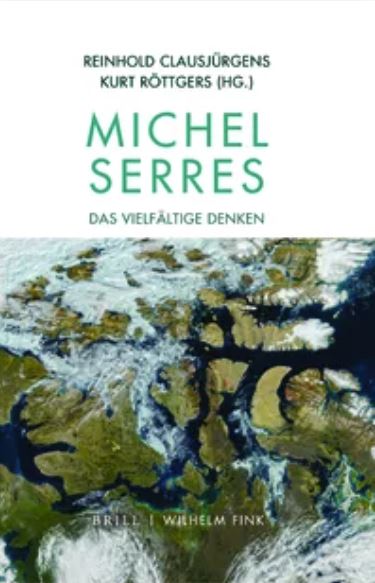
Lucie Kim-Chi Mercier, Zwischen Formalismus und Geschichte: Serres und Foucault in Clermont-Ferrand, In: Michel Serres Das vielfältige Denken, Eds Reinhold Clausjürgens and Kurt Röttgers, Brill, 2020, Pages: 193–211
DOI: https://doi.org/10.30965/9783846765142_013

First paragraph
In diesem Beitrag möchte ich zwei Autoren einander annähern, die wir vielleicht nicht gewohnt sind, zusammen zu lesen: Michel Serres und Michel Foucault. Von 1960 bis 1966 lehrten sie am Philosophie-Departement zu Clermont-Ferrand, wohin Jules Vuillemin beide eingeladen hatte, Jahre in denen sie sehr regelmäßig ihre laufenden Arbeiten diskutierten. Diese Periode deckt sich mit dem Schreiben von Les mots et des choses (1966) für den einen, von Le système de Leibniz et ses modèles mathématiques (1968) für den anderen – die noch im gleichen Jahr verteidigte und veröffentlichte Doktorats- These von Michel Serres –, zwei Bücher, die ein bemerkenswertes Echo in der philosophischen Welt der Zeit hatten, aber denen nur wenige gründliche Studien gewidmet worden sind. Über die Freundschaft dieser zwei Schüler von Canguilhem hinaus ist die Möglichkeit der Annäherung zwischen ihren Werken auf ihre damalige Ambition zurückzuführen, sich als Reflexion des Strukturalismus anzubieten. Tatsächlich wollten die beiden Bücher das Auf- kommen des Strukturalismus in einer langen Wissensgeschichte der Human- wissenschaften (Foucault) und der exakten Wissenschaften (Serres) situieren. Ihre Originalität besteht in der Art und Weise, die Probleme/Fragen/Themen des Strukturalismus im Inneren des klassischen Zeitalters wiederzufinden. Und zwar derart, dass die beiden Werke an vielen Punkten übereinstimmen, auch wenn die Archäologie von Foucault die „Autoren“ erledigt und umgekehrt das Buch von Serres die traditionelle Erscheinungsweise einer Monographie auf- recht erhält.