
Foucault News

News and resources on French thinker Michel Foucault (1926-1984)

Introduction to Post-structuralism – Essay Collection

Call for Papers Deadline: 2010-10-01

This is a call for papers for an essay collection to be entitled “Introduction to Post-structuralism.” The essay collection will consist of pedagogical, explanatory descriptions of post-structuralism to be used as references or classroom textbooks. The goal of this collection is to provide clear(er) understandings of these theorists and their works in order to further integrate them in and outside of the classroom. Submissions will need to be written for the undergraduate level of reading.

We are seeking 4 different types of submissions.

(1) Essays describing a post-structuralist from a general overview, encountering both their biographical information and academic work. Minimum word count: 7000 words.

(2) Essays describing a piece of work from a post-structuralist. Example: “Michel Foucault’s ‘History of Sexuality Vol. 1-3′”. Minimum word count: 7000 words.

(3) Essays describing post-structuralism as a field or arena of thought (along with respective qualities, foundations and other characteristics of post-structuralism), in comparison or contrast to structuralism and other modern and contemporary fields of thought. Minimum word count: 4000 words.

(4) The future, (d)evolution and (in)significance of post-structuralist thought in the future. Minimum word count: 4000 words.

The post-structuralists we would like to propose for submissions types (1) & (2) are listed below:

Kathy Acker
Giogrio Agamben
Jean Baudrillard
Judith Butler
Helene Cixous
Gilles Deleuze
Felix Guattari
Umberto Eco
John Fiske
Rene Girard
Luce Irigaray
Fredric Jameson
Sarah Kofman
Philippe Lacoue-Labarthe
Jean-François Lyotard
Jean-Luc Nancy
Bernard Stiegler
Gianni Vattimo
Michael Hardt
Antonio Negri

This essay collection will be published as a book in late 2011. Hypothetically and ideally, the book will be arranged in the following order: essay types (3) then (1) then (2) then (4). *Submissions of all types and of most post-structuralists will be needed in order to produce this publication, therefore I urge you to spread this CFP in your respective circles and circuits*.

Final versions of submissions are due no later than October 1, 2010. If you are interested in submitting, please let us know by emailing us by the following guidelines:

For submission type (1): (a) submission type, (b) post-structuralist of study, (c) full contact information

For submission type (2): (a) submission type, (b) post-structuralist of study, (c) work(s) of study, (d) full contact information

For submission type (3): (a) submission type, (b, optional/if needed) contrast/comparison to other field(s), (c) full contact information

For submission type (4): (a) submission type, (b) abstract, (c) full contact information

Submission guidelines: Please use normal margins, Times New Roman, 12 pt, black, with citations and bibliography following the most recent edition of MLA. Contributions will be made via email; no paper submissions. Must be original work and not published elsewhere.

It is our hope that all types of submissions will be more than covered by contributors and that this publication will serve as a high-quality reference and introduction to students who are willing to learn about post-structuralism.

Send submissions to:
Remington Robertson
Independent Researcher
PO BOX 1100
GLEN ROSE, TX 76043
(254) 396-0226
Email: remington.robertson@gmail.com
Social Identities. Journal for the Study of Race, Nation and Culture , Volume 16 Issue 5 2010
Special issue: Foucault 25 years on

Contents

For cutting: an introduction to Foucault, 25 years on
Ian Goodwin-Smith

Resisting Foucault: the necessity of appropriation
Ian Goodwin-Smith

Post-structuralism’s colonial roots: Michel Foucault
Pal Ahluwalia

The huntsman’s funeral: targeting the sensorium
Ryan Bishop

The post-panoptic society? Reassessing Foucault in surveillance studies
Gilbert Caluya

The paradoxical after-life of colonial governmentality
Michael Dutton

What is an anti-humanist human right?
Ben Golder

Liberalism: rationality of government and vision of history
Barry Hindess

The author, agency and suicide
Katrina Jaworski

A (con)fusion of discourses? Against the governancing of Foucault
Jim Jose

‘The History Of Sexuality Volume One By Michel Foucault: An Opera’, 2010, Premiere
Gregg Bordowitz (USA) / Paul Chan (J/USA) 01./ 02.10.10
Fri 1 Oct / Sat 2 Oct., 8.30 pm in TQW / Halle G
Tickets: € 18,- (Reductions and Online-Ticketing on http://www.tqw.at)

Gregg Bordowitz talks about his opera version of The History of Sexuality, Artforum, October 1, 2010.

‘The History of Sexuality Volume One by Michel Foucault: An Opera’ is a work-in-progress adopting the dramatic musical form to stage the major themes and philosophical insights of one of the most influential philosophers of the late twentieth century. In this adaption of Foucault´s great work, the philosopher will encounter one student, two rivals, and a sworn enemy – perhaps all of them are ghosts. Nothing less than a grand opera is required to stage the epochal theory of self-emancipation that is Michel Foucault´s unique legacy. The performance will be set against a backdrop drawn from Foucault´s biographical details; including his activism on behalf of prisoners´ rights, and his death from AIDS.

CONCEPT: Gregg Bordowitz, Paul Chan, DIRECTION & & LIBRETTO: Gregg Bordowitz, PERFORMERS: Siegmar Aigner, Alexander Braunsöhr, Didi Bruckmayr, Mara Mattuschka, Moravia Naranjo, ORIGINAL COSTUME DESIGNES: Paul Chan, COSTUME DESIGNER: Kristine Woods, PRODUCTION: Tanzquartier Wien in cooperation with MUMOK. In the framework of Push and Pull – a joint project by Tanzquartier Wien and MUMOK.

Stuart Elden has posted a quick summary and comments on the forthcoming translation of Foucault’s 1984 lectures The Courage of Truth on his Progressive Geographies blog.

The Portail Michel Foucault has just listed a number of seminars and conferences on Foucault taking place from September onwards in France.

Et si Foucault n’avait pas tort?
16/09/10 – 06/01/11

Foucault et le droit
22/09/10 – 01/12/10

Le philosophe et les livres
29/09/10 – 01/10/10

Foucault-Nietzsche : nouveaux regards
07/10/10

This is a rather interesting interview with Eric Kluitenberg who applies Foucault’s work to the creation of online archives. You can find the full interview on the Institute of Network Cultures blog

Extract from interview

Eric Kluitenberg is a well-traveled theorist, writer, and lecturer who has produced media events in The Netherlands, Moscow, and Estonia, and also currently heads the media program at De Balie, a cultural and political hotbed in Amsterdam…

EK: The Living Archive is a really a theory, founded on the problem that most traditional archives are organized through selection, inclusion and exclusion. There is a strong tendency in these traditional models to leave out what is called ephemera, for instance flyers or temporary productions, like the Prelinger Archive’s industrial films that’s made for one particular purpose then expected to disappear. Ephemera are considered noise, irrelevant, and as a result, a large aspect of living culture is often excluded.

This is the topic of The Order of Things by Foucault, who says that dominant powers ultimately determine the structures of discourse and consequently what should be preserved in the archive. Everything that falls out is automatically irrelevant. This classical notion of archiving excludes too much, a problem increasingly recognized within the archiving world itself and even more pressing now that digital media allows countless people to put weird stuff online. The official archiving world doesn’t have an effective way to deal with all this ephemera. Foucault also critiques the archive as a static collection of dead phrases no longer a part of living culture, because it’s already enshrined in a system of power. You have to dig out the power structures underneath, figure out who created the rules, the political motives and material conditions behind it all. That’s why he calls it archeology. A static archive is a completely closed thing, in contrast to the multiple, dispersed discourses of present, living culture. To Foucault there are dominant forces that try to control this dispersal and order it in a particular way, making the archive immutable.

The Living Archive, then, is a theoretical model that makes discursive practice its active component. It refuses the canon of collected statements that Foucault critiqued and doesn’t accept any kind of necessary outcome. It emphasizes active discursive production, a continuous discussion and debate about everything in the archive, using the archive as a material for the discussion itself. Wikipedia is an example of this, maybe the best at it so far.

Update: August 2025. Details of this have long since vanished from the web, but here is a video of Dreyfus discussing Moby Dick uploaded in 2018

Sept. 17 Potter lecture

Hubert Dreyfus, “Luring Back the Gods: Polytheism from ‘The Odyssey’ to ‘Moby Dick’” will be the topic of the 49th annual Potter Memorial Lecture at 7:30 p.m. Friday, Sept. 17 2010, in CUE 203.

The Department of Philosophy will host the talk by Hubert Dreyfus, professor of philosophy at the University of California, Berkeley.

Dreyfus will base the lecture on his forthcoming book, All Things Shining which he wrote with co-author Sean Kelly, and he will discuss work of authors such as Homer, Dante and Melville. Using some of the greatest books in the Western canon, Dreyfus and Kelly show step-by-step how our culture lost its sense of enchantment and meaning.

Dreyfus, who holds a doctoral degree from Harvard University, is considered a leading interpreter of the work of Michel Foucault, Maurice Merleau-Ponty and especially Martin Heidegger.

Along with teaching, Dreyfus has authored 10 books and nearly 200 articles. He has received numerous awards and fellowships, including a Fulbright and a Guggenheim.

The Potter lecture is named in memory of Frank Fraser Potter, a founding member of the WSU Department of Philosophy, who taught Latin, Greek and Italian for more than 35 years. The lecture brings an internationally known philosopher to WSU each year.

For more information about the Potter Memorial Lecture see https://pppa.wsu.edu/events-and-seminars/potter-memorial-lecture/

CFP: Twelfth Annual Graduate Symposium on Women’s and Gender History

This year’s theme: Genealogies
Twelfth Annual Graduate Symposium on Women’s and Gender History
University of Illinois at Urbana-Champaign
March 3-5, 2011

Submission Deadline: November 1, 2010

The Executive Committee of the Twelfth Annual Graduate Symposium on Women’s and Gender History at the University of Illinois at Urbana-Champaign is pleased to announce a call for papers. The Symposium, which is the capstone event of the History Department’s Women’s History month celebration, is scheduled for March 3-5, 2011. To celebrate and encourage further work in the field of women’s and gender history, we invite submissions from graduate students from any institution and discipline. The Symposium organizers welcome individual papers on any topic in the field of women’s and gender history. Papers submitted as a panel will be judged individually. Preference will be given to scholars who did not present at last year’s Symposium.

This year’s theme, “Genealogies,” references two trends in the field—the emergence of kinship and the family as tools for interpreting the past, on the one hand, and the continuing importance of the method Foucault called “genealogy,” on the other—and seeks to ask a question about the connections (and contentions) that might unite them. How might a history of the family be affected by Foucault’s insistence on refusing origin stories, and how might the new scholarship on intimacy-kinship influence an understanding of the instability and discontinuity of history? Is it possible, in other words, to construct a genealogy of genealogy?

Papers need not take up these questions directly, but they should
enthusiastically and intriguingly address some aspect of these concerns. In gathering together what we hope will be a geographically, temporally, and disciplinarily diverse body of papers, the conference will create opportunities for dialogue and discussion across these different fields. To that end, successful proposals could focus on, but would not be limited to, studies of whether and to what extent kinship relationships and claims of belonging might be said to have a history. Of related interest would be proposals that engage the idea of intimacy, particularly in relation to familial or social networks and their surrounding histories. When thinking of the idea of ‘family’, we challenge potential paper authors to critically examine the concept of
‘family’ and how the term is defined, utilized and deployed in a
variety of contexts. Additionally, we encourage panelists to focus on the kinship-related facets of the concept, including but not limited to: personal family histories, borderlands histories, architectural manifestations of gendered space, changing conceptions of the ‘traditional’ family, and family as viewed through the lens of modernity . In keeping with this year’s focus on gender, genealogy and kinship, we also hope to assemble a specifically historiographic panel addressing the state of the field. We are, then, particularly interested in paper proposals that problematize the history of genealogies—or the genealogies of history–or suggest new historiographic avenues of inquiry.

For the Twelfth Annual Symposium, we are delighted to announce a keynote speaker who engages many of these themes in her work:
• Tiya Miles, Associate Professor of History, University of Michigan, author of Ties That Bind: The Story of an Afro-Cherokee Family in Slavery and Freedom (University of California Press, 2005)

The journal Gender & History will again sponsor a prize for the best
graduate student paper presented at the Symposium. Conference presenters will also have the opportunity to publish their work in the on-line proceedings volume. We possess limited resources to subsidize travel expenses for presenters. Giving priority to presenters with limited conference experience, we will allocate these funds based on the quality of presenters’ proposals and the availability of funds.

To submit a paper or panel by email (preferred method): please send only one attachment in Word or PDF format containing a 250-word abstract and a one-page curriculum vitae for each paper presenter, commentator, or panel chair to gendersymp@gmail.com

To submit a paper or panel in a hard copy format, please send five (5) copies of all abstracts and curriculum vitae to: Programming Committee, Graduate Symposium on Women’s and Gender History 309 Gregory Hall, MC 466, 810 S. Wright Street Urbana, Illinois 61801.

For more information, please contact Programming Committee Chairs, Lance Lubelski or Scott Harrison at gendersymp@gmail.com

The first of 7 videos

Giorgio Agamben conducting a seminar on the creation of the subject in the work of of Michel Foucault. Agamben examined the idea of the subject (through a discussion of the role of the author) by contrasting theories of subjectivity between Michel Foucault and Pierre Hadot. Agamben discussed the chiasmatic relationship of the art making the art as the artist makes the art. He spoke of the movement of the location of subjectivity from autonomy to ethics, Nietzsche, praxis, the notion of indifference, the two meanings of ontology, the fundamental difference between essence and existence, and the limits of language. […]

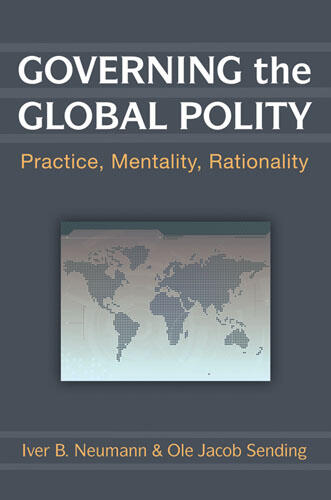
Iver B. Neumann and Ole Jacob Sending, Governing the Global Polity: Practice, Mentality, Rationality. Michigan: University of Michigan Press, 2010

About the Book
What does globalization mean for the principle of state sovereignty and for the power and functioning of states? Whereas realists assert the continued importance of states, constructivists contend that various political entities as well as the logic of globalization itself undermine state sovereignty.

Drawing on the state formation literature and on social theory, particularly the works of Weber and Foucault, Iver B. Neumann and Ole Jacob Sending question the terms of the realist-constructionist debate. Through detailed case studies, they demonstrate that states use nongovernmental organizations and international organizations indirectly to enforce social order and, ultimately, to increase their own power. At the same time, global politics is dominated by a liberal political rationality that states ignore at their peril. While states remain as strong as ever, they operate within a global polity of new hierarchies among states and between states and other actors.

“There have been many attempts to adapt Foucault’s arguments to the study of international relations, but this powerful and provocative book is the most sustained, and arguably the most successful in showing how the governmentality approach can be adapted to the analysis of global politics.”
—Barry Hindess, Research School of Social Sciences, The Australian National University

A highly welcome and original contribution to contemporary debates on the shape and future of the international system and on the possibility of reconfiguring IR theory as social theory.”
—Mathias Albert, Bielefeld University, Germany

“Iver Neumann and Ole Jacob Sending have put meat on the bones of Michel Foucault’s notion of governmentality, fulfilling the hopes of long-famished students and scholars of global governance. Through their focus on specific case studies, the authors have provided a much-needed contribution to the international relations literature, one that is sure to become a staple of courses and seminars throughout the world.”
—Ronnie D. Lipschutz, University of California, Santa Cruz

Iver B. Neumann is Director of Research at the Norwegian Institute of International Affairs and Professor of Russian Studies at the University of Oslo.

Ole Jacob Sending is Senior Researcher at the Norwegian Institute of International Affairs, where he heads the Research Programme on Global Governance and International Organizations.