
Foucault News

News and resources on French thinker Michel Foucault (1926-1984)

First two-day workshop of the CIBB Project (‘Contemporary Issues in Bioethics and Biopolitics’)

‘The Normal and the Pathological’

27th and 28th September 2011
MS.05 (second floor) Zeeman Building, The University of Warwick.

Please note that all the papers will be delivered in English.

All welcome. Free registration at normalpathological@gmail.com

Confirmed speakers: Jean-Claude Dumoncel, Robert Bernasconi, Bill Fulford, Frederic Worms, Julien Pieron, Florence Caeymaex, Guillaume Leblanc, John Protevi, Charles T.Wolfe and Giuseppe Bianco

From a philosophical perspective, the problem of illness can be seen to emerge from the tension between the subjective (a life which is mine) and objective dimensions of life. On the one hand, illness is irreducible to an objective fact, as if independent of the subjectivity which it affects; on the other hand, it is irreducible to a mere signification, and cannot be understood independently of its inscription within a living organism, its relation to an environment, and even the effort, on the part of other living beings, to know and treat it. Illness is a qualitative and individual experience that takes place within human life itself. Once we recognise the specificity of illness in those terms, can we not arrive at an understanding of life, and the normal, on the basis of the pathological, and not as what is simply threatened and, ultimately, annihilated by it? Similarly, should medicine not recognize in care (and its latin etymology cura) the ethical implications of the internal tension of life and not isolate the pathology from the subjectivity in which it is rooted?

Far from being of interest only to biology and medicine, the question of the normal and the pathological implicates our perception of life as a whole, in all its forms. Pathology is at the source of all questioning concerned with life. It’s only on the basis of suffering and distress, which are the signs of illness, that every question regarding life, or what living human beings consider normal at a given stage of their history, and the conditions under which such a state can be maintained, becomes possible. “Health is life in the silence of the organs,” wrote Leriche. This means that all discourse of life on life spring from that obscure moment when, confronted with an obstacle, life “speaks” or seeks to speak. To the extent that our purpose is to ask about life, we need to begin by asking about life’s relation to the pathological, and the epistemological, ethical and political implications of such a relation.

After the classical contributions of Canguilhem and Foucault, we are convinced that it is possible, and indeed necessary, to extend and adapt the reflection of the philosophy of pathology in the light of the new challenges emerging from the evolution of society and the life sciences. In the era of bio-power, the norms have become independent of the normative power of the human being, determining its comportments and excluding those considered pathological. To what extent is it possible to emphasise and promote the normative activity of human life in the face of a system that declares in advance, and down to the most minute details, what is normal? What paradigm of normality and health can we develop as an alternative to auto-immunisation, this disease caused by the excess of concern for health? What critical space is left, or can be generated, in an epoch in which the life sciences make it possible for the human being to intervene on itself, on other living beings, and determine their identity? Is it still possible to develop a normative critique that would not be rooted in the naturalistic paradigm?
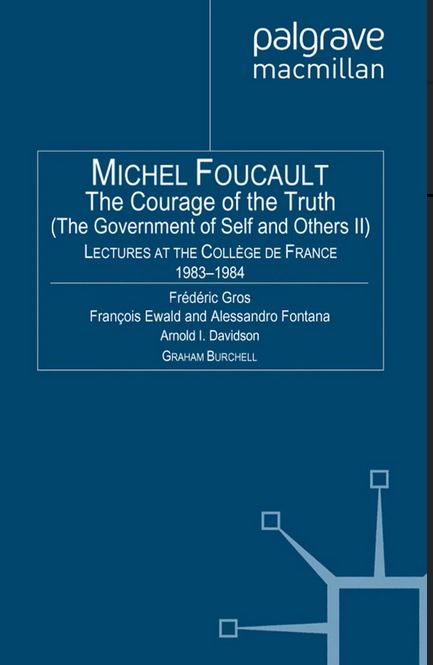
Michel Foucault The Courage of Truth, Series: Michel Foucault: Lectures at the Collège de France, Palgrave Macmillan, 2011

The course given by Michel Foucault from February to March 1984, under the title The Courage of Truth, was his last at the Collège de France. His death shortly after, on June 25th, tempts us to detect a philosophical testament in these lectures, especially in view of the prominence they give to the theme of death, notably through a reinterpretation of Socrates’ last words–’Crito, we owe a cock to Asclepius’– which, with Georges Dumézil, Foucault understands as the expression of a profound gratitude towards philosophy for its cure of the only serious illness: that of false opinions and prejudices. These lectures continue and radicalize the analyses of those of the previous year. Foucault’s 1983 lectures investigated the function of ‘truth telling’ in politics in order to establish courage and conviction as ethical conditions for democracy irreducible to the formal rules of consensus. With the Cynics, this manifestation of the truth no longer appears simply as a risky speaking out, but in the very substance of existence. In fact, Foucault offers an incisive study of ancient Cynicism as practical philosophy, athleticism of the truth, public provocation, and ascetic sovereignty. The scandal of the true life is constructed in opposition to Platonism and its world of transcendent intelligible Forms.

‘There is no establishment of the truth without an essential position of otherness. The truth is never the same. There can be truth only in the form of the other world and the other life.’

Géraldine Brausch, «Un détour par les stratèges de Jullien pour relire les analyses stratégiques de Foucault», Dissensus, N° 4 (avril 2011)

Table des matières
I. Nécessité d’une hétérotopie
II. Contre le modèle du droit, le modèle stratégique
III. La logique disciplinaire ou l’art de faire table rase du réel pour mieux le (re)créer. Retour sur la matrice militaire
IV. Une stratégie sans général, certes, mais pas sans modèle
V. Grippage, ratage, friction : la logique disciplinaire à l’épreuve de l’analyse stratégique
VI. Le dispositif de sécurité : gouverner non pas le réel mais « à partir du réel »57. Vers l’« efficience » chinoise
VII. Conclusion

Michael Power, Foucault and Sociology, Annual Review of Sociology, Volume 37 July 07, 2011
https://doi.org/10.1146/annurev-soc-081309-150133

ABSTRACT
Michel Foucault was a gifted but elusive thinker with a wide and continuing impact across many academic fields. This article positions his work as a historical sociology of knowledge and evaluates its contribution. After reviewing Foucault’s central preoccupations as they emerge in his major works, the argument briefly considers their influence on accounting scholarship as an informative exemplar of a wider Foucault effect. Four key areas for the sociological reception of Foucault are then considered: the nature of discourse and archaeology, his historical method, the problem of agency and action, and his conception of power. Articulating Foucault’s relationship to sociology is inherently problematic, not least because he takes the emergence of the sciences of man as something to be explained rather than augmented. Yet his work remains a rich resource for inquiries of the sociological type, is broadly aligned with a practice turn in social theory, and intersects with several themes in both mainstream and critical sociology.

Michael Power
Department of Accounting, London School of Economics and Political Science, London, WC2A2AE, United Kingdom; email: m.k.power@lse.ac.uk

Radu, Carmen. 2011. “Governmentality and the Deportation of Eastern European Roma in Italy and France.” Student Pulse Academic Journal 3.04.

Read online

Abstract
This case study asks the following question: given the symbol of the European Union as the ultimate supranational, rights-based, compliance-inducing international organization, why have member states France and Italy escaped punishment for their blatant violations of international law, reflected in their mass deportations of Roma and the dismantlement of Roma camps during the period of 2008 to 2010? Inspired by a Foucauldian theoretical framework, this paper analyzes how discourses and practices reveal power relationships at the EU and state levels, and argues that the mass deportations are a site of governing and biopower as defined by Foucault. The main theoretical Foucauldian tools used are governmentality, discourse, biopower, the archaeology of knowledge, and the genealogy of practice. Given that this case study analyzes factors that lie both inside and outside the state, the paper draw upon scholars who explain why governmentality is relevant to the study of international politics. Finally, because of the dire poverty in which Roma live, governmentality studies are used to highlight the government of poverty, and show how the government of poverty today entails the criminalization of the poor.

The main contention is that the discourses and practices surrounding the 2008-2010 Roma deportations reveal a power struggle between the EU’s governing of France and Italy, and France and Italy’s governing of the Roma. This power struggle allows us to understand why France and Italy were able to evade punitive measures. Because of its lack of power of norm formation in the socioeconomic rights sphere, EU discourse reveals that the EU understands the Roma situation within the context of ethnic discrimination. By governing the Roma within the context of poverty as a social danger, France and Italy escaped punitive measures because the EU has been weak in alternatively shaping the government of poverty. The Eastern European Roma remain caught in intersecting persecutions due to their status as both ethnically different and poor.

Strausz, Erzsébet, ‘Foucault’s Critique: A Topology of Thought’, Law and Critique, March 2011, 1-15
https://doi.org/10.1007/s10978-011-9082-5

Abstract
In order to elucidate some of the ways in which critique and subjectivity become inextricably linked in Foucault’s oeuvre, the paper proceeds first by briefly discussing the concept of critique as limit-attitude as it appears in some of Foucault’s methodological writings. Subsequently, the main tenets of Judith Butler’s commentary on the essay ‘What is Critique?’ will be summarized, concentrating on the image of the virtuous, self-making subject that the author’s interpretation brings out of Foucault’s original text. The second part of the paper aims to develop an alternative reading of Foucault’s notion of critique by looking at the ways in which the notion of space operates as an underlying perspective in his archaeological analysis. Ultimately, it will be shown how the spatial implications of Foucault’s early works and a more passive form of subjectivity as unfolding from his discussion of the ‘author function’ and his own methodological reflections coalesce into a form of practical critique, which, as wished by the author, may take ‘the form of a possible transgression’ (Foucault 1984a, p. 45).

Saul Newman, ‘Postanarchism and Power’, Journal of Power, Vol. 3, No. 2, August 2010, 259–274
https://doi.org/10.1080/17540291.2010.493704

Abstract
This article develops a postanarchist conception of power by using Foucault to reveal some of the tensions and limitations within classical anarchist theory. As a Foucauldian poststructuralist analysis shows, the operation of power is more complex and constitutive than was allowed in classical anarchist theory, which tended to focus on state sovereignty. The revealing of the pervasiveness of power makes problematic any sort of ontological separation between society and power. However, rather than this insight undermining the possibility of anarchism – a form of radical politics that I argue is becoming more relevant today – it necessitates a certain modification of classical anarchism into postanarchism. Postanarchism might be seen as a new way of thinking about a politics of autonomy based on practices of freedom.

Anders Fogh Jensen and Rasmus Svarre Hansen, Cartographier le pouvoir: Foucault et Bourdieu

Cartographier le pouvoir est un livre illustré qui tente de reformuler les théories de Foucault et de Bourdieu dans une langue simple et au moyen de dessins expressifs.

The Cartography of Power is a picture book which recounts Foucault and Bourdieu’s theories in a simple language supported by inspired drawings. Anders Fogh Jensen’s imaginative expressions is accompanied by Rasmus Svarre Hansen’s expressive images, and together they have created an original guide which takes the reader by the hand and leads her through a great diversity of ideas across a broad range of subjects.

Marcelo Hoffman, “Containments of the Unpredictable in Arendt and Foucault”, Telos 154 (Spring 2011).
https://dx.doi.org/10.3817/0311154141

Abstract
This article takes as its principal provocation Giorgio Agamben’s claim that Hannah Arendt’s analyses of totalitarianism do not obtain a biopolitical perspective and that, conversely, Michel Foucault’s analyses of biopolitics fall short of adequately addressing totalitarian states, thereby leaving us with mutually compatible absences. I offer an alternative to this dichotomous reading that ultimately develops into a critique of Arendt’s treatment of birth. I suggest that even as Arendt’s analyses of totalitarianism and Foucault’s analyses of biopolitics express diverging arguments about transformations in Western political theory and practice, they nevertheless accentuate the production of predictable states of life. In light of this broad affinity, what stands out is Arendt’s identification of birth as a source of the disruption of predictable states of life whereas Foucault implicitly contests the disruptive potential of birth. This difference matters because it opens up a critical space wherein Arendt appears to fall back on a biological position that she eschews elsewhere and wherein Foucault provides a much-needed remedy to this position.

From Iran Book News Agency.

New translations of Foucault made by Afshin Jahandideh and Nikou Sarkhosh will appear in Tehran International Book Fair, including “Philosophy Theater”
IBNA: Afshin Jahandideh one of the translators told IBNA: “This volume consists of Foucault’s shorter notes, lectures and interviews made since 1966 on three main bases of discourse, power and relation to the self. There are also references in these speeches to Foucault’s professor, Georges Canguilhem.”

He added: “Five lectures in this volume have been previously translated in scattered books and collections, but then we decided to retranslate them. In this translation, all the texts are carefully and uniformly edited.”

Persian translator of Foucault books added: “Moreover at the end of three lectures out of the five, there is a roundtable discussion included which helps one better understand them. Previous versions lack this.”

Jahandideh continued: “In this roundtable it is discussed what Michel Foucault really meant by the article ‘What is an author’ as it is totally different from what Roland Barthes meant by it.”

According to the translator, their translations of Foucault’s volumes like ‘Discipline and Punish’, ‘The History of Sexuality’, ‘Discourses on Iran’ as well as Deleuze’s ‘Foucault’ will be presented at 24th TIBF by Nashr-e-Ney.

At the moment Jahandideh is converting Foucault’s “The Archaeology of Knowledge” into Persian together with Nikou Sarkhosh.

The 24th Tehran International Book Fair will run from 4 to 14 May 2011 at Imam Khomeini Mosalla of Tehran.