Foucault News

News and resources on French thinker Michel Foucault (1926-1984)

Fazilleau, K.
L’Indien atemporel d’Edward S. Curtis et le mythe de la race en voie de disparition
(2023) Etudes Anglaises, 76 (2), pp. 157-179.

DOI: 10.3917/etan.762.0157

Abstract

This article aims at highlighting the dynamic link between the photographs of Native Americans taken by Edward S. Curtis between 1898 and 1927, published in his work The North American Indian, and the colonial discourse about the figure of the Indian, particularly the myth of the “Vanishing Indian.”Indeed, Curtis’s primary objective was to “preserve”the culture of an “Indian”whom he considered to be “authentic,””primitive,”and “intact,”which is to say spared from the effects of colonization and Americanization. In this manner, he hoped to portray an Indian from the past, a product of colonial imagery. The study conducted in this article borrows from Michel Foucault’s concept of networks of knowledge and power, to examine how Curtis’s undertaking was fed by colonial discourse and then in turn fed it, thus popularizing the myth of the “Vanishing Indian.”At the intersection between colonial studies and photographic studies, we will see how Curtis’s photographs are plagued with inherent contradictions, similarly to the discourse on the colonized Other. © Klincksieck.

CALL FOR ABSTRACTS:
Echoes of Foucault, forty years after

The Foucault Circle NL/BE is organizing a conference about interdisciplinary uses of Foucault’s work, with a focus on themes which Foucault did not think much about himself, but we do: decolonization, gender, climate change, etc.

University of Amsterdam: Amsterdam Roeterseilandcampus
25-06-2024

Few philosophers have been such prolific thinkers as Michel Foucault. His general theme of practices concerning ‘the subject’ led him to explore a wide range of different topics. His investigation into the subject took him from analyses of the human sciences, to dividing practices that categorize subjects as normal or abnormal, and eventually to the modes in which we change ourselves into subjects. Foucault’s work always supported emancipation of marginalized groups. Yet, many commentators have argued that, despite his prolificity, Foucault has left some surprising lacunae in his analyses. For example, in his work, he appears to have had little attention for feminist movements, decolonization, and climate change. The Echoes of Foucault conference aims to critically celebrate Foucault’s thought forty years after his death, by focusing on these lacunae. How is his work helpful for researchers today, across different disciplines? We will ask whether and how it might be possible to think with Foucault about these kinds of topics. With a wink, we say: Woke Foucault!

We invite young scholars to apply, by sending an abstract (400 words) to foucaultcirclenlbe@gmail.com by May 1st 2024. We welcome both work-in-progress, as well as more finished papers. The topics should be fit for a 20 minute presentation. We especially encourage students and (junior) scholars from underrepresented backgrounds to apply.

More information to be announced.

On behalf of the équipe Foucault Circle NL/BE:
Steven Dorrestijn / Michiel Leezenberg / Guilel Treiber / Liza Steultjens / Berend van Wijk / Casper Verstegen

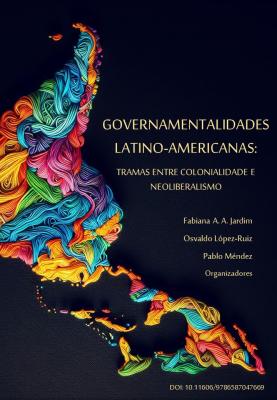
Jardim, Fabiana Augusta Alves, López-Ruiz, Osvaldo, & Méndez, Pablo. (2024). Governamentalidades latino-americanas: tramas entre colonialidade e neoliberalismo. . Universidade de São Paulo. Faculdade de Educação.

DOI: https://doi.org/10.11606/9786587047669

Open access

Includes interview with Colin Gordon
Governamentalidade e além: entrevista com Colin Gordon
Colin Gordon, William Walters, Martina Tazzioli

Sinopse
A presente coletânea inaugura a Coleção Desbordar e reúne pesquisadores latino-americanos dos campos da Sociologia, da Antropologia, da Psicologia Social e do Direito para interrogar os entrelaçamentos entre a história da colonização no continente, a formação dos Estados nacionais e as formas sociais (re)constituídas a partir e em consonância com agenda neoliberal desde os anos 1970 – tomando o golpe militar no Chile como evento inaugural. O livro está dividido em três seções: 1) Neoliberalismos e governamentalidade; 2) Neoliberalismos e trabalho e 3) Neoliberalismos e espacialidades. Na primeira parte, que se abre com a tradução de uma entrevista com Colin Gordon e sua provocação com relação aos limites da governamentalidade como arranjo capaz de interligar Estado, Lei e o horizonte de uma sociedade pacificada e com algum grau de coesão, os capítulos exploram, a partir de diferentes recortes, os laços entre Estado, burocracia, racionalidades de governo mergulhadas na colonialidade e encarnações dos neoliberalismos no continente. Na segunda parte, os capítulos exploram tanto os limites do trabalho assalariado formal na América Latina e seus efeitos sobre as formas de subjetivação e organização dos trabalhadores quanto examinam transformações no núcleo duro do mercado de trabalho formal, inteiramente modificado pelas transformações nas relações de produção e nas estratégias de produção de legitimidade e identidade profissional. A terceira seção traz um conjunto de capítulos que examinam os sentidos do espaço na gestão das cidades, das comunidades que têm resistido e resistem aos processos de colonização/desenvolvimento e das diferenças, encerrando-se com a tradução de um artigo de Elizabeth Povinelli. O livro começou a ser preparado em 2019 e foi atravessado tanto pela pandemia quanto por transformações no âmbito da política institucional por todo o continente, processos que deixaram suas marcas nas preocupações partilhadas pelos autores e na própria perspectiva de seguir pensando em comum as possibilidades e os desafios de nosso presente.

Palavras-chave:
América Latina, Governamentalidade, Neoliberalismo, Estado

Emeritus Professor Stephen J Ball will be giving a presentation as part of the Foucault 40 Years After World Congress.

Registration link

Webinar details: Tuesday 4th June 20:00-21:30 (AEST), 11:00-12:30 (UTC)

Why do we write? Or would Foucault thrive in the contemporary university?

I want to say something about Foucault’s conception of the role and purpose of academic writing, and particularly self-formation, critique and truth telling – what Graeme Burchell (1996) called the ‘ethics of intellectual work’. And use that to think about the role and purpose of writing in the contemporary university. And thus consider the problem of “finding oneself not knowing what or how to think”. The tone will be a mix of grimness and celebration.

Stephen J Ball is Emeritus Professor of Sociology of Education at the University College London, Institute of Education. He was elected Fellow of the British Academy in 2006;and is also Fellow of the Society of Educational Studies, and a Laureate of Kappa Delta Phi; he has honorary doctorates from the Universities of Turku (Finland), and Leicester. He is co-founder of the Journal of Education Policy. His main areas of interest are in theoretical informed education policy analysis; the relationships between education, education policy and social class; and thinking education without school. He has written academic 20 books, and a series of detective stories (The Enemies of Truth KDP 2023) and has published over 140 journal articles. Recent books: Edu.Net (Routledge 2017) and Foucault as Educator (Springer 2017).

Chair/s: Associate Professors Richard Niesche and Denise Mifsud

Leonard D’Cruz,
Foucault’s naturalism: The importance of scientific epistemology for the genealogical method, Philosophy & Social Criticism, March 16, 2024

DOI: https://doi.org/10.1177/01914537241235571

Abstract:
This article offers a novel reconstruction of Foucault’s methodology that emphasises his respect for the natural sciences. Foucault’s work has long been suspected of reducing knowledge to power, and thus collapsing into unconstrained relativism and methodological incoherence. These concerns are predicated on a misunderstanding of Foucault’s overall approach, which takes the form of a historico-critical project rather than a normative epistemology. However, Foucault does sometimes make normative epistemological judgements, especially about the human sciences. Furthermore, there are outstanding questions about what secures the descriptive rigour of the genealogical method. To address these issues, I develop two claims that will significantly enrich our understanding of Foucault’s methodology. The first is that Foucault’s respect for the natural sciences is crucial in making sense of his normative epistemological judgements. The second is that the descriptive rigour of his genealogical method derives from the fact it is modelled on empirical inquiry.

Gordon Hull, LLM, Inc. New APPS: Art, Politics, Philosophy, Science blog, 27 February 2024

In previous posts (one, two, three), I’ve been exploring the issue of what I’m calling the implicit normativity in language models, especially those that have been trained with RLHF (reinforcement learning with human feedback). In the most recent one, I argued that LLMs are dependent on what Derrida called iterability in language, which most generally means that any given unit of language, to be language, has to be repeatable and intelligible as language, in indefinitely many other contexts. Here I want to pursue that thought a little further, in the context of Derrida’s (in)famous exchange with John Searle’s speech act theory.
[…]

Let’s look at intentionality first. In responding to Searle, Derrida explains that he finds himself “to be in many respects quite close to Austin, both interested in and indebted to his problematic” and that “when I do raise questions or objections, it is always at points where I recognize in Austin’s theory presuppositions which are the most tenacious and the most central presuppositions of the continental metaphysical tradition” (38). Derrida means by this a reliance on things like subjectivity and representation – the sorts of things that Foucault is getting at when he complains in the 1960s about philosophies of “the subject” (think: Sartre and phenomenology).
[…]

Baxter, K.I.
Cecily Shoots a Rhinoceros: Big Game Hunting in British Somaliland and the 1900 Convention for the Preservation of Wild Animals, Birds and Fish in Africa
(2023) Law and Literature

DOI: 10.1080/1535685X.2023.2289771

Abstract
In 1900, seven European nations gathered in London to agree the Convention for the Preservation of Wild Animals, Birds and Fish in Africa. The Convention sought to regulate game hunting across the African continent, in response to the decimation of wildlife that unregulated hunting for sport and ivory had caused. Six years later, Agnes Herbert and her cousin Cecily set out from London to British Somaliland on a big game hunt. In this article, I explore the interrelationships of memoirs, such as Agnes Herbert’s, with law and literary imagination in the creation of a colonial conservation culture. I do so by invoking Foucault’s thinking about heterotopias. I unpack the temporal modalities in which ideas about big game operate in administrative and literary texts: both the idea of a lost golden age and, more particularly, the futurities of big game that they construct and debate through ideas of “preservation.”. © 2023 The Author(s). Published by Informa UK Limited, trading as Taylor & Francis Group.

Author Keywords
big game; British Empire; heterotopia; memoir; Somaliland

Bright, D., McKay, A., Firth, K.
How to be reflexive: Foucault, ethics and writing qualitative research as a technology of the self
(2023) International Journal of Research and Method in Education

DOI: 10.1080/1743727X.2023.2290185

Abstract
This paper explores reflexivity in qualitative research, challenging conventional perspectives that revolve around the binary of ‘insider’ and ‘outsider’ positioning. While traditionally reflexivity has been understood through the lens of a researcher’s socio-historical positionality, we argue for a more dynamic understanding, emphasizing that academic self-formation is an ongoing process of self-creation. Drawing inspiration from the ancient Akadēmía, where writing was a method of self-reflection, we recontextualize reflexive qualitative writing, aligning it with Foucault’s interpretations of Ancient Greek and Renaissance concepts. We posit that writing, especially in doctoral research, is not just a tool for communication but a means of self-formation. This perspective redefines reflexivity as a transformative intellectual and existential process. The paper critically examines the prevailing insider/outsider binary in the research literature, suggesting that researcher identities are fluid and constantly shaped by interactions. By integrating Foucault’s later work on ethics, we explore the ethical dimensions of reflexivity and the formation of the ethical subject. Ultimately, this paper contributes to the academic discourse on reflexivity, offering a more fluid, transformative view of the doctoral process and reflexive writing in qualitative research. © 2023 The Author(s). Published by Informa UK Limited, trading as Taylor & Francis Group.

Author Keywords

Foucault; Insider; outsider; reflexivity; writing as a method of inquiry

Gjerde, Lars Erik Løvaas. “Marrying the Sources and Mechanisms of Power? Understanding the Quarantine Hotel through Michel Foucault and Michael Mann.” Journal of Political Power, (2024), 1–20.
doi:https://doi.org/10.1080/2158379X.2024.2337617


ABSTRACT

Using the Norwegian quarantine hotel as a case, I analyse the narratives of 46 ‘guests’, so to explore this biopolitical device, which for biopolitical objectives enables a series of disciplinary mechanisms of power. To do this, I marry Michel Foucault’s approach to the mechanisms of power with Michael Mann’s work on the sources of power, fixating my analysis around the link between ‘discipline’, ‘control’ as well as ‘biopolitics’ and ‘infrastructural power’. The paper’s objective is to explore this empirical case so to advance our understanding of how mechanisms of power work, and are made to work, by exploring the infrastructural sources of power underpinning the quarantine hotel as a nexus of power. This theoretical marriage between two giants in the scholarship on power is operationalized in this empirical case to reveal the utility of exploring the link between the microphysics and macrophysics of power, in general and in the context of COVID-19, through combining these approaches.

KEYWORDS:
Biopolitics COVID-19 discipline Foucault Infrastructural power; Mann

Joinau, B.
Cultural Governance and New Forms of Governmentality Focus on the South Korean Case
(2023) Journal of Arts Management Law and Society

DOI: 10.1080/10632921.2023.2280646

Abstract
The paper discusses the reasons behind the dominance of governance in contemporary societies. The techniques of government cannot be understood apart from a critical genealogy of governmentality. This article references Michel Foucault’s analysis of governmentality to analyze the role of governance in arts and cultural management. It argues that, following the governmental state described by Foucault, the contemporary governance state is defined by a new spectacle governmentality. The globalized context of this governmentality produces a simulacrum of governance that tends to substitute for actual outcomes. The South Korean case is used to illustrate this new form of ubiquitous cultural governance. © 2023 Taylor & Francis Group, LLC.

Author Keywords
Cultural governance; Foucault; governmentality; South Korea; spectacle