Foucault News

News and resources on French thinker Michel Foucault (1926-1984)

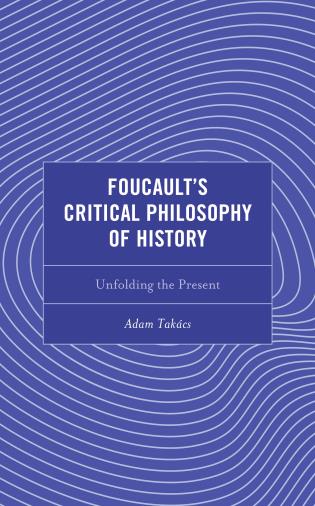
Adam Takács, Foucault’s Critical Philosophy of History. Unfolding the Present, Lexington Books, 2023

PDF flyer with discount offer

Foucault’s Critical Philosophy of History: Unfolding the Present
provides a comprehensive interpretation of Foucault’s work by focusing on its methodological, procedural, and epistemological elements. Adam Takács argues that despite all its thematic and analytical diversity, Foucault’s procedure can be understood within a unified framework based on the historical problematization of the present. This procedure, triggered by current social issues and aiming at a diagnostic screening of the present through a constructive exploration of the past, thus sets in motion not only a specific philosophical vision of history and a research practice often related to the procedures of historiography, but also new ways of critical analysis of social phenomena. This book subjects all these elements to a systematic analysis, demonstrating that within this framework, Foucault’s often debated views on historical realism and constructivism—his methodological choices and ontological commitments—take on a coherent profile, culminating in a timely social critical project of “liberation of knowledge” and “political subjectivation.”

Adam Takács is senior lecturer at Eötvös Loránd University.

Abuhassan, L.B., Dweiri, M.M.
A heterotopic perception of ‘wall’ in psychological thriller films: a place, a labyrinth and a panoptic power
(2024) Cogent Arts and Humanities, 11 (1), art. no. 2303180, .

DOI: 10.1080/23311983.2024.2303180

Abstract
A wall is often viewed simply as a structure that divides and isolates different worlds, spaces, or places. However, an alternative perspective, known as the heterotopic point of view, suggests that a wall can be seen as a place. Such a place possesses panoptical characteristics and spatial experiences that might be felt as a panoptic power and a labyrinth, rendering it suitable for the setting of many psychological thriller films. To illustrate this phenomenon, this article examines two examples from psychological thrillers and compares them with Foucault’s concept of Heterotopia. This is accomplished by breaking down his six principles of space parameters. By doing so, the article reveals the intricate and multifaceted nature of walls, as well as their potential to be portrayed in a myriad of ways in the cinematic arts. © 2024 The Author(s). Published by Informa UK Limited, trading as Taylor & Francis Group.

Author Keywords
Art & Visual Culture; Arts; Arts & Humanities; Directing; Filmmaking and Postproduction; Filmmaking Bibles; Heterotopia; Humanities; labyrinth; Lincoln Geraghty, School of Media and Performing Arts, Eldon Building, University of Portsmouth, Winston Churchill Ave, Portsmouth, PO1 2DJ, UK; Media & Film Studies; panoptic power; Philosophy; place; psychological thriller films; Screenwriting; space; Visual Arts; wall

Eric Schliesser, Bentham and Foucault on Biopolitics and Political Epistemology, digressionsimpressions’s Substack, Feb 13, 2024

Bonus Post: Foucault, the Benthamite in 1978-1979

[…]
Today’s post is a long read. The pay-off is that I show that the state’s essential role is the production and diffusion — as a machinery of record — of knowledge for Bentham. In fact, it is the main exception to laissez-faire. And so somewhat surprisingly a certain conception of political epistemology is central to Bentham’s art of government.* Oddly, Foucault seems to have grasped this while we have no reason to believe he read the salient source, while some of the most informed readers of Bentham (Viner, Keynes, Halévy) botch the argument.
[…]

In the first lecture of The Birth of Biopolitics (hereafter: BoB), 10 January 1979, Foucault claims that in the middle of the eighteenth century there is a change in what he calls ‘modern governmental reason.’ This change “consists in establishing a principle of limitation that will no longer be extrinsic to the art of government, as was law in the seventeenth century, [but] intrinsic to it: an internal regulation of governmental rationality.” (p. 10 in the Graham Burchell translation) He lists four characteristics of such an internal regulation.
[…]

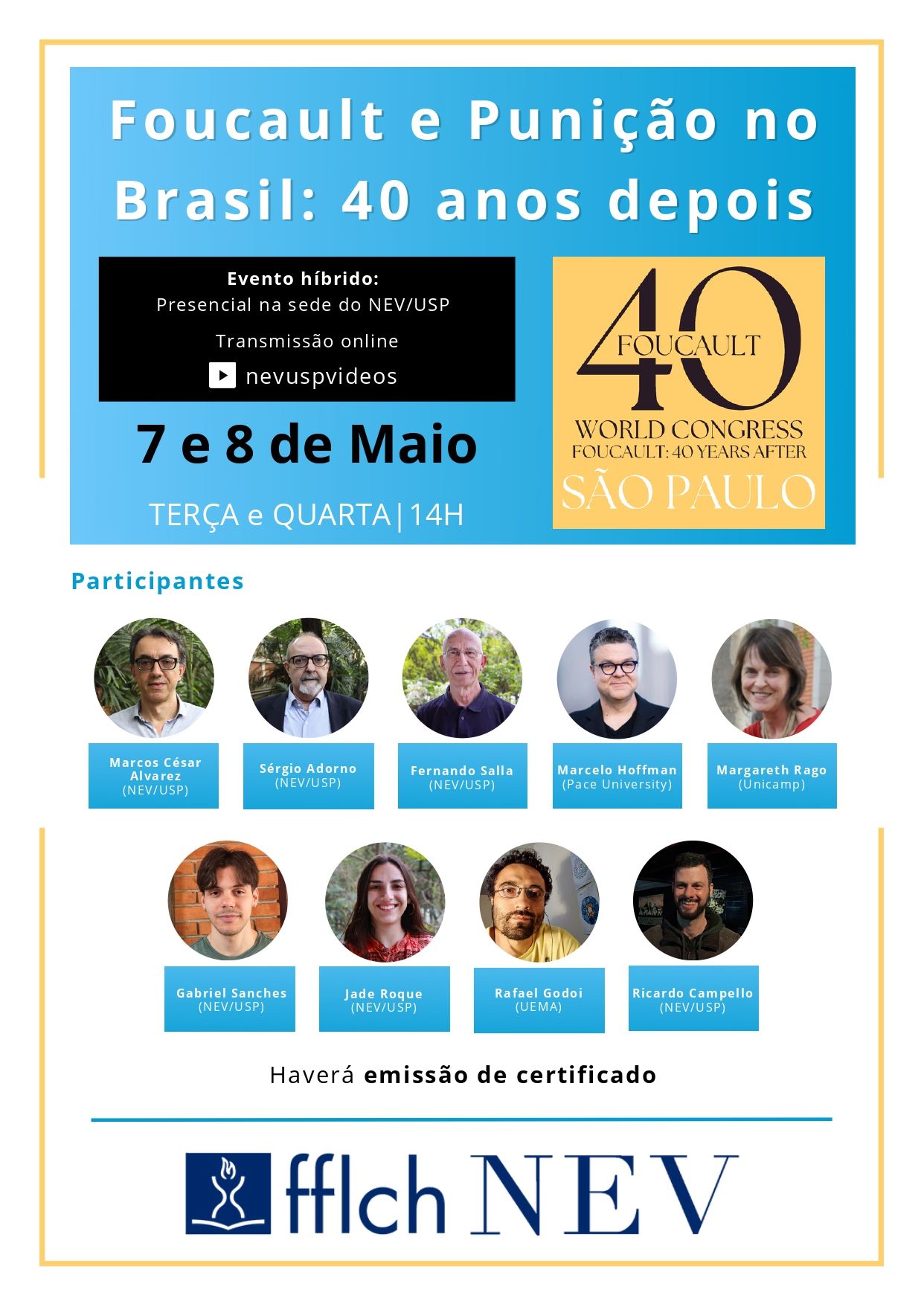
There will be transmissions online during both days at the following addresses:
7th May: https://www.youtube.com/watch?v=CmAod0zJYzg
8th May: https://www.youtube.com/watch?v=R5d9tqvIg-Q

Chevallier, Philippe. Michel Foucault et le christianisme. Lyon: ENS Éditions, 2024.
https://doi.org/10.4000/books.enseditions.47769.

Des rites antiques à la confession moderne, le christianisme fut pour Foucault une interrogation constante, aiguillée par notre actualité : quel destin cette religion a-t-elle eu dans nos vies, dans la manière de nous conduire, de connaître notre désir, de chercher notre salut ? Ce livre propose la première synthèse de l’ensemble des lectures chrétiennes de Foucault, d’Histoire de la folie au grand livre posthume Les aveux de la chair, enrichie par la consultation de ses archives. Ecartant les conclusions hâtives, ce parcours épouse la logique d’un travail que Foucault voulut autant historique que philosophique : une certaine manière de lire les textes anciens et d’inciser notre passé. Loin des lieux communs d’un christianisme ascétique et intransigeant, Foucault définit l’originalité chrétienne comme la reconnaissance d’un rapport précaire à la vérité.

Initialement publié en 2011, cet ouvrage pionnier bénéficie d’une mise à jour intégrale, qui tient compte des découvertes les plus récentes que permet l’archive.

« Cette enquête remarquable nous offre l’aperçu le plus complet et le mieux informé d’un nouveau terrain de recherche. Toute personne intéressée par l’œuvre de Foucault doit le lire. » (Colin Gordon, Foucault News)

Le texte seul est utilisable sous licence Licence OpenEdition Books. Les autres éléments (illustrations, fichiers annexes importés) sont « Tous droits réservés », sauf mention contraire.

English

From ancient rites to modern confession, Christianity involved – for Foucault – a constant questioning prompted by our present reality: what influence has this religion had in our lives, in how we conduct ourselves, in how we come to know our desire, in seeking our salvation? Published in 2011, Michel Foucault and Christianity is to this day the only critical synthesis of all of Foucault’s readings of Christianity, from his early work History of Madness (1961) to his last 1984 interviews. This brand-new edition integrates into its analyses the previously unpublished Confessions of the Flesh (2021), and through first-hand consultation of Foucault’s archives, Philippe Chevallier retraces the long, complex, and hitherto unknown editorial odyssey of Confessions of the Flesh (1976-1984). Rejecting hasty conclusions, this journey seizes the logic of a research Foucault intended to be as much historical as philosophical. Far from caricaturing Christianity as ascetic and intransigent, Foucault sees emerge in Christian texts and practices a vital recognition of our precarious relationship with truth.

“Philippe Chevallier’s major survey offers us the most informed and complete picture of the new terrain available to us. Everyone interested in Foucault should have access to it.” (Colin Gordon, Foucault News)

Michel Foucault, bibliographie
Introduction

Première partie – Le christianisme comme objet historique, une question de méthode
Introduction à la première partie

Chapitre un
Définition du modèle stratégique

Chapitre deux
Le christianisme au risque de l’analyse stratégique

Chapitre trois
Foucault et l’historiographie de l’Antiquité tardive

Deuxième partie – Une lecture singulière des Pères
Introduction à la deuxième partie

Chapitre quatre
Le christianisme dans le texte

Chapitre cinq
Conséquences sur l’usage des textes : traduire les Pères

Chapitre six
Vers une « anarchéologie » du christianisme

Troisième partie – Une interprétation du christianisme comme voie moyenne
Introduction à la troisième partie

Chapitre sept
Le christianisme comme Orient perdu

Chapitre huit
La relève d’un temps précaire

Chapitre neuf
Les Aveux, enfin
Conclusion

Annexe
Tables des matières des différentes versions des Aveux de la chair dans l’archive
Bibliographie sélective
Index des noms

Hagenmüller, M.
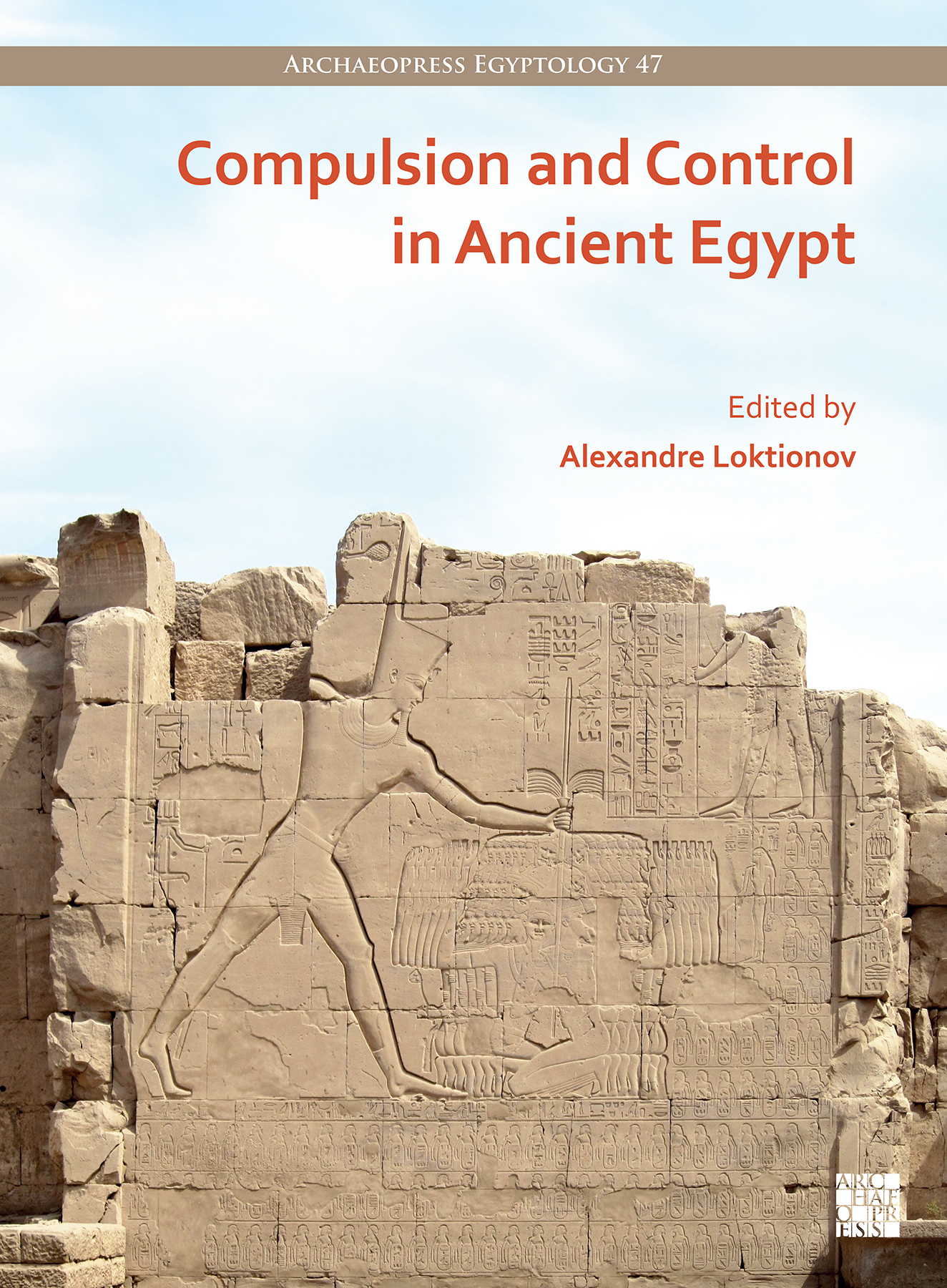
Images of control and submission in old kingdom funerary iconography: The Egyptian Tomb as a ‘Disciplinary Institution’
(2023) Compulsion and Control in Ancient Egypt: Proceedings of the Third Lady Wallis Budge Egyptology Symposium Edited by Alexandre Loktionov, Archaeopress, pp. 148-160.

Abstract
I argue that funerary scenes can be studied as what Michel Foucault called ‘disciplinary institutions’. They aimed at showing the audience, not only an ideal version of the world, but also a social order where everything revolves around the owner, and where one has to comply with the social position that has been prescribed for him. Thus, they contain an ideological discourse, whose aim is to praise control and submission as fair values. I have chosen to focus on two specific patterns: rendering of accounts, when the scribes check the workers’ accounts, and punishments. My study is limited to Old Kingdom tombs. © the individual authors and Archaeopress 2023. All rights reserved.

Author Keywords
Discipline; Iconography; Old Kingdom tombs; Rendering of accounts; Violence

Nikidehaghani, M.
Accounting and neoliberal responsibilisation: a case study on the Australian National Disability Insurance Scheme
(2023) Accounting, Auditing and Accountability Journal, .

DOI: 10.1108/AAAJ-01-2023-6250
Abstract
Purpose: This paper aims to explore how accounting is fostering neoliberal citizenship through the participants of Australia’s National Disability Insurance Scheme (NDIS). More specifically, this paper aims to understand how accounting discourse and the management accounting technique of budgeting, when intertwined with automated administrative processes of the NDIS, are giving rise to a pastoral form of power that directs people’s behaviour toward certain ends.

Design/methodology/approach:
Publicly available data has been crafted into an autoethnographic case study of one fictitious person’s experiences with the NDIS – Mina. Mina is an amalgam created from material submitted to the Joint Parliamentary Standing Committee on the NDIS. Mina’s experiences are then analysed through the lens of Foucault’s concept of pastoral power to explore how accounting has contributed to marketising and digitising public disability services.

Findings: Accounting rhetoric appears to be a central part of rationalising the decision to shift to individualised disability funding. Those receiving payments are treated as self-governable, financially responsible subjects and are therefore expected to have knowledge of management accounting techniques and budgeting. However, NDIS’s strong reliance on the accounting concepts of funds, budgets, cost and price is limiting people’s autonomy and subjecting them to intervention and control.

Originality/value:
This paper addresses calls to explore the interplay between accounting and current disability policies. The analysis shows that incorporating accounting into the NDIS’s algorithms serves to conceal the underlying ideology of the programs, subtly driving behaviours towards neoliberal objectives. Further, this research extends the Foucauldian accounting literature by revealing the contribution of accounting to reinforcing the authority of digital pastors in contemporary times. © 2023, Emerald Publishing Limited.

Author Keywords
Autoethnography; Automated disability services; Digitisation; Foucault’s pastoral power; NDIS; Neoliberalism

Rossi, A.
Techniques of Finitude: On the Pastoral Matrix of Economic Care
(2023) Theory, Culture and Society

DOI: 10.1177/02632764231203567

Abstract

Building and expanding on Foucault’s work, this essay interprets pastoral power as a turning point within the long-term history of the care of the self. Through an analysis of early Christian monasticism, it claims that the pastorate emerged out of a re-conceptualization of ancient understandings of human finitude and a correlative transformation of the techniques revolving around it. Pastoral power instantiates a specific way of framing institutionally the subject’s opening to the limits. The argument thus suggests how, and to what extent, this matrix of government still determines, albeit under a different guise, the current political phase, especially in as far as economic governmentality and its call to the indefinite self-enhancement of subjectivity are concerned. © The Author(s) 2023.

Author Keywords

economic theology; finitude; Michel Foucault; pastoral power

Foucault Circle
May 23-26 2024
Tentative Program

PDF of program

The Foucault Circle will be held in the Judee Wales Watson Theatre (known as the Judee) downstairs in the Little Building, Emerson College, 80 Boylston St, Boston, MA 02116. The conference is free and open to the public. However, all attendees must be registered in advance with the conference organizers to access Emerson College’s facilities. Please email Sam Binkley at Samuel_binkley@emerson.edu to be added to the visitor’s roster.

Thursday May 23
5:00 – 7:00pm: Asceticism, Care, and Pastoral Power
Moderator: Sam Binkley

Will Tilleczek (McGill University)
From Normativity to Social Form: Foucault’s Sociology of Ethics

Karl Katz Lyden (Södertörn University)
A Politics of Immediacy

Anna Ahlgren (Stockholm University)
Pastoral Power through Children’s Literature: Re/presentations of the Subject at School Entry

7:30pm: Welcome Reception
Contact organizers for details

Friday May 24
8:30 – 10:30am Intellectuals and Critique
Moderator: Patrick Gamez

Daniel Schultz (Whitman College)
Foucault: Secular Critique or Critique of the Secular?

Kevin Thompson (DePaul University)
Lessons from the GIS (Health Information Group): Truth-Telling, Demedicalization, and the Government of Life

Daniel Wyche (Columbia University)
Foucault’s Lost Concepts: Intellectuals, Power, and Normativity

10:45 – 11:45am Memorial for Joanna Crosby
Erinn Gilson (Merrimack College)
Dianna Taylor (John Carroll University)
Lauren Guilmette (Elon University)

11:45- 1:15pm Lunch/Business Meeting

1:15 – 3:15pm Strategies of Power in National Context
Moderator: Ed McGushin

Christian Lundahl (Örebro University)
The Reproduction of Episteme in Swedish Education, 16th to 18th century

Rebecca Robinson (Hong Kong Baptist University)
The Birth of Biopolitics in early China

Shao-Jie Chen & Yi-Chieh Lee (National Chengchi University)
The Government of homo salus: A Brief Genealogical

3:30 – 5:00pm Round Table: Histories and Futures of the Foucault Circle in conjunction with the World Congress: Foucault, 40 years After. In Memory of Tom Flynn (1936-2024)
Jana Sawicki (Williams College)
James Bernauer, SJ (Boston College)
Devonya Havis (University of Buffalo)
Dianna Taylor (John Carroll University)
Edward McGushin (Stonehill College
Kevin Thompson (DePaul University)
Dianna Taylor (John Carroll University)

6:00pm Dinner
Contact organizers for details

Saturday May 25

8:30-10:30am Emotions, Affect, Friendship
Moderator: Sam Binkley

Nicolas Arenas (London School of Economics and Political Science)
Unveiling marketing governmentality: epistemological and theoretical considerations for analyzing the instrumentalization of emotions in marketing practices

Lorenzo Petrarchi (Università di Bergamo)
The Foucauldian project of a “History of Friendship”

Kai Moore (Graduate Theological Union)
Fleshing Out “Bodies and Pleasures”: Affect, Morality, and Power in Resistance

10:45am-12:45pm Sexual Violence, Power and Discourse
Moderator: Lauren Guilmette

Miranda Young (New School for Social research)
Legibility and Intelligibility: The Discourse of Survivor Storytelling

Aurora Laybourn-Candlish (DePaul University)
The Administrative Grotesque and “The Second Rape”: A Foucauldian Critique of Carceral Approaches to Sexual Violence

Vilde Aavistland (University of Louisville)
A Punch in the Face: Foucault, Rape, and Sexual Violability

12:45 – 1:45pm Lunch

1:45 – 3:45pm The Archive in the Anthropocene
Moderator: Patrick Gamez

Almira Mert (DePaul University)
Philosophy and History of Philosophy in Foucault’s Le discours philosophique

Randall Johnson (Independent scholar)
Foucault’s Discourse on Discourse: Maintaining a tenuous grasp on an elusive now

Michael Eng (Appalachian State University)
The Names of the Archive: Writing between “Life Itself” and la vie la mort in Huffer, Foucault, and Derrida

4:00-5:30pm Book Panel: Foucault in Brazil: Dictatorship, Resistance, Solidarity by Marcelo Hoffman
Moderator: Ed McGushin
Corey McCall (Independent scholar)
Lynne Huffer (Emory University)
Response by Marcelo Hoffman (Pace University)

Sunday May 26
8:30-10:30am Workshop Discussion: The Lives of Infamous Men
Lynne Huffer (Emory University)
Fay Alafouzou (Emory University)
Taryn Jordan (Colgate University)
Haylee Harrell (University of Houston)
Ege Selin Islekel (Texas A&M)
Lauren Guilmette (Elon University)

10:45am-12:45pm Literature and Readership
Moderator: Lauren Guilmette
Samuel Talcott (Saint Joseph’s University) The Archive and the Act of Reading: Foucault on Flaubert and Modern Literature

Leonhard Riep (Goethe University Frankfurt)
The Gesture Toward the Abyss: Limit-Experience, Politics, and the Ontology of Language

Liubov Bogodelnikova (Irkutsk National Research Technical University)
What is a Reader? The Ethics of Reading in Foucault

Mahadevan, J.
What connects positivism and interpretivism in cross-cultural management studies: Genealogy as a method for re-ordering disciplinary knowledge
(2023) International Journal of Cross Cultural Management

DOI: 10.1177/14705958231223874

Abstract
Cross-cultural management (CCM) studies is the discipline that investigates the interrelations between culture, management and organization, and ensuing implications. Like all disciplines, it is built upon certain presumed ‘disciplinary truths’, such as paradigmatic delineations, and assumptions of how culture should be studied differently within different paradigms. Such presumed truths easily become ‘trends’, potentially even disciplinary closures. In this article, I show how the concept of genealogy (Foucault), can help challenge prevalent ideas of how the disciplinary knowledge of CCM studies is ordered, in particular the idea that positivism and interpretivism are opposing CCM paradigms which study culture in distinct ways. It then becomes apparent how positivism and interpretivism, as selectively understood and delineated by CCM studies, are characterized by a shared focus on stable and immaterial selected aspects of culture and, consequently, suffer from the same limitations. Genealogy thus ‘un-fixes’ disciplinary knowledge and, via widening the scope of the analysis, enables CCM scholars to make choices beyond presently taken-for-granted disciplinary delineations. © The Author(s) 2023.

Author Keywords

closure; culture; disciplinary knowledge; foucault; geertz; genealogy; hofstede; interpretivism; paradigm; positivism