Foucault News

News and resources on French thinker Michel Foucault (1926-1984)

Dean, Mitchell, Governmentality Meets Theology: ‘The King Reigns, but He Does Not Govern’, Theory, Culture and Society, Volume 29, Issue 3, May 2012, Pages 145-158

Review of The Kingdom and the Glory: For a Theological Genealogy of Economy and Government by Giorgio Agamben, trans. Lorenzo Chiesa (with Matteo Mandarini) Stanford, CA: Stanford University Press, 2011
https://doi.org/10.1177/0263276412438599

Abstract
While this ‘extraordinary’ book appears as an intermezzo within the Homo Sacer series (Negri, 2008), it supports two fundamental theses with its own philological, epigraphic, liturgical and religious-historical research, and a close reading of figures such as Ernst Kantorowicz and Marcel Mauss. These theses concern political power first as an articulation of sovereign reign and economic government and, secondly, as constituted by acclamations and glorification. These can be approached theoretically through its author’s engagement with Michel Foucault’s genealogy of governmentality and with the Erik Peterson/Carl Schmitt debate on the closure of political theology. Agamben’s reformulation of power and his derivation of liberal governmentality from the theological oikonomia prove convincing. A renewed analytics of power and politics of resistance should be possible, however, without recourse to a project seeking to deactivate all profane powers including those of public bureaucracies.

Author keywords
acclamation; glory; government; power; reign; sovereignty

Jacques Rancière The Intellectual and His People. Staging the People Volume 2 Verso, 2012

Review by Steven Poole, ‘Non-fiction reviews roundup’, The Guardian, 29 June 2012

The agitator for a “people’s theatre” seeks “to moralise the people through the spread of art”; the sociologist claims to be the only one able to see what is, like Poe’s purloined letter, in plain view; and the public intellectual performs the “ideological function of representing the social to the political”. This volume of 1970s essays by the French philosopher worries in different ways at the question of the construction of “the people” by those who claim to be speaking for them. Central is a long and fascinating discussion of the role of the intellectual in France, contrasting Sartre’s “universal vocation” with Foucault’s “local struggles”, and sneering at the emerging nouveaux philosophes.

The new philosopher, Rancière writes, is a “Pangloss”, an adventurer in “social seismology”, a “panoptic thinker”, a “traveller without luggage” – which might describe not only the Bernard-Henri Lévy of today but many of our own commentators. The republication of these essays is justified by the frequency with which Rancière’s sardonic formulations resonate beyond their original context: “There is no conformist thought today that does not complacently proclaim itself the unprecedented upsetting of everything that everyone believes.”

Foucault, une politique de la vérité, Cahiers Philosophiques n°130/3ème trimestre 2012

Le Courage de la vérité est le dernier cours prononcé par Foucault au Collège de France durant l’année 1984. Celui-ci ne détermine pas le sens ultime de l’œuvre du philosophe pas plus qu’il ne déploie une totalisation unifiée de son parcours théorique. La parrêsia – le dire vrai ou le francparler – en est le fil conducteur et l’occasion de reprendre et déplacer, une fois encore, la question des rapports entre politique et vérité, de repenser une « politique de la vérité ».
L’association déroutante de ces deux termes s’inscrit dans une réflexion sur le gouvernement de soi et des autres, sur les implications politiques de nos manières de vivre. L’éthique du parrésiaste, celui qui dit vrai au mépris des convenances, participe d’un souci de soi dont les effets sont politiques dans la mesure où ses paroles manifestent une vérité qui n’est pas celle du pouvoir dominant et qui le met en crise.
Au sommaire de ce numéro :
Dossier: Foucault, une politique de la vérité
  • N. Chouchan, éditorial, pp.4-6.
  • J. Terrel, “De la critique de la volonté de vérité au courage de la vérité”, pp. 7-28.
  • Frédéric Rambeau, “La critique, un dire vrai”, pp. 29-38.
  • Jean-Claude Vuillemin, “Réflexions sur l’épistémè foucaldienne”, pp. 39-50.
  • Julien Cavagnis, “Michel Foucault et le soulèvement iranien de 1978 : retour sur la notion de « spiritualité politique”, pp. 51-71.
  • Mathieu Potte-Bonneville, “Les corps de Michel Foucault”, pp. 72-94.
Etudes
  • Arnaud Rosset, “Un autre regard sur les visions du monde modernes”, pp. 95-111.
Situations
  • “Foucault est un personnage extraordinaire”, Entretien avec le collectif théâtral F71, par Pierre Lauret, pp. 112-126.

Source: Variazioni foucaultiane

“I would say that Anti-Oedipus (may its authors forgive me) is a book of ethics, the first book of ethics to be written in France in quite a long time. … The Christian moralists sought out traces of the flesh lodged deep in the soul. Deleuze and Guattari, for their part, pursue the slightest traces of fascism in the body.”
Michel Foucault, Preface to Anti-Oedipus.

“This requirement persists in [Spinoza’s] Ethics, albeit understood in a new way. In neither case can it suffice to say that truth is simply present in ideas. We must go on to ask what is it that is present in a true idea. What expresses itself in a true idea? What does it express?”
Gilles Deleuze, Expressionism in Spinoza.

What is that peculiar insistence on ethics that Foucault glimpsed early on? And is it at all engaged with the complications Deleuze makes with Spinoza and Leibniz — a curious ethics expressed in active affectivity of joyous passions contrasted with the passivity of sad passions?: “Most men remain, most of the time, fixated by sad passions which cut them off from their essence and reduce it to the state of an abstraction” (E in S, p. 320). Would we want to say that the sad passions that for the most part afflict most men are the micro-fascisms by which we coerce each other, reducing each to a state of abstraction? How is ‘ethics’ complicated by Deleuze? When we read Deleuze and apply his thinking in myriad fields how do we keep a Deleuzian ethics in sight? How does Deleuze not become a state of abstraction or theoretical strata, cause of its own fascisms?

Affecting Deleuze is a three-day conference that aims to focus on the practical philosophy of Gilles Deleuze, and on practices that engage the philosophy of Deleuze. We aim for papers that foreground a questioning of Deleuzian ‘ethics’ in relation to a thinking that might otherwise approach Deleuze as method or procedure in practical, or one might say, creative assemblages. How would ‘ethics’ differentiate itself from a politics and, more acutely, from a theory of the ethical?

We are calling for

Individual paper presentations — 20-minute papers/10-minute question time. We will thematically group papers for 90-minute sessions.

Panel/group presentations — 90 minutes organized according to your own inventiveness

Abstracts (250-300 words individual / up to 700 words for panel) will be blind reviewed.
Abstract submission no later than Friday 24th August.

Some possible themes to consider for a focus on Deleuze’s ethics:

  • Deleuze’s Foucault: Power, knowledge, self
  • Ethics and the outside of thought (Deleuze and Blanchot)
  • Ideas of Reason (Kant and Deleuze)
  • Aesthetics and Ethics: Expression and affects
  • Deleuze with Guattari: Thinking a new earth
  • Spinoza’s multitudes: Negri and Deleuze

And with respect to a focus on working with Deleuze:

  • Space, design and ethics
  • The image of thought: affectivity and percepts
  • Sensations and matter: Bergson and freedom
  • Ethics and the post-cinematic
  • Societies of Control

Key dates

  • Abstract submission no later than: Friday 24th August
  • Notification of acceptance by: Monday 3rd September
  • Conference early registration opens: Monday 10th September
  • Conference commences: Thursday 18th October at 5.30p.m (opening key note and reception)
  • Conference concludes: Saturday 20th October with conference dinner

Registration rates

  • Full Registration:  $130.00 (NZ)
  • Early Bird Registration (10th to 30th September):  $100.00 (NZ)
  • Student Rate:  $ 65.00 (NZ)
  • Early Bird Student (10th to 30th September):  $ 50.00 (NZ)
  • Conference dinner rate:  To be advised

(Credit card and other payment option details to be confirmed)

Send abstracts and any enquiries to:

Associate Professor Laurence Simmons (University of Auckland) l.simmons@auckland.ac.nz & Associate Professor Mark Jackson (AUT University) mark.jackson@aut.ac.nz

Domingo Fernández Agis & Ángela Sierra González (eds.), La Biopolítica en el mundo actual. Reflexiones sobre el Efecto Foucault, Barcelona: Laertes, 2012, 204 p. (ISBN: 978-84-7584-874-7)

En su origen, la aplicación del concepto de biopolítica como directriz pragmática está vinculada a una interpretación organicista del Estado, que considera a este un todo orgánico susceptible de padecer perturbaciones y enfermedades análogas a las que puede sufrir un cuerpo vivo ante la presencia de ciertos elementos patógenos. Por eso no es extraño que la biopolítica nazi pretendiera la recuperación de la salud de la Alemania de la época mediante la extirpación de aquellos estratos de población a los que identificaba como origen de los males sociales. En esta obra, intentamos exponer los rasgos específicos de la biopolítica actual, tal y como estos se ponen de manifiesto a través de la acción de los poderes públicos en materia de política de salud, de gestión de la población o, llegado el caso, en el recurso a la guerra o la acción contraterrorista.

Índice:

Presentación

Capítulo 1
Ángela Sierra González, “Cuerpo y terror, ¿una relación política?

Capítulo 2
Vincenzo Sorrentino, “Biopolítica, liberalismo y libertad en Foucault”

Capítulo 3
Cuauhtémoc Nattahí Hernández Martínez, “Foucault. Las relaciones entre el poder y la vida”

Capítulo 4
Daniele Lorenzini, “Mostrar una vida. Foucault y la (bio)política de la visibilidad”

Capítulo 5
Ardiel Z. Rodríguez Batista, “Hacia una perspectiva biopolítica de la terapia psicológica: el funcionamiento de los dispositivos de poder sobre L., «una niña agresora sexual»”

Capítulo 6
María José Guerra Palmero, “Feminismos, bioética y biopolítica. Normatividad social y cuerpos”

Capítulo 7
José Manuel de Cózar Escalante, “Nanomedicina, bioética y biopolítica”

Capítulo 8
Domingo Fernández Agis, “Foucault y Derrida, dos formas de analizar la textura del poder”

Matthew Ball, Becoming a ‘Bastion Against Tyranny’: Australian Legal Education and the Government of the Self, Law and Critique 23 (2):103-122 (2012)
https://doi.org/10.1007/s10978-012-9101-1

Abstract
Research into legal education suggests that many students enter law school with ideals about using the law to achieve social change, but graduate with some cynicism regarding these ideals. It is often argued that law schools provide a negative, competitive, and conservative environment for students, pushing many away from social justice ideals towards more self-interested, vocational concerns. This article uses Michel Foucault’s work on the government of the self to suggest another way of understanding this process. It examines a range of prescriptive texts that provide students with advice about how to study law and ‘survive’ law school. In doing so, it posits that this apparent loss of social ideals does not necessarily always signify that the student has become politically conservative or has had a negative educational experience. While these legal personae may appear outwardly conservative, and indeed still reflect particular gendered or raced perspectives, by examining the messages that these texts offer students, this article suggests that an apparent loss of social ideals can be the result of a productive shaping of the self. The legal persona they fashion can incorporate social justice ideals and necessitate specific ways of acting on those ideals. This analysis adds to the growing body of research that uses Foucault’s work to rethink common narratives of power and the shaping of the self in legal education, and provides legal educators with new ways of reflecting on the effects of legal education.

Michael Sheringham, Michel Foucault, Pierre Rivière and the Archival Imaginary’, Comparative Critical Studies 8.2–3 (2011): 235–257.
https://doi.org/10.3366/ccs.2011.0021

Introduction
Apart from his inaugural lecture, the first published fruits of Michel Foucault’s election to the Collège de France in 1970 derived from a seminar on the interaction of medical discourses and penal reform, which centred on the archive of a horrific murder case that had taken place in rural Normandy in 1835. The book, entitled Moi, Pierre Rivière, ayant égorgé ma mère, ma soeur et mon frère . . . un cas de parricide au dix-neuvième siècle présenté par Michel Foucault (1973), assembled a remarkably full dossier of materials that had been preserved in the archives of the Calvados region at Caen. After a brief introduction by Foucault, the book comprised: legal documents from the investigation and trial of the eighteen-year-old Pierre Rivière, who had carried out the slaughter; witness statements by inhabitants of the tiny hamlet La Faucterie, near Aunay, not far from Vire, where the events had taken place; conflicting medical reports on the mental condition of the murderer; articles from local newspapers such as Le Pilote du Calvados on the various phases of the affair; and finally an extraordinary memoir in which the murderer, who had been provided with writing materials in prison, first gave a detailed account of the circumstances that had led to his terrible act – cutting down his mother and siblings with a bill-hook – and, secondly, provided an autobiographical account of his actions before and after the crime.

Zhao, Guoping (2012). “The self and human freedom in Foucault and Zhuangzi” . Journal of Chinese philosophy , 39 (1), p. 139-56.
https://doi.org/10.1111/j.1540-6253.2012.01706.x

Abstract
Foucault and Zhuangzi share important insights on the role of knowledge practices play in the pursuit of human freedom. This article investigates Foucault’s discussion of the subjectivation truth games of the ancient Greeks and Romans, and in light of the discussion, reconsiders Zhuangzi’s approach to knowledge practices. It also examines the notion of self and freedom embedded in the knowledge practices of Foucault and Zhuangzi and suggests that, when trying to get away from the metaphysical subject, there is an inherent problem associated with Foucault’s embrace of the Western notion of freedom as autonomy. The conclusion suggests that Zhuangzi’s notion of freedom as breaking through our limits and entering into the larger whole; his notion of the self as non-being may make the human pursuit of freedom more successful.

Jablonska, Barbara (2012). “Władza i wiedza w krytycznych studiach nad dyskursem – szkic teoretyczny”. Studia socjologiczne , (1), p. 75-92.
https://bibliotekanauki.pl/articles/427714

Abstract
The article deals with the problem of power and knowledge in contemporary discourse studies. The presented reflections are based on theoretical assumptions of the work by two French authors: Michel Foucault and Pierre Bourdieu. These assumptions constitute crucial reference point for contemporary critical discourse analysis (CDA). Different ways of interpreting the workings of power/knowledge in discourse by leading CDA scholars – Teun van Dijk, Ruth Wodak and Norman Fairclough – are analyzed. The aim of the text is not only to present the CDA theoretical background and conceptual scheme but also to demonstrate how discursive violence and hidden power relations can be identified with the help of these theoretical frameworks. The power/knowledge relations in media discourse predominated by symbolic elites, who reproduce discursive order, are given particular attention in the article. Through the presented reflections the author advocates the view that the consolidation of theoretical and methodological assumptions and the negotiation of conceptual framwork are much needed in the field of CDA since it facilitates intersubjective communication in sociology.

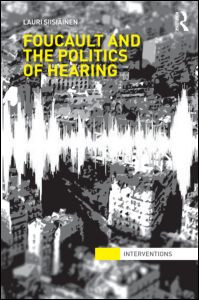
Lauri Siisiäinen, Foucault & the Politics of Hearing. Routledge, July 2012

Publisher’s page

Description
The issue of the senses and sensual perception in Michel Foucault’s thought has been a source of prolific discussion already for quite some time. Often, Foucault has been accused of overemphasizing the centrality of sight, and has been portrayed as yet another thinker representative of Western ocularcentricism. This innovative new work seeks to challenge this portrait by presenting an alternative view of Foucault as a thinker for whom the sound, voice, hearing, and listening, the auditory-sonorous, actually did matter.

Illustrating how the auditory-sonorous relates most integrally to the most pertinent issues of Foucault – the intertwinement and confrontations of power, knowledge, and resistance – the book both presents novel readings of some of Foucault’s most widely read and commented-on works (such as Discipline and Punish, the first volume of History of Sexuality), and discusses the variety of his lectures, essays, and interviews, some of which have not been noted before.

Moving beyond a commentary on Foucault, Siisiainen goes on to examine other philosophers and political thinkers (including Roland Barthes, Jean-Luc Nancy and Jacques Rancière) in this context in order to bring to the fore the potentials in Foucault’s work for the generation of a new perspective for the political genealogy of the sound, hearing, and listening, approaching the former as a key locus of contemporary political struggles.

This work will be of great interest to students and scholars in a range of areas including political theory, philosophy, and cultural studies.