Foucault News

News and resources on French thinker Michel Foucault (1926-1984)

Shaw, J. The Birth of the Clinic and the Advent of Reproduction: Pregnancy, Pathology and the Medical Gaze in Modernity, Body and Society, Volume 18, Issue 2, June 2012, Pages 110-138
https://doi.org/10.1177/1357034X10394

Abstract
In conjunction with the growing feminist literature on pregnancy and visualization, this paper uses Foucault’s The Birth of the Clinic to demonstrate how the effort to make the interior of the pregnant body visible in medical discourse was a crucial part of the development of the modern medical gaze. In doing so I develop two concurrent arguments. First, I argue that the pathological corpse of the Clinic can conceptually serve as a double for the pregnant body as it emerged in modern medicine in the 20th century. At the same time I use the insights of the Clinic to illustrate changes in pregnancy from early modernity to the 20th century. In early modernity, the pregnant body was understood in terms of generation, as a tree that bears fruit; by the 19th century, the pregnant body was a machine that reproduced the species. This transition can be seen in the overlap of pathology and pregnancy in early modernity, an overlap that continued throughout the 19th century and is inadvertently reinforced through the practice of ultrasound.

Author keywords
disease; fetus; Foucault; medicalization; pregnancy; visual culture; women’s bodies

Baldacchino, G. Governmentality is all the rage: The strategy games of small jurisdictions, Round Table, Volume 101, Issue 3, June 2012, Pages 235-251
https://doi.org/10.1080/00358533.2012.690964

Abstract
This paper discusses the contemporary sovereignty experience of small states and territories in the context of unfolding ‘strategy games’. This paper charts and illustrates some of the most salient issues over which this dynamic is played out, using binary (small state versus big state) relations as its analytic constituency. These practices are understood as part of the evolution of the conduct of government, or governmentality, as envisaged by Michel Foucault: states, no longer concerned with threats to their very existence, can flex their clout extraterritorially, and in so doing provide new and creative opportunities, but also raise threats, for the exercise of sovereignty.

Author keywords
Citizenship rights; Foucault; Governmentality; Indigenous peoples; Islands; Paradiplomacy; Small states; Sovereignty; Strategy games; Subnational jurisdictions; Xenotopia

Natanel, K. Resistance at the limits: Feminist activism and conscientious objection in Israel, Feminist Review, Volume 101, Issue 1, July 2012, Pages 78-96
https://www.jstor.org/stable/41495234

Abstract
This article investigates the relationship between feminism and conscientious objection in Israel, evaluating the efficacy of feminist resistance in the organised refusal movement. While recent feminist scholarship on peace, anti-occupation and anti-militarism activism in Israel largely highlights women’s collective action, it does so at the risk of eliding the relations of power within these groups. Expanding the scope of consideration, I look to the experiences of individual feminist conscientious objectors who make visible significant tensions through their accounts of military refusal and participation in the organised conscientious objection movement. Drawing on original ethnographic research, this article problematises feminist activism in the organised Israeli refusal movement through three primary issues: political voice; privilege; and the realisation of gender agendas. Using Michel Foucault’s conceptualisation of power as it has been critiqued and qualified by feminist scholars, I consider the ways in which resistance may be both multiple and a diagnostic of power, allowing activists and academics not only to envision new avenues for social change, but also to recognise their constraints. Critically, feminist theories of intersectionality enrich and complicate this Foucauldian approach to power, providing further modes of critique and strategy in the context of feminist activism in Israel. Ultimately, I argue not only for engagement with the limits of power, but also attention to their function, as in theory and praxis these boundaries critically inform our theorising on gender and resistance. © 2012 Feminist Review.

Author keywords
conscientious objection; feminist activism; intersectionality; Israel-Palestine; New Profile; power and resistance

CALL FOR PAPERS

The thirteenth annual meeting of the Foucault Circle at
McGill University
Montreal, Canada
April 18-20, 2013

Papers on any aspect of Foucault’s work, as well as studies, critiques, and applications of Foucauldian thinking, are welcome. This year’s conference also includes two special sessions:

A discussion of Foucault’s text I, Pierre Rivière;
A session on Foucault and the family for which we are seeking individual paper submissions.

Please send an ABSTRACT (as a “.doc” attachment) of no more than 750
words by e-mail to program committee chair Erinn Gilson (e.gilson@unf.edu) on or before Friday, November 16th, 2012.
Indicate “Foucault Circle submission” in the subject heading.

Program decisions will be announced in mid-December.

The meeting will begin with a Thursday afternoon screening and discussion of René Allio’s film, “Moi, Pierre Rivière…” (English subtitles), followed by an informal welcome session and dinner. There will be morning and afternoon paper sessions on Friday, followed by a business meeting and dinner. The conference will conclude with paper sessions on Saturday morning. Each speaker will have approximately 35 minutes for paper presentation and discussion combined—papers should be a maximum of 3000 words (15-20 minutes, preferably 15).

Logistical information about lodging, transportation, and other arrangements will be available after the program has been announced.

For more information about the Foucault Circle, please see the
website.

The Foucault Circle wishes to thank William Clare Roberts of McGill University for his help in organizing this year’s conference.


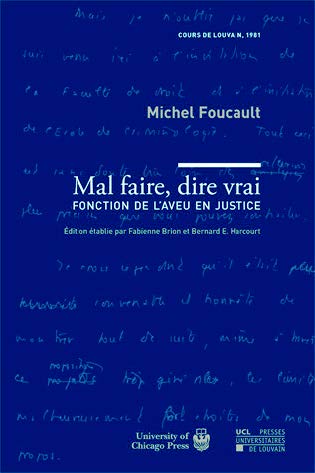
Michel Foucault, Wrong-Doing, Truth-Telling. The Function of Avowal in Justice Edited by Fabienne Brion and Bernard E. Harcourt. Translated by Stephen W. Sawyer, University of Chicago Press 296 pages, © 2013

Publisher’s page

Three years before his death, Michel Foucault delivered a series of lectures at the Catholic University of Louvain that until recently remained almost unknown. These lectures—which focus on the role of avowal, or confession, in the determination of truth and justice—provide the missing link between Foucault’s early work on madness, delinquency, and sexuality and his later explorations of subjectivity in Greek and Roman antiquity.

Ranging broadly from Homer to the twentieth century, Foucault traces the early use of truth-telling in ancient Greece and follows it through to practices of self-examination in monastic times. By the nineteenth century, the avowal of wrongdoing was no longer sufficient to satisfy the call for justice; there remained the question of who the “criminal” was and what formative factors contributed to his wrong-doing. The call for psychiatric expertise marked the birth of the discipline of psychiatry in the nineteenth and twentieth centuries as well as its widespread recognition as the foundation of criminology and modern criminal justice.

Published here for the first time, the 1981 lectures have been superbly translated by Stephen W. Sawyer and expertly edited and extensively annotated by Fabienne Brion and Bernard E. Harcourt. They are accompanied by two contemporaneous interviews with Foucault in which he elaborates on a number of the key themes. An essential companion to Discipline and Punish, Wrong-Doing, Truth-Telling will take its place as one of the most significant works of Foucault to appear in decades, and will be necessary reading for all those interested in his thought.

pdf flyer

Michel Foucault, Mal faire, dire vrai. La fonction de l’aveu en justice
Édition établie par Fabienne Brion et Bernard E. Harcourt, Presses universitaires de Louvain, Louvain-la-Neuve (2012) Co-éditeur : University of Chicago Press
ISBN : 978-2-87558-040-5
382 pages

L’ouvrage

Aux mois d’avril et de mai 1981, Michel Foucault prononce un cours qu’il intitule Mal faire, dire vrai. Fonction de l’aveu en justice. Il y poursuit l’élaboration de la notion de gouvernement par la vérité, introduite en janvier 1979 dans La naissance de la biopolitique puis reprise en janvier 1980 dans Le gouvernement des vivants pour donner un contenu positif et différencié à la notion de savoir-pouvoir et opérer par rapport à celle d’idéologie dominante un second déplace ment.

Le cours est la trace d’un engagement militant : le fruit de l’alliance nouée avec des juristes radicaux, sous l’égide de l’École de criminologie de l’Université catholique de Louvain, à l’occasion d’un projet de révision du code pénal en vigueur en Belgique. Adressé à un public de juristes et de criminologues, il replace l’analyse du développement de l’aveu pénal dans l’histoire plus générale des technologies du sujet et examine diverses techniques par lesquelles l’individu est amené, soit par lui-même, soit avec l’aide ou sous la direction d’un autre, à se transformer et à modifier son rapport à soi. D’entrée de jeu, Michel Foucault annonce que le problème qui l’occupe a deux aspects. Politique : « savoir comment l’individu se trouve lié, et accepte de se lier au pouvoir qui s’exerce sur lui ». Philosophique :« savoir comment les sujets sont effectivement liés dans et par les formes de véridiction où ils s’engagent ».

Ainsi conçues, les leçons peuvent se lire comme une suite donnée à Surveiller et punir ou comme une première esquisse de l’analyse de la parrêsia et des formes alêthurgiques développée dans Le courage de la vérité. Avec le sujet avouant, ce n’est pas seulement le thème du dire vrai qui est introduit. Parce que les formes de véridiction ont partie liée avec l’assujettissement et la déprise de soi, c’est aussi la question de ce qui s’en déduit pour la philosophie critique – qu’en l’occurrence, Michel Foucault met en oeuvre, à la croisée de l’activité pratique et de l’activité théorique, de la politique et de l’éthique.

Table des matières

Note des éditeurs

Conférence inaugurale

Leuret, l’aveu et l’opération thérapeutique. – Effets supposés du dire vrai sur soi et de la connaissance de soi. – Caractères de l’aveu. – Extension dans les sociétés chrétiennes occidentales : des individus liés à leur vérité, et obligés dans leurs rapports aux autres par la vérité dite. – un problème historico-politique : comment l’individu se lie à sa vérité et au pouvoir qui s’exerce sur lui. – un problème historico-philosophique : comment les individus sont liés par les formes de véridiction où ils s’engagent. – un contrepoint au positivisme : la philosophie critique des véridictions. – Le problème du « qui juge-t-on ? » dans l’institution pénale. – Pratique pénale et technologie de gouvernement. – Le gouvernement par la vérité.

Leçon du 22 avril 1981

Une ethnologie politique et institutionnelle de la parole vraie. – dire vrai, dire juste. – Limites de l’étude. – Véridiction et juridiction dans l’Iliade d’Homère. – Le combat de Ménélas et Antilokhos. – objet de l’aveu d’Antilokhos. – Justice et agôn ; agôn et vérité. – La course et le défi de serment, deux liturgies du vrai, deux jeux destinés à représenter avec justesse la vérité des forces. – un rituel de commémoration. – Véridiction et juridiction dans Les travaux et les jours d’Hésiode. – Le dikazein et le krinein. – Le serment des plaideurs et des cojureurs dans le dikazein : un jeu à deux, le critère étant le poids social des adversaires. – Le serment du juge dans le krinein : un jeu à trois, le critère étant le dikaion. – du poids social des adversaires à la « réalité des choses » : dikaion et alêthes.

Leçon du 28 avril 1981

Représentation du droit dans Œdipe roi, de sophocle. – un paradigme judiciaire. – Les ressorts de la tragédie. – deux anagnôriseis, trois alêthurgies. – Véridiction et prophétie. – Véridiction et tyrannie. – Véridiction et témoignage d’aveu. – Grandeur des parties, liberté de parole et conditions de l’effet de vérité dans l’enquête. – La reconnaissance par le chœur, condition de la reconnaissance par Œdipe. – du dire vrai au dire « je ». – une procédure conforme au nomos, une véridiction qui répète celle du prophète et complète celle de l’homme de la tekhnê tekhnês.

Leçon du 29 avril 1981

Herméneutique du texte et herméneutique de soi dans le christianisme primitif. – Véridiction de soi dans l’Antiquité païenne. – L’examen de conscience pythagoricien : purification de soi et mnémotechnique. – L’examen de conscience stoïcien : gouvernement de soi et remémoration du code. – L’expositio animae stoïcienne : médecine des passions et degré de liberté. – La pénitence dans le christianisme primitif. – Le problème de la réintégration. – La pénitence, un statut qui manifeste un état. – Significations de l’exomologèse. – une  vie en forme d’aveu, un aveu en forme de vie. – un  rituel de supplication – davantage que le modèle médical ou judiciaire, celui du martyre. – Véridiction de soi et mortification de soi – De la publication de soi comme pécheur à la verbalisation de soi : tentation et illusion.

Leçon du 6 mai 1981

Pratique de la véridiction dans les institutions monastiques du iVe-Ve  siècle : les Apophtegmata Patrum et les écrits de Cassien. – Le monachisme entre vie de pénitence et existence philosophique. – Caractères de la direction de conscience antique. – Caractères de la direction de conscience dans le monachisme : une obéissance indéfinie, formelle et auto-référée ; humilité, patience et soumission ; inversion du rapport de verbalisation. – Caractères de l’examen de conscience dans le monachisme : de l’actum à la cogitatio. – Mobilité de la pensée et illusion. – Discrimen et discretio : aveu et origine de la pensée.– Véridiction de soi, herméneutique de la pensée et sujet de droit.

Leçon du 13 mai 1981

Caractères de l’exagoreusis au iVe-Ve   siècle. – renonciation  à soi. – Vérité du texte et vérité de soi. – Affranchissement et ajustement de l’herméneutique du texte et de l’herméneutique de soi dans le protestantisme. – illusion, évidence et sens (descartes et Locke). – Illusion de soi sur soi et inconscient (Schopenhauer et Freud). – Juridification de l’aveu dans la tradition ecclésiastique du iVe   au VIIe   siècle. – Compénétration de l’exagoreusis et de l’exomologèse dans les premières communautés monastiques et de laïcs. – Caractères et origines de la pénitence tarifée : modèle monastique et modèle du droit germanique. – sacrementalisation et institution de la confession obligatoire au Xiiie siècle. – Juridification des rapports entre l’homme et Dieu. – Formes et significations de l’aveu dans la confessio oris.

Leçon du 20 mai 1981
Juridification dans les institutions ecclésiastiques et politiques. – Du Dieu juge à l’État de justice : souveraineté et vérité. – Aveu, torture et épreuve inquisitoire de la vérité. – Aveu, torture et preuves légales. – Aveu, loi souveraine, conscience souveraine et engagement punitif. – Auto-véridiction, évidence et dramaturgie pénale. – Hétéro-véridiction, examen et psychiatrie légale. – rapporter l’acte à l’auteur : la question de la subjectivité criminelle au XIXe   siècle. – La monomanie et la constitution du crime comme objet psychiatrique. – La dégénérescence et la constitution du criminel comme objet de la défense sociale. – de la responsabilité à la dangerosité, du sujet de droit à l’individu criminel. La question de la subjectivité criminelle au XXe siècle. – Herméneutique du sujet et signification du crime pour le criminel. – Accident, probabilité et indice de risque criminel. – La véridiction du sujet, brèche du système pénal contemporain.

Entretien de Michel Foucault avec André Berten, 7 mai 1981

Entretien de Michel Foucault avec Jean François et John de Wit, 22 mai 1981

Situation du cours

McKinlay, A.A , Wilson, J.B ‘All they lose is the scream’: Foucault, Ford and mass production, Management and Organizational History, Volume 7, Issue 1, February 2012, Pages 45-60
https://doi.org/10.1177/1744935911427219

Abstract
Henry Ford insisted that his development of mass production owed nothing to Taylorism. But Ford and Taylor can only be understood as part of a wider revolution in American management that prioritized efficiency, experimentation and flow. Following Foucault, Henry Ford represented the rationalizing capability of ‘sovereign power’. Ford’s radical innovations in production techniques depended upon parallel innovations in administration and accounting. The development of the moving assembly line in Highland Park depended upon an assemblage of organizational innovations, not just the practical experiments of Ford engineers. In 1921 Ford’s complex knowledge base was brutally dismantled in Ford’s giant new River Rouge plant. Incremental productivity gains were now squeezed from the line by supervisory pressure. The Ford experience suggests the interweaving of ‘sovereign’ and ‘disciplinary’ forms of power/knowledge.

Author keywords
assembly line; Ford; Foucault; River Rouge

Little, J. Transformational Tourism, Nature and Wellbeing: New Perspectives on Fitness and the Body, Sociologia Ruralis, Volume 52, Issue 3, July 2012, Pages 257-271
https://doi.org/10.1111/j.1467-9523.2012.00566.x

Abstract
Historical studies of rural recreation and wellbeing have drawn attention to the role of nature and the countryside in the development of ideas surrounding notions of fitness as a moral responsibility. This article builds on some of this work in an examination of transformational tourism and the ways in which nature, and in particular wild nature, is drawn into more contemporary concerns about health, wellbeing and the body. Using the work of Foucault, the article explores how wild nature (as a location and a set of practices) becomes part of a strategy employed by the individual to discipline the body in terms of ideas about size, shape and fitness and to inform broader lifestyle and therapeutic practices in the ‘care of the self’.

Steven Maynard, ‘Foucault: His Thought, His Character (review)’, Labour / Le Travail, 69, Spring 2012, pp. 255-257

Further details
Full PDF

In lieu of an abstract, here is a brief excerpt of the content:

Reading Veyne, now age 82 and Honorary Professor at the Collège de France, is a bit like listening to an elder patriarch hold forth on his favourite subjects. It’s not without its charm and much can be learned, if one is prepared to put up with the other things that often accompany such a performance.

The digressions. In a book about Foucault, there is an entire chapter on “the beginnings of Christianity.” This is one of Veyne’s own areas of expertise, and one that certainly interested Foucault. While Veyne’s detour can be read as a demonstration of how the genealogical method effectively deflates the universalist pretensions of Christianity, Foucault’s name isn’t mentioned even once in the chapter. This is followed by a long aside on Heidegger. Again, connections could be made, but instead they remain implicit, forcing Veyne, as if suddenly remembering the actual subject of his book, to make the rather awkward transition, “So let us now return to Foucault, our hero.” (73)

The dizzying degree of disparate detail. Veyne tells us Foucault was not a relativist, a structuralist, or a nihilist. But he was a nominalist, perhaps a positivist, and a one-time Communist. He was also, in Veyne’s estimation, a warrior and Samurai. But above all, Foucault was “a sceptic thinker.” (1) Here Veyne is at his best, although it is impossible not to read Veyne’s privileging of skepticism in Foucault’s thought against Foucault’s own arguably greater interest in elaborating a politically useful version of Cynicism in The Courage of Truth, his last lectures at the Collège de France. There is also a goldfish in a bowl, Veyne’s recurring metaphor for how we are all trapped within discourse (Foucault’s “ill-chosen word” [6]), and a cat that shows up at Foucault’s apartment and upon which Veyne bestows philosophical significance. Readers will likely identify with Veyne when he declares, “My head is spinning,” and this only halfway through the text. (66)

The distinct sense of having heard it all before. Foucault is an elaboration of an essay with a long history, one that goes oddly unacknowledged. It first appeared in 1986 in the French periodical Critique, although its conclusion – Veyne’s recreation of the conversation he had with Foucault about AIDS a few months before the philosopher’s death – was edited out. That intimate exchange later appeared with Veyne’s permission in Didier Eribon’s biography of Foucault, and in 1993 the complete Critique piece was translated into English for the journal Critical Inquiry. Veyne cuts and pastes into Foucault the conversation with his dying friend, almost as if he’s telling it for the first time, which has the effect, at least for this reader, of draining it of the sincerity that made the original so moving.

It’s really only in the last chapter that Veyne takes “the risk of being too anecdotal” (140) to offer some of his more personal memories, which is another way of saying that anyone hoping to find a full memoir of Veyne’s friendship with Foucault will be disappointed. Veyne remains too committed to elucidating “his thought.” And this may not be such a bad thing. A number of Veyne’s reflections on Foucault’s “character,” particularly in relation to sex and gender, give one pause. For instance, Veyne recounts how at a meeting of their cell in the early 1950s Foucault made deliberate use of a feminine homosexual argot to shock Veyne and other comrades into their first awareness of homosexuality within the Parti communiste français (pcf). Veyne reports that 20 years later Foucault “no longer sneered or relayed tittle-tattle. There was nothing at all hysterical about him.” (141) What a relief. We can all rest easy now knowing that one of the 20th century’s greatest thinkers was no flamer. And what is really behind Veyne relating in some detail the story of having once discovered…

Dean, Mitchell, Governmentality Meets Theology: ‘The King Reigns, but He Does Not Govern’, Theory, Culture and Society, Volume 29, Issue 3, May 2012, Pages 145-158

Review of The Kingdom and the Glory: For a Theological Genealogy of Economy and Government by Giorgio Agamben, trans. Lorenzo Chiesa (with Matteo Mandarini) Stanford, CA: Stanford University Press, 2011
https://doi.org/10.1177/0263276412438599

Abstract
While this ‘extraordinary’ book appears as an intermezzo within the Homo Sacer series (Negri, 2008), it supports two fundamental theses with its own philological, epigraphic, liturgical and religious-historical research, and a close reading of figures such as Ernst Kantorowicz and Marcel Mauss. These theses concern political power first as an articulation of sovereign reign and economic government and, secondly, as constituted by acclamations and glorification. These can be approached theoretically through its author’s engagement with Michel Foucault’s genealogy of governmentality and with the Erik Peterson/Carl Schmitt debate on the closure of political theology. Agamben’s reformulation of power and his derivation of liberal governmentality from the theological oikonomia prove convincing. A renewed analytics of power and politics of resistance should be possible, however, without recourse to a project seeking to deactivate all profane powers including those of public bureaucracies.

Author keywords
acclamation; glory; government; power; reign; sovereignty