Foucault News

News and resources on French thinker Michel Foucault (1926-1984)

Franck Salaün, Besoin de fiction. Sur l’expérience littéraire de la pensée et le concept de fiction pensante, Paris, Hermann, coll. “Fictions pensantes”, 2010

Présentation de l’éditeur :
Les fictions pensent-elles ? On ne se lasse pas de le dire : l’homme est un animal fabulateur, un producteur de fictions. Notre besoin de fiction est même impossible à rassasier. Mais le clivage traditionnel entre réalité et fiction occulte certaines des motivations de ce besoin et le mode d’existence des univers fictionnels. Face à ce constat, Franck Salaün propose une réflexion sur les différentes façons de recourir à la fiction. Il nous invite, en outre, à envisager la littérature comme un espace de pensée, et les oeuvres comme des systèmes signifiants dont le fin mot n’appartient ni à l’auteur ni au lecteur. Il ne s’agit pas, dans cet essai, de fournir une théorie clés en main de la fiction, mais d’interroger la façon dont les textes pensent — pas seulement àquoi ils pensent, et dans quels buts, mais comment ils pensent. C’est aussi l’occasion de préciser et d’illustrer le concept de « fiction pensante ». L’entreprise peut dérouter, il n’est donc pas superflu de cartographier la région à explorer, en signalant au promeneur quelques sites intéressants, et aux autres orpailleurs les cours d’eau et les sables aurifères.

Franck Salaün enseigne la littérature française à l’université de Montpellier. Auteur de plusieurs essais sur le siècle des Lumières, il a aussi dirigé des volumes collectifs, notamment « Diderot / Rousseau. Un entretien à distance » (Desjonquères, 2006). Son dernier ouvrage porte sur la question du statut des textes au XVIIIe siècle (« L’Autorité du discours », Champion, 2010).

Extract from review by Michael de Vita (2012)
MICHAËL DI VITA
La fiction braque le concept. De Diderot à Bourdieu & Foucault

Vient ensuite la plus longue séquence de cet ouvrage, intertitrée « Sans visage ». Michel Foucault y fait l’objet d’une étude assez étendue et quantitativement plus importante que les séquences précédentes, ce qui d’ailleurs produit chez le lecteur une vive impression de discontinuité qui pourra même lui donner le sentiment de faire face à une greffe textuelle, à un ajout hétérogène provenant d’une marche antérieure ou nouvelle que l’auteur aurait finalement décidé d’ajouter, sans jamais vraiment réussir à fournir de justification quant à ce geste relevant davantage du montage inachevé que de la toile enveloppante qu’incarne idéalement l’essai. Mais cette impression n’annule en rien l’intérêt de la réflexion sur l’expérience littéraire de la pensée qui, malgré le saut dans la forme d’écriture, répond à coup sûr aux exigences du problème que F. Salaün fait varier sous nos yeux depuis les premières lignes de son livre, cette fois en explorant la question du style de Foucault et de sa méthode imprégnée de fiction. « Que se passe-t-il […] si nous cessons d’utiliser les catégories habituelles pour nous tourner vers les discours, leur fonctionnement, leur circulation, et voir comment ils nous construisent autant que nous les construisons ? » (p. 84), voilà le nouvel angle du problème que l’auteur reprend de Foucault qui, en effet, accordait une grande importance à l’expression de la pensée conceptuelle et littéraire, au style et aux rapports politiques qu’enveloppent les discours théoriques ou explicitement fictifs. L’agencement que produisent « les mots sans que nous ayons le pouvoir d’en décider » (p. 90), « se rendre capable de se déprendre de soi-même » (p. 91), « contredire » à « la longue succession des synonymes d’un même vocable » qu’est « l’histoire des hommes » (p. 92) : ce sont là des traductions d’un problème qui développe de façon transversale ce que F. Salaün appelle les « fictions pensantes ».

read more

Dr. Thomas Szasz, Psychiatrist Who Led Movement Against His Field, Dies at 92
By
BENEDICT CAREY
Published: September 11, 2012, New York Times

Thomas Szasz, a psychiatrist whose 1961 book “The Myth of Mental Illness” questioned the legitimacy of his field and provided the intellectual grounding for generations of critics, patient advocates and antipsychiatry activists, making enemies of many fellow doctors, died Saturday at his home in Manlius, N.Y. He was 92.

He died after a fall, his daughter Dr. Margot Szasz Peters said.

Dr. Szasz (pronounced sahz) published his critique at a particularly vulnerable moment for psychiatry. With Freudian theorizing just beginning to fall out of favor, the field was trying to become more medically oriented and empirically based. Fresh from Freudian training himself, Dr. Szasz saw psychiatry’s medical foundation as shaky at best, and his book hammered away, placing the discipline “in the company of alchemy and astrology.”

The book became a sensation in mental health circles, as well as a bible for those who felt misused by the mental health system.

Dr. Szasz argued against coercive treatments, like involuntary confinement, and the use of psychiatric diagnoses in the courts, calling both practices unscientific and unethical. He was soon placed in the company of other prominent critics of psychiatry, including the Canadian sociologist Erving Goffman and the French philosopher Michel Foucault.

read more

Michel Foucault, Du Gouvernement des vivants. Cours au Collège de France (1979-1980)

Date de parution 25/10/2012

Paris: Gallimard Seuil. Collection Hautes Etudes

320 pages – 25 € TTC

Publisher’s site

Du Gouvernement des vivants est un cours charnière. Prononcé au Collège de France au premier trimestre 1980, Michel Foucault y poursuit cette histoire des « régimes de vérité » qui traverse l’ensemble des cours du Collège de France, en y apportant une inflexion majeure : commencée dans le champ du juridique et du judiciaire, l’exploration s’était poursuivie dans le champ politique ? thématique des rapports pouvoir-savoir, puis de la gouvernementalité. Elle s’investit ici dans le champ des pratiques et des techniques de soi, domaine de l’éthique que Michel Foucault ne quittera plus.

« Comment se fait-il que dans la culture occidentale chrétienne, le gouvernement des hommes demande de la part de ceux qui sont dirigés en plus des actes d’obéissance et de soumission, des “actes de vérité” qui ont ceci de particulier que non seulement le sujet est requis de dire vrai, mais de dire vrai à propos de lui-même, de ses fautes, de ses désirs, de l’état de son âme ? » se demande Michel Foucault. Ce projet le conduit d’une relecture de l’Œdipe-roi de Sophocle à l’analyse des « actes de vérité » propres au christianisme primitif, à travers les pratiques du baptême, de la pénitence et de la direction de conscience. Michel Foucault choisit de s’intéresser aux actes par lesquels le croyant est conduit à manifester la vérité de ce qu’il est lui-même, en tant qu’être indéfiniment faillible. De l’expression publique de sa condition de pécheur, dans le rituel de la pénitence à la verbalisation minutieuse de ses pensées les plus intimes, dans l’examen de conscience, c’est l’organisation d’une économie pastorale centrée sur l’aveu que l’on voit se dessiner.

Du Gouvernement des vivants est la première des enquêtes, inédite, que Michel Foucault va mener dans le champ de l’éthique, autant dans les cours du Collège de France que dans les derniers volumes de l’Histoire de la sexualité.

« Hautes Études » est une collection des Éditions de l’École des hautes études en sciences sociales, des Éditions Gallimard et des Éditions du Seuil.

Exhibition of John Miller at Praz-Delavallade Gallery in Paris

Paris, 10 September 2012, Art Media Agency (AMA).

From 8 September to 11 November 2012, the Praz-Delavallade Gallery in Paris is displaying “The Petrified Forest”, a new exhibition of artist John Miller.

John Miller’s work is characterised by a multiform aspect: painting, sculpture, photography, and video. With humour, empathy, and perspicacity, his works immerse the spectator into the maelstrom of daily life and sublimate banality. In his previous series, Miller took an interest into the differences between the price and meaning of things, and questioned in depth the notion of worth in our capitalist societies. His most recent projects are dedicated to representations both critical and poetic of the emotional affects, of the relationships to “biopower” (concept elaborated by Michel Foucault) and of its impact on individuals.

In the new series of wooden relief paintings displayed in this exhibition, Miller uses again the subject of individuals crying in reality TV shows, a theme previously tackled in the “Everything Is Said” series. The use of a drab palette of colours, of greys and browns, takes the bad taste inherent in mass media from the images and highlights the paintings’ manufactured aspect. In his “Game Show Paintings” series (1998-2000), John Miller has focused on the coloured settings of TV games, in opposition with the candidates’ apparently interchangeable character. In opposition, the gendre of reality TV shows seems to focus on individuals and on staged or unstaged situations but John Miller chooses to depict the other side of the picture. Crying has indeed become a performative asset: angers, fights and tears represent strong moments in these shows. On the same level as beauty or charisma, the ability to show one’s emotions in front of cameras seems to have become an essential prerogative when participating in these shows. With his work, Miller reminds that every representation of reality necessarily requires a subjective point of view.

This is John Miller’s fourth solo exhibition in the Praz-Delavallade Gallery. Currently, his work is also displayed in group exhibitions at the Rubell Family Collection in Miami and at the Palais de Tokyo in Paris.

Graham, Helen (2012). “Scaling governmentality: Museums, co-production and re-calibrations of the ‘logic of culture'”. Cultural studies, 26 (4), pp. 565-92.
https://doi.org/10.1080/09502386.2012.679285

Abstract
This article explores contemporary uses of museum co-production for public policy through a sustained theoretical engagement with Tony Bennett’s work on museums as an ‘object of government’. The specific focus is a theoretical discussion of the ‘logic of culture’ as it relates to new UK policy uses of participants’ ‘experience’ as the desired site of authenticity at the very same time as the process of expressing this authenticity is located as a site for reform. It is argued that Bennett mobilizes two techniques of scale (fixing the analytic lens of governmentality and drawing on a strong scalar correspondence of power) in order to secure a relatively disciplinary reading of governmentality and to foreclose the resistant possibilities of cultural politics. Drawing on the differences between practices associated in UK museums with ‘access’ (which works through the dis-intensification of the difference between the museum and everyday life) and with ‘social impact’ (which requires a re-intensification of this difference in order to increase the visibility of effect), this article concludes by countering Bennett’s more disciplinary uses of Foucault with the Foucault of ‘The Subject and Power’. It is argued that the ‘logic of culture’ can be calibrated to varying intensities in considering the coming-into-relationship between the museums and those-to-be-involved. It is specifically argued – following Foucault’s spatializaton of ‘thought’ as distance (limit-attitude) and ‘counter-conduct’ as proximity – that the ‘logic of culture’ might be actively re-calibrated to use the spatialized dynamic of distance and proximity to create spaces which might allow the museum and its associated policy – not just those involved – to be affected by the co-production encounter.

Author Keywords:
museums; governmentality; Cultural Studies; cultural policy; co-production; community engagement

stuartelden's avatarProgressive Geographies

Foucault’s 1976 lecture ‘The Mesh of Power’ is available online in English (with a link to the French) at Viewpoint Magazine. This lecture was previously translated by Gerald Moore for the Space, Knowledge and Power: Foucault and Geography collection Jeremy Crampton and I edited. But this version includes the discussion that followed Foucault’s lecture. Thanks to Peter Gratton for the link.

View original post

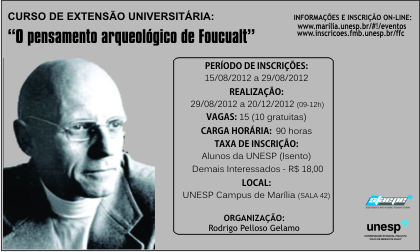
Curso de Extensão Universitária: “O Pensamento arqueológico de Foucault” (UNESP-Marília)

O curso de extensão está ocorrendo na sala 42.
Horário: 09:00h às 12:00h.
Período: todas as quintas, até 20/12/2012.
Carga horária: 90 horas.
Acesso ao Site

Via Grupo de Estudos Foucaultianos

Esposito, R. The dispositif of the person, Law, Culture and the Humanities, Volume 8, Issue 1, February 2012, Pages 17-30
https://doi.org/10.1177/1743872111403104

Abstract
In this essay one of Italy’s leading philosophers examines the category of person from legal, historical, and biopolitical perspectives. Reading texts ranging from Roman law to Christian theology to bioethics, Esposito shows how person functions in Foucault’s terms as a dispositif, that is as a way of arranging the relation between the human and animal in contemporary subjectivity. Drawing on the etymology of person from persona or mask, Esposito shows how the term allows a subject to dispose of his or her animal half through the gift of grace in order to become a human person. Reading Saint Augustine, Simone Weil, and others, Esposito shows how the archaic role played by the person in Roman law returns today in liberalism’s objectification of the body as a thing. Esposito concludes by elaborating a counter dispositif of the impersonal as a way of transforming our political lexicon.

Author keywords
Classical sovereignty; Giorgio Agamben; Human rights; Impersonal; Living being; Roman law; Saint Augustine; Simone Weil; Slave as property

Street, A.A , Coleman, S.B. Introduction: Real and imagined spaces, Space and Culture, Volume 15, Issue 1, February 2012, Pages 4-17
https://doi.org/10.1177/1206331211421852

Abstract
The hospital’s ambiguous relationship to everyday social space has long been a central theme of hospital ethnography. Often, hospitals are presented either as isolated “islands” defined by biomedical regulation of space (and time) or as continuations and reflections of everyday social space that are very much a part of the “mainland.” This polarization of the debate overlooks hospitals’ paradoxical capacity to be simultaneously bounded and permeable, both sites of social control and spaces where alternative and transgressive social orders emerge and are contested. We suggest that Foucault’s concept of heterotopia usefully captures the complex relationships between order and disorder, stability and instability that define the hospital as a modernist institution of knowledge, governance, and improvement. We expand Foucault’s focus on the disciplinary, heterotopic qualities of the hospital to explore the heterotopia as a space of multiple orderings. These orderings are not only biomedical. Rather, hospitals are notable for the intensity and heterogeneity of the ongoing spatial ordering processes, both biomedical and other, that produce them. We outline an approach to heterotopias that traces the contingent configuration of hospital space through relationships between the physical environment, technologies, and persons, while simultaneously considering the kinds of spatial imaginings, hopes for the future, and emotional responses that are rendered possible by those configurations. We provide three thematic frameworks through which the heterotopic and contingent qualities of hospital spaces might be explored: boundary work, generating scale, and layered space.

Author keywords
biomedicine; heterotopia; Hospital ethnography; medical anthropology; STS

For an article in response to this article see Comments

Biebricher, Thomas & Frieder Vogelmann, Governmentality and State Theory: Reinventing the Reinvented Wheel?, Theory & Event, Volume 15, Issue 3, 2012

https://muse.jhu.edu/article/484422

Abstract
In this paper we pose the question what constitutes the originality of governmentality as a state analytical framework by confronting it with alternative contemporary approaches in state theory, suggesting that the latter may already contain many of the insights Foucaultians sometimes tend to ascribe to the governmentality perspective exclusively and thus run the risk of reinventing the state theoretical wheel. Still, we argue that there is something unique to the governmentality perspective, namely a particular kind of unwieldy knowledge about the state it aims to produce. Generating such knowledge would no longer be state theory but rather state philosophy in a specifically Foucaultian sense.