For people whose news platform of choice is twitter, Foucault News is now on twitter.
You can also subscribe via the ‘follow’ button in the right sidebar of the blog.

For people whose news platform of choice is twitter, Foucault News is now on twitter.
You can also subscribe via the ‘follow’ button in the right sidebar of the blog.
Reblogged from Grupo de Estudos Foucaultianos

Séminaire “Avec Foucault” – Lille 3, France 2012-2013
Séminaire organisé par Philippe Sabot (Lille 3 / UMR « Savoirs, textes, langage »)
Ce séminaire est destiné à développer les activités menées au sein du groupe de travail « Avec Foucault » en 2012. Il s’agit d’une part de poursuivre la démarche de présentation de travaux en cours afin de permettre aux chercheurs travaillant sur, avec ou même à partir de Foucault, de confronter leurs recherches. Mais il s’agit d’autre part de créer, au sein même de ce collectif de recherches foucaldiennes, un espace de travail et de problématisation des concepts foucaldiens, interrogés à partir de sites précis : le savoir, la vérité, le sujet, la sexualité, l’histoire, la fiction…
Programme des séances
Jeudi 18 octobre, 16h-18h – Philippe Sabot (Lille 3 / UMR STL) : Foucault, Merleau-Ponty et la phénoménologie.
Jeudi 15 novembre, 17h-19h – Lucien Vinciguerra (Lille 3 / UMR STL) : Foucault et les mathématiques. A partir des Mots et les choses.
Jeudi 29 novembre, 16h-18h – Daniele Lorenzini (Université Paris Est -Créteil / EA « Lettres Idées Savoirs ») : Le concept de « régimes de vérité » entre épistémologie, éthique et politique.
Jeudi 13 décembre, 16h-18h – Julie Mazaleigue Labaste (UPJV Amiens / Centre d’Histoire des Sociétés, des Sciences et des Conflits) : Foucault et Sade : sur, contre, avec Sade ?
Jeudi 17 janvier, 16h-18h – Dork Zabunyan (Lille 3 / CEAC) : Foucault et le cinéma : faire passer de l’histoire.
Jeudi 31 janvier , 16h-18h – Ivan Ponton (Lille 3 / UMR STL) : Le dispositif de sexualité.
Jeudi 7 mars, 16h-18h – Philippe Chevallier (BNF Paris) : Foucault et le christianisme.
Jeudi 28 mars, 16h-18h – Stéphane Zygart (Lille 3 / UMR STL) : sur Le Pouvoir psychiatrique.
Jeudi 11 avril, 16h-18h – Luca Paltrinieri (CIRP / CIEPFC ENS-Paris ): L’usage de la fiction chez Foucault (histoire, littérature, politique).
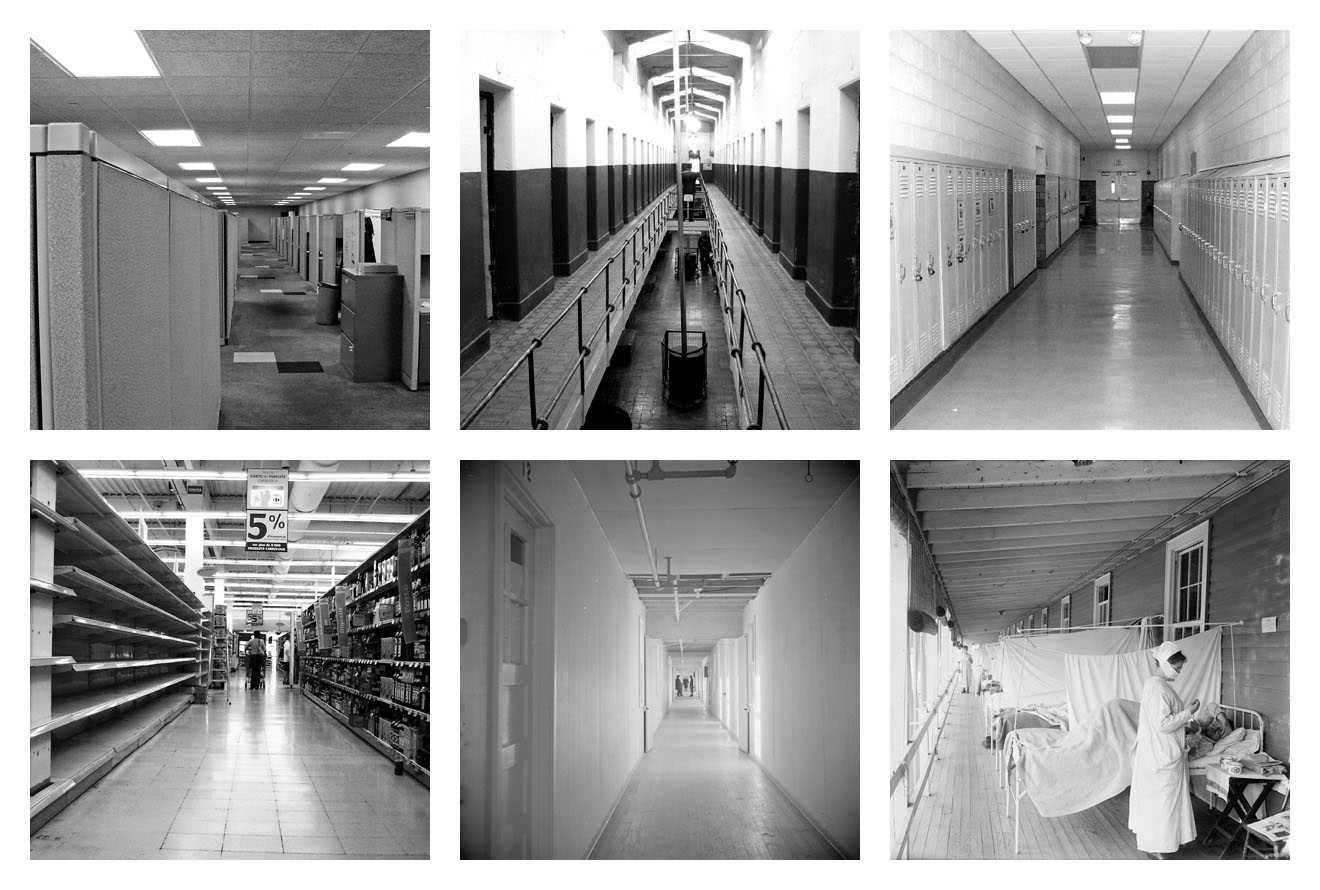 The Power of Architecture – photomontage by the author (2012)
Recently, I was lucky enough to be asked to write an article for the seventh issue of the Chilean journal SPAMand I decided to use this opportunity to articulate the clumsy addition of ideas that I started to touch on during June’s “Foucault’s week.” I hope that the following text, Foucault and Architecture: The encounter that never was, is therefore a good synthesis of the argument I was trying to explore: Despite what architects might usually think, Michel Foucault never truly engaged the problem of the political power of architecture but rather kept investigating the notion of diagram. When confronted to this observation, we might find interesting to keep a Foucauldian method to address architecture.
Foucault and Architecture: The encounter that never was
by Léopold Lambert
curated by SPAM
A certain amount of architects often refers…
View original post 2,000 more words
 Geoffroy de Lagasnerie, La dernière leçon de Michel Foucault. Sur le néolibéralisme, la théorie et la politique, Editions Fayard, A paraître, le 31 octobre 2012
Plus d’informations sur le site de l’auteur
Présentation de l’éditeur
À partir du milieu des années 1970, Michel Foucault a consacré au néolibéralisme de nombreux textes qui comptent parmi les plus controversés de son œuvre : et s’il était, à la fin de sa vie, en train de devenir libéral? Rompant avec cette interprétation dominante, Geoffroy de Lagasnerie propose une analyse neuve et originale : Foucault a constitué la tradition néolibérale comme un test, un instrument de critique de la réalité et de la pensée. Loin de désigner ce courant comme un repoussoir, Foucault en fait un foyer d’imagination qui permet de réfléchir autrement. Il y trouve des outils pour mettre en lumière les limites de la philosophie politique, des théories du contrat et du droit, du marxisme, de la psychologie, etc. Pour Foucault, il s’agit de réinventer un art de l’insoumission à partir d’une réinterprétation du néolibéralisme. Ce qui suppose de reformuler des concepts aussi classiques que ceux d’État, de société, de pouvoir, etc.
En se demandant à partir de là comment élaborer une philosophie de l’émancipation à l’ère néolibérale et quelles sont les conditions de la critique de cette gouvernementalité, Geoffroy de Lagasnerie aborde d’une manière nouvelle des sujets qui sont placés au centre du débat contemporain à l’échelle internationale.
Geoffroy de Lagasnerie est philosophe et sociologue. Il est chargé de cours à Sciences Po. Il est l’auteur de Logique de la création (Fayard, 2011), Sur la science des œuvres (Cartouche, 2011) et L’Empire de l’Université (Amsterdam, 2007).
Review 1 on Mediapart
Review 2 on Mediapart
Radio presentation by author
 Tom Roach, Friendship as a Way of Life: Foucault, AIDS, and the Politics of Shared Estrangement, SUNY Press, 2012, ISBN13: 978-1-4384-3999-0
Description
Develops Foucault’s late work on friendship into a novel critique of contemporary GLBT political strategy.
Borrowing its title from a 1981 interview of Michel Foucault, Friendship as a Way of Life develops the philosopher’s late work on friendship into a novel critique of contemporary GLBT political strategy. Tom Roach brings to life Foucault’s scant but suggestive writings on friendship (some translated here for the first time), emphasizing their ethical implications and advancing a new and politically viable concept—friendship as shared estrangement. In exploring the potential of this model for understanding not only social movements such as ACT UP and the AIDS buddy system, but the literary and artistic work of Hervé Guibert and David Wojnarowicz as well, Roach seeks to reclaim a politics of friendship for queer activism. The first book devoted exclusively to Foucault’s work on the subject, it reassesses Foucaultian queer theory in light of the recent publication of the philosopher’s final seminars at the Collège de France. Its provocative thesis returns Foucault’s concept of biopower to its home in sexuality studies and places queer theory front and center in current biopolitical debates.
Table of Contents
Tom Roach is Assistant Professor of Literary and Cultural Studies at Bryant University.
Tom Roach discusses his book in a podcast
New Foucault: A Symposium
Friday, 9 November 2012
Building 2.G.04 and 3.G.55, Bankstown Campus of The University of Western Sydney, Australia
web page
The influence of Michel Foucault’s work through the Humanities and social sciences has been sustained across more than three decades, but earlier orthodox understandings and glosses, focused on major texts and central concepts have now given way to careful analysis of less obvious but important contemporary implications. The recent publication and translation of Foucault’s lecture series, and closer examination of various shorter texts has opened up new interpretive directions. This seminar brings together scholars working in three new directions drawing on Foucault’s texts: theorizing law and neo-liberalism, renovating bio-political perspectives, and mobilizing critical concepts of experience and self-transformation.
11.00 – 12.30 Session 1, B2.G.04: Three Ways of Thinking Biopolitics beyond the Human
Matthew Chrulew (Macquarie University) – “Animals as Biopolitical Subjects”
Dinesh Wadiwel (University of Sydney) – “Thrasymachus’ Objection: Examining Pastoral Power as a Mode of Sovereignty”
Paul Alberts (UWS) – “A Foucault for the Anthropocene”
12.30 – 1.30 Lunch: Light Lunch provided
1.30 – 3.00 Session 2, B3.G.55: Foucault and Neo-liberalism
Paul Patton (UNSW) “Foucault’s ‘critique’ of Neo-liberalism Revisited”
Miguel Vatter, (UNSW) – “Foucault and Hayek on the Nomos of Civil Society”?
Respondent: Charles Barbour (UWS)
3.00 – 3.30 Afternoon Tea
3.30 – 5.00 Session 3, B3.G.55: Foucault and Critical Thought of Experience
Timothy O’Leary, (Hong Kong) – “New Tools, New Foucault? The Critique of Ethical Experience”
Jana Sawicki, (Williams, Mass.) – “Foucault, Feminism, and Queering Critical Thought”
Respondent: Allison Weir (UWS)
Brett Neilson, Ageing, Experience, Biopolitics: Life’s Unfolding, Body and Society, Volume 18, Issue 3-4, September 2012, Pages 44-71
https://doi.org/10.1177/1357034X12446377
Abstract
In the wake of Foucault, the debate on biopolitics has focused on the tensions of bíos and zoé, community and immunity, generation and thanatopolitics. What remains obscure in these accounts is the experiential aspect of life – its unfolding and entanglement with the ageing process. This is true both of approaches that emphasize the ethical implications of the life sciences and those that explore the biopolitical workings of wider social processes. In the contemporary capitalist formation, life’s unfolding is caught up in global flows of information, finance and labour. The organization of the human faculties, the general preconditions for knowledge and communication, becomes central to value creation. And the human body, like fixed capital for Marx, becomes a cost to be amortized as quickly as possible. Investigating these processes with regard to transformations in practices of care provides a means for reassessing current debates regarding the ageing of people and populations. © The Author(s) 2012.
Author keywords
ageing; biopolitics; capitalism; care; experience; Foucault
Alvaro Sevilla-Buitrago, Territory and the governmentalisation of social reproduction: Parliamentary enclosure and spatial rationalities in the transition from feudalism to capitalism, Journal of Historical Geography, Volume 38, Issue 3, July 2012, Pages 209-219
https://doi.org/10.1016/j.jhg.2012.02.002
Abstract
Recent applications of Foucauldian categories in geography, spatial history and the history of town planning have opened up interesting new perspectives, with respect to both the evolution of spatial knowledge and the genealogy of territorial techniques and their relation to larger socio-political projects, that would be enriched if combined with other discursive traditions. This article proposes to conceptualise English parliamentary enclosure-a favourite episode for Marxist historiography, frequently read in a strictly materialist fashion-as a precedent of a new form of sociospatial governmentality, a political technology that inaugurates a strategic manipulation of territory for social change on the threshold between feudal and capitalist spatial rationalities. I analyse the sociospatial dimensions of parliamentary enclosure’s technical and legal innovations and compare them to the forms of communal self-regulation of land use customs and everyday regionalisations that preceded it. Through a systematic, replicable mechanism of reterritorialisation, enclosure acts normalised spatial regulations, blurred regional differences in the social organisation of agriculture and erased the modes of autonomous social reproduction linked to common land. Their exercise of dispossession of material resources, social capital and community representations is interpreted therefore as an inaugural logic that would pervade the emergent spatial rationality later known as planning.
Author keywords
Commons; Michel Foucault; Parliamentary enclosure; Planning history; Spatial governmentality; Territoriality
Gordon Tait, Clare O’Farrell, Sarah Davey Chesters, Joanne Brownlee, Rebecca Spooner-Lane, “Are There Any Right or Wrong Answers in Teaching Philosophy?: Ethics, Epistemology, and Philosophy in the Classroom” Teaching Philosophy, 35 (4), pp.367-381
https://doi.org/10.5840/teachphil201235442
Abstract
This article assesses undergraduate teaching students’ assertion that there are no right and wrong answers in teaching philosophy. When asked questions about their experiences of philosophy in the classroom for primary children, their unanimous declaration that teaching philosophy has ‘no right and wrong answers’ is critically examined across the three sub-disciplinary areas to which they were generally referring, namely, pedagogy, ethics, and epistemology. From a pedagogical point of view, it is argued that some teaching approaches may indeed be more effective than others, and some pupils’ opinions less defensible, but pedagogically, in terms of managing the power relations in the classroom, it is counter-productive to continually insist on notions of truth and falsity at every point. From an ethical point of view, it is contended that anti-realist approaches to meta-ethics may represent a viable intellectual position, but from the point of view of normative ethics, notions of right and wrong still retain significant currency. From an epistemological point of view, it is argued using Karl Popper’s work that while it may be difficult to determine what constitutes a right answer, determining a wrong one is far more straightforward. In conclusion, it is clear that prospective teachers engaging in philosophy in the classroom, and also future teachers in general, require a far more nuanced philosophical understanding of the notions of right and wrong and truth and falsity. In view of this situation, if we wish to promote the effective teaching of philosophical thinking to children, or produce educators who can understand the conceptual limits of the claims they make and their very real and often serious practical and social consequences, it is recommended that philosophy be reinstated to a fundamental, foundational place within the pre-service teaching curriculum.
Ben Anderson, Affect and biopower: Towards a politics of life, Transactions of the Institute of British Geographers, Volume 37, Issue 1, January 2011, Pages 28-43
https://doi.org/10.1111/j.1475-5661.2011.00441.x
Abstract
In this paper I stage an encounter between two concepts that have become popular placeholders for a broad concern with a politics of life: affect and biopower. Through engagement with Antonio Negri’s writings on the ‘real subsumption of life’ in contemporary capitalism and Michel Foucault’s lectures on neoliberalism, I show that understanding how forms of biopower work through affect requires attending to three relations: affective relations and capacities are object-targets for discipline, biopolitics, security and environmentality; affective life is the outside through which new ways of living may emerge; and specific collective affects (including ‘state-phobia’) are part of the conditions for the birth of forms of biopower. In what is simultaneously a departure from, and an affirmation of, recent work on affect, I argue that attending to the dynamics of affective life may become political as a counter to forms of biopower that work through processes of normalisation. The consequence is that understanding how biopower works on and through affect becomes a precondition for developing affirmative relations with affective life.
Author keywords
Affect; Biopolitics; Biopower; Life; Neoliberalism; Non-representationaltheories

 Foucault News