Foucault News

News and resources on French thinker Michel Foucault (1926-1984)

Michael Guilfoyle, Towards a grounding of the agentive subject in narrative therapy, Theory & Psychology, October 2012 vol. 22 no. 5, 626-642

https://doi.org/10.1177/0959354311433446

Abstract
This paper examines the tensions between narrative therapy’s self-identification as a Foucauldian poststructural practice, and its attachment to the notion of personal agency. Michael White—narrative therapy’s primary author—used Foucault’s work as a theoretical foundation, moving us to pose a question that White did not address: Can the narrative therapeutic commitment to an agentive subject be sustained alongside White’s loyalty to the Foucauldian notion of power/knowledge and its account of the constituted subject? I argue that while Foucault is often criticized for not making space for freedom or agency, something like an agentive subject is implicit in, even required for, his constitutionalist perspective to work. Working through this problem could be useful for the developing field of narrative therapy. Three proposals are offered as a way of imagining this agentive figure, and their relevance to narrative therapy practice is discussed.

Keywords
agency, agentive subject, constituted subject, Foucault, narrative therapy

Kioupkiolis, A. The agonistic turn of critical reason: Critique and freedom in Foucault and Castoriadis, European Journal of Social Theory, Volume 15, Issue 3, August 2012, Pages 385-402
https://doi.org/10.1177/1368431012439866

Abstract
Straddling the divide between universalism and relativism, agonistic reason as construed by Foucault and Castoriadis dismisses universal foundations without becoming context-bound or inescapably subjectivist. It is propelled by a strong commitment to freedom and it draws flexibly on available resources and its creative potentials in order to vindicate its conditional claims. This provides a hyper-critical and liberating mode of critical reason which delves into the underlying norms of agency in order to open them up to question and to enhance free self-direction. The argument that is put forward, then, is threefold. Firstly, Castoriadis’ accent on ontological reflection, the imaginative disclosure of new figures and the global intent of critique contrasts with Foucault’s account of agonistic reason and yields a more robust version of critical rationality. Secondly, this form of reflective agonism can effectively address fundamental challenges and reason across contexts, tackling moral and other issues that arise from cultural innovation and exchange. Lastly, agonistic reason need not, and should not, call upon absolute principles on any level in order to uphold its own values and do justice to its radical others.

Author keywords
Agonistic reason; boundless critique; disclosure

Government, Truth, Subject – Michel Foucault and the late lecture courses at Collège de France. A colloquium at the Jan van Eyck Academie.

7 November 2012

Jan van Eyck Academie
Academieplein 1
6211 KM Maastricht
Netherlands

The colloquium is devoted to Foucault’s late lectures at Collège de France (Du gouvernement des vivants [unpublished], Subjectivité et vérité [unpublished], L’Herméneutique du sujet, Le gouvernement de soi et des autres, and Le courage de la vérité). In this particular body of works Foucault undertakes a genealogy of the subject: a subject capable of its own constititution through what Foucault defines as the care of the self and on the notion of parresia, a certain mode of truth-telling of the Greek Antiquity. But what then is the relation to the previous work, where the subject seemed rather like an effect of relations of power and knowlede? These lecture courses will be examined in terms of their form, methodology, their internal constitution as well as their shifts and consistencies with Foucault’s previous works.

The event will be open to the public.

14.00 Introduction
14.15 Arianna Bove: Change
15.00 Alexandre Costanzo: The Grimaces of Truth
15.45 Break
16.00 Karl Lydén: The Blind Empiricist
16.45 Discussion moderated by Jamila Mascat

Arianna Bove is a co-founder and editor of Generation-Online, as well as the English translator of books by Antonio Negri, Franco Berardi, and Maurizio Lazzarato.

Alexandre Costanzo is a philosopher living in Paris, where he teaches at l’Ecole Supérieure d’Art d’Annecy. He is completing his PhD under the direction of Alain Badiou, and has published a number of essays on the relations between philosophy, art, and politics.

Karl Lydén is an editor of Site Magazine, and the Swedish translator of Michel Foucault’s Il faut défendre la société (2008) as well as the upcoming Le gouvernement de soi et des autres (2013). He is a researcher at the theory department of the Jan van Eyck Academie.

Jamila Mascat is a teaching assistant of the chair of Practical philosophy at the university La Sapienza (Rome). She has published the book Hegel a Jena. La critica dell’astrazione (2011), and her current work focuses on the semantics of space within the context of French post-structuralism. She is a reserchear at the theory department of the Jan van Eyck Academie.

Marie-Christine Leps, Thought of the outside: Foucault contra Agamben. Radical Philosophy, (Sep/Oct 2012)

Further info

It is gladly believed that a culture is more attached to its values than to its forms, that these can easily be modified, abandoned, taken up again; that only meaning is deeply rooted. This is to misunderstand … that people cling more to ways of seeing, saying, doing, and thinking, than to what they see, what they think, say or do… In the twentieth century things have taken an unusual turn: the ‘formal’ itself, reflexive work on the system of forms, has become an issue. And a remarkable object of moral hostilities, of aesthetic debates and political clashes.
Michel Foucault

Beginning of article

If Giorgio Agamben expressly situates his work on biopolitics in relation to Michel Foucault’s, it is on a somewhat ambiguous footing. ‘The Foucauldian thesis’, he famously states in Homo Sacer, ‘will then have to be corrected, or at least completed.’ More recently in The Signature of All Things, Agamben claims a methodological filiation: ‘these observations appear to be investigations on the method of Michel Foucault, a scholar from whom I have learned a great deal in recent years.’ ‘Archaeological vigilance’ brings him to interpret the affinities, and perhaps even the signatures among their respective genealogical inquiries on life, the body, and their politicization. Yet critics argue that Agamben’s interpretations of Foucault’s biopolitics amount to radical transformations; that his analyses take place on ontological, epistemological, historical and political planes that fundamentally alter those of his precursor. Arguing from a juridico-institutional, linguistic and transhistorical perspective, through what Paul Patton terms ‘conceptual fundamentalism’, it seems that Agamben would be guilty of turning Foucault on his head, apparently without noticing. I would like to return to the crux of this argument and suggest that Agamben is indeed following lines of analysis drawn by Foucault, but by the early Foucault, the one before May ’68, the Groupe d’Information sur les Prisons and Discipline and Punish – paradoxically, the Foucault who, by his own admission, did not have the concepts or the means to deal with power, bio- or otherwise.

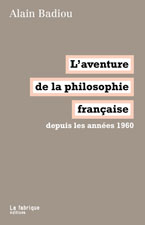
Alain Badiou, L’aventure de la philosophie française depuis les années 1960, Paris: La fabrique
Sortie 22 octobre 2012

Avec Alain Badiou, nous avons la chance d’avoir à la fois un témoin et un acteur dans le domaine. Ceux dont il parle dans ce livre, il les a tous connus : les uns ont été ses maîtres (Althusser, Canguilhem), d’autres de grands aînés (Foucault, Deleuze), d’autres des contemporains (Rancière, Lyotard, Nancy). Certains sont ou ont été des compagnons de lutte, d’autres des adversaires philosophiques. Cette traversée est irremplaçable : très rares sont ceux qui peuvent rassembler de tels textes.

Dans ce livre, il est question de la Révolution culturelle, bien sûr – chez Lardreau et Jambet (L’Ange), de Kant (chez Françoise Proust), du sujet (chez Canguilhem, et, de façon presque opposée, chez Ricœur). On y trouve un long texte sur Rancière (« J’en ai dit par le passé assez de mal, ma réserve est épuisée. Oui, oui, nous sommes frères, tout le monde le voit, et moi aussi, à la fin. »).

Badiou rend hommage à Sartre (« un de nos rares éclaireurs »), à Althusser (celui de 1966, époque de Lire le Capital). Il est plus critique envers Jean-Luc Nancy (« Je me suis demandé si la tâche la plus ingrate et la plus difficile n’était pas de tenter de dire du mal de cet homme incontesté ») ; envers Lyotard, mais non sans respect (« Si pour moi Jean-François Lyotard, le philosophe, regarde exagérément au désert de sable du multiple, il faut convenir que “l’ombre d’un grand oiseau lui passe sur la face” »). Critique admirative, encore, que celle du Pli de Deleuze (« Quand on lit Deleuze, on ne sait jamais exactement qui parle, ni qui assure ce qui est dit, ou s’en déclare certain. Leibniz ? Deleuze ? Le lecteur de bonne foi ? L’artiste de passage ? »)

Ce livre constitue un grand ensemble philosophique, parfois difficile, souvent drôle, toujours original et passionné.

Alain Badiou est un philosophe, romancier et dramaturge. D’inspiration marxiste, il cherche dans la pensée et dans l’art d’écrire tout ce qui est compatible avec une politique égalitaire. On citera, en philosophie, Métaphysique du bonheur réel (PUF, 2015) ; en littérature, Calme bloc ici-bas (POL, 1997); pour le théâtre, Le Second procès de Socrate (Actes Sud, 2015) ; pour les essais politiques, De quoi Sarkozy est-il le nom ? (Éd. Lignes, 2007).

Cities, Space and Development Seminars at LSE

Colin Gordon, (Independent Scholar, Editor and Translator of the works of Michel Foucault) Governmentality: How much is enough?

Seminar Convenor: Dr Sharad Chari
London School of Economics,
Geography and Environment
11 December 2012
Tuesday 4-6 pm
Room V112, Tower 2

London School of Economics and Political Science
Houghton Street
London
WC2A 2AE
England
UK

Map and directions

Info on other seminars in this series

Soirée exceptionnelle à l’occasion de la présentation du livre

Mal faire, dire vrai. Fonction de l’aveu en justice, un livre inédit de Michel Foucault d’après des leçons données à l’Université catholique de Louvain (Belgique) en 1981, édité par Fabienne Brion et Bernard E. Harcourt aux Presses universitaires de Louvain associées à University of Chicago Press.

Mardi 6 novembre 2012,
Centre Wallonie-Bruxelles, 46, rue Quincampoix, 75004 Paris

Rencontre animée par Colin Gordon accompagné par les éditeurs et d’autres spécialistes du philosophe : Fabienne Brion, Bernard E. Harcourt, Daniel Defert, François Ewald, Michel Senellart.

Colin Gordon est traducteur, rédacteur et commentateur de l’oeuvre de Michel Foucault depuis les années 1970.

Fabienne Brion, professeur à la Faculté de droit et de criminologie de l’UCL et Bernard E. Harcourt, professeur de droit et de théorie politique et président du Département de sciences politiques à l’Université de Chicago sont coéditeurs de Mal faire, dire vrai.

Daniel Defert, agrégé de philosophie, fut le compagnon de Michel Foucault pendant près de vingt ans. Il a publié le recueil des Dits et Écrits, en 1994, avec François Ewald, docteur ès lettres, assistant de Michel Foucault.

Michel Senellart, professeur de philosophie politique à l’École Normale Supérieure de Lyon, a édité les cours donnés par Michel Foucault au Collège de France entre 1978 et 1980 : Sécurité, territoire, population, Naissance de la biopolitique en 2004 et Du gouvernement des vivants en 2012,  (coédition EHESS-Gallimard-Le Seuil, collection « Hautes Études »).

Le mardi 6 novembre à 19 heures. Entrée libre dans la limite des places disponibles.

Métro : Châtelet-Les-Halles/Rambuteau/Hôtel de Ville

Admission free, registration welcomed (email lettres@cwb.fr ).

Workshop “Foucault and the critique of our present: Reworking the Foucauldian tool-box”

organized at Goldsmiths College (London) by Yari Lanci, Amedeo Policante and Martina Tazzioli, with the support of the Department of Politics and of mf / materiali foucaultiani

Wednesday, October 31, 2012
4-6 pm (RHB 140)

Alberto Toscano (Goldsmiths College): “Sub-power and surplus-value: A commentary on Truth and Juridical Forms”
pdf flyer

Ilivitzky, M., Origins of biopolitics: Tensions between Foucault and Arendt [Orígenes de la biopolítica: tensiones entre Foucault y Arendt] Araucaria Volume 14, Issue 27, 2012, Pages 24-41

Download pdf here

Abstract
This article aims to explore the differences between the views that Michel Foucault and Hannah Arendt respectively held of the political sphere in general and of its relation with biological, social and economical processes in particular. Hence, the theoretical presumptions present in Foucault’s La volonté de savoir will be contrasted with those analyzed by Arendt in her work The Human Condition. In the conclusions Giorgio Agamben’s desire of reunion of part of these authors’ weltanshauungen over this topic will be enquired.

Author keywords
Action; Biopolitics; Hannah Arendt; Michel Foucault; Politics

Neiva Furlin, Is a sociology of the subject possible? An approach to the theories of Foucault and Touraine [É possível uma sociologia do sujeito? Uma abordagem sobre as teorias de Foucault e Touraine] Sociologias Issue 29, January 2012, Pages 274-311
https://doi.org/10.1590/S1517-45222012000100011

Abstract
This research essay analyzes the theoretical concepts of the notion of “subject” in the works of two French intellectuals, Touraine and Foucault. This comparative approach seeks to establish a relation between the convergent and the contrasting aspects of their social theories, on the purpose of reflecting on their contributions to the comprehension of contemporary society, especially concerning individuals’ subjectivation processes. For this purpose we chose the last works in the scholarly trajectory of these intellectuals. Touraine as well as Foucault offer theoretical contributions to a sociology that does not resort to the great historical phenomena, but puts the efforts of the subjects within their social micro-relations on the stage, considering their cultural, economic, political and personal contradictions.

Author keywords
Contemporary society; Social theory; Sociology of the subject