Foucault News

News and resources on French thinker Michel Foucault (1926-1984)

A new blog titled Foucaultblog  has recently been established at the University of Zurich. Contributions are in German, French and English.

Update September 2025. This blog has been retitled the G+C blog which is the blogging platform of the open access Genealogy + Critique journal. The link to the original blog is from the Wayback Machine

Editorial

The thought and intellectual praxis of Michel Foucault (1926-1984) are a reference of unbroken fascination for a vast number of scholarly, artistic, and political projects. Even now, almost thirty years after his death, new interviews with and lectures by the French philosopher and historian are being published; even now, his work remains neither categorized nor “grasped”; even now, we find that it remains full of surprises; and even now, his texts, therefore, invite new and renewed readings and his thought invites further thought.

Often, however, “Foucault” appears not merely as an unavoidable but also as an almost overpowering reference, bolstered by a doxa that believes it knows its maître à penser and tends to deform Foucault’s though, which is both flexible and sustained by its own contemporaneity, into a type of doctrine. To be sure, Foucault is far from being “dead”, yet at the same time a certain historicization—that is, a careful look at Foucault’s past present—may provide a means of escaping the dogmatic constriction of his reception.

This foucaultblog lends itself to both: unabashed fascination and cool historicization. It aspires to achieve this twofold objective by reflecting in a short, concise manner on the breadth and diversity of references to Foucault, as well as on research about Foucault—and thereby invite further critical thought. The foucaultblog is intended as an open forum for anyone who has not finished with Foucault.

We, the publishers of the foucaultblog, are historians and cultural researchers from Zurich, Munich, Vienna, and Paris involved in various projects with and about Foucault, without always agreeing on Foucault. This candidness should also shape the foucaultblog. We welcome any texts that contribute to such a debate.

Zurich, 1 April 2013.

With thanks to Margaret Kettle for this link

Vrasti, W. Universal but not truly ‘global’: Governmentality, economic liberalism, and the international (2013) Review of International Studies, 39 (1), pp. 49-69.
https://doi.org/10.1017/S0260210511000568

Abstract
This article responds to issues raised about global governmentality studies by Jan Selby, Jonathan Joseph, and David Chandler, especially regarding the implications of ‘scaling up’ a concept originally designed to describe the politics of advanced liberal societies to the international realm. In response to these charges, I argue that critics have failed to take full stock of Foucault’s contribution to the study of global liberalism, which owes more to economic than political liberalism. Taking Foucault’s economic liberalism seriously, that is, shifting the focus from questions of natural rights, legitimate rule, and territorial security to matters of government, population management, and human betterment reveals how liberalism operates as a universal, albeit not yet global, measure of truth, best illustrated by the workings of global capital. While a lot more translation work (both empirical and conceptual) is needed before governmentality can be convincingly extended to global politics, Foucauldian approaches promise to add a historically rich and empirically grounded dimension to IR scholarship that should not be hampered by disciplinary admonitions.

DOI: 10.1017/S0260210511000568

Décès du prix Nobel de médecine François Jacob, à 92 ans
AFP
22/04/2013,
Midi Libre.fr

Le biologiste avait notamment écrit "La logique du vivant", qualifiée de plus remarquable histoire de la biologie par le philosophe Michel Foucault.
Le biologiste avait notamment écrit “La logique du vivant”, qualifiée de plus remarquable histoire de la biologie par le philosophe Michel Foucault. (AFP THOMAS COEX)

Le prix Nobel de médecine, François Jacob, s’est éteint vendredi à l’âge de 92 ans. Cet éminent biologiste et chercheur avait obtenu le prix Nobel en 1965.

Le biologiste et professeur François Jacob, prix Nobel de médecine en 1965, est décédé vendredi à l’âge de 92 ans, a indiqué dimanche soir  l’ancien chancelier de l’Ordre de la Libération Fred Moore.

Ses recherches sur la génétique bactérienne et les circuits de régulation lui ont valu d’innombrables récompenses scientifiques, dont le prix Nobel, conjointement avec André Lwoff et Jacques Monod.

“La logique du vivant”

Jacob souhaitait devenir chirurgien mais ses blessures de guerre le faisant souffrir – notamment la station debout – il s’est tourné à la Libération vers la biologie, “par nécessité intérieure et hasard extérieur”, expliquait cet homme charmant à belle allure et doté d’un solide sens de l’humour.

François Jacob, par ailleurs amateur de peinture, était l’auteur de nombreux articles scientifiques et de plusieurs ouvrages, notamment un essai qui eut un grand écho, “La Logique du vivant” (1970), qualifié par le philosophe Michel Foucault de “plus remarquable histoire de la biologie jamais écrite”.

Biologiste de réputation

Professeur titulaire de la chaire de génétique cellulaire au Collège de France (1965-1991), ce Compagnon de la Libération, membre de l’Académie des sciences (1977) et de l’Académie française (1996), avait été de 2007 à 2011 chancelier de l’Ordre de la Libération, 16e personnage de l’Etat dans l’ordre protocolaire.

Il était Grand Croix de la Légion d’Honneur, Grand Officier de l’Ordre National du Mérite et Croix 39/45. Une cérémonie militaire devrait avoir lieu mercredi en début d’après-midi aux Invalides, a-t-on précisé de même source.

Après le décès de François Jacob, il ne reste plus que 22 Compagnons de la Libération en vie.

See also article on Le blog des livres

Call for papers

Hofstra University LGBT Studies Program and the Hofstra Cultural Center in New York

present

Hofstra’s Sixth Annual LGBT Studies Conference

Michel Foucault 2014: Beyond Sexuality

Thursday and Friday, March 27 and 28, 2014

PDF of Call for Papers

Keynote Speakers:
Dr. Roderick Ferguson, Professor of American Studies; Gender, Women and Sexuality Studies; and African American and African Studies, University of Minnesota
Dr. Ladelle McWhorter, James Thomas Professor in Philosophy; Professor of Women’s, Gender and Sexualities Studies, University of Richmond

Conference Co-Directors
Ann Burlein, Associate Professor and Chair of Religion, Hofstra University
Steven D. Smith, Associate Professor of Classics and Comparative Literature, Hofstra University

Description
One of the foremost and most widely read French philosophers of the 20th century, Michel Foucault is known especially for his three-volume History of Sexuality. This conference uses the occasion of the 30th anniversary of the publication of the final two volumes of that magnum opus as a jumping-off point for an evaluation of his work and the notion of a history of the present, with an eye toward the future: Where do we go from here, beyond Foucault, post-Foucault, without him?

Foucault died in the middle of a large project, the contours of which are only becoming visible to us now as his lectures are being published – a project that spun out between his critique of neoliberalism (and his own work on discipline) on the one hand and a turn to the ancient practices of the self and truth-telling on the other.

How does Foucault’s project – unfinished, fragmented – look today?
The conference organizers are especially interested in presentations on the following topics, though submissions on a range of other topics are welcome:

  • Crisis in the academy – Foucault elaborated his notion of the “specific intellectual” in response to a crisis in the university of his day: What is the role of intellectuals today amid an academy arguably in crisis?
  • The turn toward Greco-Roman classics – What was Foucault’s “Greco-Roman journey” about? What has come of it – in classics, philosophy, cultural studies?
  • Beyond Sexuality? Post-queer?  Identity – subjectivity – an ethics of de-subjectivation: What frameworks seem most promising for thinking sexual practices now?
  •  Medicine as a way that we are governed – The history of medicine, biopolitics and the future of medicine in light of Foucault’s impact.
  • Telling truths and telling stories – What is the role of art and literature, new media and an aesthetics of existence in a politics of the future?

Please email inquiries and proposals of no more than 500 words to Steven D. Smith at Steven.D.Smith@hofstra.edu by September 1, 2013. Decisions will be rendered by November 1, 2013, and participants should expect notification shortly thereafter.

For more information, please contact the Hofstra Cultural Center in New York at 516-463-5669 or

hofculctr@hofstra.edu or visit our website

CFP – Journal materiali foucaultiani

Butler/Foucault: undoing norms, reworking subjects

PDF of call for papers

Foucault’s analyses on sexuality have had a huge influence on Judith Butler’s theories on gender and sexual identities. Both Foucault and Butler’s work have played an eminent role within the feminist debate of the last decade, especially in the Anglo-Saxon and in the Spanish contexts. More broadly, Butler’s analysis of the working of norms in shaping subjects is a widely explored area of study and it is often used as an important reference also by Foucauldian scholars. At the same time, Butler’s work has taken into account some Foucauldian ethical and political issues as production of subjectivity and critical attitude: even if her latest work develops a conception of ethics and ethical subject that draws mostly  from  Levinas  and  Arendt  to  propose  the  idea  of  “unchosen  cohabitation”  and  stress vulnerability as a common universal condition of human life, the Courses of the late Foucault at the Collège de France do represent an important theoretical horizon for Butler which she engages to rethink processes of subjectivation. The ethical intersection of Butler and Foucault’s preoccupations is one of the least explored among scholars dealing with their work. Moreover, Butler has engaged in a theoretical conversation with Foucault’s work on parrhesia in her theory of performative acts: it is particularly the account of the subject’s “scene of address” and her focus on body politics that many political and philosophical analyses have been drawing from.

It is along these three main orientations that this special issue of materiali foucaultiani on “Butler and Foucault: undoing norms, reworking subjects” will centre. Contributions could focus both on Butler’s uses of some Foucauldian concepts/approaches and on critical analyses that make use of the two authors to develop specific themes.

We would welcome contributions concerned with the following themes:

– The force of norms: heteronormativity of subjects and “drift” from the norms
– Critical attitude and critique as virtue
– Body insurrections, gender construction and the undoing of the politics of identity
– Performative acts, parrhesia, scenes of answerability
– Counteracting the politics over life: vulnerability, precariousness and production of subjectivity
– Ethical issues: ethics as unchosen cohabitation / ethics as reflective practice of freedom

Abstracts of 1000 words (in Italian, English or French) should be submitted by June 12013 to redazione@materialifoucaultiani.org

Selected articles will have to be presented by September 15 2013, and will then be submitted to the peer review process.

Join Tate Liverpool and world-renowned literary theorist Leo Bersani for the second in a year-long series of FREE Keywords lectures in Liverpool. 

Thursday 9 May 2013, 19.00 – 20.00.
LEAF on Water Street, 25 Water Street, Liverpool, Merseyside L2 0RG.

Keywords is a dynamic exhibition and lecture programme that looks at how changes in the meaning of words reflect cultural shifts in our society.  The programme is inspired by Raymond Williams’ Keywords, a seminal work in the study of the English language as well as the fields of Cultural Studies and Visual Culture.

In his lecture, Bersani will discuss the keyword sex, and the ‘place’ sex holds in our culture.  Drawing on the work of Sigmund Freud and the late French theorist Michel Foucault, Bersani will confront psychoanalysis with the imperatives of the body to arrive at a definition of a ‘soma-analysis’. On the evening there will be an opportunity for attendees to actively engage and share their thoughts with the guest speaker and exhibitions curators.

Leo Bersani is Professor Emeritus of French at the University of California, Berkeley specialising in 19th and 20th century art and literature. His writings on sexuality – particularly gay sexualities – psychoanalysis and the visual arts have inspired generations of cultural theorists and activists.

Please note that this event takes place at LEAF on Water Street, 25 Water Street, Liverpool, Merseyside L2 0RG.

Lectures are free.  Please forward onto your students or colleagues who may also be interested in attending.

This event is related to the exhibition Keywords

Aggarwal, N.K. Mental discipline, punishment and recidivism: Reading Foucault against de-radicalisation programmes in the War on Terror (2013) Critical Studies on Terrorism. Article in Press.
https://doi.org/10.1080/17539153.2012.749059

Abstract
This article uses Michel Foucault’s Discipline and Punish to examine how de-radicalisation programmes in the War on Terror transform power-knowledge relations, mental discipline and punishment by attempting to instil self-governance through non-violence. Foucault’s theories on the evolution of discipline and punishment can be applied to de-radicalisation programmes, but only after considerable revision. By asking questions on the nature of knowledge, practice, state involvement and recidivism of de-radicalisation, I contend that many programmes may be ultimately limited by a disproportionate focus on religious rehabilitation rather than political dialogue regarding the motivations for such violence.

Author Keywords
critical terrorism studies; cultural psychiatry; de-radicalisation; forensic psychiatry; psychiatric anthropology

DOI: 10.1080/17539153.2012.749059

bucema7 Philippe Chevallier, « Étudier l’Église comme « gouvernementalité » », Bulletin du centre d’études médiévales d’Auxerre | BUCEMA [En ligne], Hors-série n°7 | 2013, mis en ligne le 29 mars 2013, consulté le 24 avril 2013.
https://doi.org/10.4000/cem.12874

Extrait
C’est en 1978 au Collège de France, dans le cours Sécurité, territoire, population, que Michel Foucault croise les notions de « christianisme » et de « gouvernement des hommes ». Il le fait dans une formule particulièrement assertive, scandée par des répétitions qui équarrissent violemment un large bloc d’histoire :

« […] la véritable histoire du pastorat, comme foyer d’un type spécifique de pouvoir sur les hommes, l’histoire du pastorat comme modèle, comme matrice de procédures de gouvernement des hommes, cette histoire du pastorat dans le monde occidental ne commence guère qu’avec [1] ».

Proposition historique forte : il y a un « type spécifique de pouvoir » qui s’appelle « gouvernement des hommes » et dont le pastorat chrétien constitue la « matrice ». L’importance historique de cette matrice fut assurée par la constitution de la religion chrétienne en Église, assemblée qui a la particularité de se soucier de la vie non seulement de chacun de ses membres mais de l’humanité tout entière. Pour Foucault, ce souci de tous et de chacun commence aux II-IIIe siècles – exit, donc, le siècle de l’origine [2] – et se poursuit sur un millénaire et demi, avec des périodes successives d’intensification et d’accélération, tel le développement du monachisme aux IVe-Ve siècles, qui offre un modèle particulièrement fin et exhaustif de direction des âmes, ou encore le vaste mouvement de christianisation du xvie siècle. [3]

suite

With thanks to Colin Gordon for this link

bucema7Michel Senellart, « Michel Foucault : une autre histoire du christianisme ? », Bulletin du centre d’études médiévales d’Auxerre | BUCEMA [En ligne], Hors-série n°7 | 2013, mis en ligne le 29 mars 2013, consulté le 24 avril 2013.
https://doi.org/10.4000/cem.12872

Extrait
La question du christianisme, à partir du milieu des années 70, occupe une place croissante dans le travail de Foucault. Elle est abordée de différents points de vue : celui des disciplines, tout d’abord, et du processus de normalisation sociale à l’âge classique, puis celui du pastorat, comme matrice de la gouvernementalité moderne, celui, enfin, de la véridiction, avec la comparaison des formes antique et chrétienne d’examen de conscience et de parrhesia. Si les angles d’approche varient, l’analyse foucaldienne, en revanche, suit un fil directeur assez constant, à travers la problématique générale de l’aveu, c’est-à-dire du rapport spécifique, dans la culture chrétienne, qui lie le sujet à sa propre vérité, en vue d’assurer son salut. Il est permis, dès lors, de considérer la recherche de Foucault comme les fragments successifs d’une « analytique » du christianisme visant à mettre en relief les formes originales de production de la subjectivité élaborées par ce dernier au cours des siècles : une étude, donc, du christianisme dans la perspective de l’histoire du sujet. C’est l’historicité du sujet, non celle du christianisme en tant que tel qui serait au centre de la réflexion de Foucault. Ce constat, sans doute, est indiscutable, mais demande néanmoins à être nuancé, voire corrigé, pour deux raisons : d’une part, parce que Foucault, tout au long de ces années, approfondit sa recherche selon une démarche régressive qui le fait remonter, par étapes, des XVIe-XVIIe siècles (Contre-réforme tridentine) aux IVe-VIIIe (organisation du pastorat, monachisme), puis aux Ier-IIIe (pratiques de véridiction) et, dans le dernier cours, au tout début du 1er (parrhesia) ; d’autre part, parce que ce parcours le conduit à poser avec insistance la question du « propre du christianisme » [1] par rapport aux autres formes de civilisation. Tout se passe donc, chez Foucault, comme si la mise en évidence d’une dimension particulière du christianisme disait en même temps quelque chose d’essentiel sur sa véritable nature en tant que phénomène historique. C’est pourquoi il nous paraît légitime de nous demander quelle histoire du christianisme découle de la problématique développée et sans cesse retravaillée par Foucault dans les dix dernières années de son enseignement.

suite

With thanks to Colin Gordon for this link

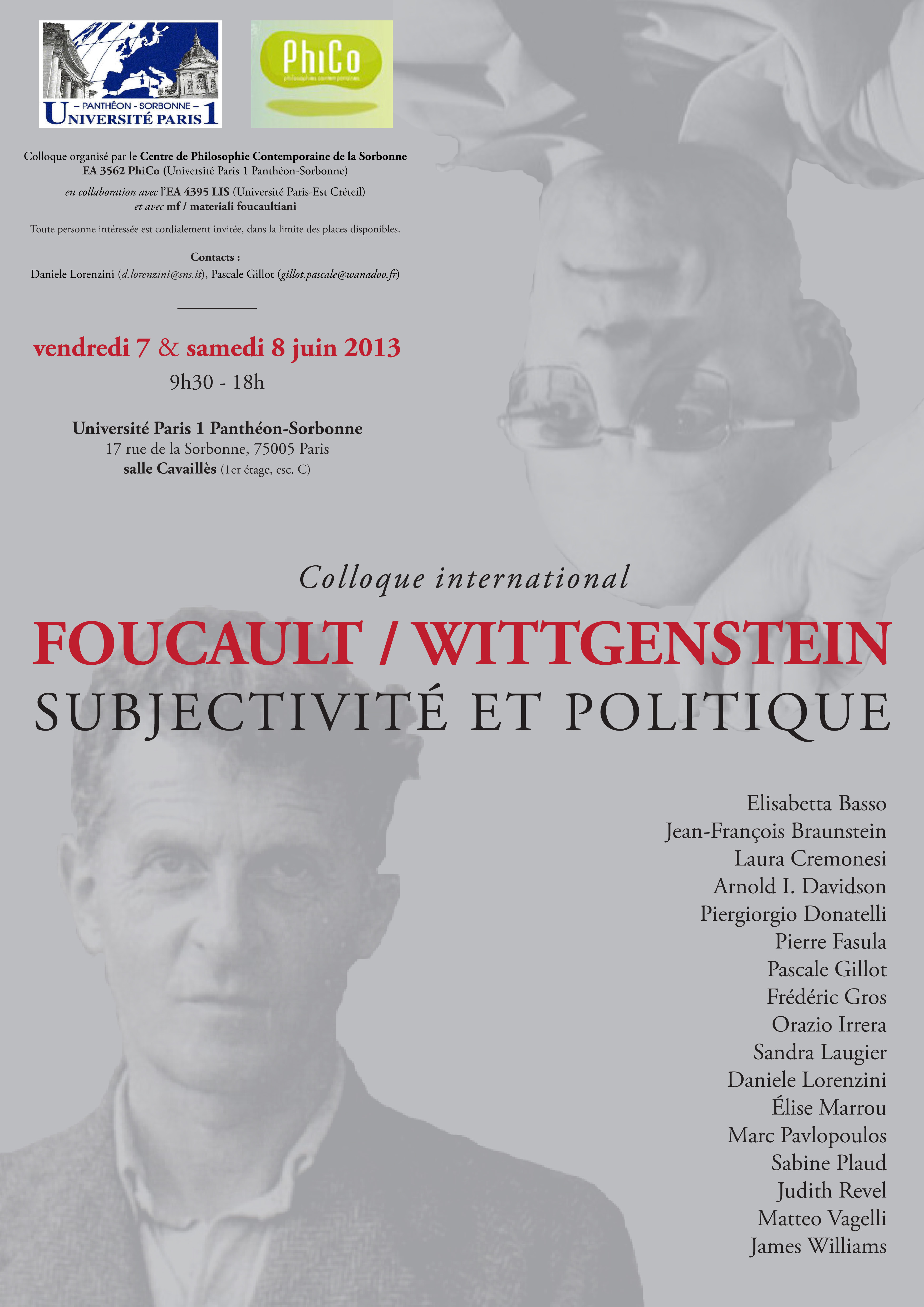
Affiche (A3)

Colloque international

 Foucault / Wittgenstein : subjectivité et politique

vendredi 7 & samedi 8 juin 2013
9h30 – 18h

 Université Paris 1 Panthéon-Sorbonne
17 rue de la Sorbonne, 75005 Paris
salle Cavaillès (1er étage, esc. C)

Programme pdf

Argumentaire

À partir de deux traditions philosophiques distinctes, Michel Foucault et Ludwig Wittgenstein ont chacun proposé une critique radicale, non seulement du psychologisme, mais aussi de la notion classique d’une subjectivité souveraine comme du modèle afférent d’un sujet de l’action et du savoir transparent à soi-même. L’opposition de ces deux auteurs à une pensée d’obédience cartésienne-husserlienne offre ainsi une intersection entre philosophie dite « continentale » et philosophie analytique. Le combat engagé par Foucault (à la suite de Cavaillès et de Canguilhem) contre la « philosophie de l’expérience, du sens et du sujet » présente une analogie cruciale avec le projet wittgensteinien de dissolution de la mythologie des processus dits « mentaux », contre l’identification de l’esprit à une sphère privée, d’un genre spécifique.

Cette double critique du sujet souverain (et en particulier du « Je pense » cartésien entendu comme sujet de connaissance) n’invalide pourtant pas, chez les deux auteurs, l’impératif d’une enquête à propos des conditions de la subjectivité : une subjectivité inscrite dans le social et ses institutions, les rapports de pouvoir, les « formes de vie », les pratiques discursives, une communauté de langage. L’interrogation explicitement à l’œuvre, dans les derniers travaux de Foucault, à propos de l’expérience antique du « souci de soi » et de la parrêsia est à cet égard cruciale. Cet intérêt pour les techniques de soi et les processus de « subjectivation », dans la mesure où il ne renoue pas avec une philosophie de la conscience, peut en effet s’entendre en résonance avec l’effort toujours plus marqué, chez le dernier Wittgenstein, pour rendre compte d’une expérience en première personne aussi inéliminable qu’indescriptible au sens strict, dissociée comme telle de l’activité d’un sujet de la connaissance et de la représentation. Surtout, il fait signe vers une « insertion » possible de l’éthique dans la politique, précisément dans la mesure où le travail du sujet sur lui-même devient un point crucial de résistance et contre-conduite. Or cette dimension politique de la subjectivation n’est pas absente chez Wittgenstein : on peut songer tant au lien subjectivité-expressivité-communauté de langage qu’à la tâche (indissolublement éthique et politique) d’apprendre à voir ce qui est important mais qui, tout en étant sous nos yeux, n’est pas d’ordinaire remarqué.

Ce colloque a donc pour but, à travers la discussion et la confrontation des perspectives wittgensteinienne et foucaldienne, de mieux délimiter l’efficace persistante d’une pensée non psychologique et non « métaphysique » de la subjectivité, si décisive dans les débats contemporains autour de la reconnaissance et de la subjectivité constituée, ainsi que d’en mettre en lumière les conséquences sur les plans éthique et politique. Il ne saurait se réduire, toutefois, à un simple repérage des effets de résonance entre les approches de ces deux auteurs, mais s’attellera aussi à en explorer les divergences, dont l’analyse pourra se révéler féconde quant à la clarification des problèmes précédemment évoqués.

Pascale Gillot & Daniele Lorenzini

 Colloque organisé par le Centre de Philosophie Contemporaine de la Sorbonne – EA 3562 PhiCo (Université Paris 1 Panthéon-Sorbonne)
en collaboration avec l’EA 4395 LIS (Université Paris-Est Créteil) et avec mf / materiali foucaultiani