
Foucault News

News and resources on French thinker Michel Foucault (1926-1984)

Whitney Arnold, The Secret Subject: Michel Foucault, Death and the Labyrinth, and the Interview as Genre, Criticism, Volume 54, Number 4, Fall 2012
https://dx.doi.org/10.1353/crt.2012.0029

Extract
My relationship to my book on Roussel, and to Roussel’s work, is something very personal. . . . I would go so far as to say that it doesn’t have a place in the sequence of my books.
—Michel Foucault, “An Interview with Michel Foucault”

In this 1983 interview with Charles Ruas, Michel Foucault reflects on his 1963 work Raymond Roussel (translated into English as Death and the Labyrinth: The World of Raymond Roussel). While Foucault often uses his interviews to paint trajectories of his thought—even characterizing his interviews as “scaffolding” holding together and plotting a course between his works—in this particular interview he insists on the differences between Death and the Labyrinth and the rest of his oeuvre. In Death and the Labyrinth—a text that has received a marked lack of critical attention—Foucault examines Roussel’s Comment j’ai écrit certains de mes livres (How I Wrote Certain of My Books), in which Roussel describes the methods he employed for structuring certain of his works. Foucault’s efforts to clarify Death and the Labyrinth through his interview about the text parallel Roussel’s problematic efforts to explain his texts with How I Wrote Certain of My Books. Much as Roussel veils while unveiling in his explanatory text, revealing the presence of an undisclosed “secret,” Foucault clarifies Death and the Labyrinth in the interview by pointing to what he does not reveal. He presents Death and the Labyrinth as a personal text intricately connected to his private thoughts, desires, and experiences, yet he declines to elaborate on these connections.
Seungho Moon, Disciplinary Images of “Korean-Ness”: Autobiographical Interrogations on the Panopticon, SAGE Open, July-September 2012 vol. 2 no. 3
https://doi.org/10.1177/2158244012455649

Abstract
The purpose of this study is to generate complicated conversations about identity and culture with an examination of various panoptic technologies, including separation, invisibility, control, and productivity. Drawn from Foucault’s panopticism, the author examines how discipline operates as a controlling power in several Korean institutions of schools, the seminary, and the military. This autobiographical self-reflexive research explores disciplinary images of “Korean-ness,” which has been discursively and materially constructed and embodied via panoptic technologies. These counter-narratives do not support for the advancement of the universalized version of the “Korean” identity. Rather, the author theorizes Korean identity as discursive practices in modern power structures, while dealing with the “political ‘double bind’” of (a) individualization through instruments of discipline and (b) the reinforcement of Confucian ideal of proper human relationships. This article provides educators with a lens to examine the ways in which disciplinary power/knowledge operates to control students’ ways of thinking, behaving, and living, in relation to “self,” “others,” and institutions. By opening possibilities to examine cultural identity beyond discovering “true” self, the author emphasizes the analyses of power in its examination of cultural sameness/difference in multicultural curriculum studies.

Sardinha, Diogo (2012). “Le Kant de Foucault, une lecture téléologique de l’anthropologie”. Kant-Studien , 103 (3), pp. 361-9.
further info

Abstract:
Foucault’s main thesis in his Introduction to Kant’s Anthropology is that the meaning of Anthropology from a Pragmatic Point of View can only be entirely grasped in the light of certain notes concerning the human being, assembled in the Opus Postumum. He asserts that the discourses held on human beings in the Anthropology and the introduction to the Logic are temporary – though necessary – moments in the transition from the critical to the transcendental philosophy: the latter is the accomplishment of Kantian philosophy, to which the former was only a Propädeutik. In this paper I call this a ‘teleological reading’ of the Anthropology, one which certainly has the merit of integrating this book in the evolution of Kant’s thought, but which can also be misleading, since it rarely considers the book Anthropology in itself. Hence, Foucault carries out what is more of a study of ‘Kant’s philosophy from an anthropological point of view’ rather than a study of the Anthropology. In the end, I also indicate the way in which this method enables us to distinguish his philosophical position both from Heidegger’s interpretation of Kant and from Sartre’s humanism.

Deslandes, Ghislain (10/2012). “The care-of-self ethic with continual reference to Socrates: towards ethical self-management”. Business ethics, 21 (4), pp. 325-38.
https://doi.org/10.1111/beer.12003

Abstract
‘Have you ever taken sufficient care of yourselves?’ By asking the elite Athenian youth this question, Socrates implies that the liberation of self and the capacity to govern are inseparable. Drawing on the lectures given by Michel Foucault at the Collège de France in 1984 – only recently made available to the public – we show the consequences of the return to this ancient care-of-self ethic in the organizational context. After reviewing the contributions made to business ethics by these two philosophers, we propose four phases necessary to the emergence and constitution of a moral subject in organizations: self-awakening, self-evaluation, self transformation and self-presentation. We then suggest various managerial practices and behaviour inspired by this philosophical parrhesia embodied by the Greek philosopher wherein the manager should have a personal relationship with his or her own activity. Finally, we discuss implications of our study in the field of business ethics and propose an agenda for future research.

The Foucault Circle 2013
McGill University
Montréal, Canada
April 18th-20th, 2013

For further details please contact Dianna Taylor dtaylor@jcu.edu or Erinn Gilson e.gilson@unf.edu

Thursday, April 18th
4:00-6:00 – Film Screening: René Allio’s “I, Pierre Rivière…”at La Sala Rossa (4848 rue St-Laurent)

6:00-9:00 – Drinks/Dinner at La Sala Rossa

Friday, April 19th
8:30-9:00 – Coffee, tea, light breakfast

9:00-10:10 – Feminist and Foucauldian Perspectives on Relations of Care
Moderator: Patrick Ryan (University of Western Ontario)

Katherine Logan (University of Oregon): “Foucault’s Bourgeois, Biopolitical Mother and Her Relation to the State”

Richard Lynch (DePauw University): “A Foucauldian-Feminist Ethics of Care”

10:20-11:30 – Queer Theory
Moderator: Sean Irwin (Barry University)

Stephen Seely (Rutgers University): “Revisiting Bodies and Pleasures (Again): The Uses and Abuses of Foucault in Queer Theory”

Zachary Fouchard (Carleton University): “Gay Marriage, Gay Family: On the Foucault-Defert Relationship and the Foucault Archives”

Noon-1:15 – Lunch at Lola Rosa (545 Rue Milton)

1:30-2:50 – Roundtable Discussion of Foucault’s I, Pierre Rivière… and René Allio’s film

2:40- 3:50 – Epistemology, Parrhēsia and Truth
Moderator: William Clare Roberts (McGill University)

Andrei Poama (Yale University): “The Truth About Crime? Reading Pierre Rivière’s Story as a Case of Epistemological Juncture”

Len Lawlor (Pennsylvania State University) and Janae Scholtz (Alvernia University): “Speaking Out for Others: Philosophy’s Activity inDeleuze and Foucault (and Heidegger)”

4:00-5:00 – Business Meeting

7:00 – Dinner at Rumi (5198 rue Hutchison)

Saturday, April 20th

8:30-9:00 – Coffee, tea, light breakfast

9:00-10:10 – Experience
Moderator: Dianna Taylor (John Carroll University)

Megan Dean (Kings College), “Thinking Experience Differently”

Robert Nichols (University of Alberta), “Objectification and Subjectification in Heidegger and Foucault”

10:20-11:30 – Governmentality and Globalization
Moderator: Chloë Taylor (University of Alberta)

Ricky Crano (Ohio State University), “The Ends of Biopolitics: Human Capitalist as Homo Financius, Governmentality as Telematic Self-Control”

Margaret McLaren (Rollins College), “Governmentality and Globalization”

11:40-12:50 – Race
Moderator: Zoe Avner (University of Alberta)

Christophe Ringer (Vanderbilt University), “Foucault and Incarceration: Race, Erasure, and Governmentality”

David Gougelet (Simpson College), “Exhibiting the Other: Empire and Heterotopia in the Human Zoo”

All Friday and Saturday sessions will be held in the Redpath Museum Auditorium.

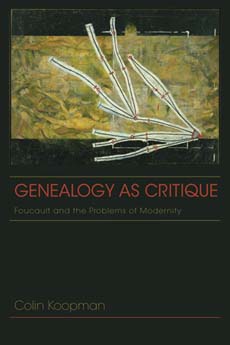
Colin Koopman, Genealogy as Critique:Foucault and the Problems of Modernity, Indiana University Press, Series: American Philosophy

Publication date: 2/25/2013
Format: paper 362 pages
ISBN: 978-0-253-00621-9

Author’s blog

Description
Viewing Foucault in the light of work by Continental and American philosophers, most notably Nietzsche, Habermas, Deleuze, Richard Rorty, Bernard Williams, and Ian Hacking, Genealogy as Critique shows that philosophical genealogy involves not only the critique of modernity but also its transformation. Colin Koopman engages genealogy as a philosophical tradition and a method for understanding the complex histories of our present social and cultural conditions. He explains how our understanding of Foucault can benefit from productive dialogue with philosophical allies to push Foucaultian genealogy a step further and elaborate a means of addressing our most intractable contemporary problems.

Table of contents
Acknowledgments
Introduction: What Genealogy Does
1. Critical Historiography: Politics, Philosophy & Problematization
2. Three Uses of Genealogy: Subversion, Vindication & Problematization
3. What Problematization Is: Contingency, Complexity & Critique
4. What Problematization Does: Aims, Sources & Implications
5. Foucault’s Problematization of Modernity: The Reciprocal Incompatibility of Discipline and Liberation
6. Foucault’s Reconstruction of Modern Moralities: An Ethics of Self-Transformation
7. Problematization plus Reconstruction: Genealogy, Pragmatism & Critical Theory

Colin Koopman is Assistant Professor of Philosophy at the University of Oregon and author of Pragmatism as Transition: Historicity and Hope in James, Dewey, and Rorty.

Henri-Paul Fruchaud et Jean-François Bert, « Un inédit de Michel Foucault : « La Parrêsia ». Note de présentation », Anabases [Online], 16 | 2012, Messo online il 01 octobre 2015, consultato il 10 janvier 2013. URL : http://anabases.revues.org/3956

This text will be published in its entirety online in October 2015

C’est à l’invitation d’Henri Joly, spécialiste de la philosophie antique, que Michel Foucault prononce au mois de mai 1982 à l’université de Grenoble une conférence consacrée à la parrêsia, peu de temps après la fin du cours au Collège de France de l’année 1982, dans lequel cette notion apparaît pour la première fois dans ses travaux. Henri Joly connaissait Foucault depuis son passage à Clermont Ferrand, et comme le précise Pascal Engel : « Le spécialiste de Platon qu’était Joly s’intéressait au “retour aux Grecs” de Foucault et ce dernier avait accepté de venir donner un exposé. Nous allâmes ensemble le chercher à la gare, en l’attendant à la sortie principale, mais là point de Foucault. La gare de Grenoble a une seconde sortie, quasi clandestine, qu’on prend rarement. Michel Foucault trouva le moyen de passer par là et nous eûmes la surprise de l’entendre nous héler derrière nous. Il était, comme le dit une page célèbre de L’Archéologie du savoir, “ressurgi ailleurs” et “en train …

Via Variazioni foucaultiane

binswangerLudwig Binswanger, Rêve et existence, Paris : Vrin, « Bibliothèque des Textes Philosophiques – Poche », 2013. Traduction par Françoise Dastur, Postface d’Elisabetta Basso, 120 p., 11 × 18 cm. ISBN : 978-2-7116-2454-6

Rêve et existence occupe une place tout à fait singulière à l’intérieur du corpus binswangerien, de ce vaste ensemble d’articles, conférences et ouvrages par lesquels la Daseinsanalyse avait déjà atteint son plein développement en 1954, au moment où parut la première traduction en français de ce texte accompagnée d’une longue introduction signée Michel Foucault. Si dans les années vingt le psychiatre suisse avait consacré ses efforts à la question du statut épistémologique de la psychologie et de la psychiatrie, avec cet essai de 1930 il exprimait pour la première fois l’ambition philosophique de conjuguer l’analytique phénoménologique de Heidegger avec la psychopathologie. On trouvera ici une nouvelle traduction de cet essai qui représentait en quelque sorte, aux yeux de Binswanger lui-même, le manifeste programmatique de la Daseinsanalyse.

Pdf of the Postface by Elisabetta Basso on the academia.edu site. This postface examines the relationship between Foucault and phenomenological psychiatry.

Special Issue: Future Foucault: Afterlives of Bodies and Pleasures, South Atlantic Quarterly, Volume 111, Number 3, Summer 2012 Jacques Khalip, Special Issue Editor

Further info

Jacques Khalip, Introduction: Voir venir

Abstract
It has been more than twenty-five years since the death of Michel Foucault, one of the last century’s most crucial philosophers, as well as just as many years since the publication of the final two volumes of The History of Sexuality. Since then, an extraordinary body of interdisciplinary scholarship has emerged around the work of Foucault, with much attention focused on his writings on ethics, neoliberalism, governmentality, biopolitics, and war. The introduction considers notions of futurity, openness, and risk in Foucault’s thought and how such notions intersect with his various projects of relationality.

COPERTINA I,2 (white80sb)
materiali foucaultiani
Volume I, number 2 (July-December 2012)
ISSN 2239-5962

See site for full texts of articles

TABLE OF CONTENTS

Un’immagine ci teneva prigionieri  (pp. 3-9)
Laura Cremonesi, Orazio Irrera, Daniele Lorenzini, Martina Tazzioli

Genealogie della razza e dei razzismi

Introduzione  (pp. 11-18)
Laura Cremonesi, Orazio Irrera, Daniele Lorenzini, Martina Tazzioli

Una lettura coloniale di Foucault. Corpi borghesi e sé razziali  (pp. 19-48)
Ann Laura Stoler

L’aveu (anti)colonial. Race et vérité dans les colonies: Fanon après Foucault  (pp. 49-68)
Matthieu Renault

Protection Displaced. The Racialization and Counter-Conduct of Vulnerability for Libyan War Refugees in Italy  (pp. 69-82)
Glenda Garelli

Foucault, Biopower and Psychiatric Racism  (pp. 83-106)
John Iliopoulos

For Blacks Only. Pharmaceuticals, Genetics, and the Racial Politics of Life  (pp. 107-135)
Jonathan Xavier Inda

Interviste
Il potere, i valori morali e l’intellettuale. Un’intervista con Michel Foucault  (pp. 137-144)
Michel Foucault

Volonté de vérité et pratique militante chez Michel Foucault  (pp. 145-157)
Daniel Defert

Retenons donc nos larmes. Riletture e polemiche intorno alla conferenza Che cos’è un autore? di Michel Foucault  (pp. 159-178)
Silvia Chiletti

Dissidenza e stile d’esistenza. La prospettiva della cura tra Jan Patočka e Michel Foucault  (pp. 179-204)
Caterina Croce

Michel Foucault e le immagini. Tre contributi per un’archeologia del figurativo  (pp. 205-221)
Marco Malandra