Foucault News

News and resources on French thinker Michel Foucault (1926-1984)

Haueis, P. Apollinian Scientia Sexualis and Dionysian Ars Erotica? On the relation between Michel Foucault’s History of Sexuality and Friedrich Nietzsche’s Birth of Tragedy, Journal of Nietzsche Studies, Volume 43, Issue 2, September 2012, Pages 260-282
https://muse.jhu.edu/article/492112

Abstract
This article explores how a nonreductionist account of Nietzsche’s influence on Michel Foucault can enrich our understanding of key concepts in singular works of both philosophers. I assess this exegetical strategy by looking at the two dichotomies Apollinian/Dionysian and ars erotica/scientia sexualis in The Birth of Tragedy and volume 1 of The History of Sexuality, respectively. After exploring the relation between these two dichotomies, I link the science of sexuality to the Apollinian art instinct via the existence of Socratic culture and argue against the “pleasure of analysis” as a sublated form of (Dionysian) ars erotica. These considerations lead to the notions of history in Nietzsche’s and Foucault’s philosophies that result in situating the polyvalent Ursprung of Greek tragedy and the descent of ars erotica and scientia sexualis in an antimetaphysical and nonteleological picture of historical development.

Journée d’étude “Michel Foucault et le XVIIe siècle”

30 mai 2013
Université catholique de Louvain
Journée d’étude du GEMCA (Group for Early Modern Cultural Analysis / Groupe d’Analyse Culturel de la Première Modernité)

Argument
À première vue, le XVIIe siècle se présente dans l’œuvre de Michel Foucault comme un moment de ruptures décisives tant pour nos manières de penser que pour nos pratiques sociales et/ou individuelles : le partage raison / déraison corrélativement au processus de renfermement ; le renvoi au silence du système interprétatif des ressemblances ouvrant ainsi la voie, quelque siècle plus tard, à l’établissement des sciences humaines ; conjugué à ces ruptures, la préfiguration de l’avènement d’un ensemble de techniques disciplinaires comme mode d’assujettissement aboutissant à une régulation des conduites sans précédent à l’échelle de la société ; la rupture décisive pour la subjectivité occidentale dans son mode d’accès à la vérité concurremment à l’apparition d’une conception de la morale dite « du code » ; ou encore, la tentative de reconstitution d’une éthique et d’une esthétique de soi, etc., toutes ces ruptures tournant, peu ou prou, autour de ce que Michel Foucault a appelé « le moment cartésien ». Cette interrogation inlassable portant sur cette période tout au long de son œuvre, de l’Histoire de la folie à ses derniers cours au Collège de France, présente le XVIIe siècle comme ce nœud gordien autour duquel Michel Foucault n’a cessé de tourner et en lequel il a souhaité penser, le tranchant et le renouant tour à tour, pour penser à nouveau notre présent.

Paradoxalement, l’œuvre de Michel Foucault est très peu utilisée dans les études consacrées spécifiquement au XVIIesiècle. À quelques rares exceptions près, on ne la cite généralement que du bout des lèvres, confusément, au sein d’une bibliographie massive, mais sans nécessairement exploiter les résultats de ses recherches ou sans se positionner face à ceux-ci. Chez d’autres, le philosophe agace, voire suscite une certaine antipathie et un véritable rejet sans autre forme de procès que le déni. Cette réserve et ce rejet proviennent probablement à la fois du caractère protéiforme et prolixe de l’œuvre de Michel Foucault et du ton affirmatif, pourtant, qu’il n’hésite pas parfois à prendre pour proposer ses thèses. En effet, le chercheur ne cesse de multiplier les points de vue tant sur le plan des champs de recherche (philosophie, histoire, littérature, politique, sociologie, épistémologie, etc.) que sur les pôles constitutifs de la pensée (savoir, pouvoir, sujet), laissant au lecteur la tâche ardue de le lire et le relire sans cesse dans l’espoir de saisir le fil de sa pensée. Par conséquent face à cette œuvre qui se présente telle une broussaille hirsute et rebelle, le plus simple pour beaucoup est de rebrousser chemin, transformant la question de savoir ce qu’on peut faire avec Foucault en : qu’allons-nous faire de Foucault ?

Au-delà de ces difficultés qui, d’ailleurs, ne sont pas uniquement l’apanage des écrits foucaldiens, mais bien celui de toute grande œuvre qui nous met au défi de repenser nos propres manières de penser et de vivre, il s’agira de questionner le rapport de Michel Foucault au XVIIe siècle au sein de l’ensemble de son œuvre, par l’étude de ses textes les plus significatifs concernant cette période. Pourquoi le philosophe s’est-il intéressé à celle-ci ? Quels sont ses apports les plus originaux, mais aussi, parfois, les plus déroutants pour la recherche strictement « dix-séptiémiste » ? Quelles sont ou quelles peuvent être encore aujourd’hui les nouvelles pistes de recherche suscitées par son travail ? Ses études consacrées au XVIIe siècle peuvent-elles être lues indépendamment de son projet global de lecture de l’histoire de la pensée occidentale ? Aussi, peut-on saisir la portée de sa pensée en dehors de sa visée politique ? Qu’en est-il, enfin, de sa méthode ? N’en avons-nous pas davantage à apprendre de celle-ci que du contenu de ses hypothèses ou de ses propositions ?

Autour de ces questions et de bien d’autres encore, loin de poser les résultats des recherches de Michel Foucault comme les dogmes d’une nouvelle vérité, loin de le poser comme un nouvel « instaurateur de discours », il s’agira de l’interroger afin de nous interroger nous-mêmes tant sur nos propres pratiques de recherche que sur l’avancée de nos hypothèses.

Comité scientifique: Frédéric Gros, Judith Revel, Agnès Guiderdoni et Marc Escola
Comité organisateur: Emmanuel Picardi, Thierry Lenain, Agnès Guiderdoni et Aline Wiame

Programme

Olivier Guerrier (Toulouse Le Mirail), « Régimes de vérité au XVIIe siècle, prolégomènes »

Frédéric Gros (Paris XII – UPEC), « Les arts de soi et les techniques de direction, à l’Antiquité et à l’âge classique »

Aline Wiame (ULB), « “Un nouvel archiviste est nommé dans la ville”. Ruses philosophiques et enjeux historiques des recours foucaldiens aux énoncés de l’Âge classique »

Fabienne Brion (UCL), « “Mal-faire, dire vrai”. Quelques pistes de recherche pour une lecture du moment cartésien »

Arianna Sforzini (Paris XII – UPEC), « Michel Foucault au XVIIe siècle. Théâtre et représentation »

Noëmie Charrié (UCL), « La souveraineté au regard de la tragédie : Racine et Shakespeare, ou l’envers de la cérémonie »

Arnaud Welfringer (Paris 8), « Dire vrai au XVIIe siècle : pour une histoire de la parrêsia à l’âge classique »

Britt Grootes (Université de Gand), “How to be able to say the truth about oneself ? Subjectivity and lyric poetry in the 17th century”

Informations pratiques

De 9h30 à 17h00
Salle du Conseil de la faculté de philosophie, arts et lettres
Place Blaise Pascal, 1
1348 Louvain-la-Neuve
Belgique

Responsable : Emmanuel Picardi, Thierry Lenain, Agnès Guiderdoni et Aline Wiame

Joe's avatarThe Disorder Of Things

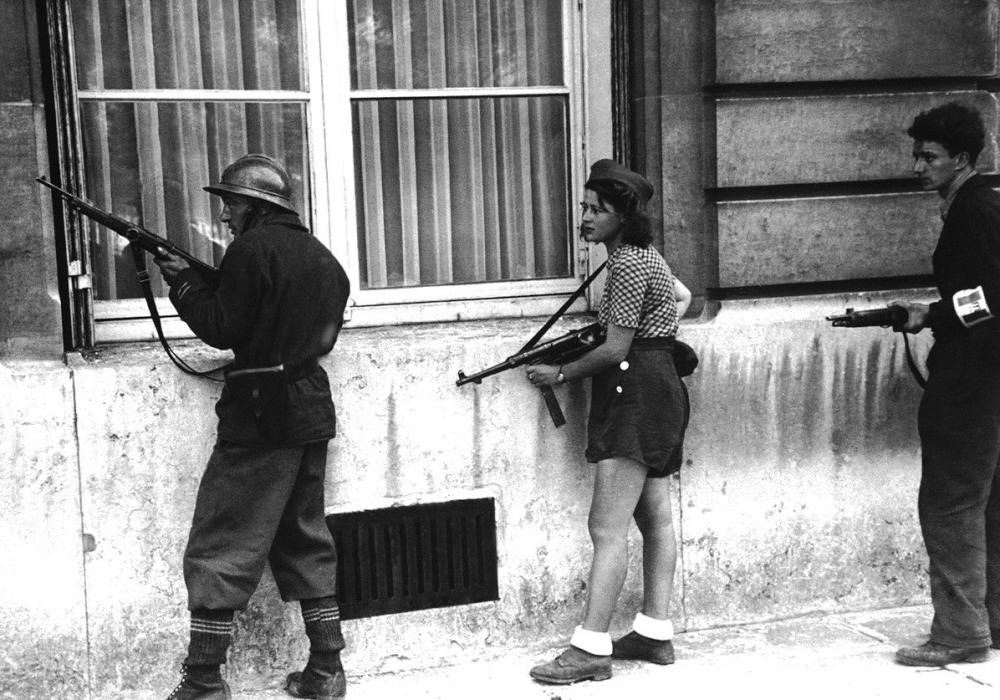
french-resistance-1944

For two inter-linked, consecutive workshops under the theme of Subjects and Practices of Resistance to be held 9-11 September 2013 at University of Sussex.

The first workshop (9-10 Sept) is on Discipline(s), Dissent and Dispossession and the second on Counter-Conduct in Global Politics (10-11 Sept).  The workshop convenors encourage attendance at both workshops.  However, paper proposals should specify the intended workshop and which days participants would be able to attend.

The workshopsare generously sponsored and supported by the BISA Poststructuralist Politics Working Group (PPWG) and the Centre for Advanced International Theory (CAIT) at the University of Sussex 

View original post 837 more words

stuartelden's avatarProgressive Geographies

Foucault, Biopolitics, and Governmentality, an open-access e-book edited by Sven-Olov Wallenstein and Jakob Nilsson, with essays by Thomas Lemke, Johanna Oksala, Catherine Mills, Julian Reid, Lukasz Stanek, Helena Mattsson, Warren Neidich, Cecilia Sjoholm, Maurizio Lazzarato, and Adenna Mey.

diva2_615362Foucault’s work on biopolitics and governmentality has inspired a wide variety of responses, ranging from philosophy and political science to history, legal studies, and urban planning. Drawing on historical sources from antiquity to twentieth century liberalism.

Foucault presented us with analyses of freedom, individuality, and power that cut right to the heart of these matters in the present.

View original post

Jørgen Ole Bærenholdt, Governmobility: The Powers of Mobility, Mobilities, 2012
http://dx.doi.org/10.1080/17450101.2012.747754

Abstract
Mobility is often associated with flow and freedom; nonetheless, it is also about power and government. While mobility studies have shown how interpersonal social relations are increasingly supported by mobile technologies, it seems less clear how mobilities are involved in governing societies. Inspired by Michel Foucault’s concept of governmentality and his 1978 lectures on security, territory and population, this article suggests that societies are increasingly governed through mobility, rather than there being government of mobility. If circulation has become a producer of, rather than an obstacle to, societies, then governmobility is a meaningful concept relating to how societies are ruled through connections. In conclusion, the article asks: what are the implications of governmobility for border studies, and more broadly, what are the powers of mobility studies?

On Hannah McCann’s blog. See also her main website

binarythis's avatarBINARYTHIS

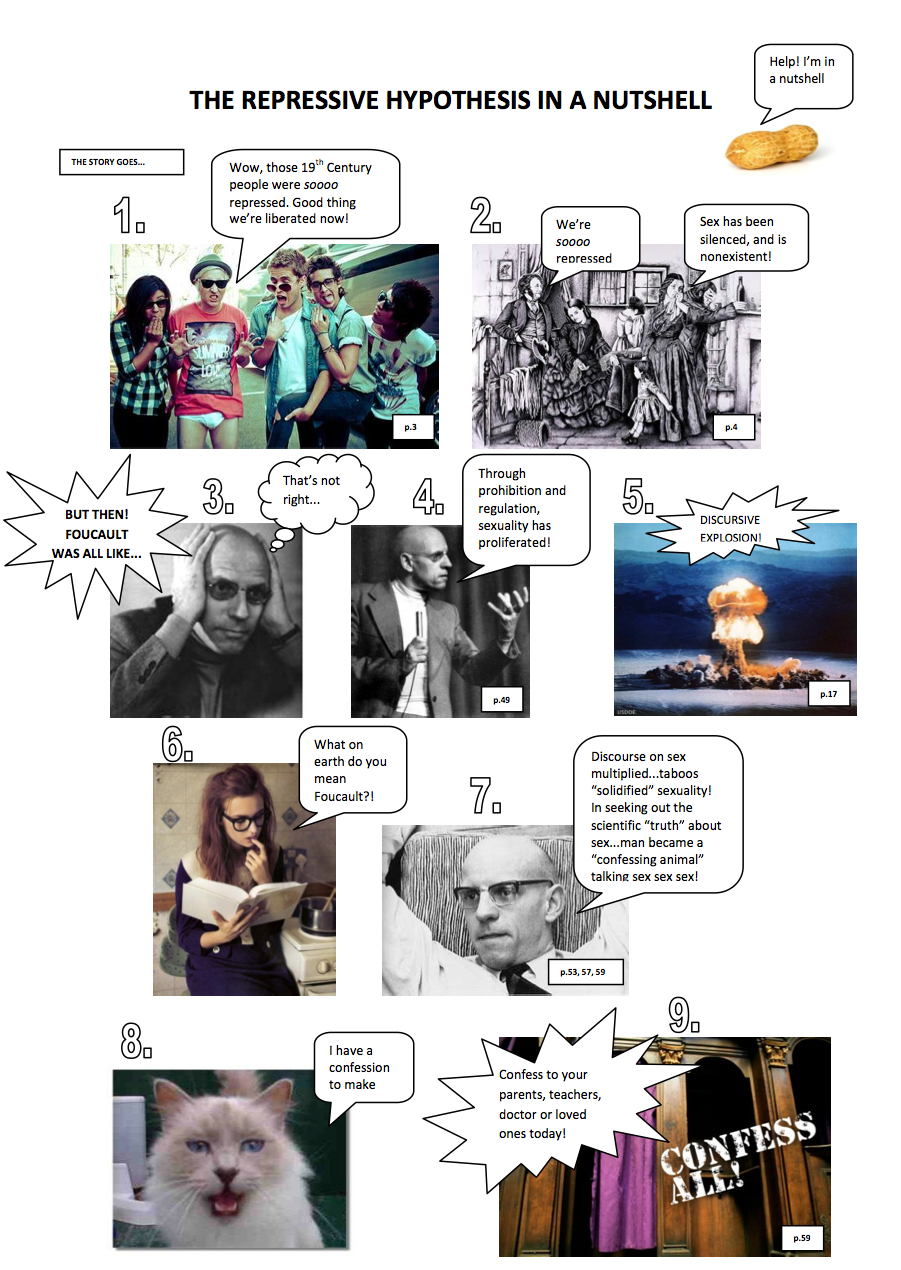
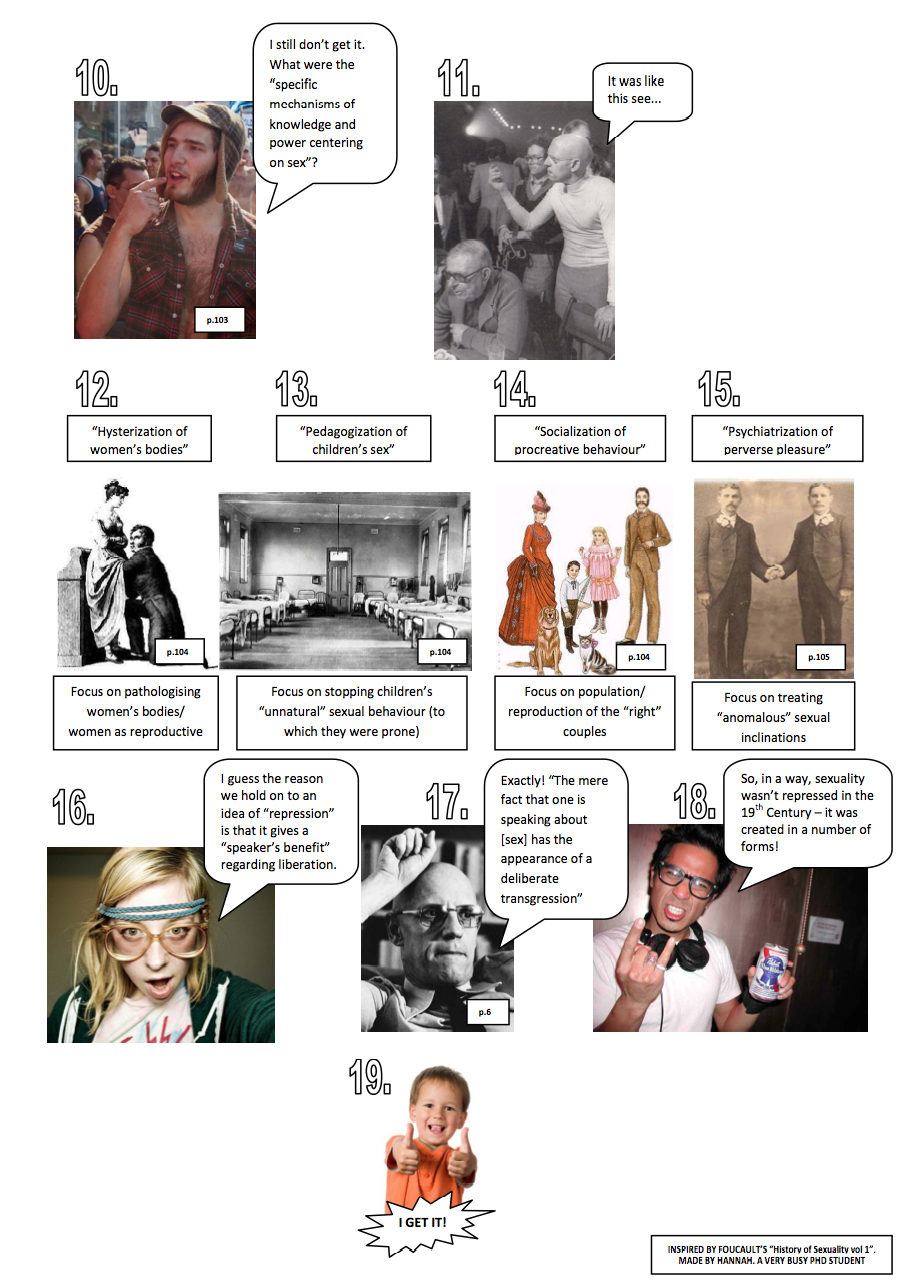
A comic I made for a second year gender studies course I tutored for in 2012, to help students understand some of the themes from Foucault’s The History of Sexuality Vol.1:f1

f2All page references from Foucault, M. (1976 [2008; trans 1978]), The History of Sexuality: Volume 1., R. Hurley, [trans], Victoria: Penguin Group

Stay tuned for Judith Butler explained with cats!


View original post

Gane, N. The governmentalities of neoliberalism: Panopticism, post-panopticism and beyond, Sociological Review, Volume 60, Issue 4, November 2012, Pages 611-634
http://dx.doi.org/10.1111/j.1467-954X.2012.02126.x

Abstract
This paper draws on the writings of Michel Foucault, in particular his lectures on biopolitics at the Collège de France from 1978-79, to examine liberalism and neoliberalism as governmental forms that operate through different models of surveillance. First, this paper re-reads Foucault’s Discipline and Punish in the light of his analysis of the art of liberal government that is advanced through the course of these lectures. It is argued that the Panopticon is not just an architecture of power centred on discipline and normalization, as is commonly understood, but a normative model of the relation of the state to the market which, for Foucault, is ‘the very formula of liberal government’. Second, the limits of panopticism, and by extension liberal governance, are explored through analysis of Gilles Deleuze’s account of the shift from disciplinary to ‘control’ societies, and Zygmunt Bauman’s writings on individualization and the ‘Synopticon’. In response to Deleuze and Bauman, the final section of this paper returns to Foucault’s lectures on biopolitics to argue that contemporary capitalist society is characterized not simply by the decline of state powers (the control society) or the passing down of responsibilities from the state to the individual (the individualization thesis), but by the neoliberal marketization of the state and its institutions; a development which is underpinned by a specific form of governmentality. In conclusion, a four-fold typology of surveillance is advanced: surveillance as discipline, as control, as interactivity, and as a mechanism for promoting competition. It is argued that while these types of surveillance are not mutually exclusive, they are underpinned by different governmentalities that can be used to address different aspects of the relationship between the state and the market, and with this the social and cultural logics of contemporary forms of market capitalism more broadly. © 2012 The Author. The Sociological Review © 2012 The Editorial Board of The Sociological Review.

De Marzio, D.M. The Pedagogy of Self-Fashioning: A Foucaultian Study of Montaigne’s “On Educating Children”, Studies in Philosophy and Education, Volume 31, Issue 4, July 2012, Pages 387-405
DOI: 10.1007%2Fs11217-011-9282-3

Abstract
In this paper I interpret Montaigne’s essay, “On Educating Children”, as a pedagogical text through its performance of a distinct epistolary function, one that addresses the letter-recipient for the purpose of shaping the ideas, actions, and beliefs of that individual. At the same time, I also read “On Educating Children” within the context of the wider project of Montaigne’s Essays, which, as I suggest, is an ethical-aesthetic project of self-fashioning and self-cultivation. The net result is an interpretation of teaching as an ethical-aesthetic practice of the self, one that is in concert with the interpretation of Montaigne’s writing of the Essays as a similar practice of the self. In order to build this case, I employ Michel Foucault’s fourfold schema of ethical subjectivity, mapping that schema onto “On Educating Children”, so as to reveal a unique pedagogy of self-formation-a pedagogy that works as much upon the self of the teacher as it does the self of the student.

Author keywords
Ethical-subjectivity; Foucault; Letter-writing; Montaigne; Plutarch; Self-fashioning

Erdinc, M. The Subject and Governmental Action: A Foucauldian Analysis of Subjectification and the 24 Year-Old Rule in Denmark, Feminist Legal Studies, Volume 20, Issue 1, April 2012, Pages 21-38
https://doi.org/10.1007/s10691-012-9192-y

Abstract
This article discusses the effects of the 24 year-old rule in Denmark utilising Foucault’s understanding of the ‘subject’ within a governmentality framework. The 24 year-old rule is a good example of how a gendered knowledge about immigration becomes a reality that steers biopolitics, enables practices of normalisation and subjectifies immigrants in various ways. The article foregrounds the subjectivity of immigrant women through a narrative analysis of the constitution of the subject within discourses and in an asymmetrical relationship to power in governance. This analysis reveals the complexity of empirical interactions between the ideational structure of legislative measures and personal meanings expressed by immigrant subjectivities. While I illustrate certain modes of subjectification in relation to the 24 year-old rule, I emphasise the ways subjects employ certain identity strategies by resisting, reworking or contributing to the practices of normalisation.

Author keywords
Denmark; Foucault; Gender; Governmentality; Immigration; Subjectification

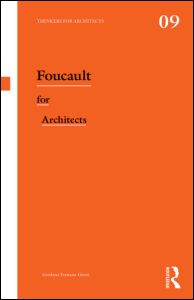
architects Gordana Fontana-Giusti, Foucault for Architects, Routledge, May 2013

Publisher’s page

The author is also conducting an inaugural public lecture at 6 pm on the 24th of May 2013 at the University of Kent, Canterbury, Faculty of Humanities to coincide with the publication of the book.
Pdf flyer for event

Description
From the mid-1960s onwards Michel Foucault has had a significant impact on diverse aspects of culture, knowledge and arts including architecture and its critical discourse. The implications for architecture have been wide-ranging. His archaeological and genealogical approaches to knowledge have transformed architectural history and theory, while his attitude to arts and aesthetics led to a renewed focus on the avant-garde.

Prepared by an architect, this book offers an excellent entry point into the remarkable work of Michel Foucault, and provides a focused introduction suitable for architects, urban designers, and students of architecture.

Foucault’s crucial juxtaposition of space, knowledge and power has unlocked novel spatial possibilities for thinking about design in architecture and urbanism. While the philosopher’s ultimate attention on the issues of body and sexuality has defined our understanding of the possibilities and limits of human condition and its relation to architecture.

The book concentrates on a number of historical and theoretical issues often addressed by Foucault that have been grouped under the themes of archaeology, enclosure, bodies, spatiality and aesthetics in order to examine and demonstrate their relevancy for architectural knowledge, its history and its practice.

Contents

Introduction Part 1: Positioning 1.1 Context 1.2 Resisting Boundaries 1.3 Architecture Unspoken

Part 2: Archaeology 2.1 Human Sciences, Knowledge and Architecture 2.2 Archaeology as Difference

Part 3: Enclosure 3.1 Madness 3.2 The Asylum 3.3 The Clinic 3.4 The Prison

Part 4: Bodies 4.1 The History of Sexuality 4.2 Sexuality, Knowledge and the Structure of Aesthetic Experience 4.3 Biopower 4.4 Bodies, Architecture and Cities

Part 5: Spatiality/Aesthetics 5.1 Spatiality and its Themes 5.2 Avant-Garde and the Language of Space 5.3 Deleuzian Century 5.4 Ad Finem