Foucault News

News and resources on French thinker Michel Foucault (1926-1984)

Carlsson, P.
Foucault, Magritte and negative theology beyond representation (2013) Studia Theologica – Nordic Journal of TheologyPublished online: 20 Feb 2013
https://doi.org/10.1080/0039338X.2012.733729

Abstract
Recent theological writings on the French philosopher Michel Foucault often mention Foucault in relation to negative theology. This article discusses the negative motion in Foucauldian thinking through Foucault’s essay on the Belgian painter René Magritte. On the basis of this discussion, the article sketches a renewed account of negative theology. It is a post-representational account of negative theology in accordance with Foucault’s critique of representation, as presented in his Magritte essay.

DOI: 10.1080/0039338X.2012.733729

Mark Kelly, Michel Foucault’s Political Thought, Internet Encyclopedia of Philosophy, 2013

The work of twentieth-century French philosopher Michel Foucault has increasingly influenced the study of politics. This influence has mainly been via concepts he developed in particular historical studies that have been taken up as analytical tools; “governmentality” and ”biopower” are the most prominent of these. More broadly, Foucault developed a radical new conception of social power as forming strategies embodying intentions of their own, above those of individuals engaged in them; individuals for Foucault are as much products of as participants in games of power.

The question of Foucault’s overall political stance remains hotly contested. Scholars disagree both on the level of consistency of his position over his career, and the particular position he could be said to have taken at any particular time. This dispute is common both to scholars critical of Foucault and to those who are sympathetic to his thought.

What can be generally agreed about Foucault is that he had a radically new approach to political questions, and that novel accounts of power and subjectivity were at its heart. Critics dispute not so much the novelty of his views as their coherence. Some critics see Foucault as effectively belonging to the political right because of his rejection of traditional left-liberal conceptions of freedom and justice. Some of his defenders, by contrast, argue for compatibility between Foucault and liberalism. Other defenders see him either as a left-wing revolutionary thinker, or as going beyond traditional political categories.

Read more

Donald Gillies, Educational Leadership and Michel Foucault, Routledge, 2013
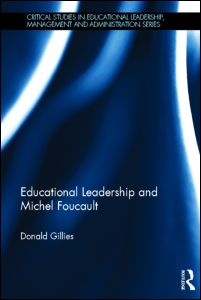
gilliesPublisher’s site

Description
Drawing from the ideas of Michel Foucault, this book offers a critical examination of today’s dominant discourse of educational leadership. Foucault’s understanding of critique is as a ‘permanent’ ethos in which humans explore the nature of their existence but at the same time query the limits imposed upon them, and probe opportunities for increasing freedom. This book outlines the key concepts in the work of Foucault, and demonstrates how his concepts of discourse, power/knowledge, and governmentality offer an understanding of how ideas of educational leadership and management have emerged, how they serve to establish a discipline, and how they construct individuals – pupils, teachers, and head teachers – in particular ideological ways.

The discourse of educational leadership and management not only represents a specific means of ‘governing’ education but also calls for the development of approved management and leadership skills and behaviours. The related focus on cultivating, valuing, and rewarding effective leaders is eminently suited to Foucauldian critique, which not only questions the basis for its assumptions and norms, but also examines the way in which the subjects of ELMA – today’s educational professionals – are both constructed by the discourse and are called upon to shape themselves accordingly.

Included in the book:

– educational leadership as discourse

– educational leadership as discipline

– power and educational leadership

– governmentality and educational leadership.

By both applying theory and examining empirical exemplars, this volume offers a challenge to dominant leadership discourse and suggests alternative understandings of the field and approaches to practice. The book will be of value to researchers and postgraduate students with an interest in educational leadership, management and administration, as well as to practitioners in the school system.

From Stuart Elden’s blog

stuartelden's avatarProgressive Geographies

In 2005 I published a piece entitled ‘The Problem of Confession’, freely available here. which had a lot of discussion of Foucault’s different plans for his History of Sexuality and the issues that revolved around them. That piece had a summary table of the plans, the lecture courses and related material. In 2011 I updated the table in the light of new publications and information, and I did so again for the lecture in Newfoundland last week. The table is in a pdf here; or click on the image below for a larger version. It might be useful to others.

History of Sexuality table 2013

View original post

Oels, A.(2013), Rendering climate change governable by risk: From probability to contingency Geoforum, 45, pp. 17-29.
https://doi.org/10.1016/j.geoforum.2011.09.007

Abstract
In this paper, I use Foucault’s concept of governmentality to investigate changes in the risk management of climate change. In an exploratory analysis of primary and secondary sources, I demonstrate that the risk construction of climate change has shifted significantly from 1988 to 2010. Risk construction has broadened, and related policies now include mitigation, adaptation and disaster preparedness. Furthermore, I demonstrate that the meaning of ‘security’ and the related modes of risk management have shifted over time. I show that traditional science-based risk management has been dominant in mitigation and adaptation policy. The articulation of climate change as a security issue since 2003 indicates risk management through contingency. I argue that what the Copenhagen School has studied as the ‘failed securitization’ of climate change and a lack of extraordinary measures to curb greenhouse gas emissions are better understood as the ‘climatization’ of security. The governmental rationale since 2007 has been to prepare for and manage the ‘inevitable’ primary and secondary impacts of unmitigated climate change.

Author Keywords
Climate;  Foucault;  Governmentality;  Risk;  Securitization;  Security

Index Keywords
carbon emission, climate change, contingent valuation, greenhouse effect, greenhouse gas, hazard management, policy analysis, probability, risk assessment

DOI: 10.1016/j.geoforum.2011.09.007

timrayner's avatarPhilosophy for change

This is the first instalment in a three-part series.

Part 2. I tweet, therefore I become
Part 3. The call of the crowd

——————————————-

You start the day bleary-eyed and anxious. You stayed up late last night working on a post for your blog, gathering facts and memes from about the web and weaving them into an incisive whole. Has it produced a spike in the stats? You sign in on your iPhone as you brew the coffee. But it’s too early to slip into the professional headspace – you decide that you don’t want to know. Someone has messaged you on Facebook, so you check that instead. Japanese manga mashup! Killer breaks off the cost of Lombok. Lady Gaga is a man and we have photoshopped evidence to prove it! A friend will appreciate that one, so you share it with her directly. Perhaps not something that you’d want…

View original post 1,025 more words

David Nowell Smith, Surfaces: Painterly illusion, metaphysical depth, Paragraph, Volume 35, Issue 3, 2012, Pages 389-406
https://doi.org/10.3366/para.2012.0066

Abstract
This essay analyses the way in which the relation between surface and depth in modern painting is endowed with philosophical significance in the work of Michel Foucault, Maurice Merleau-Ponty and Michel Henry. Whereas Foucault considered the work of Magritte and Manet to undermine the notion of depth as such, by showing the movement of ‘similitude’, Merleau-Ponty and Henry saw post-impressionist painting as engendering an experience of depth that exceeds the Cartesian model of space as res extensa. The motif of painterly surface thus brings into debate two significant movements in French twentieth-century thought: structuralism and phenomenology; in each case, the engagement with painterly technique becomes a way of grasping broader questions regarding the relation between perceptual experience and linguistic meaning.

Marnia Lazreg, Poststructuralist theory and women in the Middle East: Going in circles? (2013) Contemporary Arab Affairs, 6 (1), pp. 74-81.
https://doi.org/10.1080/17550912.2012.757884

Abstract
This article examines the effects of the uncritical use of the poststructuralist Foucauldian theoretical approach on studies of Middle Eastern women and gender. Focusing on the twin concepts of ’empowerment’ and ‘resistance’ as they have been applied to account for the re-veiling trend among Muslim countries and communities, it explores the epistemic transformation of the explanation of this trend into its justification. It further provides an example of a historicized application of Michel Foucault’s conception of power.

Author Keywords
empowerment; explanation; justification; power; re-veiling; resistance

DOI: 10.1080/17550912.2012.757884

Warren Montag, Althusser and His Contemporaries: Philosophy’s Perpetual War, Duke University Press, 2013

Description
Althusser and His Contemporaries alters and expands understanding of Louis Althusser and French philosophy of the 1960s and 1970s. Thousands of pages of previously unpublished work from different periods of Althusser’s career have been made available in French since his death in 1990. Based on meticulous study of the philosopher’s posthumous publications, as well as his unpublished manuscripts, lecture notes, letters, and marginalia, Warren Montag provides a thoroughgoing reevaluation of Althusser’s philosophical project. Montag shows that the theorist was intensely engaged with the work of his contemporaries, particularly Foucault, Derrida, Deleuze, and Lacan. Examining Althusser’s philosophy as a series of encounters with their thought, Montag contends that Althusser’s major philosophical confrontations revolved around three themes: structure, subject, and beginnings and ends. Reading Althusser reading his contemporaries, Montag sheds new light on structuralism, poststructuralism, and the extraordinary moment of French thought in the 1960s and 1970s.

Warren Montag is the Brown Family Professor in Literature, English and Comparative Literary Studies at Occidental College in Los Angeles. He is the author of Louis Althusser; Bodies, Masses, Power: Spinoza and His Contemporaries; and The Unthinkable Swift. He is editor of Décalages: A Journal of Althusser Studies.


Teresa Macias, ‘Tortured bodies’: The biopolitics of torture and truth in Chile (2013) International Journal of Human Rights, 17 (1), pp. 113-132.
https://doi.org/10.1080/13642987.2012.701912

Abstract
In the same way that torture has become a common and privileged instrument of war and political repression, and a regular occurrence of our time, so, too, has the question of how to speak and account for torture and its legacies become a concern and an unavoidable issue for nations either transitioning from periods of torture or invested in separating themselves from regimes of torture. In Chile, the democratic transition that ended the authoritarian regime in 1990 gave way to demands for the recognition of torture and other human rights violations. In 2003, Chile instituted the Torture Commission, its second truth and reconciliation commission. This article uses the Foucaultian concept of biopower to analyse the strategies and practices used by the Torture Commission to produce a national truth about torture by critically looking at the implications and challenges of organising national processes of accounting for practices such as torture.

Author Keywords
Agamben; Biopolitics; Chile; Foucault; Torture; Truth and reconciliation commissions

DOI: 10.1080/13642987.2012.701912