Foucault News

News and resources on French thinker Michel Foucault (1926-1984)

James Newbery,
Space of Discipline and Governmentality: The Singer Sewing Machine Factory, Clydebank, in the Twentieth Century
(2013) Scottish Geographical Journal, 129 (1), pp. 15-35.

https://doi.org/10.1080/14702541.2012.738824

Abstract
This paper examines work at the Singer factory, Clydebank, in the first half of the twentieth century. It employs a geographical reading of the temporal and spatial strategies of worker control in the factory. Using both archival and oral history data to critique commonly accepted understandings of factory work, I argue that although the factory space can be read as disciplinary, this must not obscure the resistive spatial and social strategies employed by workers. I draw on Foucault’s ideas of discipline and governmentality but also consider the arguments of commentators analysing the modern work space and the ways in which the worker may evade and display ambivalence towards discourses aimed at them.

Author Keywords
discipline; discourse; factory work; governmentality; oral history

Index Keywords
employment, spatial analysis, twentieth century; Clydebank, Scotland, United Kingdom, West Dunbartonshire

DOI: 10.1080/14702541.2012.738824

Matthew Clarke and Barbara Hennig,
Motivation as ethical self-formation
(2013) Educational Philosophy and Theory, 45 (1), pp. 77-90. 

https://doi.org/10.1080/00131857.2012.715386

Abstract
Motivation is a concept more frequently found in venues concerned with educational psychology than in ones concerned with educational philosophy. Under the influence of psychology, and its typically dualistic way of making sense of the world, motivation in education has tended to be viewed in dichotomous terms, for example, as intrinsic or extrinsic in character. Such psychology-derived theories of educational motivation operate within a dichotomous ontology, traceable to structuralist notions of agency versus (rather than within) structure, while exemplifying the tendency in psychology that philosopher R. S. Peters identified over half a century ago, of seeking to provide totalizing, comprehensive theories of human behaviour in emulation of the achievements of the natural sciences.

This article offers an alternative reading of motivation in terms of Foucauldian ethical self-formation that attempts to recognize motivation as arising from the individuals’ socially situated and constrained agency, and that focuses on how individuals pursue learning as a way of creating a particular desired version of the self. We illustrate this approach through a vignette of Wolfgang, a Hong Kong learner of German as a third language. Although we are certainly not seeking to supplant other approaches to theorizing motivation, we believe that the approach we elaborate here contributes significantly to the repertoire of motivational research in education.

Author Keywords
Ethics;  Foucault;  Identity;  Motivation;  Philosophy;  Psychology

DOI: 10.1080/00131857.2012.715386

Volonte_Savoir_couverture La Volonté de savoir de Michel Foucault. Regards critiques 1976-1979
Dossier coordonné par Jean-François Bert

Textes choisis, présentés et traduits par Philippe Artières, Jean-François Bert, Philippe Chevallier, Frédéric Gros, Florian Nicodème, Luca Paltrinieri, Mathieu Potte-Bonneville, Ariane Revel, Judith Revel, Martin Saar, Michel Senellart, Ferhat Taylan.

coédition Presses universitaires de Caen – IMEC, Collection Regards critiques
2013, 11,5 x 18, br.,

ISBN : 978-2-84133-439-1

C’est avec La Volonté de savoir (1976) que Michel Foucault entame le projet d’écrire une histoire de la sexualité. Ce premier volume, court, incisif, programmatique, traite d’un sujet hautement polémique dans la société française de l’après-1968 où l’émancipation sexuelle apparaît alors comme l’ultime et décisif combat. Comment, depuis le XIIe siècle, la sexualité est-elle devenue dans nos sociétés occidentales un enjeu de pouvoir, mais aussi un instrument de subjectivation ? C’est par un détour historique que Foucault en arrivera à remettre en cause l’idée de l’hypothèse répressive et son corollaire, celle de la libération du sexe. L’Occident, loin d’avoir censuré la sexualité, l’a inventée de toutes pièces.

La réception de l’ouvrage porte la trace de ce questionnement du philosophe : sexe et politique, identité sexuelle, plaisir et désir, construction du genre, dispositif de sexualité… voici quelques-uns des thèmes qui sont mis en avant dans les très nombreuses lectures, venant aussi bien de théoriciens que de militants qui ont suivi la publication de l’ouvrage. Un livre de Foucault qui, comme les autres, est venu heurter les schémas de pensée qui avaient jusque-là dominé les analyses de la sexualité et les luttes de libération sexuelle.

From the Korea Herald 10 April 2013

William Forsythe on Foucault’s ’space of otherness’

The “space of otherness” is what iconoclastic choreographer William Forsythe is bringing to Korea this week with the Korean stage debut of his 2006 work “Heterotopia.”

A site-specific dance which requires the audience to move between two rooms on stage, “Heterotopia” explores the theme of language and its interpretation, as well as the meaning of theater as a space.

The title of Forsythe’s work is derived from French philosopher Michel Foucault’s essay “Des Espaces Autres,” which uses the term “Heterotopia” to describe “spaces of otherness” that are “neither here nor there,” such as the moment one sees himself in the mirror. There is also a raucous soundtrack performed in incomprehensible yet intelligible languages, blurring the boundary between music and the human spoken language.

“Heterotopia” has been initially staged in “properties without seats,” and this week’s Korean runs, being held at Seongnam Arts Center from Wednesday to Sunday, are a rare opportunity to experience the work in a conventional theater.

Only 300 audience members will be admitted to each show at the theater venue, which is normally capable of holding more than 1,800 viewers. All audience members will be asked to ascend onto the stage to see the work.

A scene from William Forsythe’s “Heterotopia.” (Seongnam Arts Center)

A scene from William Forsythe’s “Heterotopia.” (Seongnam Arts Center)

The American choreographer met with local reporters on Tuesday in Seoul and shared his thoughts on a number of subjects, including “Heterotopia,” his musical upbringing, Foucault’s influence in his works, and the “crisis” in the world of classical ballet today.

Q: “Heterotopia” requires the audience to move between two rooms. Tell us more.

A: “Heterotopia” is a work which is hard to see, but it’s easy to hear. It is slightly deceptive. In one room, what looks like a dance is actually a concert that looks like a play. And this concert is actually the music for a different work that takes place in another room. So dancers, when they move, are not “dancing,” per se. They are conducting like an orchestra. But sometimes the conductors follow the musicians. So there are many overlapping structures of responsibility and initiation. I hope the public will take the initiative to change rooms because if you stay in one room, you don’t understand anything.

Rest of interview and article

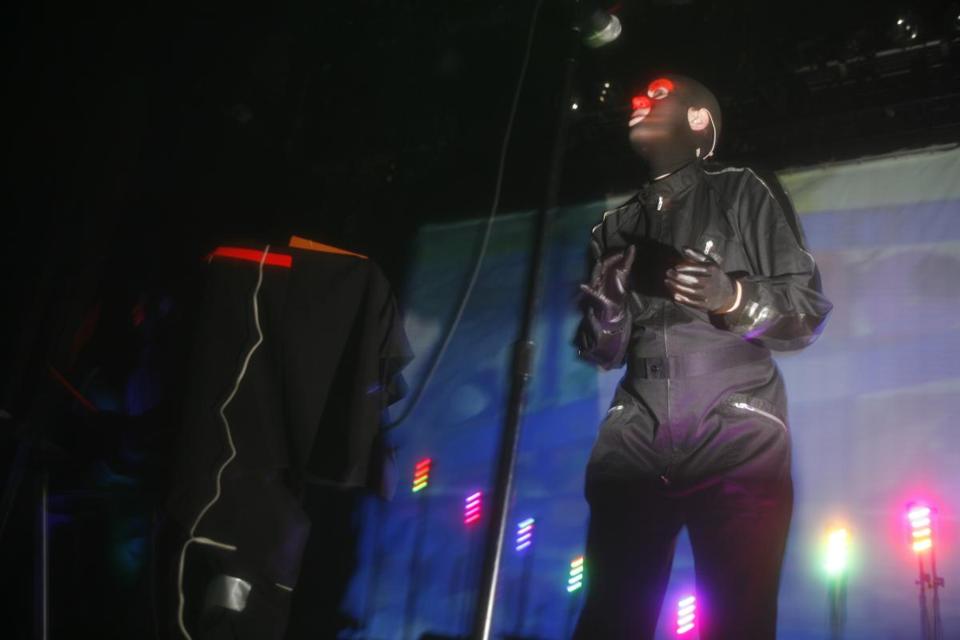
James Reed, The Knife, ‘Shaking the Habitual’, The Boston Globe, April 9 2013

knife2408

Calling “Shaking the Habitual” an album sells it short. The latest from the Swedish electronic duo the Knife, it’s more along the lines of an installation piece you’d find at a gallery, a knotty tangle of polyrhythms, distorted vocals, and heady influences ranging from French philosopher Michel Foucault to gender studies. It’s pop music that belongs under glass: Look, but don’t touch.

It’s the kind of record that is so self-possessed and primal, it nearly steamrolls the listener. Thirteen songs give way to 98 minutes and address everything from sexuality to the evils of capitalism and political corruption. Oh, and there’s a song called “Fracking Fluid Injection” full of fractured and oscillating vocals. (Let that be the line in the sand.)

rest of article

Review from the Orlando Weekly

When a band’s first-ever double album finds its namesake in a quote from philosopher Michel Foucault about re-evaluating conventional thinking, has its longest song clocking in at 19 minutes and has an overall runtime close to 100 minutes, you can expect a sort of marathon listening experience. After a four-year hiatus, the long-lost – but not forgotten – Swedish duo the Knife returned this year with a proper new album, Shaking the Habitual.

Also… a review of a London concert by the band

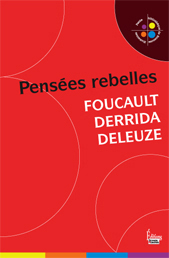
Pensees-rebellesPensées rebelles: Foucault, Derrida, Deleuze, Editions Sciences Humaines.
21 mars 2013 – 192 pages – ISBN : 9782361060343

Foucault, Derrida, Deleuze : trois philosophes longtemps boudés par la France et aujourd’hui redécouverts. Leurs pensées peuvent être qualifiées de «  rebelles  » à double titre. Rebelles d’abord parce que singulières, critiques, irréductibles, remettant sans cesse en question le pouvoir, l’institution et la manière même de penser et de philosopher. Rebelles également parce que souvent difficiles d’accès – parfois même obscures ou hermétiques – et rétives à une lecture univoque. Et pourtant, en dépit de leur difficulté intrinsèque, elles trouvent encore un large écho aujourd’hui et pas seulement dans les cercles universitaires. Si leurs textes sont souvent ardus, ces philosophes ont toutefois réussi à se faire entendre. Leur engagement y est sans doute pour beaucoup. Loin de s’enfermer dans leur tour d’ivoire, ils se sont confrontés au réel et ont participé aux luttes concrètes de leur temps.

Les sciences humaines prennent aujourd’hui conscience de la fertilité de la pensée de ces trois philosophes : «  nomadisme  », «  rhizome  », «  biopolitique  » autant de concepts et d’outils qui irriguent désormais la réflexion sur la mondialisation et la résistance au libéralisme. À l’heure où ces pensées semblent s’être patrimonialisées, ce livre vient souligner la force de leur posture critique. Rebelles, elles furent… rebelles, elles sont encore.

Avec les contributions de :
Marc Abélès, Sébastien Camus, François Cusset, Elie During, Arlette Farge, Marie Gaille, Marc Goldschmit, Frédéric Gros, Bernard Lahire, Michel Lallement, Michèle Lamont, Carole Maigné, Elsa Rimboux, Élisabeth Roudinesco, Frédéric Streicher.

au sommaire :

Introduction

Si loin, si proches, le retour de trois pensées critiques (C. Halpern)
La French Theory, métisse transatlantique (F. Cusset)
L’affaire Sokal : pourquoi la France ? (N. Journet)

Michel Foucault (1926-1984)

Michel Foucault, l’insoumis (C. Halpern)
La quête inachevée de Michel Foucault (M. Lallement)
À propos de Histoire de la folie à l’âge classique (C. Halpern)
À propos de Surveiller et Punir. Naissance de la prison (M. Fournier)
Microphysique du pouvoir (C. Lefranc)
Le gouvernement de soi (Frédéric Gros)
Sous le regard de la critique (Jean-François Dortier)
Petit vocabulaire foucaldien (encadré)
Foucault et l’anthropologie (entretien avec M. Abélès)
Quel apport pour la sociologie ? (Bernard Lahire)
Foucault et l’histoire (entretien avec A. Farge)

Jacques Derrida (1930-2004)

La passion de l’excès (S. Camus)
Citoyen Jacques Derrida (M. Gaille)
Une éthique impossible (E. Rimboux)
Derrida débat avec… (encadré)
Le cas Derrida vu par la sociologie des sciences (M. Lamont)
Le rire de l’écriture (M. Goldschmit)

Gilles Deleuze (1925-1995)

Le libertaire (C. Halpern)
Le «  sale gosse  » de l’histoire de la philosophie (F. Streicher)
À propos de Différence et Répétition (F. Streicher)
Libérer les flux du désir (C. Halpern)
L’anti-Œdipe vu par la psychanalyse (entretien avec É. Roudinesco)
Deleuze à travers ses œuvres (encadré)
À propos de Qu’est-ce que la philosophie ? (C. Maigné)
Le devenir du rhizome (X. de la Vega)
La pop’philosophie (entretien avec E. During)

Cet ouvrage est une reprise, revue et actualisée, du Hors-série spécial n° 3 du magazine Sciences Humaines (mai-juin 2005) : « Foucault, Derrida, Deleuze : Pensées rebelles ».

Steven Dorrestijn, Technical Mediation and Subjectivation: Tracing and Extending Foucault’s Philosophy of Technology, Philosophy & Technology, June 2012, Volume 25, Issue 2, pp 221-241.
https://doi.org/10.1007/s13347-011-0057-0

Abstract
This article focuses on tracing and extending Michel Foucault’s contributions to the philosophy of technology. At first sight his work on power seems the most relevant. In his later work on subjectivation and ethics technology is absent. However, notably by recombining Foucault’s work on power with his work on subjectivation, does his work contribute to solving pertinent problems in current approaches to the ethics of technology. First, Foucault’s position is compared to critical theory and Heidegger, and associated with the approach of “technical mediation” (Latour, Ihde, Verbeek). Next, a detailed study of Discipline and Punish, results in the identification of two distinct “figures of technical mediation”. Finally, Foucault’s later work on ethics and subjectivation is employed to elaborate an ethics of technology that focuses on care for the quality of the interactions and fusions with technology. Hybridization is central in the approach: it is not to be rejected, neither is it the greatest danger, but it does deserve the greatest care.

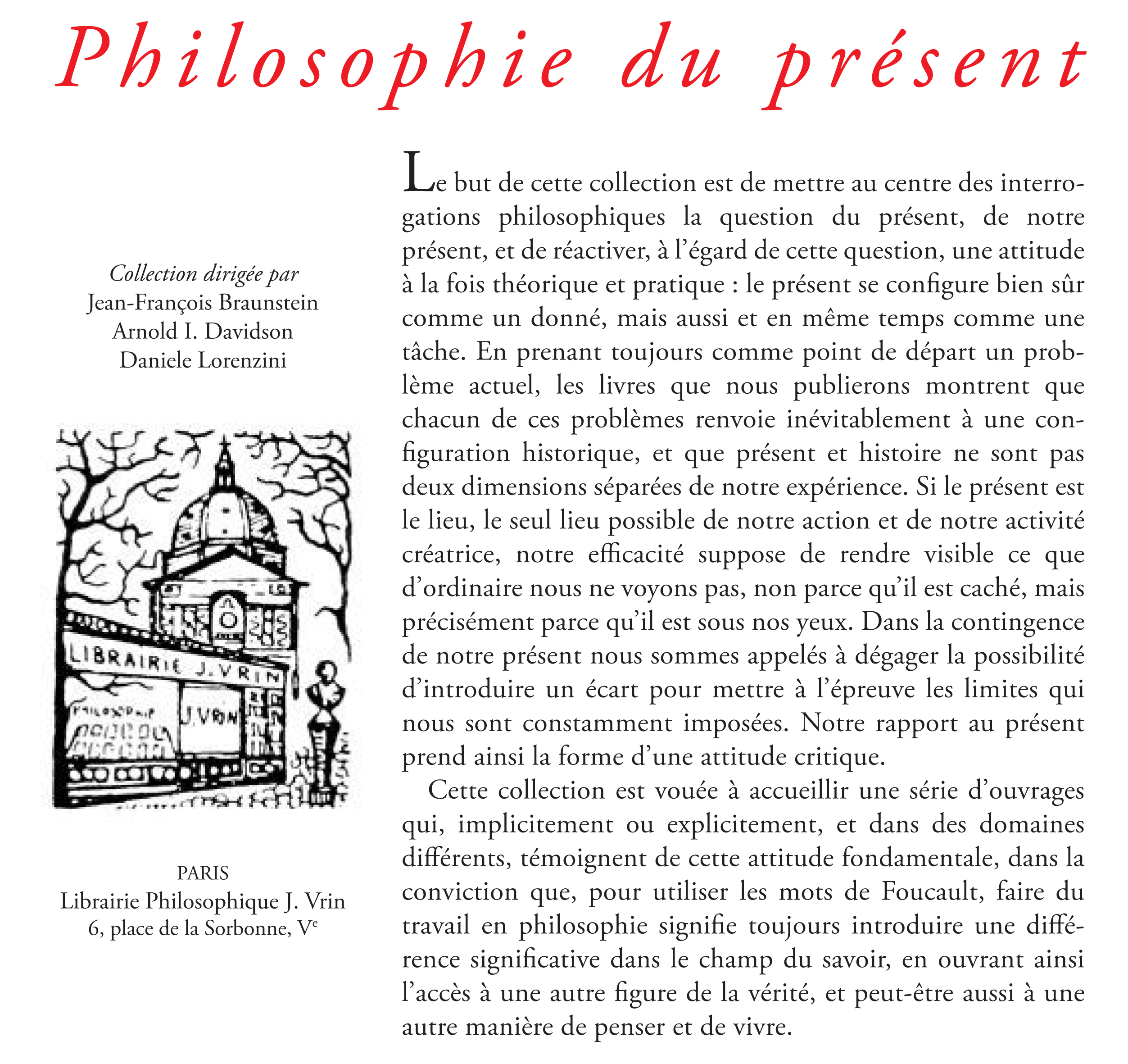
En septembre 2013 paraîtront chez Vrin (Paris) les premiers deux volumes de la nouvelle collection « Philosophie du présent », dirigée par Jean-François Braunstein, Arnold I. Davidson et Daniele Lorenzini.

PDF

Le but de cette collection est de mettre au centre des interrogations philosophiques la question du présent, de notre présent, et de réactiver, à l’égard de cette question, une attitude à la fois théorique et pratique : le présent se configure bien sûr comme un donné, mais aussi et en même temps comme une tâche. En prenant toujours comme point de départ un problème actuel, les livres qui seront publiés dans « Philosophie du présent » montrent que chacun de ces problèmes renvoie inévitablement à une configuration historique, et que présent et histoire ne sont pas deux dimensions séparées de notre expérience. Si le présent est le lieu, le seul lieu possible de notre action et de notre activité créatrice, notre efficacité suppose de rendre visible ce que d’ordinaire nous ne voyons pas, non parce qu’il est caché, mais précisément parce qu’il est sous nos yeux. Dans la contingence de notre présent nous sommes appelés à dégager la possibilité d’introduire un écart pour mettre à l’épreuve les limites qui nous sont constamment imposées. Notre rapport au présent prend ainsi la forme d’une attitude critique.

Cette collection est vouée à accueillir une série d’ouvrages qui, implicitement ou explicitement, et dans des domaines différents, témoignent de cette attitude fondamentale, dans la conviction que, pour utiliser les mots de Foucault, faire du travail en philosophie signifie toujours introduire une différence significative dans le champ du savoir, en ouvrant ainsi l’accès à une autre figure de la vérité, et peut-être aussi à une autre manière de penser et de vivre.

La collection « Philosophie du présent » accueillera en outre la série « Foucault inédit », publiée sous la direction de Jean-François Braunstein, Arnold I. Davidson, Henri-Paul Fruchaud et Daniele Lorenzini, dont le but est d’établir l’édition critique d’une série de conférences et d’interviews de Michel Foucault qui demeurent encore inédites en français, ou inédites tout court. Le premier volume, à paraître en septembre 2013, recueillera les conférences données par Foucault à Dartmouth College en novembre 1980 sur « L’origine de l’herméneutique de soi », avec les variantes de la version prononcée par Foucault le mois précédent à Berkeley, ainsi que deux autres interventions inédites, contemporaines de ces conférences.

Philosophie du présent

In French with no subtitles.

From a series titled Le Temps des Philosophes. 4. Philosophie et Vérité. Entretien entre Georges Canguilhem, Jean Hyppolite, Paul Ricoeur, Michel Foucault, Dina Dreyfus and Alain Badiou.

The original program was produced by Radio-Télévision scolaire in 1965 and released on VHS in 1993 by the Centre National de Documentation Pédagogique.

Foucault appears at 7 minutes.

The extra details not listed on the link page are from the video sleeve.

With thanks to Dirk Felleman for this link.

James Schmidt's avatarPersistent Enlightenment

It is unfortunate that no one has gotten around to translating Michel Foucault’s 1966 review of the French translation of Ernst Cassirer’s Philosophie der Aufklärung.1 Granted, it is a short text and – prior to its reprinting in Foucault’s Dits et Ecrits – finding it required some (though not much) digging. But it is a text worth knowing: sensitive to the political context of Cassirer’s study of the Enlightenment and sympathetic to his general approach. Had it been more widely known, it might have complicated certain assumptions about Foucault’s stance towards the Enlightenment. All of this is more than enough to suggest that the editor of What is Enlightenment? Eighteenth-Century Answers and Twentieth-Century Questions was guilty of a significant lapse in judgment when he failed to include it in his collection. The accused is not inclined contest that verdict and will try to make amends in this brief…

View original post 2,592 more words