Foucault News

News and resources on French thinker Michel Foucault (1926-1984)

Background

Editor (Clare O’Farrell): I have been running a network on the Ning platform since 2008 with the title of Poststructural Theory, but most of the activity on it is currently related to Foucault and Education, so I have re-purposed the network and re-titled it Foucault and Education. [Update 14 March 2026. This network is no longer in existence]

The Ning platform allows for the creation of custom social networks. Further information about how the Ning platform works can be found on the Wikipedia page. I have found Ning to provide a far more satisfactory interface for supporting effective work and research collaboration than platforms such as Facebook, Twitter or dedicated blogging platforms.

Details

Foucault and Education is an international network for students and researchers applying the work of Foucault to Education. It incorporates the Poststructural Theory Special Interest Group (SIG) of the Australian Association for Research in Education (AARE).

Anybody engaged in research and study applying the ideas of Michel Foucault to the discipline of education is welcome to join this network.

Members can create their own profile pages and ‘friend’ each other, form private interest, work and reading groups, post status updates and post to the main forum or to the small private group forums. They can also post blog entries and notices of events. The network can be used to post notices of publications, calls for papers as well as for discussion of any other topics of general interest relating to Foucault and education. Members can in addition post documents, photos and videos, which is useful for those wishing to form work or reading groups.

The network also includes members of the Poststructural Theory Special Interest Group (SIG) of the AARE (Australian Association for Research in Education).

Foucault, Governmentality,Biopolitics – Analytical strategies for critique of power (PhD course, 11-13 December 2013)

Faculty
• Jeffrey Bussolini, Associate Professor, Staten Island, City University of New York, USA.
• Mitchell Dean, Professor of Public Governance, CBS/University of Newcastle, Denmark/Australia,
• Thomas Dumm, Professor, Department of Political Science, Amherst College, USA.
• Marius Gudmand-Høyer, Post.Doc, Dept. of Management, Politics & Philosophy, CBS, Denmark.
• Kaspar Villadsen, Associate Professor, Dept. of Management, Politics & Philosophy, CBS, Denmark.

Place: Department of Management, Politics & Philosophy, CBS, Copenhagen

Course Coordinators: Kaspar Villadsen & Mitchell Dean

Prerequisite/progression of the course:
Only PhD students can participate in the course.
It is a precondition for receiving the course diploma that the PhD student attends the whole course.

Aim of the course
The course will provide the participants with:

a) An updated introduction to key analytical concepts in the Governmentality literature, and the potentials and weaknesses of these concepts will be discussed.

b) Possibilities for supplementing the governmentality approach with other analytical sources will be discussed.

c) Furthermore, a detailed consideration of the current status of governmentality studies and post-Foucauldian studies will be given, in particular in light of recent claims for a crisis of critique.

d) Finally, suggestions will be presented on how to elaborate or move beyond the framework of governmentality by activating concepts of bio-power and sovereignty, reconsidering the social and notions of society, and focusing on international dimensions of governmentality.

In brief, the course aims to provide participants with a thorough understanding of the governmentality framework, that is, its analytical possibilities, its current status, and its possible directions of development.

Course content, structure and teaching
Over the last 20 years, post-Foucauldian “governmentality studies” have come to growing prominence. These studies have been effective in critically analyzing new types of liberal government, in particular by demonstrating ‘the active side of laissez faire’. They describe how the motto of ‘pulling back the state’ has been accompanied by a series of governmental strategies and technologies aimed at shaping institutions and subjects in particular ways. Perhaps most noticeably, they have presented a diagnosis of a proliferation of regimes of enterprise and accounting in new and surprising places. But a wide range of other domains have been subjected to governmentality analysis spanning from genetic screening and risk calculation, new crime prevention strategies, to health promotion by self-responsibilization. To be sure, the concepts in governmentality studies continue to constitute effective tools for critical social analysis.

Nevertheless, in recent years critical objections have been raised against the governmentality approach. It has been noted by some observers that the Foucauldian and post-structuralist language, originally used for critical academic purposes, seems to be increasingly appropriated by ‘the powers’ that were the object of such critique. Most notably, this point has been voiced (although in different versions) by Zizek, Boltanski, and Hardt & Negri.

These thinkers suggest that a post-structural ’politics of difference’ increasingly seems to be an integral part of the ways, in which institutions and companies organize themselves. If modern liberal government has begun to speak for the dissolution of binary essentials, the destabilization of rigid power structures, the creation of space for the subject’s self-transforming work upon itself, and so on. In light of this development, we need to think of ways to revitalize the Foucauldian concepts of critique/criticism or to push a critical perspective beyond Foucault.

A central theme of the PhD course is the search for effective analytical strategies for critique of power (some perhaps less noticed) in the works of Foucault and other writers within and outside the governmentality tradition. Of particular interest is Giorgio Agamben’s recent critique and extension of Foucault’s genealogy of government.

The course requires the submission of a paper that deals with conceptual problems or analytical designs in relation to Foucauldian inspired/governmentality studies. Furthermore, papers that apply Foucauldian concepts to empirical problems in a variety of domains are welcomed.

It is also possible to participate on the basis of an abstract stating the theme of the PhD project. An abstract should be approximately 1 page, whereas a paper should be approx. 5 pages. In both cases, the PhD student should state his main analytical challenge/concern at his/her current stage in the project.

Papers/abstracts
must be in English. DEADLINE is 2 December 2013.

Lecture plan

Wednesday 11th December.
10:00-12:30 Kaspar Villadsen Analytical approaches in governmentality studies
12:30-13:30 Lunch
13:30-16:00 Mitchell Dean Concepts of power:‘The signature of power’‘
16:00-17:00 Kaspar Villadsen & Mitchell Dean Papers from Ph.D. scholars

Thursday 12th December.
10.00-12.30 Thomas Dumm Foucault, Neo-liberalism and Freedom.
12:30-13:30 Lunch
13.30-15.00 Kaspar Villadsen Technologies and organisations in Foucault’s thinking
15.00-17.00 Kaspar Villadsen, Thomas Dumm & Mitchell Dean Papers from Ph.D. scholars

Friday 13th December
10:00-11:30 Jeffrey Bussolini Biopolitics: Foucault meets Agamben
11:00-12:30 Mitchell Dean Governmentality meets theology
12.30-13.30 Lunch
13:30-15:00 Marius Gudmand-Høyer Dispositive analysis: the key concept in Foucault?
15.00-16.00 Kaspar Villadsen, Jeffrey Bussolini & Mitchell Dean, Papers from Ph.D. scholars
16:00-17:00 Kaspar Villadsen & Mitchell Dean Concluding discussion and evaluation

Teaching methods
The course will use lectures given by specialists in the field, roundtable discussions, and presentation of papers from PhD students. Participation in the course requires a paper with an outline of PhD project or parts of the project.
See more details above.

Course literature

Agamben, G. (2011) The Kingdom and the Glory: a Theological Genealogy of Economy and Government. Stanford University Press, especially pages 109-114; Appendix.

Bussolini, J. (2010) ‘Critical encounter between Giorgio Agamben and Michel Foucault: Review of recent works by Giorgio Agamben’, Foucault Studies 10: 108-143.

Dean, M. (2012) ‘Governmentality meets theology: the king reigns but does not govern’, Theory, Culture and Society 29 (3):145-58.

Dean, M. (2012) ‘The signature of power’, Journal of Political Power 5 (1): 101-117.

Foucault, M. (2007) Security, Territory, Population. New York: Palgrave Macmillan (especially lecture 5)

Foucault, M. (2008) The Birth of Biopolitics. New York: Palgrave Macmillan (especially lecture 12).

Villadsen, K. & Karlsen, M.P. (2008) “Who Should Do the Talking? The proliferation of dialogue as governmental technology”, in: Culture & Organization, no. 14, vol. 4.

Villadsen, K. (2008) “Doing without the State and Civil Society as Universals: ‘Dispositifs’ of care across the classic sector divide”, Journal of Civil Society, no. 4, vol. 3.

ECTS awarded
3 ECTS

Language
English

Maximum and Minimum number of participants
Min: 19
Max:

Fee
DKK 3,900 (covers the course, coffee, tea, lunch and one dinner)

Enrol no later than 1 November 2013

dandysme
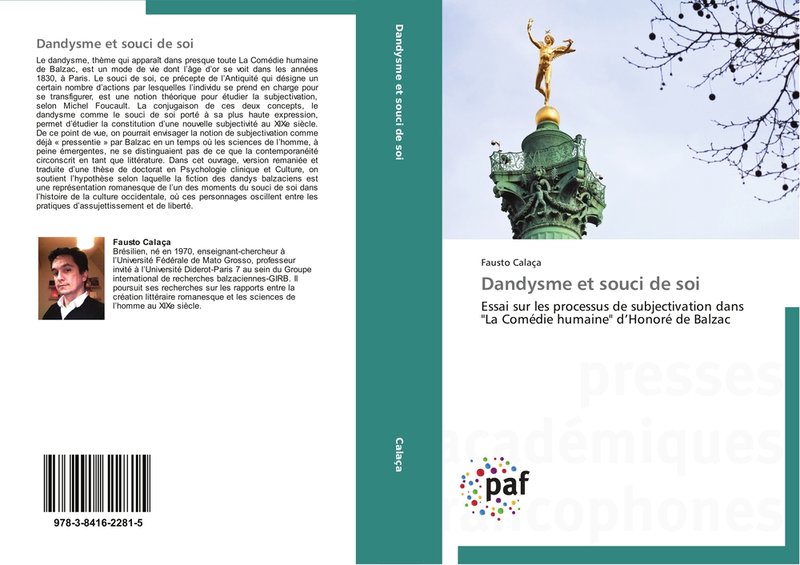
Fausto Calaça, Dandysme et souci de soi: Essai sur les processus de subjectivation dans “La Comédie humaine” d’Honoré de Balzac, Presses Académiques Francophones ( 28.08.2013 )

Cet ouvrage est la version remaniée et traduite d’une thèse de doctorat en « Psychologie clinique et Culture » soutenue dans sa version en langue portugaise, « Dandismo e cuidado de si : ensaios de subjetivação em Balzac », le 10 mars 2010 à l’Université de Brasilia (Brésil), par Fausto Calaça, sous les directions de Terezinha de Camargo-Viana et Olivier Bara. La recherche scientifique a été accomplie avec un stage doctoral à la Faculté des Lettres de l’Université Lumière Lyon 2 et dans l’UMR « Littérature, idéologies, représentations, XVIIIe-XIXe siècles-Lire » (CNRS), dans le cadre du Collège Doctoral Franco-Brésilien, financé par la Fondation Capes-Brésil.

Le dandysme, thème qui apparaît dans presque toute La Comédie humaine de Balzac, est un mode de vie dont l’âge d’or se voit dans les années 1830, à Paris. Le souci de soi, ce précepte de l’Antiquité qui désigne un certain nombre d’actions par lesquelles l’individu se prend en charge pour se transfigurer, est une notion théorique pour étudier la subjectivation, selon Michel Foucault. La conjugaison de ces deux concepts, le dandysme comme le souci de soi porté à sa plus haute expression, permet d’étudier la constitution d’une nouvelle subjectivité au XIXe siècle. De ce point de vue, on pourrait envisager la notion de subjectivation comme déjà « pressentie » par Balzac en un temps où les sciences de l’homme, à peine émergentes, ne se distinguaient pas de ce que la contemporanéité circonscrit en tant que littérature. Dans cet ouvrage, version remaniée et traduite d’une thèse de doctorat en Psychologie clinique et Culture, on soutient l’hypothèse selon laquelle la fiction des dandys balzaciens est une représentation romanesque de l’un des moments du souci de soi dans l’histoire de la culture occidentale, où ces personnages oscillent entre les pratiques d’assujettissement et de liberté.

HF-lorenzini
Un demi-siècle d’Histoire de la folie, sous la direction de Daniele Lorenzini et Arianna Sforzini, Editions Kimé, 2013.

L’Histoire de la folie à l’âge classique de Michel Foucault a produit, au moment de sa publication, une onde de choc. Cet ouvrage, foisonnant, baroque, labyrinthique, est apparu aussitôt comme insituable. S’agissait-il d’histoire, de philosophie, de littérature, de sociologie ? Les partages disciplinaires traditionnels furent emportés par le courant impétueux de ce livre impossible. Mais il n’y eut pas que les cercles universitaires pour se trouver inquiétés par ces thèses tumultueuses (l’exclusion de la folie par l’âge classique, l’hypocrisie atroce de la libération des fous par les médecins modernes, etc.). Le récit épique de l’enfermement des fous dans les prisons de l’ordre moral, des nouveaux partages imposés par les révolutionnaires, altérait la bonne conscience d’une psychiatrie qui se pensait, fondamentalement, et par la vertu d’une fondation originaire jamais interrogée, humaniste. Histoire de la folie préparait ainsi les révoltes de l’anti-psychiatrie.

Cinquante ans après la parution de ce qui, au départ, était une simple thèse de doctorat, l’éclat de la rupture est intact. Ce livre continue à troubler, fasciner, irriter. Notre culture ne l’a toujours pas digéré. On découvre sans cesse de nouvelles apories, de nouveaux problèmes, de nouvelles perspectives pour interroger l’avenir. Ces rencontres, provoquées à l’occasion de cet « anniversaire », ne sont pas des commémorations. Il ne s’agit pas d’établir scientifiquement ici ce que Foucault a vraiment voulu dire, mais d’entendre jusqu’à quel point, encore aujourd’hui, ce texte réinvente notre rapport à la folie.

Daniele Lorenzini finit l’écriture d’une thèse sur le rapport entre éthique et politique chez Michel Foucault, Pierre Hadot et Stanley Cavell ; il a coédité les conférences de Foucault sur L’origine de l’herméneutique de soi (Vrin, 2013).

Arianna Sforzini prépare une thèse sur la présence et l’importance du théâtre dans l’œuvre de Foucault et finit l’écriture d’un livre intitulé <emFoucault et la pensée du corps (à paraître aux PUF, coll. « Philosophies »). Ils co-animent, tous les deux, avec Frédéric Gros et Ariane Revel, le séminaire « Actualités Foucault » à l’Université Paris-Est Créteil.

SOMMAIRE
Introduction. L’Histoire de la folie dans l’œuvre de Foucault
Daniele Lorenzini & Arianna Sforzini

PREMIERE PARTIE
Esthétiques de la déraison

Degré zéro de l’histoire de la folie et texte cartésien : l’archéologie de quel silence ?
Emmanuel Gripay

La présence du théâtre dans Histoire de la folie
Arianna Sforzini

La folie et la mort chez Foucault : éléments pour une pensée du dehors
Jérémy Romero

DEUXIÈME PARTIE
Origines du cogito

Événement et origine dans Histoire de la folie
Francesco Paolo Adorno

La naissance du cogito
Kojiro Fujita

TROISIÈME PARTIE
Folie, psychiatrie, histoire

La sorcière et la possédée : deux figures du désordre
Paul Mengal

L’affaire Firmin (1794-1799) et l’absence de législation sur le crime en « démence » : une voie politique pendant la Révolution française ?
Caroline Mangin-Lazarus

Michel Foucault, folie, psychiatrie
Roger Ferreri

APPENDICE

Foucault en Italie
Manlio Iofrida

Biobibliographies des auteurs
Index des noms

Ritu Birla, Maine (and Weber) Against the Grain: Towards a Postcolonial Genealogy of the Corporate Person (2013) Journal of Law and Society, 40 (1), pp. 92-114.
https://doi.org/10.1111/j.1467-6478.2013.00614.x

Abstract
This essay forges ties between postcolonial methodologies and the economic sociology of law, emphasizing the history, legal production, and governmental habitus of that modern abstraction called ‘the economy’. It pursues three interrelated sites to do so: the categories of government and economy, via Weber and Foucault; classical legal discourse on corporate or group life and its temporizing from status to contract; and the relationship between the legal subject and homo economicus, investigated and telescoped through the figure of the corporate person. Empirically, focusing on India as a lens to highlight a colonial genealogy of neoliberal modernity, the analysis animates these themes via the history of colonial market governance, its relationship to the ’embedded’ practices of vernacular capitalism, and emergent forms of economic citizenship today, seen through Indian case law on the corporate person and corporate veil-piercing.

DOI: 10.1111/j.1467-6478.2013.00614.x

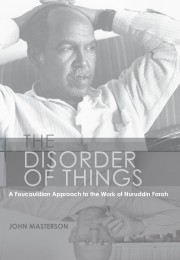
DisorderCover-HR1-180x260 John Masterson, The Disorder of Things: A Foucauldian Approach to the Work of Nuruddin Farah, Wits University Press, 2013

Nuruddin Farah is widely regarded as one of the most sophisticated voices in contemporary world literature. Michel Foucault is revered as one of the most important thinkers of the twentieth century, with his discursive legacy providing inspiration for scholars working in a range of interdisciplinary fields. The Disorder of Things offers a reading of the Somali novelist through the prism of the French philosopher. The book argues that the preoccupations that have remained central throughout Farah’s forty year career, including political autocracy, female infibulation, border conflicts, international aid and development, civil war, transnational migration and the Horn of Africa’s place in a so-called ‘axis of evil’, can be mapped onto some key concerns in Foucault’s writing most notably Foucault’s theoretical turn from ‘disciplinary’ to ‘biopolitical’ power.

In both the colonial past and the postcolonial present, Somalia is typically represented as an incubator of disorder: whether in relation to internecine conflict, international terrorism or contemporary piracy. Through his work, both fictional and non-fictional, Farah strives to present alternative stories to an expanding global readership. The Disorder of Things analyses the politics and poetics that underpin this literary project, beginning with Farah’s first fictional cycle, Variations on the Theme of an African Dictatorship (1979-1983), and ending with his Past Imperfect trilogy (2004-2011). Farah’s writing calls for a more refined, substantial reading of our current geo-political situation. As such, it both warrants and compels the kind of critical engagement foregrounded throughout The Disorder of Things.

This book will appeal to students, academics and general readers with an interest in the interdisciplinary study of literature. Its engagement with theorists, drawn from postcolonial, feminist and development studies, set against the backdrop of a host of philosophical and sociological discourses, shows how such intellectual cross-fertilisation can enliven a single-author study.

John Masterson is a lecturer in the Department of English at the University of the Witwatersrand, South Africa. He has published work on a range of writers, including Chinua Achebe, Chimamanda Ngozi Adichie, Kiran Desai, Dave Eggers and Abdulrazak Gurnah, and on topics, including the Rwandan genocide and postcolonial conflict.

… an important addition to the study of the oeuvre of Nuruddin Farah, one of this continent’s leading and most original novelists. The study will be of great interest to scholars specialising in contemporary African literature […] whilst being accessible to general readers with an especial interest in Foucault; in African politics and social developments; or in assessing the contribution of an intriguing but ‘difficult’ author.
—Annie Gagiano, University of Stellenbosch

The author is ambitious; this is not a study which applies Foucault, but a study which at its best attempts to reread each figure (Foucault and Farah) in dialogue with the other.
—Eleni Coundouriotis, University of Connecticut

I’m posting this a bit late – but still an item worth knowing about. Posted on The Bartlett UCL site

15 August – 05 September 2013

Location: UCL North Lodge, Gower Street, WC1E 6BT

[Update 4 April 2026: Links updated – with some archived on the Wayback Machine]

Pantopticon: Experimental Tales of Jeremy Bentham

This free collaborative exhibition explores the life, influence and radical ideas of Jeremy Bentham. A display of facsimile manuscripts from UCL Special Collections is enhanced by projected images and text, weaving a different tale for each visitor. The “flexible” display methods will help us understand how exhibition designers and curators can use digital technology to explore multiple narratives from one set of artefacts.

This exhibition showcases two UCL-based research initiatives: Design with Heritage (in collaboration with the Victoria & Albert Museum) and Transcribe Bentham.

Design with Heritage is a twelve-month Creative Economy Knowledge Exchange Project supported by the Arts and Humanities Research Council (AHRC). It is run in collaboration between UCL Centre for Sustainable Heritage and the Victoria & Albert Museum. The aim of the project is to develop connections between designers, academic researchers, and arts and heritage institutions by identifying shared interests and creating opportunities for collaboration.

Transcribe Bentham is an award-winning participatory project based at University College London. Its aim is to engage the public in the online transcription of original and unstudied manuscript papers written by Jeremy Bentham, the great philosopher and reformer. To date, over 5500 Bentham manuscripts have been digitally transcribed by volunteers worldwide.

Download the exhibition poster as a PDF

With thanks to Dirk Felleman for this info

CALL FOR PAPERS
The fourteenth annual meeting of the Foucault Circle

University of Malmö
Malmö, Sweden

June 5-8, 2014

We seek submissions for:

1). Papers on any aspect of Foucault’s work, as well as studies, critiques, and applications of Foucauldian thinking;

2). Round table discussions comprised of four or five panelists:

  • European and North American perspectives on Foucault’s work;
  • Feminist perspectives on Foucault’s work;
  • Utilizing the Foucauldian “Toolbox”.

Individual paper submissions require an abstract of no more than 750 words; round table submissions require a 500 word abstract describing the overall theme and 150 word summaries of each panelist’s talking points. All submissions should be formatted as “.doc” attachments and sent via email to program committee chair Edward McGushin (emcgushin@stonehill.edu) on or before January 2, 2014. Indicate “Foucault Circle submission” in the subject heading. Program decisions will be announced by early February.

All abstracts should be prepared for anonymous review.

The meeting will begin Thursday afternoon with a round table discussion, followed by an informal welcome session and dinner. Morning and afternoon paper sessions will be held on Friday and Saturday; the Saturday sessions will be followed by a business meeting and dinner. The conference will conclude with paper sessions on Sunday morning. Presenters of individual papers will have approximately 35 minutes for paper presentation and discussion combined; papers should be a maximum of 3000 words (15-20 minutes, preferably 15). Round tables will have approximately 50 minutes total for presentation and discussion combined; individual panelists should plan to speak for no more than 5-7 minutes.

Logistical information about lodging, transportation, and other arrangements will be available after the program has been announced.

For more information about the Foucault Circle, please see our website

stuartelden's avatarProgressive Geographies

03_1971_03_p00008303_1971_03_p000084

This text was co-authored by Michel Foucault, Pierre Vidal-Nacquet and Jean-Marie Domenach, and was first read at a news conference on 8 February 1971. It was subsequently published in Esprit in March 1971. As far as I know, the only partial translations of this important document are found in the English edition of Didier Eribon’s biography, Michel Foucault, translated by Betsy Wing, London: Faber and Faber, 1992, pp. 224-5; and in David Macey, The Lives of Michel Foucault, London: Random House, 1993, p. 258.

These translations are very good, but both are incomplete, and there are some interesting and important elements within the text that are somewhat obscured. This manifesto was issued right in the middle of Foucault’s first course at the Collège de France, now translated as Lectures on the Will to Know. There are several important resonances in the language. The version below attempts to make these…

View original post 604 more words

The book was very much inspired by Foucault’s work, even if Stuart Elden takes issue with what Foucault says directly about territory. For an interview with Stuart Elden which provides an overview of the book see the Exploring Geopolitics site

stuartelden's avatarProgressive Geographies

BofTI’ve just received my advance copy of The Birth of Territory, and additional copies have been sent by the warehouse. The Chicago page for the book has the book listed as published, and orders from them direct will be sent now (there are also electronic copies available). I guess online bookstores will take a few more days to receive copies.

[Update 9th September: the Kindle edition is now available. Amazon have the physical copy down for release on 13th September]

View original post