Foucault News

News and resources on French thinker Michel Foucault (1926-1984)

James Lee, Ethopoiesis: Foucault’s late ethics and the sublime body (2013) New Literary History, 44 (1), pp. 179-198.
https://dx.doi.org/10.1353/nlh.2013.0005.

Abstract
This paper argues that Neil Hertz’s model of the sublime turn allows us to perceive the aesthetic, and specifically literary, consequences of Foucault’s late ethics reimagined as a sublime poetics. In doing so, the present analysis attempts to reanimate the concept of the sublime as a powerful ethical category reconceiving the subject in terms of the acts of writing that structure a constitutive aesthetic relationship to her own body. More generally, this account of Foucault proposes that his late ethics, and not necessarily the politics of his earlier work, holds the most interest for literary critics, since these ideas explicitly rethink ethics as a poetics, and thus foreground the frequently under recognized force of literary creation, and not simply cultural representation, in shaping subjects of power.

DOI: 10.1353/nlh.2013.0005

John Roberts, Testing the limits of structuration theory in accounting research (2013) Critical Perspectives on Accounting., Volume 25, Issue 2, Pages 135-141
https://doi.org/10.1016/j.cpa.2012.12.002

Abstract
In 1985 I published a paper in Accounting Organizations and Society with Bob Scapens titled ‘Accounting Systems and Systems of Accountability; understanding accounting practices in their organisational contexts’. The paper suggested the potential usefulness of Anthony Giddens’ structuration theory for efforts to understand accounting in its organisational contexts. Rather than engage in a further review of the use of structuration theory in accounting, this paper sets out to test our original proposition as to the usefulness of Giddens ideas for accounting research. I explore three points of possible criticism in the paper. That structuration theory does not take the ‘agency’ of accounting sufficiently seriously; that Foucault and Lacan allow us to get much closer to the ways in which accounting information works back upon human subjects; and that Giddens and accounting share a lack of ethics.

Author Keywords
Accountability; Actor network theory; Modalities of interaction; Structuration theory

Jason Schaub, Roger Dalrymple, Surveillance and silence: New considerations in assessing difficult social work placements (2013) Journal of Practice Teaching and Learning, 11 (3), pp. 79-97.
https://doi.org/10.1921/jpts.v11i3.279

Abstract
Studies to date have highlighted a number of key factors in the assessment of difficult social work placements including the need for adequate professional formation; communication; the changing social work education framework; and the influence of the wider social work context. Factors less widely examined are the perceptions of some practice educators that the assessment of placement students operates in a wider context of surveillance and scrutiny by a range of stakeholders. We argue that such perceptions of surveillance can cause a discursive anxiety for practice educators and can inhibit key developmental conversations between assessor and student. Drawing on interviews with ten practice educators, we examine the tendency of practice educators reflecting on a failed placement to rehearse or even enact those key developmental conversations post hoc, broaching previously unstated or tacit aspects of the placement experience. We argue for the need to create a safe discursive space for these conversations to take place in situ during the challenging placement and suggest that a diminution in perceptions of surveillance and enhanced outcomes for students and practice educators will result.

Author Keywords
anxiety; discursive spaces; failing students; Foucault; practice educators; surveillance

Key Thinkers: Michel Foucault by John Frow. Videos of lecture delivered in 2009 at the University of Melbourne. Posted 3 May 2013 by The Monthly

RaĂşl Sánchez GarcĂ­a and Antonio Rivero Herraiz, ‘Governmentality’ in the origins of European female PE and sport: The Spanish case study (1883-1936) Sport, Education and Society, 18 (4), 2013, pp. 494-510.
https://doi.org/10.1080/13573322.2011.601735

Abstract
The purpose of the paper is twofold: (1) to contribute to the analysis of the origins of modern European female PE and sports from a power perspective, inspired by Foucault’s work; and (2) to present a detailed analysis of female PE and sport in Spain (1883-1936) as a specific European case study. It is argued that these physical activities could be conceived in the Spanish case as part of a specific kind of ‘governmentality’ with a dual nature. On the one hand they represented disciplinary ‘technologies of power’ over the female body. Selected physical activities-dictated mainly from the hygienic-moral position of the Regeneracionistas (‘Regenerationists’)-were exerted as a kind of ‘bio-power’ for the control of the female population. On the other hand, such kind of activities (especially sports) represented certain ‘technologies of the self’ for middle and upper class women. Through participation in sports, women gained a more active and public role in the Spanish society of the era, obtaining some degree of autonomy in self-governance over their bodies and their lives. © 2013 Copyright Taylor and Francis Group, LLC.

Author Keywords
Foucault; Governmentality; Physical Education; Power; Spain; Sports; Women

Jérôme Englebert
Some evidence for a psychopathological consideration on psychopathy: Part I [Quelques Ă©lĂ©ments en faveur d’une rĂ©flexion psychopathologique sur la psychopathie : Première partie]
(2013) Annales Medico-Psychologiques, 171 (3), pp. 141-146.

https://doi.org/10.1016/j.amp.2012.05.025

Jérôme Englebert
Some evidence for a psychopathological consideration on psychopathy: Part II [Quelques Ă©lĂ©ments en faveur d’une rĂ©flexion psychopathologique sur la psychopathie : Seconde partie]
(2013) Annales Medico-Psychologiques, 171 (3), pp. 147-153.

https://doi.org/10.1016/j.amp.2012.05.024

Abstract
Objectives: The objectives of this study are to offer some clinical and semiological considerations for a psychopathological conception of psychopathy. In the first part, the author provides a history of this diagnosis (see Introduction of this paper) and a description of the current trends in the international literature: the contributions of R.D. Hare and the PCL-R, D.J. Cooke and the Comprehensive Assessment of Psychopathic Personality (CAPP) and T.H. Pham for French-speaking validations (subtitle 2 of this paper). After that, the author proposes a definition of psychopathology in the sense of Minkowski and Jaspers proposals (i.e. these latter come from the principles of the continental phenomenology) (subtitle 3 of this paper). Patients and methods: This theoretical essay is improved by clinical situations. The psychopaths were interviewed in prison or in forensic centers.

The method used was a psychopathological analysis from the clinical material, as well as references to the phenomenological psychopathology (continental phenomenology) and the philosophy of J.-P. Sartre, M. Foucault and P. RicĹ“ur. Results: This study shows that it is useful to consider a psychopathological reflection on psychopathy and this approach gives a framework for the clinical investigations. Regarding that, the author proposes a first comparison between the binswangerian conception of mania and the psychopathic functioning (subtitle 4 of this paper). By this way, we can understand why many studies show a positive correlation between the scoring in the PCL-R and the scale of the MMPI mania. The behavior is similar but the difference is about the dialectic between the ” ego” and the ” alter ego”.

The maniac has a fundamental crisis of the ” ego” , which the psychopath does not have. A second finding of our investigations concerns emotions and the dimension of the adaptive psychopathic disorder (subtitle 5 of this paper). An epistemological discussion of the concept of emotions allows us to say that the psychopath is competent in the management of emotional stimuli, which confers a psychological advantage to him. In addition, fundamental research on the management of the emotional stimuli in the psychopath seems to confirm our hypothesis of an adaptive dimension for the psychopathic disorder. The last point we discuss is about ” morality” and ” ethics” for the psychopath (these notions are from the concepts of empathy and sympathy). On the basis of Foucault’s distinction between these two concepts, it becomes possible to study these dimensions and integrate them in the practice of psychopathology. This proposal enables to introduce the concept of narrativity. This observation prompts the clinician to listen to the patient and to pay attention to how he has to tell himself.

Conclusions: Our contribution shows that it is possible to conduct a study about the psychopathology of psychopathy. Our study is not intended to be complete and irrefutable. Our goal is rather to give some evidence for a psychopathological consideration on psychopathy (as indicated by the title of this paper). Finally, we offered some thoughts on the practice of psychotherapy by integrating the adaptive dimension of this disorder which, when it is missed, can lead to a psychotherapeutic stalemate. © 2012 Elsevier Masson SAS.

Author Keywords
Adaptation; émotion; éthique; Emotion; Empathie; Empathy; Ethics; Mania; Manie; Morale; Morality; Psychopathie; Psychopathologie; Psychopathology; Psychopathy; Psychothérapie; Psychotherapy; Sympathie; Sympathy

DOI: 10.1016/j.amp.2012.05.025
DOI: 10.1016/j.amp.2012.05.024

PDF of flyer

mf_progBD

ricoeur Johann Michel (2013), Ricœur et ses contemporains, Presses Universitaires de France

L’ouvrage se propose de confronter la philosophie de Ricœur avec certains de ses contemporains que l’on regroupent sous la bannière des « post-structuralistes

L’ouvrage

Si l’on connaît aujourd’hui le dialogue fructueux que Paul Ricœur a noué avec les penseurs structuralistes, on ignore largement son positionnement face à la mouvance poststructuraliste. Faut-il opposer la philosophie de Ricœur au poststructuralisme à la française ou au contraire doit-on montrer qu’elle en est une variante singulière ?
C’est la seconde option qui est ici défendue. Certes, le poststructuralisme ne doit pas être considéré comme une école de pensée mais comme une reconstruction qui relève de l’histoire de la philosophie. Dans la mesure où les horizons de dépassement du structuralisme ont été posés de manière chaque fois particulière, il est préférable de parler de poststructuralismes au pluriel. C’est la raison pour laquelle J. Michel propose des confrontations dyadiques entre Ricœur et certains de ses contemporains (Deleuze, Derrida, Foucault, Bourdieu…) que l’on regroupe habituellement dans cette mouvance.

Table des matières

Introduction

Chapitre I : L’habitus, le récit et la promesse
Habitus et Identité-idem. Identité narrative et illusion biographique. La promesse et ses dilemmes.

Chapitre II : Le sens de la démesure. Un hégélianisme avec réserves
Hégélianisme inversé et hégélianisme brisé. L’horizon kantien et l’ontologie heideggerienne. Le tiers et la question de la justice.

Chapitre III : Le hors-sujet et le devenir-sujet
La structure, l’intrigue et l’événement. Force, sens et désir. Le désir, la culpabilité, la loi.

Chapitre IV : Le souci de soi et le souci des autres
Devenir humain et adulte. L’anthropologie du soi et l’épistémologie des sciences humaines. Le souci des institutions justes.

Chapitre V : Les imaginaires et les institutions
La réhabilitation de l’imaginaire social. La leçon des « maîtres du soupçon » en débat : Marx vs Freud. La force des héritages et la création social-historique. L’utopie, concept mystificateur ou concept émancipateur ?

A propos des auteurs

Johann Michel est professeur des universités (Institut universitaire de France, université de Poitiers) et rattaché à l’EHESS. Membre du conseil scientifique du Fonds Ricœur, codirecteur de la revue internationale Études Ricœuriennes/Ricœur Studies (Pittsburgh University), il est notamment l’auteur de Gouverner les mémoires (Puf, 2010) et Sociologie du soi (PUR, « Sens social », 2012).

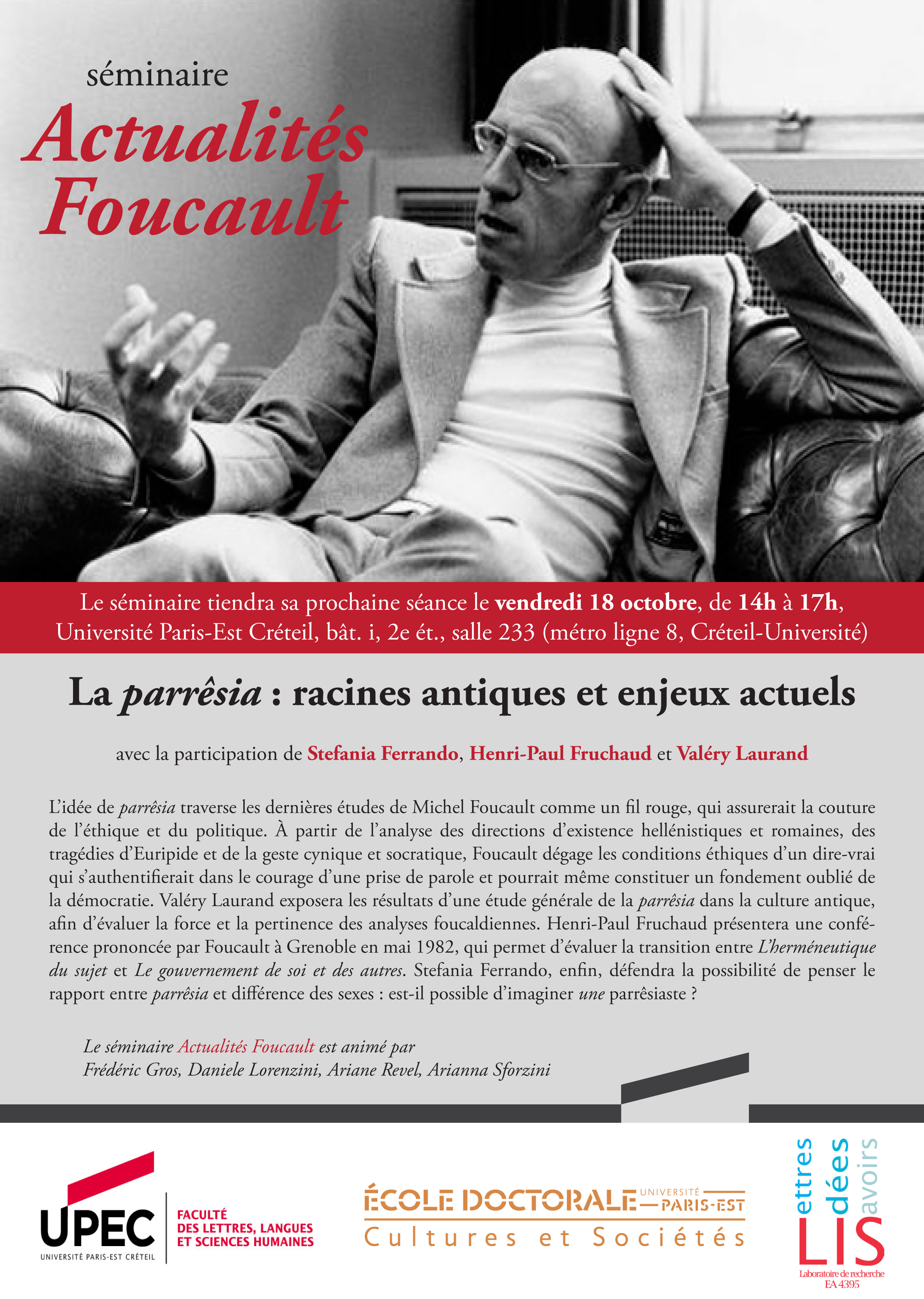
Séminaire Actualités Foucault s2

Séminaire « Actualités Foucault »

animé par Frédéric Gros, Daniele Lorenzini, Ariane Revel, Arianna Sforzini

Université Paris-Est Créteil, EA 4395 LIS « Lettres, Idées, Savoirs »

PDF

Présentation du séminaire :

L’objectif de ce séminaire est de rassembler régulièrement tous ceux qui travaillent sur ou à partir de la pensée de Michel Foucault, et de créer un espace de débats et d’échanges autour d’une œuvre foisonnante dont la perception se renouvelle fortement et rapidement, grâce à des publications toujours plus nombreuses.

Il s’agira à chaque fois de présenter une actualité triple. Actualité académique : les étudiants travaillant actuellement sur ou à partir de Foucault (masters, doctorats, projets d’articles ou de livre) pourront exposer leur recherche. Actualité critique : on rendra compte des ouvrages ou articles importants parus dernièrement (parfois en présence de l’auteur). Actualité éditoriale : présentation à la fois des inédits de Foucault récemment publiés (conférences, articles, entretiens, cours au Collège de France), mais aussi présentation de travaux d’édition de nouveaux textes de Foucault à paraître. Nous profiterons de cet espace également pour annoncer les plus importantes manifestations foucaldiennes prévues.

Nous tâcherons enfin de mettre les concepts foucaldiens à l’épreuve des grandes mutations (techniques, politiques, éthiques) contemporaines, pour rester fidèles à l’injonction de diagnostic de notre présent.

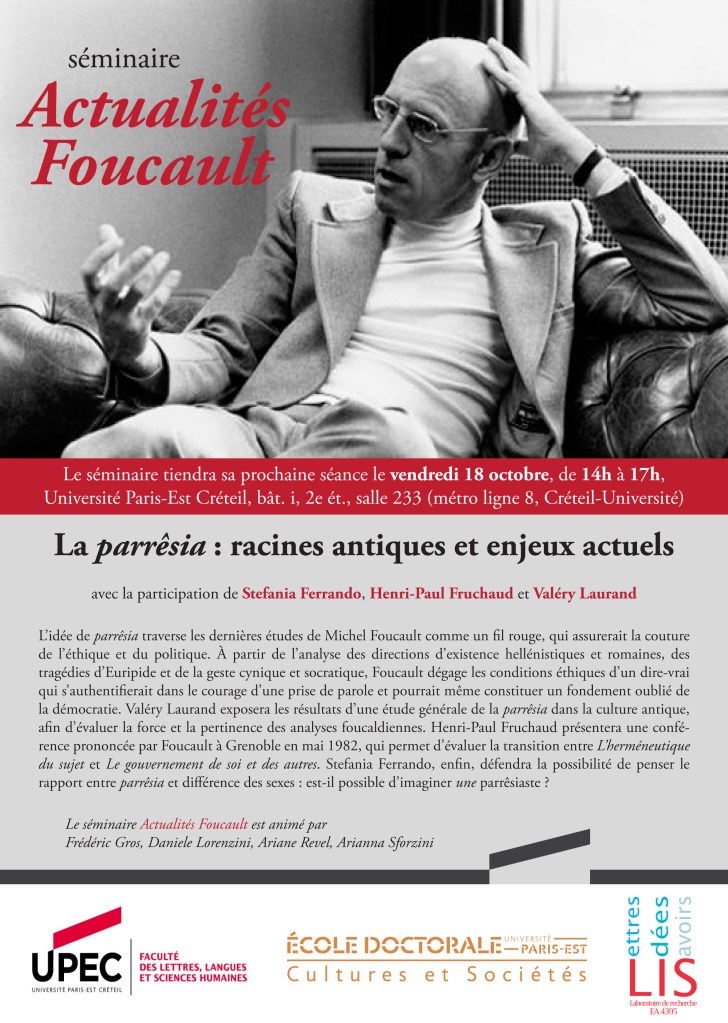
Prochaine séance :

« La parrêsia : racines antiques et enjeux actuels »

avec la participation de Stefania Ferrando, Henri-Paul Fruchaud et Valéry Laurand

Vendredi 18 octobre 2013, 14h-17h

Université Paris-Est Créteil, bâtiment i, 2e étage, salle 233 (métro ligne 8, Créteil-Université)

L’idée de parrêsia traverse les dernières études de Michel Foucault comme un fil rouge, qui assurerait la couture de l’éthique et du politique. À partir de l’analyse des directions d’existence hellénistiques et romaines, des tragédies d’Euripide et de la geste cynique et socratique, Foucault dégage les conditions éthiques d’un dire-vrai qui s’authentifierait dans le courage d’une prise de parole et pourrait même constituer un fondement oublié de la démocratie. Valéry Laurand exposera les résultats d’une étude générale de la parrêsia dans la culture antique, afin d’évaluer la force et la pertinence des analyses foucaldiennes. Henri-Paul Fruchaud présentera une conférence prononcée par Foucault à Grenoble en mai 1982, qui permet d’évaluer la transition entre L’herméneutique du sujet et Le gouvernement de soi et des autres. Stefania Ferrando, enfin, défendra la possibilité de penser le rapport entre parrêsia et différence des sexes : est-il possible d’imaginer une parrêsiaste ?

Calendrier du séminaire 2013-2014 :

Vendredi 18 octobre 2013

Vendredi 13 décembre 2013

Vendredi 24 janvier 2014

Mercredi 12 février 2014

Mercredi 5 mars 2014

Mercredi 2 avril 2014

Les séances se tiendront toujours à l’Université Paris-Est Créteil, de 14h à 17h.

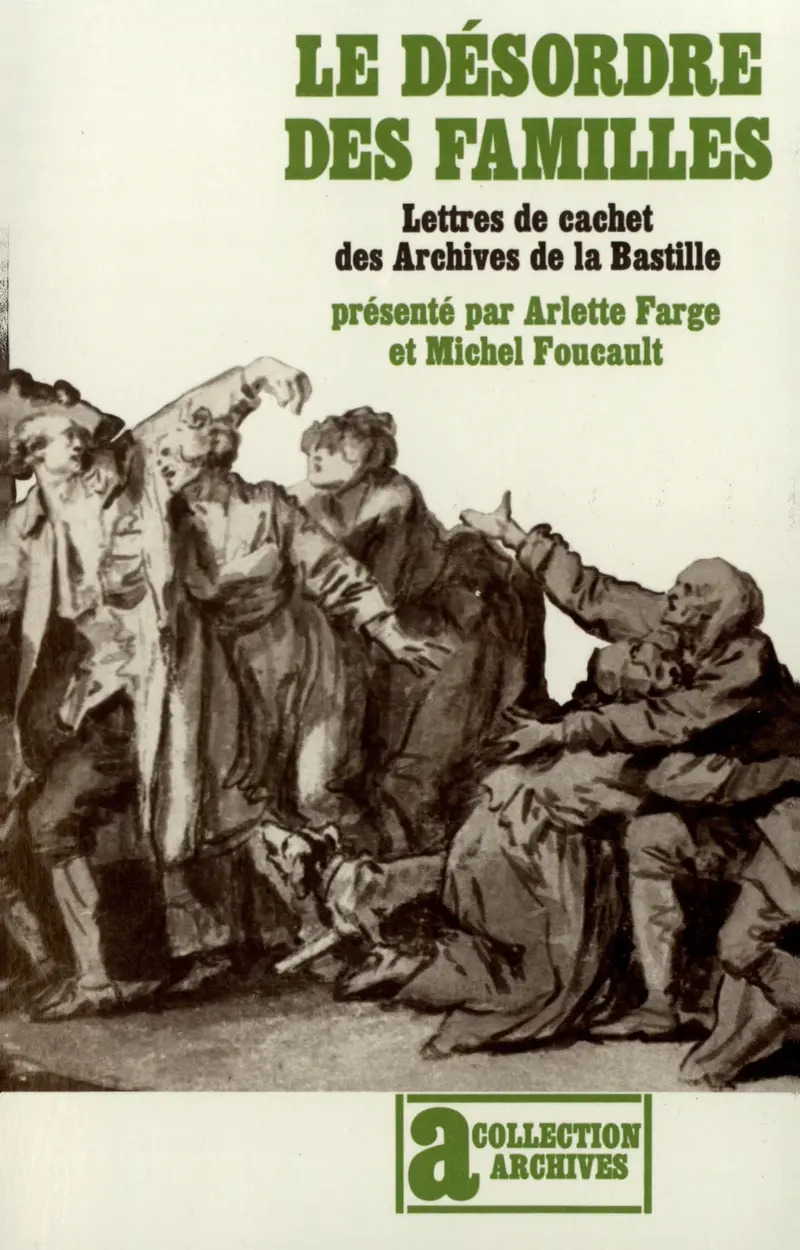
Arlette Farge, Michel Foucault, Le Désordre des familles. Lettres de cachet des Archives de la Bastille au XVIIIe siècle, Collection Archives (n° 91), Gallimard, Parution : 02-11-1982

A useful review by Jean-Yves Alt published 1 Septembre 2018 can be found at Culture et questions qui font débat