Foucault News

News and resources on French thinker Michel Foucault (1926-1984)

Barry Smart, Foucault, Marxism and Critique, Routledge – 1983 Reissued 2013

In this work, originally released in 1983, Barry Smart examines the relevance of Foucault’s work for developing an understanding of those issues which lie beyond the limits of Marxist theory and analysis – issues such as ‘individualising’ forms of power, power-knowledge relations, the rise of ‘the social’, and the associated socialisation of politics. He argues that there exist clear and substantial differences between Foucault’s genealogical analysis and that of Marxist theory. Smart thus presents Foucault’s work as a new form of critical theory, whose object is a critical analysis of rationalities, and of how relations of power are rationalised.

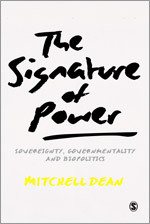
dean Mitchell Dean, The Signature of Power: Sovereignty, Governmentality and Biopolitics, SAGE, September 2013

Publisher’s page

Description
Mitchell Dean revitalized the study of ‘governmentality’ with his bestselling book of the same title. His new book on power is a landmark work. It combines an extraordinary breadth of perspective with pinpoint accuracy about what power means for us today. For students it provides sharp readings of the main approaches in the field. On this level, it operates as a foundational work in the study of power. It builds on this to reframe the concept of power, offering original and exceptionally fruitful reading. It throws new light onto the importance of biopolitics, sovereignty and governmentality. Mitchell Dean has established himself as a master of governmentality. This new book will do the same for how we conceptualize and use power.

Mitchell Dean is Professor of Public Governance at Copenhagen Business School, Denmark and Professor of Sociology at the University of Newcastle, Australia.

Contents

Introducing the Signature of Power
The Shadow of the Sovereign
Economies of Power
The Prince and the Population
Enemy Secrets
Secular Orders
Reign and Government
Glorious Acclaim
Conclusion

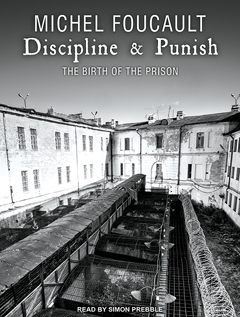
DisciplinePunish Michel Foucault, Discipline & Punish: The Birth of the Prison
Narrated by Simon Prebble

Tantor Audio Books

Publication Date: 09/23/2013 Running Time: 13 hrs 8 min

Editorial comment: This ebook seems to be subject to stringent copyright zone restrictions (available in the US, but not in some other countries). A customer comment on Amazon indicated that it is an abridged version as well.

Synopsis

In this brilliant work, the most influential philosopher since Sartre suggests that such vaunted reforms as the abolition of torture and the emergence of the modern penitentiary have merely shifted the focus of punishment from the prisoner’s body to his soul.

Summary

Two hundred and fifty years ago, a man condemned of attempting to assassinate the King of France was drawn and quartered in a grisly spectacle that suggested an unmediated duel between the violence of the criminal and the violence of the state. This groundbreaking book by Michel Foucault, the most influential philosopher since Sartre, compels us to reevaluate our assumptions about all the ensuing reforms in the penal institutions of the West. For as Foucault examines innovations that range from the abolition of torture to the institution of forced labor and the appearance of the modern penitentiary, he suggests that punishment has shifted its focus from the prisoner’s body to his soul—and that our very concern with rehabilitation encourages and refines criminal activity.

Lucidly reasoned and deftly marshaling a vast body of research, Discipline and Punish is a genuinely revolutionary book, whose implications extend beyond the prison to the minute power relations of our society.

Source: Variazioni Foucaultiane

Peter Johnson, The Geographies of Heterotopia, Geography Compass, Volume 7, Issue 11, November 2013. pp.790–803
https://doi.org/10.1111/gec3.12079

Abstract
This article explores the ongoing fascination with Foucault’s brief and rather sketchy idea of heterotopia. Drawing out some key lessons from the most sustained interpretations of this curious spatio-temporal concept, it addresses weaknesses and potential contradictions and goes on to highlight trends and emerging themes in studies that incorporate the notion. The article argues that although the uses of Foucault’s accounts of heterotopia are bewilderingly diverse, heterotopias are most productively understood in the context of Foucault’s insistence on ‘making difference’ and their adoption as a tool of analysis to illuminate the multifaceted features of cultural and social spaces and to invent new ones.

DOI: 10.1111/gec3.12079

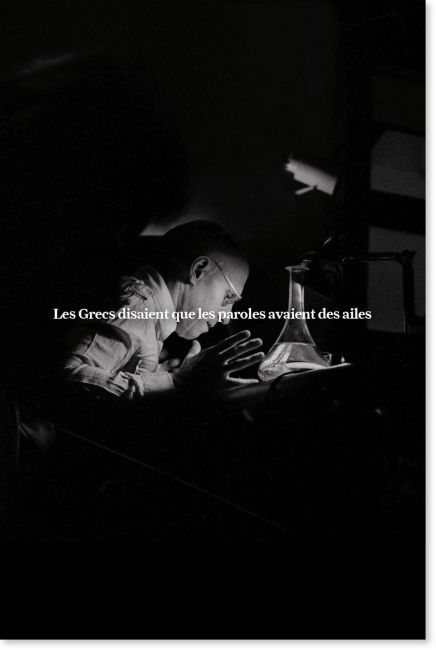
grecs-manuella-editions Michel Foucault. Les Grecs disaient que les paroles avaient des ailes, Manuella Editions, 2013

Présenté sous forme de leporello de huit volets, cet hommage à Michel Foucault est édité à l’initiative du Centre Michel Foucault.

Il est composé d’un texte extrait de l’émission “Le corps et ses doubles” du 28 janvier 1963, de la série radiophonique “L’usage de la parole” produite par Michel Foucault et réalisée avec Jean Doat, et de dix photographies prises par Michèle Bancilhon au cours d’une conférence de Michel Foucault au Collège de France.

Un texte qui, en interrogeant la question du langage du corps et du double, entre en résonnance avec les jeux d’ombre et de lumière des photographies de Michèle Bancilhon qui saisissent Michel Foucault dans sa singulère présence :

“C’est l’horreur de n’avoir ni ombre ni reflet, d’être réduit à une existence absolument blanche, mate, devenue poreuse et comme vidée de sa substance. C’est l’épouvante d’être allégé de mon poids d’ombre intérieure, de cette douce fourrure trouble qui me double au-dedans et au-dehors de moi-même.”

Une production du Centre Michel Foucault

Editions numérotée limitée à 500 exemplaires
Photographies de Michèle Bancilhon
10 reproductions noir et blanc
18 pages
12 x 18 cm
Leporello
Paru en mars 2013
ISBN : 978-2-917217-49-8
15,00 €

Brief review by Foucault News

This lovely individually numbered art edition consists of a cardboard concertina foldout of 10 black and white photographs of Foucault by Michèle Bancilhon on one side and text by Foucault (in French) on the other. Perfect for sitting on your desk or filing cabinet and providing photographic and textual inspiration when you are worn down by neoliberal administrative duties. The book can be ordered directly from the publisher.

Call for Papers in French and English

FROM “SECURITY SOCIETIES” TO (NEO)LIBERALISM

FOUCAULT, THE MODERN INTERNATIONAL AND WORLD POLITICS

Foucault Doctoral Workshop

January 15th-16th, 2014

IMEC, Caen, France

PDF of CFP in French
PDF of CFP in English

The Association for the Centre Michel Foucault with the support of the Fondation de France, organizes a doctoral workshop that will bring together PhD candidates whose work derives from, or who work on Michel Foucault’s work.

As during previous years, the purpose is to connect young scholars in a pleasant and relatively informal way in order to constitute an international research network.

This year, the theme of the Doctoral workshop will be: From ‘security societies’ to ‘(neo)liberalism. Foucault, the modern international and world politics. It will build on a previous session  co- organized with the Instituto de Relações Internacionais, University PUC-Rio (IRI/PUC-Rio, Brazil) on September 25th-27th in Rio de Janeiro.

O V E R A L L    P R E S E N T A T I O N

The relationship between Foucault and the domain of knowledge nowadays associated with the so-called discipline of “International Relations” (IR) is, to say the least, a peculiar one. Between the end of the 1970s and the mid-1990s, the work of Michel Foucault heavily contributed to nourish and substantiate a radical critique of the onto-epistemological assumptions of the  mainstream theories of IR. Such critique has not yet been grounded on the set of works in which Foucault gets the closest to this “domain of knowledge” (we especially refer to the last lessons from the Security, Territory, Population series), but on what a certain Anglo-Saxon tradition had come to characterize as the “first Foucault”.

Such a critique – now particularly associated with the names of R.B.J. Walker, Michael Shapiro, Richard Ashley, William Connolly, Nicholas Onuf, Michael Dillon, David Campbell and James der Derian – found in the Foucault of The Order of Things and The Archaeology of Knowledge the arguments to introduce the necessity to study discursive practices into the study of “international politics”. The theoretical options developed by these authors worked within a pluralist ontology, insisting on multiplicity instead of unity, difference instead of identity, heterogeneity instead of homogeneity.

From an epistemological point of view, the archaeo-genealogical mood that  was progressively being articulated in the “IR discipline” enabled to question the universalistic assumptions of epistemic realism that had, that far, dominated theories of International Relations (Shapiro & Der Derian, 1989; Ashley & Walker, 1990; Der Derian,  1995).  Hence,  it  became possible to shed light upon the historical practices that contributed to the construction of what we have come to call the State, sovereignty, and the International (Bartelson, 1995), and also diplomacy (Der Derian, 1987;  Constantinou,  1996),  foreign  policy  (Campbell,  1998),  or  security (Der Derian, 1993; Dillon, 1996). All of these started being stressed as historical practices made invisible by an unproblematized use of these concepts that, in the discipline, had been able to work as givens (impensés).

Such “critical” literature resulted into a (at least partial) genealogy of the discipline itself (Ashley, 1987; Walker, 1993). Hence, it not only allowed to raise questions about how the study of “international relations” had been historically constituted as a specific domain of knowledge within an academic discipline, but also to highlight how these theories of IR were more an expression of a particular  and  historically  situated  spatial  and  political  imaginary  than  the  explanations  of  world politics they purported to be. The “critical turn” contributed, therefore, to establish the historically contingent character of the discipline itself.

Hadn’t Michel Foucault initiated this very task in his lessons on March 22nd and 29th 1978 at the Collège de France in the Security, Territory, Population series while discussing the idea of Europe as it emerged at the turn of the XVIIIth  Century, and suggesting the transition from the right of the sovereign to a “physics of States”? In doing so, hadn’t Foucault  paved  the  way  for  an authentic archaeo-genealogy of the discipline of IR in which the idea of a “balance of power” have played  such  a  crucial role?  Why  doesn’t  Foucault  ever  refer  to  IR theory?  Such  questions  are further underlined by the fact that it is difficult to imagine that Foucault ignored this domain of knowledge that, despite having been instituted mainly outside of France, counts with intellectuals such as Raymond Aron and Pierre Hassner, who were already considered as the two main French names in the study of “international relations”.

In return, these questions call attention to those who, today, in IR, repeatedly evoke concepts such as governmentality and biopolitics without ever (to our knowledge) referring to these two lessons. At the time of the “critical turn”, Security, Territory, Population wasn’t available, either in French or in English. Only some recordings of Foucault’s lectures have circulated among restricted circles. Hence, it is of no surprise that no one had interrogated Michel Foucault’s strange silence on the theories of “international relations’. However, this is no longer the case, now  that  Security, Territory, Population has been available in French for almost ten years, and in English for almost seven.

Taking these considerations as a starting point, the participants of this doctoral workshop propose to (1) interrogate this relation of mutual ignorance; (2) work towards a genealogy of the discipline of International Relations; (3) explore how the works of Foucault on security, liberalism, and, more importantly, the art of governing, can help to think in novel ways what the theories of International Relations have progressively come to build as their object  of  study:  “international politics” and the role of the state within it.

M O  D  A  L  I  T  I  E  S     O  F     P A  R T  I  C I  P A  T  I  O  N

The doctoral workshop will take place on January 15th and 16th 2014 at IMEC, in the Abbaye d’Ardenne close to Caen (with a departure from Paris early morning on the 15th  and a return in Paris early evening on the 16th). Both English and French will be  used  during  the workshop.

On-site housing and catering costs as well as return train tickets Paris/Caen will be paid for by the Association pour le Centre Michel Foucault.

In order for discussions to be the most fruitful possible and because housing capacities are limited at the Abbey, the number of participants has been set to 10, which will inevitably imply a selection of applicants.

PhD students who participated to the workshops the previous years are welcome to submit, but we will consider new applicants in priority, as well as those whose proposals had not been selected for the previous encounters.

Proposals (one page at most), focusing either on a particular question of your PhD work or on a specific methodological issue, should be sent either in French or in English before December 15th, 2013. A response will be given before December 22nd and  preliminary  program  will circulate on December 30th.

Please do not hesitate to contact us for any question or for further information:  Philippe Bonditti: philippe.bonditti@gmail.com; Luca Paltrinieri: l.paltrinieri@gmail.com

With our very best wishes,

The Association pour le Centre Michel Foucault

DES « SOCIETES DE SECURITE » AU (NEO-)LIBERALISME

FOUCAULT, L’INTERNATIONAL MODERNE ET LA POLITIQUE MONDIALE

 Ecole doctorale Foucault

15-16 janvier 2014

IMEC, France

L’Association pour le Centre Michel Foucault propose, cette année encore, avec l’aide de la Fondation de France une école doctorale visant à réunir les doctorants travaillant sur, avec et autour de la pensée de Michel Foucault.

Comme les années précédentes, l’objectif est de mettre en relation, le plus agréablement possible et de manière assez informelle, les jeunes chercheurs afin de constituer un réseau de travail international.

Cette année, l’Ecole doctorale portera sur le thème : Des « sociétés de sécurité » au (néo)libéralisme. Foucault, l’international moderne et la politique mondiale. Elle s’inscrira à la suite d’une précédente rencontre doctorale sur le même thème co-organisée avec l’Instituto de Relações Internacionais de l’Université PUC-Rio (IRI/ PUC-Rio) du 25 au 27 septembre 2013 à Rio de Janeiro.

P R O  B L  E  M  A  T  I  Q  U  E

Le rapport de Foucault au domaine de savoir associé à ladite discipline des « relations internationales » (RI) est pour le moins étrange. Entre la fin des années 1970 et le milieu des années 1990, les travaux de Michel Foucault ont en effet largement nourri une critique radicale des présupposés onto-épistémologiques des principales théories des RI. Ce n’est pourtant pas dans les travaux de Foucault qui s’approchent le plus de ce « domaine de savoir » (nous pensons notamment aux derniers cours de la série Sécurité, Territoire, Population) que la critique est allée puiser, mais dans le Foucault des « early years » comme aime à le catégoriser une  certaine  tradition  anglo- saxonne.

Cette critique – aujourd’hui plus particulièrement associée aux noms de RBJ  Walker,  Michael Shapiro, Rick Ashley, William Connolly, Nicholas Onuf, Michael Dillon, David Campbell ou James Der Derian s’inspire de Foucault pour, notamment, faire surgir l’étude des pratiques discursives dans celle des « relations internationales ». Les options théoriques développées par ces  auteurs fonctionnaient alors à l’intérieur d’une ontologie pluraliste insistant sur la multiplicité plutôt que sur l’unité, la différence plutôt que l’identité, l’hétérogénéité plutôt que l’homogénéité.

D’un point de vue épistémologique, l’humeur archéo-généalogique qui se déploie progressivement dans ladite discipline des RI a permis de contester les présomptions universalistes du réalisme épistémique qui dominait alors les théories des RI (Shapiro & Der Derian, 1989, Ashley/Walker, 1990, Der Derian, 1995). Elle a ainsi permis de porter l’attention sur les pratiques historiques ayant contribué à la construction de ce que nous en sommes venus a appeler l’Etat, la souveraineté, l’international (Bartelson, 1995), mais aussi la diplomatie (Der Derian,  1987, Constantinou, 1996), la politique étrangère (Campbell, 1998) ou la sécurité (Der Derian, 1993, Dillon, 1996). Des pratiques historiques invisibilisées par un usage non-problématique de ces notions qui, dans la « discipline des RI », en étaient venues à fonctionner comme des impensés.

Cette littérature « critique » a notamment impliqué une généalogie, au moins partielle, de la discipline elle-même (Ashley, 1987, Walker, 1993) qui n’a pas seulement permis de poser la question de savoir comment l’étude des « relations internationales » s’était historiquement constituée en domaine particulier de savoir, mais aussi de mettre en évidence la manière dont les théories des relations internationales étaient bien davantage les expressions d’un imaginaire spatial et politique particulier et historiquement situé que les explications de la politique mondiale qu’elles prétendaient être. Ainsi le « tournant critique » a-t-il contribué à poser le caractère historiquement contingent de la discipline elle-même.

Cette tâche, Michel Foucault ne l’avait pas lui-même initiée dans les cours des 22 et 29 mars 1978 de la série Sécurité, Territoire, Population, lorsque, discutant l’idée d’Europe telle qu’elle surgit au tournant du XVIIIe siècle, il évoque le passage d’un « droit des souverains » à une « physique des Etats » ? Ce faisant, n’a-t-il pas posé les bases d’une véritable archéo-généalogie des RI à l’intérieur desquelles la notion d’« équilibre des puissances » (Balance of power) a joué un rôle si central ? Mais alors, pourquoi Foucault ne fait-il dès lors aucune référence à la théorie des RI ? La question se pose tant il est difficile de concevoir qu’il n’ait pas eu connaissance de cette région de savoir qui, si elle s’est principalement imposée hors de France, n’en comptait pas moins parmi ses représentants des intellectuels aussi éminents que Raymond Aron et Pierre Hassner, déjà reconnus comme les deux principales figures françaises de l’étude des « relations internationales ».

Cette série d’interrogations se retourne immédiatement vers ceux qui, aujourd’hui, dans la discipline des relations internationales, usent abondamment des  notions  de  gouvernementalité  et  de biopolitique sans jamais (à notre connaissance) évoquer ces deux cours. A l’époque du « tournant critique », la série Sécurité, Territoire, Population n’est pas encore disponible, ni en Français, ni en anglais. Seuls circulent quelques enregistrements des cours de Foucault. Et l’on ne s’étonnera donc guère que personne ne se soit interrogé sur cet étrange silence de Michel Foucault à propos des « théories des relations internationales ». Mais ce n’est plus le cas aujourd’hui. Sécurité, Territoire, Population est disponible en français depuis presque dix ans, et en anglais depuis bientôt sept ans.

Partant de ce constat, les participants à ce séminaire doctoral se proposent tout à la fois : (1) d’interroger ce rapport d’ignorance réciproque ; (2) de travailler à une généalogie de la discipline des « relations internationales » ; (3) d’explorer la manière dont les travaux de Michel Foucault sur la sécurité, le libéralisme et, plus largement, sur l’art de gouverner peuvent aujourd’hui aider à penser de manière autre ce que les théories des relations internationales se sont progressivement données comme leur principale objet d’étude: la « politique internationale » et, en son sein, le rôle de l’Etat.

M O  D  A  L  I  T  E  S     D  E     P A  R T  I  C  I  P A  T  I  O  N

La rencontre doctorale aura lieu les 15 et 16 janvier 2014 à l’IMEC, dans l’abbaye d’Ardenne à Caen avec un départ de Paris prévu le 15 tôt le matin et un retour sur Paris le 16 en début de soirée. Les langues de travail seront le Français et l’Anglais.

Les frais de séjour sur place et les billets Paris-Caen-Paris sont pris en charge par l’Association pour le Centre Michel Foucault.

Pour que les échanges soient le plus féconds possibles – et compte tenu des capacités d’accueil de l’abbaye – le nombre de participants est limité à 10, ce qui impliquera nécessairement un choix de notre part.

Les doctorants ayant participé aux journées les années passées pourront bien entendu décider de soumettre une proposition pour ces nouvelles rencontres doctorales. Priorité sera toutefois donnée aux nouveaux intervenants et à ceux dont les propositions n’avaient pu être retenues les années précédentes.

Les propositions d’intervention (une page maximum), portant soit sur une question particulière de votre travail de thèse, soit sur un problème méthodologique précis, devront nous être envoyées, en français ou en anglais, avant le 15 décembre 2013. Une réponse sera donnée au plus tard le 22 décembre et un programme préliminaire sera mis en circulation au plus tard le 30 décembre.

N’hésitez pas à nous contacter pour toutes demandes d’informations complémentaires : Philippe Bonditti : philippe.bonditti@gmail.com; Luca Paltrinieri : l.paltrinieri@gmail.com

Très cordialement,

L’Association pour le Centre Michel Foucault

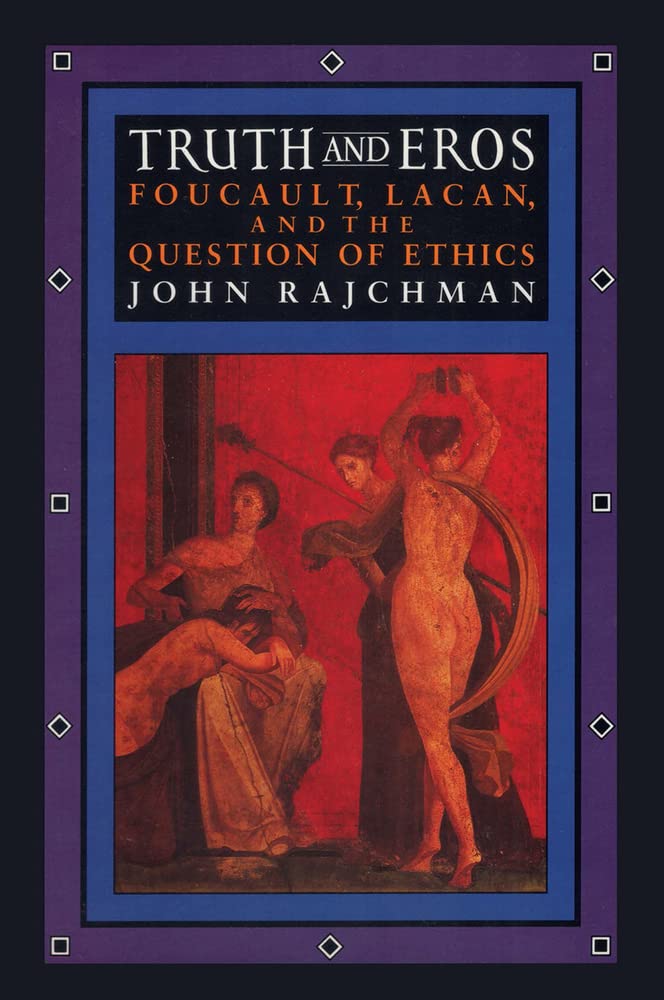
John Rajchman, Truth and Eros Foucault, Lacan and the question of ethics. Routledge, 1991. Reissued 2013

In this reissused work, first published in 1991, John Rajchman isolates the question of ethics in the work of Foucault and Lacan and explores its ramifications and implications for the present day. He demonstrates that the question of ethics was at once the most difficult and the most intimate question for these two authors, offering a complex point of intersection between them. As such, he argues that it belongs to the great tradition that is concerned with the passion or eros of philosophy and of its “will to truth”.

Truth and Eros suggests a way of reading Foucault and Lacan as philosophers who re-eroticised the activity of thought in our time, opening new and different spaces for thought and action – new types of subjectivity.

Foucault-Origine-Couv

Michel Foucault, L’origine de l’herméneutique de soi. Conférences prononcées à Dartmouth College, 1980, Paris, Vrin, coll. « Philosophie du présent / Foucault inédit », 2013 (168 pages, ISBN 978-2-7116-2509-3, 14€).

Édition établie par Henri-Paul Fruchaud et Daniele Lorenzini.
Introduction et apparat critique par L. Cremonesi, A.I. Davidson, O. Irrera, D. Lorenzini, M. Tazzioli.

En novembre 1980, Michel Foucault prononce en anglais, à Dartmouth College, deux conférences intitulées Truth and Subjectivity et Christianity and Confession. Dans ces conférences, à travers l’étude des techniques de soi, et notamment de l’examen de conscience et de l’aveu, dans l’Antiquité gréco-romaine et le christianisme primitif, Foucault retrace la généalogie du sujet moderne et de l’herméneutique de soi qui nous caractérise encore aujourd’hui.

Cette édition présente pour la première fois la traduction française des conférences de Dartmouth College, avec les variantes de la version prononcée par Foucault le mois précédent à l’Université de Californie à Berkeley. Elle présente également deux interventions inédites, contemporaines de ces conférences : un débat public qui s’est tenu à Berkeley et une interview, où Foucault répond à des questions sur ses recherches et est amené à préciser quelles sont les valeurs qui guident son travail.

L’origine de l’herméneutique de soi est le premier d’une série de volumes qui seront publiés chez Vrin dans la nouvelle collection « Philosophie du présent », dirigée par Jean-François Braunstein, Arnold I. Davidson et Daniele Lorenzini, et qui recueilleront des textes, des conférences, des débats publics et des entretiens de Michel Foucault encore inédits en français, mais aussi parfois inédits au sens propre.

Summary in English
In November 1980, at Dartmouth College, Michel Foucault pronounces two lectures in English: Truth and Subjectivity and Christianity and Confession. In these lectures, through the study of some techniques of the self, namely examination of conscience and avowal (aveu), in Greco-Roman Antiquity and Early Christianity, Foucault retraces the genealogy of the modern subject and of the hermeneutics of the self that still characterizes our contemporary Western societies.

This edition offers for the first time the French translation of the Dartmouth College lectures, together with the variants of the version of these same lectures pronounced by Foucault the previous month at the University of California, Berkeley. In addition, it offers also two unpublished interventions, contemporary with these lectures: a public debate held in Berkeley and an interview, where Foucault answers to some questions about his researches and is pushed to clarify the values that govern his work.

L’origine de l’herméneutique de soi is the first of a series of books with still unpublished texts, conferences, public debates and interviews by Michel Foucault that are going to be published by Vrin in the new collection « Philosophie du présent » (edited by Jean-François Braunstein, Arnold I. Davidson and Daniele Lorenzini).

Communiqué de presse
Collège International de Philosophie
1, rue Descartes F – 75005 Paris

Diogo Sardinha
élu Président de l’Assemblée collégiale du Collège International de Philosophie

Le Collège International de Philosophie a élu à la fin du mois de septembre le nouveau président de son Assemblée collégiale pour un mandat de 3 ans : Diogo Sardinha, 42 ans, de nationalité portugaise, devient le premier philosophe étranger à accéder à cette charge depuis la fondation du Collège en 1983.

Reçu au Collège en 2010 pour une période de six ans, Diogo Sardinha y mène un programme sur « Violence et politique : l’émeute comme forme de mouvement sauvage ». Il part de l’actualité des émeutes urbaines depuis 2005, pour réfléchir philosophiquement aux discours et catégorisations que suscitent ces événements.

La philosophe suisse Marie-Claire Caloz-Tschopp, professeure émérite de l’Université de Genève, occupe le poste de vice-présidente. Avec une large expérience des relations internationales et une œuvre particulièrement attentive aux thèmes de l’exil et de la citoyenneté, elle renforce l’ouverture au monde qui marque cette nouvelle étape de la vie de l’institution.

Également directrice de programme depuis 2010, Marie-Claire Caloz-Tschopp travaille sur « Exil, création philosophique et politique : repenser l’exil dans la citoyenneté contemporaine ». Ses recherches se situent sur le terrain de la migration, en coopération étroite avec des professionnels de la santé, du social, du droit et du service public, mais aussi avec des migrants exilés et des exilés du monde du travail et de l’appartenance politique au sens large.

La confiance manifestée en ce « tandem » par les membres de l’Assemblée collégiale, avec 63% des voix dès le premier tour, est l’illustration la plus récente de l’ouverture grandissante du Collège à l’international, qu’on constate depuis plusieurs années par l’augmentation du nombre des directeurs et directrices de programme formés (aussi) dans d’autres pays. Actuellement, 30% des membres du Collège, soit quinze sur cinquante, dirigent des programmes hors de France, établissant ou renforçant des liens privilégiés avec leurs pays de résidence ou de vie (Allemagne , Brésil , Canada, Chine, États-Unis, Italie, Japon, Portugal, Royaume-Uni et Suisse).

À eux s’ajoutent des directeurs de programme qui, basés en France, travaillent sur d’autres parties du globe, du Maghreb et du pourtour méditerranéen à l’Amérique Latine. Le Collège tirera parti de cette richesse pour renforcer son rayonnement, montrant que la philosophie française n’est plus seulement faite à partir des structures de formation, de recherche et d’enseignement traditionnelles, mais elle comprend désormais une myriade de penseurs qui,- n’étant pas nés en France, ont adopté le français comme langue de travail. Simultanément, cette réalité s’oppose au prétendu déclin de la langue française en philosophie.

Actuellement chercheur invité à l’Université de Columbia à New York, Diogo Sardinha a été formé dans les Universités de Lisbonne et de Paris et a mené, pendant les dernières années, des travaux notamment en Allemagne et au Brésil , pays avec lesquels il entretient des liens étroits. Il succède à Mathieu Potte-Bonneville, président de 2010 à 2013. Fondé par François Châtelet, Jacques Derrida , Jean-Pierre Faye et Dominique Lecourt, le Collège a fêté son trentième anniversaire en juin dernier.

Information in English
[Editor: Updated 16 April 2026 to page archived on the Wayback Machine]

Diogo Sardinha

Diogo Sardinha (ICLS Visiting Scholar July-December 2013) is the Chair of the Collège International de Philosophie in Paris where he also heads the research program “Violence and Politics” (2010-2016). He studied philosophy at Lisbon (B.A. 1997) and at Paris-Nanterre (M.A. 1999, Ph.D 2005) before continuing his research in São Paulo and Berlin. He is a full member of the Center for Philosophy of Science of the University of Lisbon. His main books are Order and Time in Foucault’s Philosophy (in French, 2011), and The Emancipation from Kant to Deleuze (in French, 2013). His research project at the ICLS is entitled “Anthropology After The ‘End of Man’: Kant, Foucault, and the contemporary renewal of the reflection on human being”.

Nicolas Thirion, Des rapports entre droit et vérité selon Foucault : une illustration des interactions entre les pratiques juridiques et leur environnement, Revue interdisciplinaire d’études juridiques, 2013/1 (Volume 70), 180-88.

Further info and PDF for download

Abstract
La contribution est consacrée à la présentation synthétique de deux ouvrages récemment parus transcrivant la parole délivrée par Michel Foucault dans le cadre d’un cours au Collège de France, d’une part , et d’une chaire Francqui au titre international à l’Université Catholique de Louvain, d’autre part , qui sont l’occasion de reprendre, sous un angle différent, un problème que le philosophe français avait déjà abordé plus tôt dans les années 1970 : celui des rapports entre les modes de production de la vérité et le droit.