Foucault News

News and resources on French thinker Michel Foucault (1926-1984)

allen Amy Allen, The Politics of Our Selves: Power, Autonomy, and Gender in Contemporary Critical Theory, Columbia University Press, 2007.

This has just been newly published in paperback.

Publisher’s page

  • Draws on the work of Michel Foucault, Jurgen Habermas, Judith Butler, Seyla Benhabib, and others
  •    The book is both an analysis of power and an account of autonomy
  • Up to now, most critical theorists have assumed that these two aspects of the politics of the self are incompatible with one another
  • develops a theoretical framework that illuminates how the self can both be constituted by power and at the same time capable of being autonomously self-constituting.

Some theorists understand the self as constituted by power relations, while others insist upon the self’s autonomous capacities for critical reflection and deliberate self-transformation. All too often, these understandings of the self are assumed to be incompatible. Amy Allen, however, argues that the capacity for autonomy is rooted in the very power relations that constitute the self. Her theoretical framework illuminates both aspects of what she calls, following Foucault, the “politics of our selves.” It analyzes power in all its depth and complexity, including the complicated phenomenon of subjection, without giving up on the ideal of autonomy. Drawing on original and critical readings of a diverse group of theorists, Allen shows how the self can be both constituted by power and capable of an autonomous self-constitution.

“Persuasive and well-reasoned”—J. Jeremy Wisnewski, Notre Dame Philosophical Reviews

“This admirable book provides incredibly clear and lucid readings of texts that students find notoriously difficult . . . Highly recommended.”—Choice

“Nuanced and careful readings of Foucault, Butler, Habermas and Benhabib.”
—Margaret A. McLaren, Foucault Studies

“A pathbreaking and elegantly argued book.”—Jana Sawicki, PhiloSOPHIA

““[A] tour de force. . . . The Politics of Our Selves forces its reader to think hard, and honestly to think through the implications of the glib stand-off between Foucault and Habermas that stands in for a much more meaningful dialogue that we rarely get to have.”—Cressida Heyes, Philosophy and Social Criticism

Amy Allen is the Parents Distinguished Research Professor in the Humanities and professor of philosophy and women’s and gender studies at Dartmouth College. She is also the author of The Power of Feminist Theory: Domination, Resistance, Solidarity.
f71

Collectif f71

Appel à participation

Le samedi 14 décembre à 11h, réunion d’information à propos des séances de travail avec des amateurs
proposées par le collectif F71 à l’occasion des représentations de Notre corps utopique au Théâtre de la Bastille (Paris 11e)

Information et réservation, Nicolas Transy, 01 43 57 57 17, ntransy@theatre-bastille.com

D’autres séances auront lieu au Théâtre Eurydice à Plaisir (78) en décembre
puis au Collectif 12 à Mantes à Jolie (78) la fin du mois de janvier

Pour plus d’informations, Mélanie Autier, 06 22 13 06 82, production.collectiff71@gmail.com

Création – Notre corps utopique

Les 19 décembre à 14h30 et 20 décembre à 14h30 et 20h30, création du nouveau spectacle du collectif F71,
Notre corps utopique, Théâtre Eurydice, Plaisir (78), avec le soutien de la Ferme de Bel Ebat, Guyancourt (78)

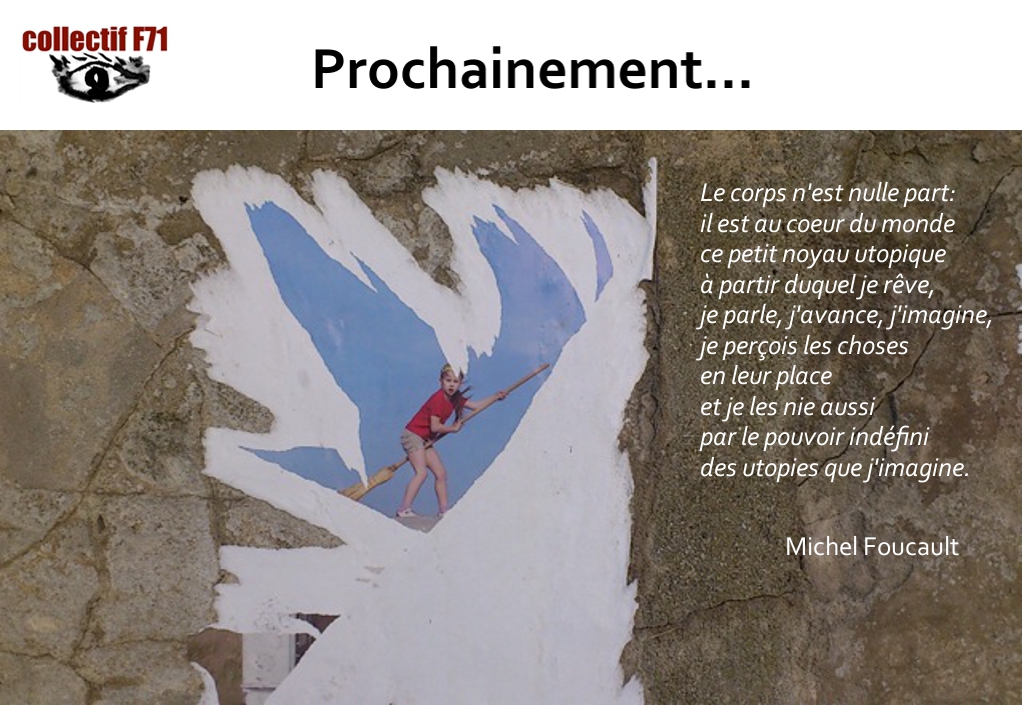
Dans une conférence radiophonique donnée en 1966, Michel Foucault arpente le corps comme un territoire.
Espace a priori limité, personnel, imposé à chacun mais territoire que nous partageons en commun, sujet et objet de notre imaginaire. Comment s’emparer collectivement de ce corps utopique, lieu de tous les possibles ?

Pour en savoir plus, visitez cette page ou celle-ci ou encore celle-là
Réservations, 01 30 55 50 05, eurydice@seay.asso.fr

A venir en 2013-2014

Du 7 au 22 janvier à 19h30, les Dimanche à 15h, Notre corps utopique, Théâtre de la Bastille, Paris (75)
(Relâche les 9, 13, 14 et 20 janvier)

Les 24 et 25 janvier à 20h30, Notre corps utopique, Collectif 12, Mantes la Jolie (78)

Les 27 et 29 mars à 19h00 et le 28 mars à 20h30, Foucault 71, Théâtre La Grange de Dorigny – Université de Lausanne (CH)

Pour en savoir plus, visitez cette page

Pendaison de crémaillère

Depuis quelques jours, le collectif F71 a  installé ses nouveaux bureaux au collectif La Blanchisserie à Ivry-sur-Seine!

Pour découvrir le projet, c’est ici

Contact

Mélanie Autier, 06 22 13 06 82, production.collectiff71@gmail.com
Rejoignez-nous sur notre page facebook, ici

www.collectiff71.com

Bath, C. Conceptualising listening to young children as an ethic of care in early childhood education and care (2013) Children and Society, 27 (5), pp. 361-371.

Further info

Abstract
This paper focuses on recent discourses and practices of listening to young children, in order to highlight listening as an ethical practice in early childhood education and care settings. The paper asks how discourses of listening should be viewed in theoretical terms and explores the work of a diverse range of authors who define autonomy and rights issues as relational. Central to the paper is a consideration of feminist critique of Foucault’s ethics of care argument. To contextualise this, the paper discusses examples of recent research in the field of listening to young children and highlights issues facing the status of the early years workforce. In summary, the paper contends that an ethical view of listening can bring adults and children together in democratic care practices which challenge conceptions of childhood and reconnect ideas of care and education.

Author Keywords
Childcare; Early years; Education; Ethics; Participation

DOI: 10.1111/j.1099-0860.2011.00407.x

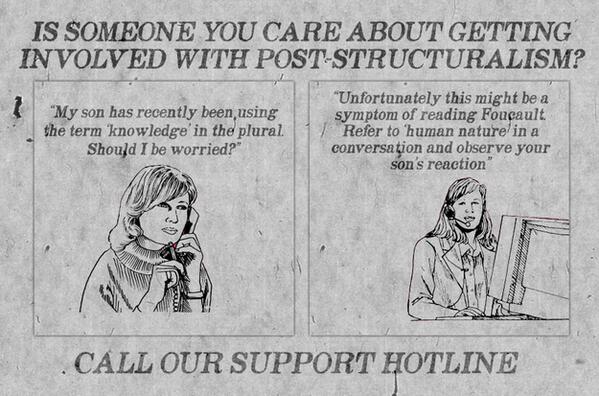
structuralism

This strip was created by David and appears on his blog Hugging the Horse

Update October 2025: The link above is to the the archived page on the Internet Archive Wayback Machine.

With thanks to Dirk Felleman for this item and also to Philippe Theophanidis for alerting me to the original source

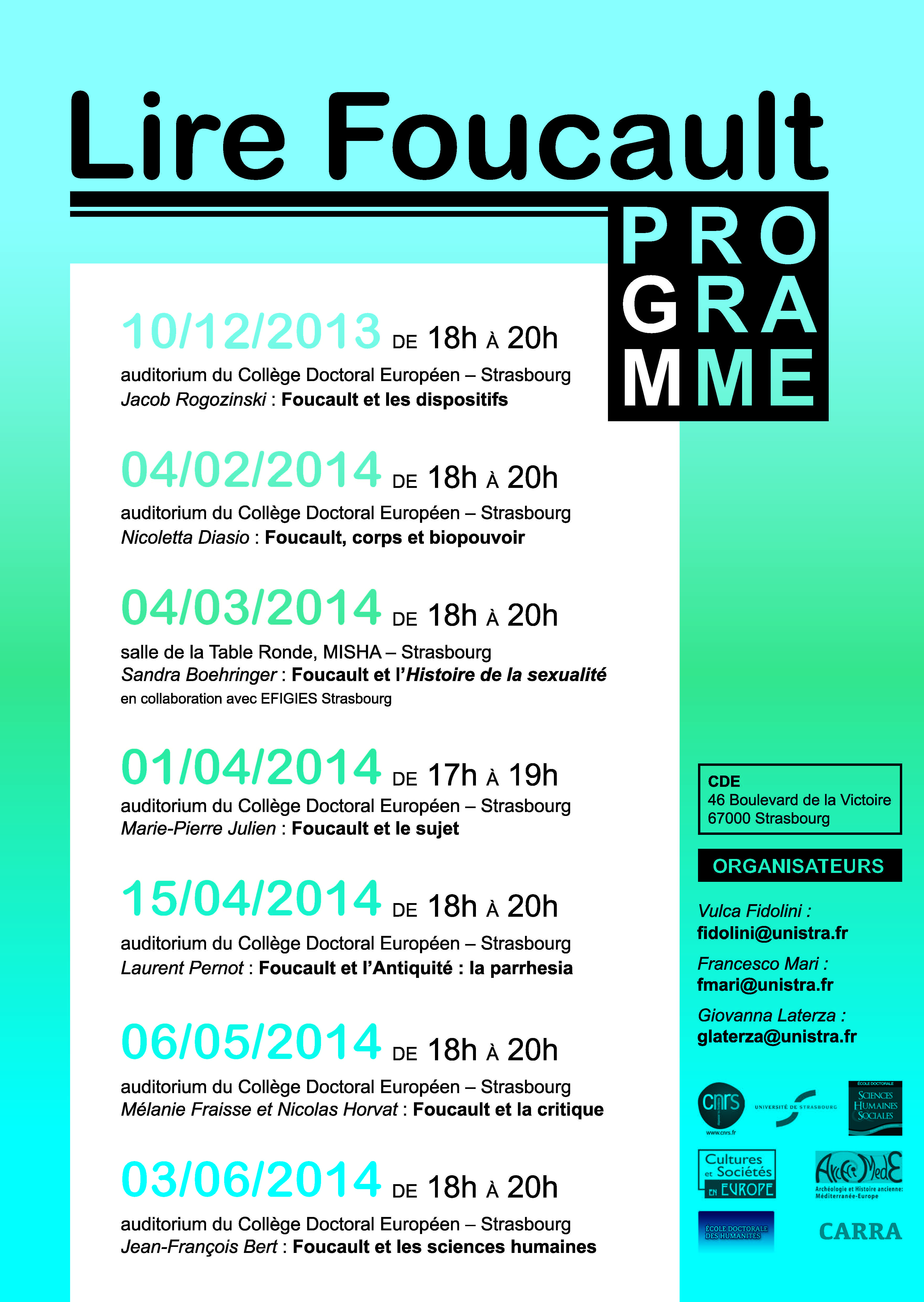
PDF of flyer

LireFoucaultProgramme

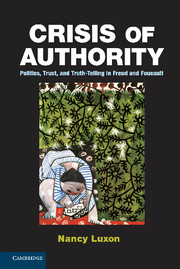
luxon Nancy Luxon, Crisis of Authority. Politics, Trust, and Truth-Telling in Freud and Foucault, Cambridge University Press, 2013

isbn: 9781107038738

Publisher’s page

Description
Contemporary social and political theory has reached an impasse about a problem that had once seemed straightforward: how can individuals make ethical judgments about power and politics? Crisis of Authority analyzes the practices that bind authority, trust, and truthfulness in contemporary theory and politics. Drawing on newly available archival materials, Nancy Luxon locates two models for such practices in Sigmund Freud’s writings on psychoanalytic technique and Michel Foucault’s unpublished lectures on the ancient ethical practices of “fearless speech,” or parrhesia. Luxon argues that the dynamics provoked by the figures of psychoanalyst and truth-teller are central to this process. Her account offers a more supple understanding of the modern ethical subject and new insights into political authority and authorship.

Offers a novel reading of Freud and Foucault alongside, rather than against, one another
Recovers resources for ethical and political agency
Draws on newly available archival materials

Shira Wolosky, Foucault at School: Discipline, Education and Agency in Harry Potter, Children’s Literature in Education, 45, 285–297 (2014)
https://doi.org/10.1007/s10583-013-9215-6

Abstract
The formative power of children’s literature is both great and suspicious. As a resource of socialization, the construction and experience of children’s literature can be seen as modes of disciplinary coercion such as Michel Foucault has anatomized. Harry Potter, as a “craze” phenomenon, has attracted particular controversy due to its intense commercialization and dissemination, raising questions about its socializing roles. Here I argue that Harry Potter itself addresses, represents, and reflects on socializing disciplines as both psychological and socio-historical processes, with special focus on and implications for educational scenes and methods. Discipline is shown to be inevitable and necessary, but not only in the coercive ways of Foucault. It is no less important for constructing the self in positive senses. Hogwarts, as the central site of action, becomes a stage for a wide variety of educational models and disciplinary modes and goals. These range from Dolores Umbridge, whose classroom is coercively disciplinary in full Foucauldian sense; through Snape’s abuses of power, Albus Dumbledore’s modelling of educational and moral values, and Harry’s own role as student-teacher exemplifying educational principles which Jerome Bruner and others have called a “community of learning.” This variety of educational experiences explores the possibilities through which discipline emerges not only as coercive, but also as formative in ways that are maturing, strengthening, and rewarding: a possibility with strong implications for questions of socialization and creativity in general. Harry Potter concludes with a reconstitution of self and society, in a way that endorses discipline even as it suspects its coercive abuses. This becomes not only a personal project but an explicitly social and political one, requiring both critique and investment in culture. Socialization then is shown to be a process of formation that is not merely coercive but creative.


Shira Wolosky
received her Ph.D. from Princeton University and was Associate Professor of English at Yale before moving to the Hebrew University of Jerusalem. Her books include Emily Dickinson: A Voice of War, Language Mysticism, Poetry and Public Discourse, The Riddles of Harry Potter and Feminist Theory across Disciplines. Her awards include a Guggenheim, ACLS and Fulbright Fellowship, a Fellowship at the Institute of Advanced Studies of Princeton University and a Drue Heinz Visiting Professorship at Oxford University.

Florence Hulak, « Michel Foucault, la philosophie et les sciences humaines : jusqu’où l’histoire peut-elle être foucaldienne ? », Tracés. Revue de Sciences humaines [En ligne], #13 | 2013, mis en ligne le 21 octobre 2013,
https://doi.org/10.4000/traces.5718

Résumé

L’œuvre de Michel Foucault a pu être lue comme inaugurant une pratique révolutionnaire de l’histoire. Toutefois, les historiens qui se sont inspirés de ses travaux n’ont pas poussé jusqu’au bout la transformation de l’écriture de l’histoire qu’impliquait ce modèle. S’il revient à l’historiographie d’examiner les difficultés conjoncturelles qu’a pu connaître la réception de Foucault, cet article se propose d’analyser les obstacles proprement épistémologiques à la pleine introduction de sa pensée en histoire. Il montre que, pour devenir véritablement foucaldienne, l’histoire devrait renoncer à son appartenance aux sciences humaines, c’est-à-dire à la fois à son statut de science, à l’étude du social et à la référence au réel. Le diagnostic que porte Foucault sur les sciences humaines ne saurait en effet épargner l’histoire, même s’il n’a jamais insisté sur ce point, préférant défaire l’ancrage de l’histoire dans les sciences humaines pour mieux l’associer à l’archéologie puis à la généalogie. Mais cette nouvelle alliance prive alors l’histoire de son propre régime de vérité, en la faisant dépendre de celui d’un discours philosophique.

In English

According to some readings, Michel Foucault has invented a revolutionary way to write history. However, even the historians who have drawn from his work have not accomplished the full transformation of their practice that was required by the foucaldian paradigm. While historiography explores the circumstantial reasons for this limited scope, this article focuses on the epistemological obstacles to a full integration of Foucault’s thought in historical works. It shows that a fully foucaldian history could not belong to the human sciences any more, which means it should give up at once its scientific status, the study of the social, and the reference to reality. The diagnosis that Foucault makes on the human sciences does not indeed spare history, even if he never laid emphasis on this point. He prefers to remove history out of the human sciences, so as to connect it better with archeology and then genealogy. Yet this new alliance deprives history of its own regime of truth, and makes it dependent on a philosophical one.

Foucault , Neoliberalism and Global Post-Politics

Canadian Centre for German and European Studies site at the University of Montreal

Les films de l’atelier du CCEAE tenu à Berlin en mai 2012

Vous trouverez ici tous les films réalisés pendant l’atelier sur Foucault qui s’est tenu à Berlin en mai 2012 sur le thème :

Using and Reading Foucault in Europe, Asia, and America

Il s’agissait d’un atelier sponsorisé par :

Deutscher akademischer Austauschdienst (DAAD)
Centre canadien d’études allemandes et européennes (CCEAE)
Centre d’études et de recherches internationales de l’Université de Montréal (CERIUM)
European School of Management and Technology (ESMT)

Mark Duffield

“How Did we Become Unprepared ? From modernist to post-modernist conceptions of disaster”

Didier Bigo

“Security, a Field Left Fallow : towards a governmentality of (un)freedom”

James Faubion

“Scenario Planning and the Rhetoric of Risk”

Susanne Krasmann

“Foucault’s Law ? The case of targeted killing”

Alessandro dal Lago

“Foucault in the Age of Globalisation : the governmentality of war”

Luis Lobo-Guerrero

“Using Foucault to Problematize the Uncertainties of the Insured World”