Foucault News

News and resources on French thinker Michel Foucault (1926-1984)

Antoine Doré, L’exercice des biopolitiques Conditions matérielles et ontologiques de la gestion gouvernementale d’une population animale, Revue d’anthropologie des connaissances, 2013/4 (Vol. 7, n° 4), pp. 837-855

Full article

À partir de ses recherches consacrées à l’histoire des formes de gouvernement dans les sociétés occidentales, Michel Foucault décrit une forme de pouvoir spécifique de la modernité qu’il nomme « bio-pouvoir » et qu’il définit comme une « gestion calculatrice de la vie » (Foucault, 1976, p. 184) où « des procédés de pouvoir et de savoir prennent en compte les processus de la vie et entreprennent de les contrôler et de les modifier » (Foucault, 1976, p. 187). La biopolitique devient alors, chez cet auteur, un concept analytique central pour penser la naissance de la société libérale marquée par le développement des techniques de gestion à distance des individus ou, pour reprendre les mots de Gilles Deleuze (Deleuze, 1990), des techniques de « contrôle à l’air libre ». L’invention des dispositifs d’identification et de suivi des individus, associée à la généralisation des techniques administratives et statistiques de calcul et de prévision des conduites, marquent le passage d’un régime de pouvoir à un autre : avec l’articulation d’une discipline des individus-corps à une régulation des individus-population, le pouvoir souverain de l’âge classique laisse progressivement place au biopouvoir.

suite

Marianne Dortants and Annelies Knoppers,
Regulation of diversity through discipline: Practices of inclusion and exclusion in boxing (2013) International Review for the Sociology of Sport, 48 (5), pp. 535-549.

https://doi.org/10.1177/1012690212445279

Abstract
Boxing gyms in the Netherlands, which were traditionally bastions of ‘white’ men, have become more and more diverse. Since boxers with different ethnic backgrounds and women have joined boxing clubs, trainers need to manage this emerging diversity in their gyms. This empirical study of a gym in the Netherlands, where full participation of women is the norm, attempts to gain insights about practices of and experiences in the regulation of social inclusion and exclusion. We explore points of connection between Foucault’s conceptualization of regulation and disciplinary techniques and the regulatory and embodied practices of boxing. In this case study, observations and interviews were conducted to explore how trainers address diversity of members in training sessions and at matches. The results show how the participation of male and female boxers with different ethnic backgrounds was normalized by trainers. The gym, with a traditional hierarchical and patriarchal culture, enabled trainers to use disciplinary techniques to normalize their construction of what is normal in the gym. These trainers are not all-powerful, however, and had to negotiate their construction of boxers in interaction with others. The use of disciplinary techniques produced both uniformity and differentiation and, through an on-going process of negotiation, they defined who would be included or excluded. © The Author(s) 2012.

Author Keywords
boxing; discipline; diversity; inclusion and exclusion; normalization

DOI: 10.1177/1012690212445279

campbellTimothy Campbell, Adam Sitze (eds.), Biopolitics: A Reader, Duke University Press, 2013

Description
This anthology collects the texts that defined the concept of biopolitics, which has become so significant throughout the humanities and social sciences today. The far-reaching influence of the biopolitical—the relation of politics to life, or the state to the body—is not surprising given its centrality to matters such as healthcare, abortion, immigration, and the global distribution of essential medicines and medical technologies.

Michel Foucault gave new and unprecedented meaning to the term “biopolitics” in his 1976 essay “Right of Death and Power over Life.” In this anthology, that touchstone piece is followed by essays in which biopolitics is implicitly anticipated as a problem by Hannah Arendt and later altered, critiqued, deconstructed, and refined by major political and social theorists who explicitly engaged with Foucault’s ideas. By focusing on the concept of biopolitics, rather than applying it to specific events and phenomena, this Reader provides an enduring framework for assessing the central problematics of modern political thought.

Contributors. Giorgio Agamben, Hannah Arendt, Alain Badiou, Timothy Campbell, Gilles Deleuze, Roberto Esposito, Michel Foucault, Donna Haraway, Michael Hardt, Achille Mbembe, Warren Montag, Antonio Negri, Jacques Rancière, Adam Sitze, Peter Sloterdijk, Paolo Virno, Slavoj Žižek

Table of contents
Introduction. Biopolitics: An Encounter / Timothy Campbell and Adam Sitze 1
1. Right of Death and Power over Life / Michel Foucault 41
2. “Society Must Be Defended,” Lecture at the Collége de France, March 17, 1976 / Michel Foucault 61
3. The Perplexities of the Rights of Man / Hannah Arendt 82
4. Selections from The Human Condition / Hannah Arendt 98
5. Introduction to Homo Sacer: Sovereign Power and Bare Life / Giorgio Agamben 134
6. The Politicization of Life / Giorgio Agamben 145
7. Biopolitics and the Rights of Man / Giorgio Agamben 152
8. Necropolitics / Achille Mbembe 161
9. Necro-economics: Adam Smith and Death in the Life of the Universal / Warren Montag 193
10. Biopolitical Production / Michael Hardt and Antonio Negri 215
11. Biopolitics as Event / Michael Hardt and Antonio Negri 237
12. Labor, Action, Intellect / Paolo Virno 245
13. An Equivocal Concept: Biopolitics / Paolo Virno 269
14. The Biopolitics of Postmodern Bodies: Constitutions of Self in Immune System Discourse / Donna Haraway 274
15. The Immunological Transformation: On the Way to Thin-Walled “Societies” / Peter Sloterdijk 310
16. Biopolitics / Roberto Esposito 317
17. The Enigma of Biopolitics / Roberto Esposito 350
18. The Difficult Legacy of Michel Foucault / Jacques Rancière 386
19. From Politics to Biopolitics . . . and Back / Slavoj Zizek 391
20. What Is It to Live? / Alain Badiou 412
21. Immanence: A Life / Gilles Deleuze 421

With thanks to the Critical Theory blog for this item

Foucault and Education: retrospect and prospect

29 January 2014,
ICOSS, University of Sheffield

Conference website

Update September 2025. Conference site as it is archived on the Wayback Machine

Conference Program

10:00am REGISTRATION AND COFFEE
10:30am INTRODUCTION:
Ansgar Allen, University of Sheffield,
Carrie Paechter, Goldsmiths, University of London

10:45am KEYNOTE:
‘The Use and Abuse of Michel Foucault in Educational Studies’
Stephen Ball, Institute of Education, University of London

11:45am COFFEE

12:00am DISCUSSION PAPERS (2 parallel streams, 2 papers per stream, 35 min per paper)
CONFERENCE ROOM BOARDROOM GLASS ROOM

‘Not reform but resistance: Foucault, education and ontology’
Nick Peim, University of Birmingham

‘A genealogy of the struggle over school education in Chile: Allende’s last months’
Paula Mena, University of London

‘Biopower and Border Control: The Banning of the Hijab in French Schools’
Emily Berckley, University of Leeds,

‘Educational places: mobilising Foucault’s heterotopoanalysis for 21st century education’
Philip Tonner, University of Oxford

‘From a disciplinary school to a school of control: Foucault and education after Deleuze’
Samuel Matuszewski, University of Nottingham

‘Moving away from Bourdieu and reproduction: Foucault, resistance and gender in secondary school’
Ali Meghji, University of Cambridge

1:10pm LUNCH

2:00pm KEYNOTE:

‘Knowing Foucault, Knowing You’
Erica Burman, School of Education, University of Manchester

3:00pm COFFEE

3:15pm DISCUSSION PAPERS (3 parallel streams, 3 papers per stream, 35 min per paper)
CONFERENCE ROOM BOARDROOM GLASS ROOM

‘Post-Foucault, Posthuman: The case of dis/ability’
Dan Goodley, University of Sheffield

‘Foucault and the educational field: the French case as mirror’
Luca Paltrinieri, Collège Internationale de Philosophie, Paris

‘Disruptive technologies in higher education: innovation and the episteme’
Michael Flavin, King’s College London

‘Removing the ‘bias’ towards inclusion: the on-going relevance of disciplinarity in relation to the Coalition Government’s approach to Special Educational Needs’
Jane McKay, University of Chester

‘Substituting ‘Lemon and Milk’: The peculiar legacy of Foucault to the 21st century university’
Mujadad Zaman, University of Cambridge

‘Toward a New Concept of Education’
Iuliia Reshetnikova, Slovenian Academy of Sciences & Arts.

‘What does Foucault have to say about an individual with autism?’
Hui-Fen Wu, University of Sheffield

‘Foucault: relevant since 1784’
Peter Harrison, University of Sheffield

5:00pm PANEL DISCUSSION:
Stephen Ball, Erica Burman, Carrie Paechter, Ansgar Allen

5.30pm CONFERENCE CLOSES

5.45pm RETIRE TO THE RED DEER
(just round the corner at 18 Pitt St)

A note for presenters: Individual papers are allocated 35 minutes. We encourage presenters to leave time for discussion. Please could you let the chair of your session know in advance how much time you want to leave. We would be grateful if you would also act as chair for a presentation in your session.

Keynotes:

‘The Use and Abuse of Michel Foucault in Educational Studies’
Professor Stephen J Ball
Institute of Education, University of London
S.Ball@ioe.ac.uk

ABSTRACT
Michel Foucault is a stimulating, frustrating and elusive scholar. He systematically evaded the sort of categories and identities that we are used to using in the western academic tradition.
I don’t feel that it is necessary to know exactly what I am. The main interest in life and work is to become someone else that you were not in the beginning … My field is the history of thought. Man is a thinking being. (25 October 1982)
Indeed his work is defined by his attempts to find a position outside of the human sciences from which to see the social world and to see the human sciences themselves as a part of that social world – a space that is both liberating and perhaps impossible. His work is extensive, complex and often difficult and it is not of a piece, although he did make claims about the integrating principles of his work, which rest on the topics and questions that preoccupied him rather than the ideas he brought to bear. In 1983 Foucault described his work of the previous 20 years as having been ‘to create a history of the different modes by which, in our culture, human being are made subjects’ (Dreyfus and Rabinow 1983 p. 208). Prado (1995 p. 56) however, cautions that ‘Foucault’s efforts to present his work as more homogenous, coherent, and focused than it was should be judiciously assessed’. His work has a developmental trajectory in the sense of building, moving, changing overtime, with distinctive points of transition, although also some lines of thought were abandoned and dead ends reached. In part in this presentation I want to talk about the style of Foucault’s scholarship and about his anti-essentialism – no truth, no freedom, no subject – and about what happens if we take Foucault really seriously.
Educational studies has taken up Foucault’s work primarily in two respects – the work on power and discipline drawing on Discipline and Punish and The History of Sexuality Volume 1, and the work of governmentality, mainly drawn from secondary sources, in what is called the British school of governmentality studies – Rose, Burchell and others. Most of this latter originates in his 1978-79 College de France Lectures The Birth of Biopolitics. Peters and Besley (Peters and Besley 2007 p. 3) say ‘in the field of education scholars and theorists deform him … they abuse him in countless ways; they unmake and remake him; they twist and turn him and his words…’ or as Marshall (Marshall 1989 p. 98) puts it: ‘it is far from clear that the theoretical radicalness of the work has been grasped’. The earlier work on discourse and the later work on truth are much less often attended to, although many claim to use Foucauldian discourse analysis, and attempts at genealogical work are few and far between. I want to suggest some ways in which discourse, truth and genealogy may be of use to us.

Dreyfus, H. L. and P. Rabinow (1983). Michel Foucault: Beyond Structuralism and Hermeneutics. Chicago, University of Chicago Press.
Marshall, J. (1989). “Foucault and education.” Australian Journal of Education 2(1): 97-111.
Peters, M. and T. Besley, Eds. (2007). Why Foucault? New Directions in Educational Research. New York, Peter Lang.
Prado, C. G. (1995). Starting with Foucault: An Introduction to Genealogy. Boulder: Co, Westview Press.

BIOGRAPHY
Stephen J Ball is Karl Mannheim Professor of the Sociology of Education at the Institute of Education, University of London since 2001 (and previously taught at Sussex University 1975-1985 and King’s College London 1985-2001) and Editor of the Journal of Education Policy since 1985. His work is in ‘policy sociology’ and he has conducted a series of 12 ESRC funded studies which focus on issues of social class and policy and has received research funding also from Leverhulme, Joseph Rowntree, Education International, British Academy, Department for Health, Cancer Relief Macmillan and others.
Recent books include: Global Education Inc. (Routledge 2012); How Schools do Policy (with Meg Maguire and Annette Braun) (Routledge 2012); Networks, New Governance and Education (with Carolina Junemann) (Policy Press 2012), Foucault, Power and Education (Routledge 2012), The Education Debate (2nd Edition 2013). He is author of 19 books, mainly in the field of education policy analysis, and more than 150 journal articles. His work has been translated into nine languages. He has given numerous keynote and public lectures around the world (most recently the Vere Foster Lecture in Dublin), and has been interviewed on radio and television many times in relation to educational issues.
He has an honorary doctorate from Turku University, Finland, and the University of Leicester, and is visiting professor at the University of San Andres, Argentina. He was elected as an Academician of Social Science in 2000 and a Fellow of the British Academy in 2006, the first sociologist of education to be so recognised.

‘Knowing Foucault, Knowing You’
Professor Erica Burman
Manchester Institute of Education, University of Manchester
Erica.Burman@manchester.ac.uk

ABSTRACT
This paper evaluates the continuing contemporary relevance of Foucauldian analyses for critical educational and social research practice. Framed around examples drawn from everyday cultural and educational practices, I argue that current intensifications of psychologisation under neoliberal capitalism not only produce and constrain increasingly activated and responsibilised educational subjects but do so via engaging particular versions of feminisation and racialization. Like Hacking’s ‘looping effect’, Foucauldian ideas may themselves now figure within prevailing technologies of subjectivity but this means we need more, as well as more than, Foucault.

f71-2

Création – Notre corps utopique

Du 7 au 22 janvier à 19h30, les Dimanche à 15h, Notre corps utopique, Théâtre de la Bastille, Paris (75)
Relâche les 9, 13, 14 et 20 janvier
Le 21 janvier, rencontre au bord du plateau après la représentation

Le nouveau spectacle du collectif F71, a été créé le 19 décembre 2013 au Théâtre Eurydice à Plaisir (78).
Dans une conférence radiophonique donnée en 1966, Michel Foucault arpente le corps comme un territoire.
Espace a priori limité, personnel, imposé à chacun mais territoire que nous partageons en commun, sujet et objet de notre imaginaire. Comment s’emparer collectivement de ce corps utopique, lieu de tous les possibles ?

Pour en savoir plus, visitez cette page ou cette page
Réservations, 01 43 57 42 14 ou ici
Faites vite ! Beaucoup de dates sont déjà complètes !!!

Le collectif F71 sur les ondes

Vendredi 10 janvier à 23h15, France Inter, Studio Théâtre,Laure Adler
Lundi 13 janvier à 10h, France Culture, Les Nouveaux chemins de la connaissance, Adele Van Reeth
Lundi 13 janvier à 19h, France Culture, Le Rendez vous, Laurent Goumarre
Lundi 20 janvier à 14h30, Radio Libertaire, Ondes de choc, Jean van Langhen Hoven

A venir en 2013-2014

Les 24 et 25 janvier à 20h30, Notre corps utopique, Collectif 12, Mantes la Jolie (78)
Le 12 février de 14h00 à 17h00, contribution au séminaire Actualités Foucault, Université Paris-Est Créteil (94)
Les 27 et 29 mars à 19h00 et le 28 mars à 20h30, Foucault 71, Théâtre La Grange de Dorigny – Université de Lausanne (CH)
Du 8 au 25 avril, Corps tatoué, corps utopique?, Atelier à la Maison d’Arrêt de Fresnes avec le SPIP 94 et le MAC/VAL

Pour en savoir plus, visitez cette page

Le collectif s’aggrandit

Depuis la mi-décembre, le collectif F71 est ravi d’accueillir sa nouvelle chargée des actions culturelles et de diffusion.
Bienvenue à Christelle Kongolo !

Contact

Mélanie Autier, 06 22 13 06 82, production.collectiff71@gmail.com
Christelle Kongolo, 06 15 87 39 64, diffusion.collectiff71@gmail.com
Rejoignez-nous sur notre page facebook, ici

www.collectiff71.com

From Didier Eribon’s public facebook page

Programme du séminaire Foucault 2014

Université Paris 1 Panthéon-Sorbonne
EA3562 PhiCo – Centre de philosophie contemporaine de la Sorbonne

Animé par Jean-François Braunstein

Les séances ont lieu de 10 h 30 à 12 h 30 à l’UFR de philosophie de la Sorbonne, escalier C, premier étage, salle Lalande.

Website

Samedi 25 janvier

Henri-Paul Fruchaud, Frédéric Gros (UPEC), Daniele Lorenzini (UPEC)

Présentation de Michel Foucault, L’origine de l’herméneutique de soi, Vrin, 2013

Samedi 15 février

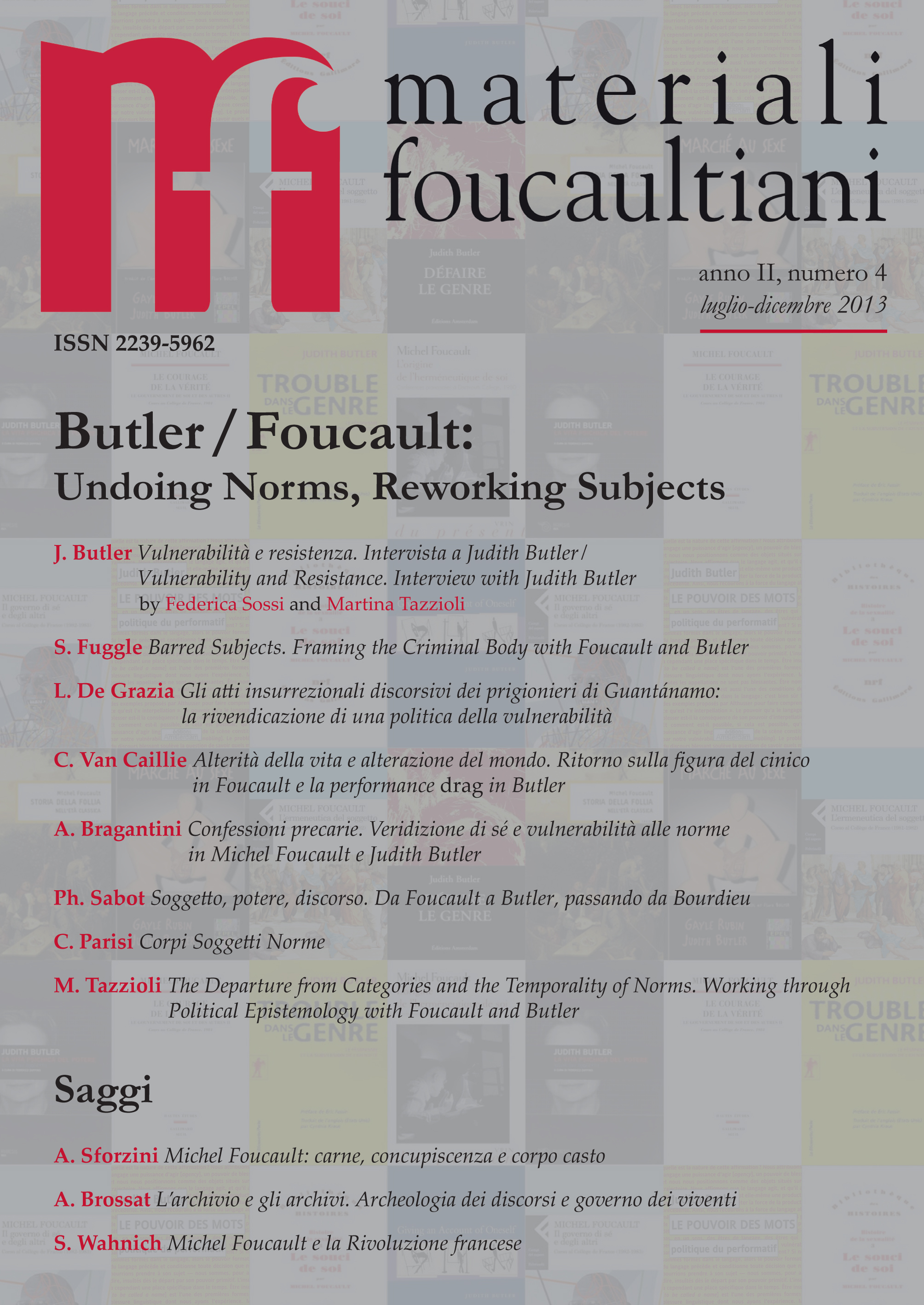
Orazio Irrera (Materiali Foucaultiani)
Épistémologies coloniales et racisme d’État chez Foucault

Samedi 15 mars

Journée d’études organisée par Judith Revel (Paris 1 – PhiCo-EXeCO) et Pascale Gillot (Paris 1 – PhiCo-EXeCO)
Foucault, la psychiatrie et la psychanalyse

Samedi 5 avril

Jacqueline Carroy (EHESS-Centre Koyré)
Les usages de Foucault dans l’histoire des sciences humaines

Samedi 17 mai

Ronan de Calan (Paris1)
Foucault, mythologue des sciences

Source: le Site personel de Didier Eribon

FOUCAULT : MAGRITTE, KLEE, MANET….
J’ai retrouvé dans mes fichiers l’ébauche d’un chapitre sur Foucault et Magritte et Manet qui devait s’intégrer dans mon livre paru en octobre 1994 chez Fayard, Michel Foucault et ses contemporains. Il est resté à l’état d’esquisse (j’ai abandonné plusieurs chapitres de cet ouvrage, dont celui-ci, pour qu’il ne grossisse pas démesurément). Je le donne à lire dans son caractère totalement inachevé, à titre documentaire. Quand j’avais commencé à y travailler, en 1993 ou au début de l’année 1994, les Dits et écrits de Foucault n’existaient pas encore ; et j’avais simplement ajouté quelques mentions ou références à ces volumes – dont j’avais reçu les épreuves pendant l’été 1994 – ce qui explique que les notes ne renvoient le plus souvent qu’aux lieux de publication initiaux).

suite

Paolo B. Vernaglione, Foucault in rete, Alfabeta2, 2 gennaio 2014

Per una urgente archeologia dei saperi dell’ultima modernità, Michel Foucault “sul web” potrebbe funzionare come dispositivo di sottrazione al potere narcisistico e commerciale della rete e come luogo di acquisizione di sapere in rapporto immediato con la realizzazione quotidiana della soggettività.

Se si pensa alla caotica produzione di informazione su social network e mobiles ci si rende conto della enorme sproporzione tra l’inesauribile dispersione di testi e la concentrazione, ahimè residuale, dell’impresa cartacea, affidata ad archivi non digitalizzati e a pochi e mal finanziati centri di ricerca. Da qui l’esigenza di compilare un regesto dell’attività svolta da siti e blog dedicati a Foucault.

In questa impresa, di cui qui si offre una sorta di possibile work in progress, ci viene incontro il terzo prezioso volume della rivista Materiali Foucaultiani, scaricabile dal sito omonimo e dedicato per metà alla pubblicazione in italiano di una inedita conferenza del 1964 all’Università belga di Saint Louis, Langage et literature, tradotta da Miriam Iacomini, in cui l’autore di Le parole e le cose espone l’intera panoplia di tematiche su cui si è appuntato il suo sguardo analitico: che cos’è un autore, la differenza tra scrittura e letteratura, il ruolo e la funzione di essa come critica genealogica della soggettività e come esperimento su sé stessi.

Read more

Eric Aeschimann, Pourquoi Michel Foucault est partout, Le nouvel observateur, 21 décembre 2013.

Economie, politique, genre, histoire, spiritualité… 30 ans après la mort du philosophe, notre siècle néolibéral porte son nom. Explications

n 1979, dans le cadre de son cours hebdomadaire au Collège de France, Michel Foucault consacre trois séances à la théorie néolibérale. Il y analyse des auteurs peu connus en France: les économistes allemands de l’après-guerre, l’Autrichien Friedrich Hayek ou encore l’ultralibéral américain Gary Becker, futur prix Nobel d’économie.

Avec un sens stupéfiant de l’anticipation, il dévoile le véritable projet de ce courant de pensée: officiellement, le néolibéralisme prétend «libérer» les individus et leur permettre d’agir à leur guise; en réalité, explique le philosophe, il s’agit d’imposer une façon de vivre entièrement guidée par l’intérêt et le calcul économique. Le marché n’est pas un mécanisme naturel, mais un dispositif, une «discipline», une «technique de gouvernement», comme la prison ou l’hôpital psychiatrique. Le néolibéralisme fabrique Homo economicus de la même manière que la clinique fabrique le fou.

A l’époque, la question n’intéresse guère. Thatcher n’est pas encore au pouvoir, et personne n’imagine la déferlante néolibérale qui va s’abattre sur la planète. Foucault passe à un autre sujet, et, lorsqu’il meurt, en 1984, cet aspect de son travail tombe dans l’oubli. En 2004, le cours de 1979 devient un livre, sous le titre «Naissance de la biopolitique», ce qui ne facilite pas sa diffusion dans le milieu des économistes.

suite