
Foucault News

News and resources on French thinker Michel Foucault (1926-1984)

Re-Making Normal: Governing the Social in Neoliberal Times

Call for Contributions

Deborah Brock, editor dbrock@yorku.ca

PDF

Re-Making Normal: Governing the Social in Neoliberal Times is a ‘sequel’ to my sole edited (Nelson 2003) publication, Making Normal: Social Regulation in Canada.  However, it differs from the 2003 edition in a number of respects, most notably, it will be published by a scholarly press rather than a commercial press, it can serve as a reader for upper year undergraduate courses and some graduate courses (although it is not intended to be a textbook), and it will be comprised entirely of chapters on contemporary concerns, forgoing the historical content of the earlier book.

Re-Making Normal explores how we are constituted as neoliberal subjects; for example, as sexually, fiscally and organizationally responsible subjects, and as biopolitical subjects of citizenship, militarism, development aid, etc.  In keeping with a governmentality approach, how focused investigations will be foregrounded.  In this text, neoliberalism is understood as more than an ideological perspective favoring the notion of the minimal state, competitive individualism, and ‘free’ trade and markets.  Neoliberalism has fundamentally reshaped how the self can be known and what interests the self holds through a reconfiguration of subjectification.

Re-Making Normal will potentially include a range of topics from self-fashioning (such as how we come to know and represent ourselves as sexual subjects, as psy subjects constituted through therapeutic authority, as having a particular kind of character, and of what ‘truths’ we speak) to broader biopolitical processes (such as schooling, surveillance, the organization of public and domestic spaces, the “management of the mind”[1], consumption, and how we labour).  All relevant topics will be considered.

All contributions must engage directly with activities of neoliberal governance as materially grounded and empirically verifiable sets of practices.  As such, Michel Foucault’s work provides a foundation for the book, and all contributions must engage directly with his governmentality approach.  I welcome contributions that use, challenge, and extend governmentality studies.  In this text, the governmentality approach is broadly conceived and open to a range of potentialities, in keeping with the fact that governmentality is not a specific theory and not a school of thought.  However contributions should, where possible, directly address the following:

-Take an approach to power that is much more nuanced than a social control model, and considers the ways in which contemporary western societies are characterized by conditions of ‘regulated freedom’.[2]

-Engage with the ‘programmes, strategies and techniques’[3] of government.

-De-centre the state and instead demonstrate how the state is produced as an affect of multiple force relations.

-Connect everyday life to the big issues of our day, centering the political character of personal, social, cultural and economic activity.

-Capture tensions between normalization and individualization, and homogenization and diversification, noting how they are integral to contemporary forms of governance.

-Demonstrate the dynamic and mutually constitutive relation between power and knowledge.

-Take up a critique of concepts such as ‘choice’, ‘freedom’, ‘empowerment’, ‘human rights’, etc.

-Pose the possibilities of resistance, beginning with an interrogation of truth, power and subjectivity.[4]

All contributions will pose critical analytic questions, directions for further research, and suggestions for resistance tactics and strategies.

Chapters may contain an historical component, but not be primarily historical.  While the text will be primarily Canadian in focus, international foci are most welcome (my preference is for non- US focused contributions), particularly where they contribute to a ‘global governmentality’.[5]

Chapter length:  In order to accommodate as broad a range of issues as possible, this book will feature relatively short chapters.  Chapters can range from a minimum of 3,780 words including references (approximately 9 published pages) to 7,560 words including references (approximately 18 published pages).

Without compromising scholarly rigor, I invite contributors to write in the first person (the ‘I’ form), to use plentiful examples, accessible language, and to be personable and somewhat colloquial in style.

Chapters will be selected based on their ability to meet the objectives of the collection, their coherence with other chapters in the collection, and overall quality.  All contributions must be new original articles for this edition.

 Format:  Chicago Manual of Style

Schedule:

31 March 2014            Last day for receipt of indication of interest in participation

30 April                       Last day for receipt of detailed proposals

29 August                    Chapters (Draft 1) due

8 Sept – 31 Oct           Editor Tasks (editing and suggestions for revision)

19 December              Chapters (Draft 2) due

29 Dec– 27 Feb 2015  Editor Tasks (preparation of complete manuscript)

2 March                       Submit manuscript to publisher for consideration/review

1 June                          Receipt of reviewer responses and decision of publisher

2 June – 31 July          Further revisions

4 August                      Production begins for spring 2016 publication

Please contact Deborah Brock dbrock@yorku.ca

Deborah Brock is an Associate Professor in the Department of Sociology, York University, Toronto, Canada.  Her research and teaching address social, moral, and sexual regulation.  Her publications include Criminalization, Representation, Regulation (co-edited with Amanda Glasbeek and Carmela Murdocca) University of Toronto Press, forthcoming 2014; Power and Everyday Practices (co-edited with Rebecca Raby and Mark Thomas) Nelson, 2011; Making Work, Making Trouble:  The Social Regulation of Sexual Labour University of Toronto Press, 2009, 1998; and Making Normal: Social Regulation in Canada Nelson, 2003.


[1] Nikolas Rose Neuro: The New Brain Sciences and the Management of the Mind Princeton:  Princeton University Press, 2013).

[2] Nikolas Rose and Peter Miller “Introduction: Governing Economic and Social Life” in Governing the Present: Administering Economic, Social and Personal Life (Cambridge: Polity, 2008).

[3] Rose and Miller, 2008.

[4] Johanna Oksala “Neoliberalism and Biopolitical Governmentality” in Jakob Nilsson and Sven-Olov Wallenstein, eds Foucault, Biopolitics and Governmentality (Södertörn Philisophical Studies, 2013) www.sh.se/publications; Rose and Miller, 2008.

[5] Thomas Lemke “Foucault, Politics and Failure” in Jakob Nilsson and Sven-Olov Wallenstein, eds. Foucault, Biopolitics and Governmentality (Södertörn Philisophical Studies, 2013) www.sh.se/publications. See also Wendy Larner and William Walters Global Governmentality: Governing International Spaces London: Routledge, 2004.
Exclusion, discipline, terreur : à partir de Michel Foucault

Colloque international
11 et 12 avril 2014, Strasbourg

vendredi 11 avril :
amphithéâtre du Collège doctoral européen, 42 bd de la Victoire

PDF

9h : accueil des participants, introduction

9h30-10h30 : Alain Brossat, Université Paris-8, “Le ” geste obscur– partage et/ou persécution”

10h30-11h30 : Jacob Rogozinski, Université de Strasbourg, “Des dispositifs de persécution : pourquoi introduire ce concept?”

11h30-12h30 : Guilherme Castelo Branco, Université fédérale de Rio de Janeiro, “Gestion, violence, terreur

12h30-14h : pause déjeuner

14h-15h : Geoffroy de Lagasnerie, ENSAPC, Paris-Cergy, “Les lieux du pouvoir” 15h-16h :  Andreas  Hetzel,  Université  d’Istanbul,  “Borders  as  Dispositif:  the

Governementality of Exclusion

16h-17h : Luca Paltrinieri, Collège International de Philosophie, Paris, “Bodin à Lampedusa : souveraineté, migrations, capital humain”

samedi 12 avril
Institut Le Bel, 4 rue Blaise Pascal salle Ourisson (1° étage à droite)

9h30-10h30 : Roberto Nigro, Université de Zurich, “De la lutte des classes aux antagonismes diffus”

10h30-11h30 : Julie Mazaleigue-Labaste, Université de Picardie, Amiens, “Le diabolique de l’Age Classique au XXIème siècle : concept, figures et affects de l’exclusion

11h30-12h30 : Jean-Claude Monod, ENS et CNRS, Paris, “Exclusion, inclusion forcée ou interprétation forcée? Le Grand Renfermement et le sujet moderne”

12h30-14h : pause déjeuner

14h-15h : Diogo Sardinha, Collège International de Philosophie, Paris, “Sorcières, possédées, mystiques et hystériques : exclusion, discipline et terreur sur les femmes”

15h-16h : Maria Muhle, Merz Akademie, Stuttgart, “Monstres et anormaux : l’exclusion entre loi et norme

16h-17h : Claire Cosquer, ENS, Paris, L’absence impériale : sexualité, libéralisme, et colonialité”

With thanks to Geoffroy de Lagasnerie for this link

With thanks to Dirk Felleman for this link

Dorrestijn, S., Verbeek, P.-P.
Technology, wellbeing, and freedom: The legacy of utopian design (2013) International Journal of Design, 7 (3), pp. 45-56.

Further info

Abstract
This paper is about the application of user-influencing design for improving wellbeing, focusing on the ethical issue of finding the right balance between determination and freedom. Two contemporary approaches for user-influencing design, “Persuasive Technology” and “Nudge,” are discussed against the background of social engagement in the history of design. What can be learned from the past? The most explicit but also contested examples of improving people’s lives by means of design can be found in movements of “utopian design.” We discuss the utopian aspirations in Arts and Crafts, New Objectivity, Gute Form, and Postmodernism. The major lesson to be learned is that it is necessary to find a way out of the repeated ethical dilemma between coercing human behavior on the one hand and fostering human freedom on the other. Following Michel Foucault, we will conceptualize freedom not as the absence of influences on people, but as a practice of shaping one’s life in interaction with these influences. User-influencing design methods can help to prolong the tradition of socially engaged design, with tempered, non-utopian goals, but at the same time with improved understanding and more effective tools concerning how technology mediates our existence.

Author Keywords
Design for wellbeing; Ethics; Freedom; Nudge; Persuasive technology; User-influencing technology; Utopian design

See earlier post on this exhibition and events.

Olson, M., Fejes, A., Dahlstedt, M. & Nicoll, K. (2014) Citizenship discourses: Production and curriculum. British Journal of Sociology of Education. DOI: 10.1080/01425692.2014.883917

Abstract

This paper explores citizenship discourses empirically through upper secondary school student’s understandings, as these emerge in and through their everyday experiences. Drawing on a post-structuralist theorisation inspired by the work of Michel Foucault, a discourse analysis of data from interviews with students is carried out. This analysis characterises three discourses of the active citizen – a knowledgeable citizen, a responsive and holistic citizen, and a self-responsible ‘free’ citizen. The analysis raises questions over the implications of contemporary efforts for the intensification of standardising forces through citizenship education. It also stresses the notion that engaging students actively does always also involve discourses other than those stressed through the curriculum, which nurtures the body and nerve of democracy itself.

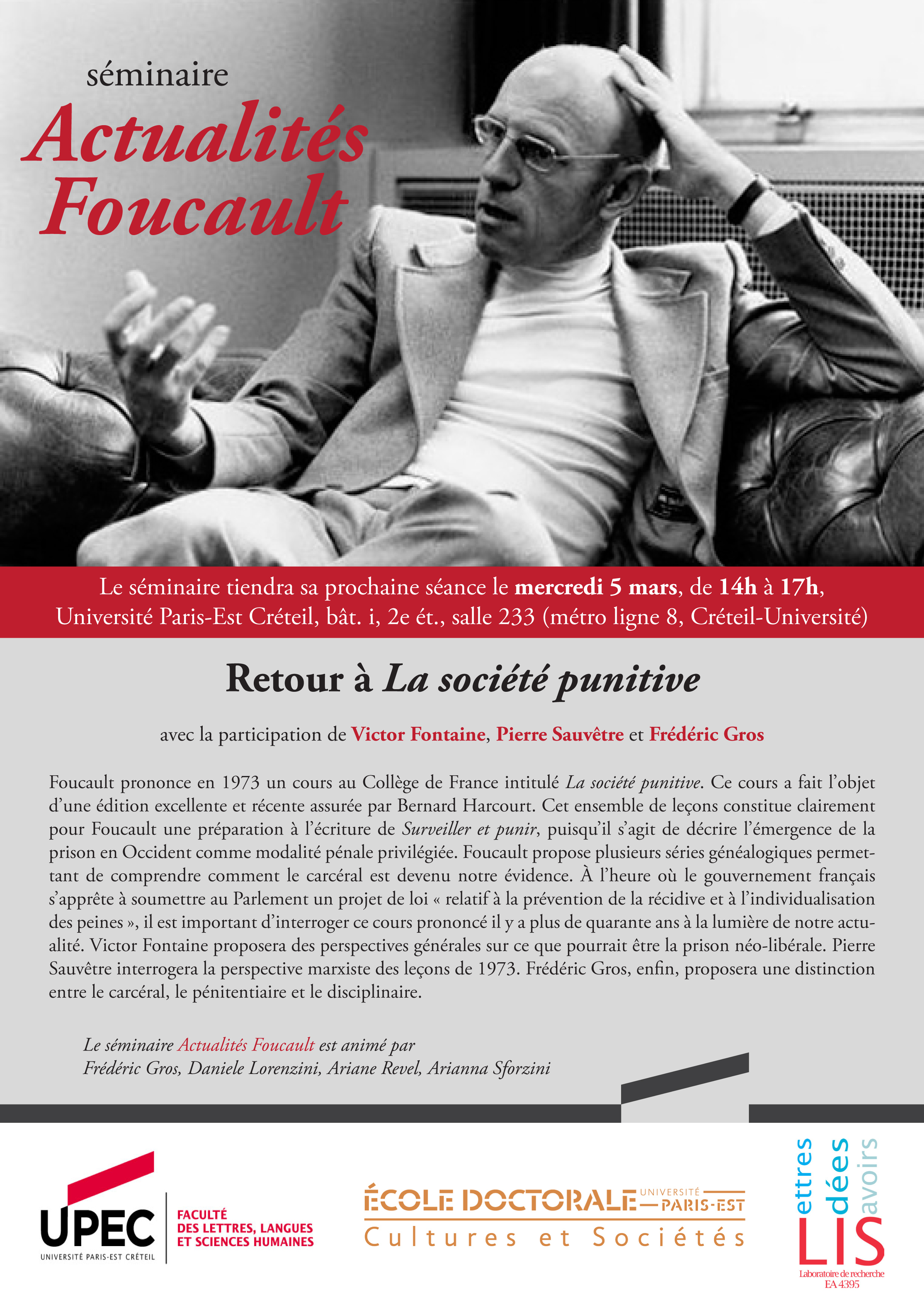
Séminaire Actualités Foucault s5

PDF flyer

Karine Rodrigues, Foucault e a crise do sistema prisional brasileiro, O Globo, 11th January 2014

Update September 2025: Original link is no longer live. Link above is to the page as it is archived on the Wayback Machine

Autor de livro sobre história da prisão no Brasil comenta teses do filósofo francês acerca do modelo carcerário e analisa crise do sistema brasileiro, exposta mais uma vez em rebeliões no Maranhão

Nos idos de 1850, quem ingressava na Casa de Correção da Corte, primeira unidade prisional do Brasil, depois transformada no já extinto Complexo Penitenciário Frei Caneca, no Centro do Rio, lá permanecia por não mais de uma década. Nenhuma relação com os crimes cometidos. Tratava-se, na verdade, do tempo que o corpo suportava condições tão aviltantes. O borracheiro Elson de Jesus Pereira, porém, não chegou a tanto, embora tenha sido detido um século e meio depois. Levado à Penitenciária de Pedrinhas, no Maranhão, sob acusação de ter receptado quatro pneus roubados, ele foi decapitado poucos dias depois, em outubro do ano passado, durante uma das inúmeras rebeliões ocorridas naquela unidade prisional.

Em Pedrinhas, a separação de presos conforme a natureza do delito cometido é letra morta. Situação que, segundo levantamento do Conselho Nacional do Ministério Público (CNMP), concluído em fevereiro do ano passado, é comum a 1.598 unidades prisionais do país, apesar de ser uma norma da Constituição de 1988. Bem antes disso, em 1975, no livro “Vigiar e Punir: O nascimento da prisão” (publicado no Brasil pela Vozes), o filósofo Michel Foucault já considerava o critério de divisão por gravidade do delito como um dos sete princípios fundamentais para garantir condições favoráveis ao cumprimento da pena nos estabelecimentos prisionais.

Read more

globo-FoucaultInterview with Foucault conducted in 1975 published in national newspaper O GLOBO, Rio de Janeiro, Brazil

Uma entrevista com Michel Foucault, O Globo, 11th January 2014

Update September 2025: Live link no longer available. Link above is to the interview as it is archived on the Wayback machine

No ano em que se completam três décadas da morte do filósofo francês, o Prosa publica uma entrevista concedida por ele em 1975 durante visita ao Brasil. Nela, Foucault discute as origens de seu método, fala sobre mecanismos de controle na sociedade e critica o ideal de humanismo fundado em “poder normalizador”

Poucos dias depois do assassinato de Vladimir Herzog por agentes do regime militar, em 25 de outubro de 1975, o jornalista e escritor Claudio Bojunga e o psicanalista e ensaísta Reinaldo Lobo entrevistaram o filósofo francês Michel Foucault (1926-1984), então em visita à Universidade de São Paulo. Publicada originalmente no “Jornal da Tarde”, vespertino de “O Estado de S. Paulo”, a conversa examinava as ideias do filósofo libertário das marginalidades sociais e das minorias culturais, raciais e sexuais. Ainda sob o impacto da violência cometida contra Herzog, os entrevistadores procuraram também esclarecer os conceitos de Foucault sobre os grandes aparelhos de poder e os micropoderes — a Justiça, a polícia, a confissão, a prisão, a psiquiatria, o asilo, a tortura.

No ano em que se completam três décadas da morte de Foucault, o Prosa republica a entrevista. Nela, o filósofo expõe uma visão da cultura e da História que não pretendia explicar o presente pelo passado. Preferia investigar os discursos que condicionam as formas de ver e julgar, e analisar a maneira pela qual a cultura contemporânea determina as condições de possibilidade do novo. Construiu assim sua arqueologia da cultura ocidental.

Foucault dizia que a tarefa do pensamento consistia em reconstituir os sistemas do subsolo da cultura sobre os quais flutuava a imagem da existência. Falava na “morte do homem”, mas negava que ela produzisse um esvaziamento ético, assim como o anúncio de Nietzsche sobre a morte de Deus não propiciara um abismo de permissividade moral. Achava mesmo que essas mortes abriam espaços de liberdade. O pensamento devia pensar-se — para descobrir o que se encontrava na espessura inconsciente do que pensamos.

Por Claudio Bojunga e Reinaldo Lobo*

continue reading

With thanks to Karine Sá Antunes Rodrigues for this link

Joachim Radkau,
Nature and power: An intimate and ambiguous connection (2013) Social Science History, 37 (3), pp. 325-345.

https://doi.org/10.1215/01455532-2209402

Abstract
Nature and Power is to be understood not only as human power against nature but also as power by nature in the sense of Michel Foucault’s biopouvoir (biopower) or Francis Bacon’s “Naturae non imperator nisi parendo” (Only by obeying nature may we dominate nature). The fragile human attempts to get power over nature and by nature have a long history, reaching back over millennia until prehistoric times, and much of world history may be explained in part by the unstable relationship between humans and nature. The environmental approach offers a fresh look at global history. The great change that has happened in modern times seems to have been described best by Karl Polanyi (1944) in his Great Transformation, which also refers to a revolution in the human relation to nature. There are primeval symbioses of humans and nature that are the basis of environmental history until modern time. A global history of the environment may be written for a long time along the three great commons of history: woodlands, water, and pasture. The dark tune of Garrett Hardin’s (1968) “Tragedy of the Commons,” to be sure, does not dominate the whole melody of environmental history. There is also a lot of historical evidence for Elinor Ostrom’s rehabilitation of the commons. But it is better to be cautious with dogmatic theories and sweeping judgments. In modern times Hardin may be right, at least in this or that regard. Ostrom’s concept applies only to local, not to global commons. The underlying philosophy of Nature and Power is neither optimism nor pessimism but possibilism. © 2013 by Social Science History Association.