Foucault News

News and resources on French thinker Michel Foucault (1926-1984)

See earlier post on this exhibition and events.

Olson, M., Fejes, A., Dahlstedt, M. & Nicoll, K. (2014) Citizenship discourses: Production and curriculum. British Journal of Sociology of Education. DOI: 10.1080/01425692.2014.883917

Abstract

This paper explores citizenship discourses empirically through upper secondary school student’s understandings, as these emerge in and through their everyday experiences. Drawing on a post-structuralist theorisation inspired by the work of Michel Foucault, a discourse analysis of data from interviews with students is carried out. This analysis characterises three discourses of the active citizen – a knowledgeable citizen, a responsive and holistic citizen, and a self-responsible ‘free’ citizen. The analysis raises questions over the implications of contemporary efforts for the intensification of standardising forces through citizenship education. It also stresses the notion that engaging students actively does always also involve discourses other than those stressed through the curriculum, which nurtures the body and nerve of democracy itself.

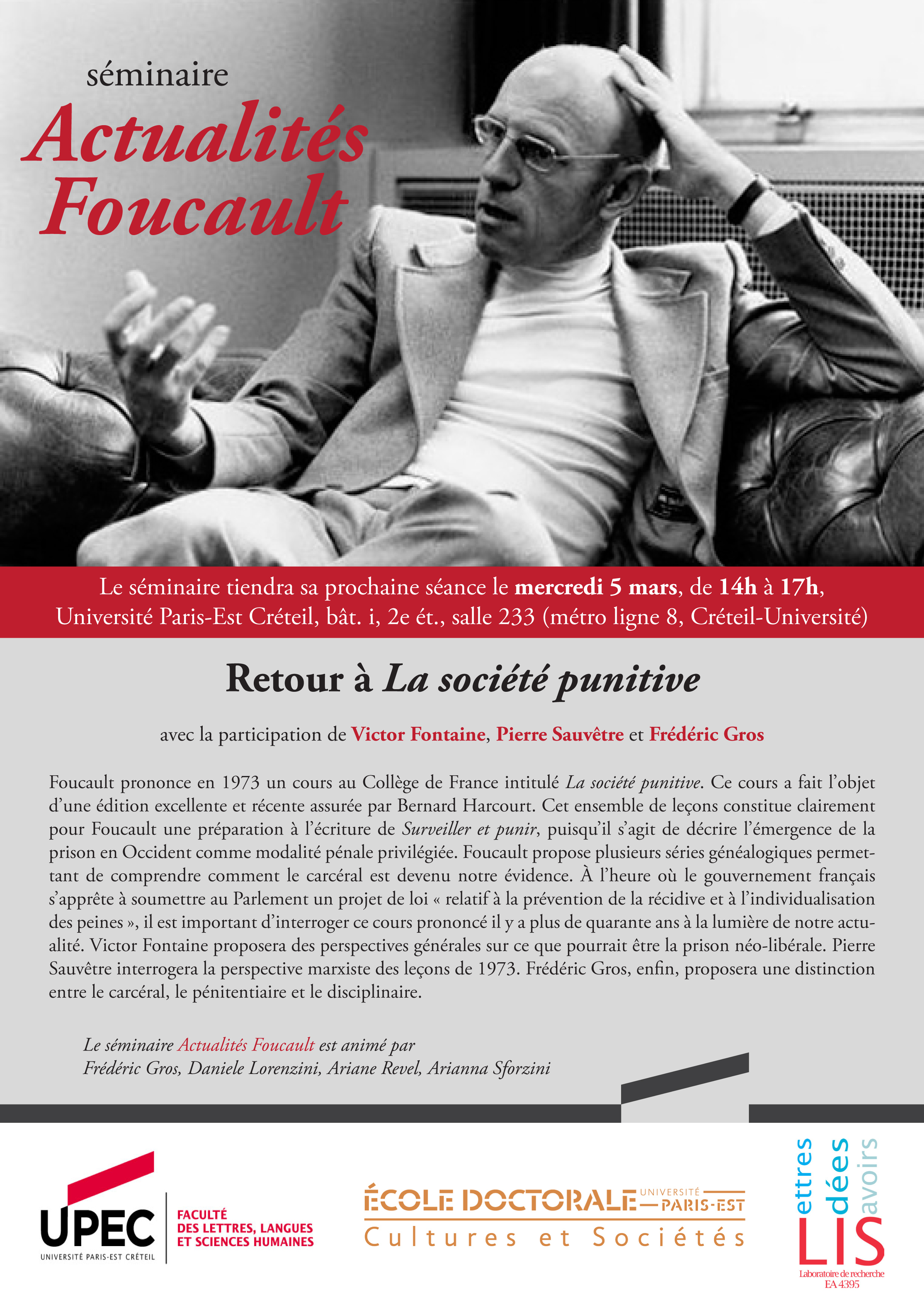
Séminaire Actualités Foucault s5

PDF flyer

Karine Rodrigues, Foucault e a crise do sistema prisional brasileiro, O Globo, 11th January 2014

Update September 2025: Original link is no longer live. Link above is to the page as it is archived on the Wayback Machine

Autor de livro sobre história da prisão no Brasil comenta teses do filósofo francês acerca do modelo carcerário e analisa crise do sistema brasileiro, exposta mais uma vez em rebeliões no Maranhão

Nos idos de 1850, quem ingressava na Casa de Correção da Corte, primeira unidade prisional do Brasil, depois transformada no já extinto Complexo Penitenciário Frei Caneca, no Centro do Rio, lá permanecia por não mais de uma década. Nenhuma relação com os crimes cometidos. Tratava-se, na verdade, do tempo que o corpo suportava condições tão aviltantes. O borracheiro Elson de Jesus Pereira, porém, não chegou a tanto, embora tenha sido detido um século e meio depois. Levado à Penitenciária de Pedrinhas, no Maranhão, sob acusação de ter receptado quatro pneus roubados, ele foi decapitado poucos dias depois, em outubro do ano passado, durante uma das inúmeras rebeliões ocorridas naquela unidade prisional.

Em Pedrinhas, a separação de presos conforme a natureza do delito cometido é letra morta. Situação que, segundo levantamento do Conselho Nacional do Ministério Público (CNMP), concluído em fevereiro do ano passado, é comum a 1.598 unidades prisionais do país, apesar de ser uma norma da Constituição de 1988. Bem antes disso, em 1975, no livro “Vigiar e Punir: O nascimento da prisão” (publicado no Brasil pela Vozes), o filósofo Michel Foucault já considerava o critério de divisão por gravidade do delito como um dos sete princípios fundamentais para garantir condições favoráveis ao cumprimento da pena nos estabelecimentos prisionais.

Read more

globo-FoucaultInterview with Foucault conducted in 1975 published in national newspaper O GLOBO, Rio de Janeiro, Brazil

Uma entrevista com Michel Foucault, O Globo, 11th January 2014

Update September 2025: Live link no longer available. Link above is to the interview as it is archived on the Wayback machine

No ano em que se completam três décadas da morte do filósofo francês, o Prosa publica uma entrevista concedida por ele em 1975 durante visita ao Brasil. Nela, Foucault discute as origens de seu método, fala sobre mecanismos de controle na sociedade e critica o ideal de humanismo fundado em “poder normalizador”

Poucos dias depois do assassinato de Vladimir Herzog por agentes do regime militar, em 25 de outubro de 1975, o jornalista e escritor Claudio Bojunga e o psicanalista e ensaísta Reinaldo Lobo entrevistaram o filósofo francês Michel Foucault (1926-1984), então em visita à Universidade de São Paulo. Publicada originalmente no “Jornal da Tarde”, vespertino de “O Estado de S. Paulo”, a conversa examinava as ideias do filósofo libertário das marginalidades sociais e das minorias culturais, raciais e sexuais. Ainda sob o impacto da violência cometida contra Herzog, os entrevistadores procuraram também esclarecer os conceitos de Foucault sobre os grandes aparelhos de poder e os micropoderes — a Justiça, a polícia, a confissão, a prisão, a psiquiatria, o asilo, a tortura.

No ano em que se completam três décadas da morte de Foucault, o Prosa republica a entrevista. Nela, o filósofo expõe uma visão da cultura e da História que não pretendia explicar o presente pelo passado. Preferia investigar os discursos que condicionam as formas de ver e julgar, e analisar a maneira pela qual a cultura contemporânea determina as condições de possibilidade do novo. Construiu assim sua arqueologia da cultura ocidental.

Foucault dizia que a tarefa do pensamento consistia em reconstituir os sistemas do subsolo da cultura sobre os quais flutuava a imagem da existência. Falava na “morte do homem”, mas negava que ela produzisse um esvaziamento ético, assim como o anúncio de Nietzsche sobre a morte de Deus não propiciara um abismo de permissividade moral. Achava mesmo que essas mortes abriam espaços de liberdade. O pensamento devia pensar-se — para descobrir o que se encontrava na espessura inconsciente do que pensamos.

Por Claudio Bojunga e Reinaldo Lobo*

continue reading

With thanks to Karine Sá Antunes Rodrigues for this link

Joachim Radkau,
Nature and power: An intimate and ambiguous connection (2013) Social Science History, 37 (3), pp. 325-345.

https://doi.org/10.1215/01455532-2209402

Abstract
Nature and Power is to be understood not only as human power against nature but also as power by nature in the sense of Michel Foucault’s biopouvoir (biopower) or Francis Bacon’s “Naturae non imperator nisi parendo” (Only by obeying nature may we dominate nature). The fragile human attempts to get power over nature and by nature have a long history, reaching back over millennia until prehistoric times, and much of world history may be explained in part by the unstable relationship between humans and nature. The environmental approach offers a fresh look at global history. The great change that has happened in modern times seems to have been described best by Karl Polanyi (1944) in his Great Transformation, which also refers to a revolution in the human relation to nature. There are primeval symbioses of humans and nature that are the basis of environmental history until modern time. A global history of the environment may be written for a long time along the three great commons of history: woodlands, water, and pasture. The dark tune of Garrett Hardin’s (1968) “Tragedy of the Commons,” to be sure, does not dominate the whole melody of environmental history. There is also a lot of historical evidence for Elinor Ostrom’s rehabilitation of the commons. But it is better to be cautious with dogmatic theories and sweeping judgments. In modern times Hardin may be right, at least in this or that regard. Ostrom’s concept applies only to local, not to global commons. The underlying philosophy of Nature and Power is neither optimism nor pessimism but possibilism. © 2013 by Social Science History Association.

Garratt, D., Piper, H., Taylor, B.
‘Safeguarding’ sports coaching: Foucault, genealogy and critique (2013) Sport, Education and Society, 18 (5), pp. 615-629.

Abstract
This paper offers a genealogical account of safeguarding in sport. Drawing specifically on Foucault’s work, it examines the ‘politics of touch’ in relation to the social and historical formation of child protection policy in sports coaching. While the analysis has some resonance with the context of coaching as a whole, for illustrative purposes it focuses principally upon the sport of swimming. Our analysis demonstrates how the linked signifiers of ‘abuse’, ‘protection’ and ‘safeguarding’ produce both continuity and change in the philosophy and meaning around coaching practice, giving rise to particular notions of ‘government’ and regulation, risk aversion and prohibitions, and values. Within a culture of fear in sports coaching and society, the analysis traces the development of swimming policy following the exposure of select high-profile cases or critical incidents, where such historical events prompted a series of authoritative statements about the nature of child protection discourse in sport and education, and practice.

Author Keywords
Child protection policy; Critique; Foucault; Genealogy; Safeguarding; Swimming

DOI: 10.1080/13573322.2012.736861

MORTENSON, W.B., SIXSMITH, A., WOOLRYCH, R.
The power(s) of observation: theoretical perspectives on surveillance technologies and older people (2013) Ageing and Society, pp. 1-19. Article in Press.

Abstract
There is a long history of surveillance of older adults in institutional settings and it is becoming an increasingly common feature of modern society. New surveillance technologies that include activity monitoring, and ubiquitous computing, which are described as ambient assisted living (AAL), are being developed to provide unobtrusive monitoring and support of activities of daily living and to extend the quality and length of time older people can live in their homes. However, concerns have been raised with how these kinds of technologies may affect user’s privacy and autonomy. The objectives of this paper are (a) to describe the development of home-based surveillance technologies; (b) to examine how surveillance is being restructured with the use of this technology; and (c) to explore the potential outcomes associated with the adoption of AAL as a means of surveillance by drawing upon the theoretical work of Foucault and Goffman. The discussion suggests that future research needs to consider two key areas beyond the current discourse on technology and ageing, specifically: (a) how the new technology will encroach upon the private lived space of the individual, and (b) how it will affect formal and informal caring relationships. This is critical to ensure that the introduction of AAL does not contribute to the disempowerment of residents who receive this technology.

Author Keywords
ambient assisted living; Foucault; Goffman; surveillance

DOI: 10.1017/S0144686X13000846

Brown, K.D., Goldstein, L.S.
Preservice elementary teachers’ understandings of competing notions of academic achievement coexisting in post-NCLB public schools (2013) Teachers College Record Volume 115 Number 1, 2013, p. 1-37

Further info

Abstract
Background/Context: Since the 2002 implementation of No Child Left Behind, teaching in public school contexts has become more complex and challenging. Today, public school teachers at all grade levels are accountable for maintaining a steady focus on their students’ academic achievement. However, many teachers have found themselves wrestling with two conflicting understandings of academic achievement. These two conflicting understandings reflect two existing discourses used to frame students’ acquisition of school-centered knowledge and skills: academic progress and academic success.

Purpose/Objective/Research Question/Focus of the Study: In this article, we focus on the coexisting discourses of academic achievement circulating within in our participants’ teaching credential preparation experience. We present the data, drawn from the first two sets of interviews completed for our larger study of preservice teachers’ understandings of the relationship between sociocultural factors and academic achievement, that document our participants’ confusion and uncertainty about the meaning of “academic achievement.” We draw from the notion of discourse, as theorized by Michel Foucault, to foreground the need to establish specific terminology-namely, academic progress and academic success-to clarify the various aspects of academic achievement and to facilitate discussion of this critically important construct.

Research Design: The study draws from a basic or generic qualitative methodology in which the aim is to understand a situation by exploring, analyzing, and interpreting the perspectives and understandings of individuals within that situation. The findings come from data generated across two interviews conducted with preservice teachers at the beginning and conclusion of their first semester in the professional development sequence of their elementary (pk-4) teacher education program.

Setting: The study takes place at a large urban university teacher education program in the U.S. South.

Population/Participants/Subjects: Participants are a racially and ethnically diverse set of 12 preservice teacher candidates. Ten were pursuing a elementary generalist teaching credential, and 2 were pursuing a elementary generalist-bilingual teaching credential.

The Social Theory Applied blog started out as a theory and educational research blog but as Mark Murphy, who runs the blog, explains it has recently broadened its focus

Please note that the remit of the site is to become broader than its original focus on educational research – now to cover the field of social science research generally. This change in emphasis is in line with my own intellectual interests but also reflects my strong belief that research in fields such as education should not be considered in isolation from other connected fields such as social work, urban studies, etc.

Here is a link to mainly education focused posts relating to Foucault

The blog welcomes new contributions.