
Foucault News

News and resources on French thinker Michel Foucault (1926-1984)

Michelle Murphy, The economization of life, parts 1 and 2 (2014)
Conversation recorded with Michelle Murphy in Toronto on June 21, 2014

Link to audio and further info

Update October 2025: The link above is to the archived page on the Internet Archive Wayback Machine

This conversation with Michelle Murphy is divided into two parts:

BIOPOLITICAL FEMINISM: The first part introduces Foucault’s concept of biopolitics and applies it to forms of economization of life particularly in relation to female bodies. Paraphrasing Foucault, Michelle affirms that governmental capitalism needs for “some must not to be born so that future others will live more consumptibly, productively in the logic of macro-economy .” She thus unfolds the political history of regulation and ‘marketing’ of reproduction and contraception that organizes such an economization of life at a scale of a population. Further, we discuss of Michelle’s concept, “The Girl” as the problematic current vessel of financial investment in the context of imperial humanitarianism.

CHEMICAL INFRASTRUCTURES: The second part considers the body as topological, blurring the limits between inside and outside and, following Peter Sloterdijk think of it as a “being-in-the-breathable.” Michelle has been working on the elaboration of the concept of “chemical infrastructures” to think of our era as the Anthropocene: a time when all atmospheres are fundamentally manufactured (deliberately or not) by human activity. Following Spinoza and his approach of the Genesis’s apple, we talk of our ignorance, as humans, of what ecologies really are, and how we can start thinking of them as ethical systems rather than moralistic ones.

Michelle Murphy is a Professor in the History Department and Women and Gender Studies Institute at the University of Toronto, with graduate appointments in Science and Technology Studies at York University and the Institute for the History and Philosophy of Science and Technology at U of T. She is an organizer of the Toronto Technoscience Salon. I am also coordinator of the Technoscience Research Unit. She is the author of Seizing the Means of Reproduction: Entanglements of Feminism, Health, and Technoscience (Duke UP, 2012) and Sick Building Syndrome and the Problem of Uncertainty: Environmental Politics, Technoscience, and Women Workers (Duke UP, 2006), as well as the co-editor of Landscapes of Exposure: Knowledge and Exposure in Modern Environments, Osiris v. 19 (University of Chicago Press, 2004).

Foucault’s freedom, Johanna Oksala interviewed by Richard Marshall, 3:AM Magazine, Friday, August 1st, 2014.

Update October 2025: Link above to archived page on the Internet archive Wayback Machine

Oksala_talk2

Johanna Oksala is a political philosopher who broods on Foucault, thinks that it’s time people stopped thinking in terms of continental vs analytic, thinks about Foucault and freedom, on Foucault, politics and violence, on Chantal Mouffe’s compelling ideas,on state violence, on why neoliberal rationality must be resisted, and on political spirituality. She’s out there making windows where there were once walls…

3:AM: What made you become a philosopher?

Johanna Oksala: I initially started to study philosophy because it seemed like an easy subject that wouldn’t consume too much of my precious time – I was young so my primary interest at the time was to study life! I was involved in various forms of anarchist politics such as squatting and organizing illegal parties and events in different European cities. While that was exciting and eye opening in many ways, it also taught me that genuine political change requires that people fundamentally alter the way they think. I believe that good philosophy can sometimes do that: it can make possible completely new ways of seeing the world around us. (I have also discovered since that philosophy is not easy at all and nowadays it consumes practically all my time!)

read more

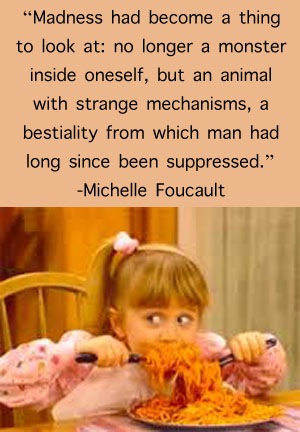
Michelle Foucault: Full House child star by day, French philosopher by night

tumblr blog created by artist Buzz Slutzky.

A sample…
tumblr_blog-michelle-foucault

Courtney Szto & Sarah Gray
Forgive me Father for I have Thinned: surveilling the bio-citizen through Twitter
(2014) Qualitiative Research in Sport, Exercise and Health, . Article in Press.

https://doi.org/10.1080/2159676X.2014.938245

Abstract
The Biggest Loser (TBL) is a reality weight-loss television show that aims to address the notion of an ‘obesity epidemic’ by instructing viewers about how to be responsible for their own health. The popular American show, produced by the National Broadcasting Company, has become a televised confessional for contestants, whereby participants are asked to reflect on their health struggles and express general disgust, disappointment and/or hope about their changing physical state. This study observes that many viewers take their cue from the contestants and use social media to confess their own health sins and ask for redemption. The goal of this study was to provide insight into how viewers of TBL make sense of and interact with the information (re)produced by the television show by analysing viewer engagement through Twitter. Drawing on the work of Michel Foucault, the authors argue that Twitter facilitates the ability to create a public record of personal transgressions, obedience and transformation, which are necessary confessional processes for the production of ‘good’ bio-citizens. Viewers of TBL were observed to facilitate their own captivity and regulation in the Obesity Clinic, an invisible structure that invites individuals to adhere to normative concepts of behaviour. This analysis concludes by arguing for the cancellation of TBL due to the dangerous precedent it creates for both its contestants and viewers.

Author Keywords
Biggest Loser; confession; obesity; surveillance; Twitter

Society of the Query #2
Session 4: Reflections on Search

Antoinette Rouvroy (BE): Algorithmic Governmentality and the End(s) of Critique
Conference Day 2 (8 November 2013)

Algorithmic personalization is characterised primarily by the two following movements: a) dissipation of all forms of transcendent ‘scale’, ‘benchmark’, or hierarchy, in favour of an immanent normativity evolving in real time; b) avoidance of any confrontation with individuals (meaning-making subjects) whose opportunities for subjectivation have become increasingly scarce. This dual movement is the consequence of the focus on relations rather than substances in contemporary statistics or data mining. To what extent are these two aspects of the ‘algorithmic personalization’ – emancipatory as they may appear with regard to ‘old’ hierarchies and with regard to ‘old’ conceptions of the subject as a stable, unitary entity – conducive to new processes of individuation? Simondon and Deleuze-Guattari show that the possibility of becoming and of processes of individuation through relations necessarily require disparities – a heterogeneity of scales, a multiplicity of regimes of existence that algorithmic personalization is continuously stifling. Algorithmic personalization, folding up individuation processes on the individual monad, tends to foreclose the emancipatory perspectives of these philosophers. In the ‘big data era’, the goal of individual and collective individuation is inseparable from an epistemic and semiotic critique of the algorithmic production of what counts as real.

Engin Isin, Citizens without frontiers, Open Democracy: Free thinking for the world, 15 October 2012

Movements without frontiers are neither commercial nor protected. In fact, state, corporate and religious authorities often do not endorse or support their movements and attempt to inhibit their activities. It is in this sense that the founding aspect of these movements is traversing frontiers.
[…]

International citizenship

Let me then return to the movements ‘without frontiers’ again. These can only be traced back to the 1970s. There were doubtless many originary moments for these movements without frontiers and the founding of MSF was certainly an important one. I want to briefly focus on a speech Michel Foucault gave at the United Nations headquarters in Geneva in 1981 on ‘confronting government’. It signals something different. Foucault said ‘There exists an international citizenship that has its rights and its duties, and that obliges one to speak out against every abuse of power, whoever its author, whoever its victims.’ Then he added as if it was self-evident: ‘After all, we are all members of the community of the governed, and thereby obliged to show mutual solidarity.’ Calling this ‘international citizenship’ Foucault defines its duty ‘… to always bring the testimony of people’s suffering to the eyes and ears of governments, sufferings for which it’s untrue that they are not responsible. The suffering of men must never be a silent residue of policy.’

Foucault claims that the suffering of other men, or rather witnessing thereof, ‘grounds an absolute right to stand up and speak to those who hold power.’ Insisting that we must refuse a division of labour between those who act (governments) and those who talk (citizens), Foucault emphasizes that ‘Amnesty International, Terre des Hommes, and Médecins du monde are initiatives that have created this new right—that of private individuals to effectively intervene in the sphere of international policy and strategy.’ What does Foucault mean by ‘private individuals’? Obviously, he cannot use ‘citizens’ because that would mean ‘nationals’. The kind of right that he is claiming as new cannot be confined to citizens as nationals. Yet, ‘private individuals’ is a problematic phrase for a statement of solidarity that traverses frontiers. The themes in this short and succinct statement are nonetheless quite significant. The declaration that although we might reside under different jurisdictions we share the same condition of being governed and claim that we have a right to responsibility were ambitious declarations.

Read more

With thanks to Colin Gordon for this news.

With thanks to Zorbitor for this news

Charlotte Epstein, Experiences of bodily privacy are changing in the contemporary surveillance society

Wednesday 6 August, 3.30pm – 5.00pm 2014
Bankstown Campus
,
Room 3.G.27
University of Western Sydney
All welcome

More info

Abstract
In this paper I consider how our experiences of bodily privacy are changing in the contemporary surveillance society. To this end I use biometric technologies as a lens for tracking the changing relationships between the body and privacy that underwrite our modern democratic polities. Adopting a broader genealogical perspective, however, I begin by retracing the role of the body in the constitution of the modern liberal political subject. I consider successively two quite different understandings of the subject, the Foucauldian political subject as theorized by Michel Foucault, followed by the subject of psychoanalysis analysed by Jacques Lacan. My genealogy of the modern political subject begins with the habeas corpus, and observes a classically Foucauldian periodization, the historical succession of a regime of sovereignty¹ with a regime of governmentality¹ within which our surveillance societies are currently taking shape. In the final part of the article, instead of the unidirectional Foucauldian gaze, I switch to a two-way scopic relationship, by way of Lacan¹s analysis of the mirror stage. I locate both the place of the body and the function of misrecognition in the constitution of the psychic subject. The psychoanalytic perspective, in which the powerful gaze is revealed as that of the Other, serves to appraise the effects upon the subject of excessive exposure. I conclude to the importance of the subject¹s being able to hide, even when she has nothing to hide. By considering these two facets of subjectivity, political and psychic, I hope to make sense of our enduring, and deeply political, passionate attachment to privacy, notwithstanding the increasing normalization of surveillance technologies and practices.

Biography
My interests are in the areas of International Relations theory, particularly in post-structuralist approaches and discourse theory, critical security studies and global environmental politics. In my book, The Power of Words in International Relations: Birth of An Anti-Whaling Discourse, I approach the topic of whaling both as an object of analysis in its own right and as a lens for examining the role of discursive power in international relations.

Colin Koopman, “”New Media, New Power? From Biopower to Infopower,” Sept. 21 2013. Frontiers of New Media Symposium, University of Utah.

Paolo B. Vernaglione, Follia e discorso, Alfabeta2, 22 luglio 2014

Update October 2025: Link above is to the archived page on the Wayback Machine

“Brisset era stato ufficiale di politzia giudiziaria. Dava lezioni di lingua. Ai suoi allievi proponeva dettati come: Noi Paul Parfait, carabinieri a piedi, essendo stati mandati al villaggio Capeur, vi siamo andati, rivestiti delle nostre insegne”. Nel 1970 Michel Foucault scrive l’introduzione all’opera linguistica dell’autore della Grammaire Logique (1878) e della Science de Dieu ou la Creation de l’Homme (1900), compresa nel primo volume dell’Archivio, ripubblicato nell’impeto onomastico della scomparsa (assurdo che non si possano scaricare gratis i tre volumi italiani).

Il furore del trentennale ha fatto emergere anche il corso al Collège de France del 1979-80, Del governo dei viventi, e negli anni scorsi il corso di Lovanio del 1981, Mal fare, dir vero, e Il coraggio della verità (1984), mentre da qualche mese si possono leggere il corso del 1972-73, La societé punitive e Subjectivitè et veritè (1980-81), che saranno forse tradotti tra una ventina d’anni, se va bene… Nel frattempo è consigliabile leggere l’edizione americana dei Detti e scritti, a suo tempo curata da Paul Rabinow, soprattutto per gli interventi e le interviste degli anni Ottanta.

[read more]