Foucault News

News and resources on French thinker Michel Foucault (1926-1984)

New Series: Continental Philosophy in Austral-Asia. Rowman & Littlefield International

Further info

Continental philosophy left home in the second half of the twentieth century, to migrate to the US, Australia, New Zealand, and Asia. It has established itself in the Anglophone world as a minor tradition in philosophy programmes, but also in cultural studies, literature, film, gender studies, sociology and politics programmes. Continental philosophy has been particularly well adapted to attempts to interrogate the socio-historical situation of European colonisation of the new worlds. From Foucault to Deleuze and Guattari to Derrida, Spivak, Agamben, Butler and beyond, continental approaches to philosophy have been able to explore, with apparently less cultural chauvinism, the specificity of the habitats in which thought finds itself. Through this adaptation, continental thought has also been taken up in novel and distinct ways. Not only has geographical displacement enabled continental philosophy to shed new light on antipodal modes of cultural and political life, it has also subjected continental philosophy itself to various kinds of critical pressure.

By responding to environmental, social, cultural and political contexts specific to the countries of Austral-Asia, and by virtue of their distance from the traditions, priorities and hierarchies of the North Atlantic world, philosophers in this region have become known for their original and surprising interpretations and articulations of the ‘continental’ tradition. Taking seriously the commitment to historicity and place found in that tradition, authors in this series challenge the centrality of European culture and shapes of life. They ask how continental philosophy comes to terms with the places that were rendered according to — but that also and in every case exceed and confound — the constraints of European imagination. They ask how the various social and political impasses in which Austral-Asian countries have become entrenched owe their provenance to European modes of thought and of life. They ask how continental philosophy may help to think beyond such impasses, for example: How does continental philosophy assist thinking about the relationship between colonising and indigenous peoples? Or about mutual responsibilities in a multicultural society? Or about our responsibilities to non-human others? How does continental philosophy respond to the challenges to imagination posed by the fragile ecologies of Australia, New Zealand and island nations in Asia that will be most affected by global warming? How does the world conceived according to European traditions of thought and language compare with the non-European worlds of Asia and the Pacific?

This series will seek to show the vicissitudes of European thought in the dreams it had for itself, once it left home to seek its fortune… and to become, perhaps, wiser, or at least more circumspect about its own purity. Far from an exercise in parochialism, then, “Continental Philosophy in Austral-Asia” presents new critical perspectives on philosophical methodologies practiced globally, thereby opening continental philosophy to novel imperatives and trajectories.

The series is developed in collaboration with members of the Australasian Society for Continental Philosophy (ASCP), which was established in 1995 to recognise and support the burgeoning interest in Continental Philosophy in Australian Universities. The ASCP came to include philosophers working in New Zealand, and continues to attract international members and to develop networks with scholars in the broader Asian region. The Society also traverses disciplinary boundaries, serving scholars working with continental philosophy in the fields of English, Cultural Studies, Sociology, Political Theory, and Fine Art. Like the Society, the book series aims to represent the multifaceted and interdisciplinary ways in which continental philosophy is used in Australasia. And also like the Society, the book series will support and promote high quality work of early-career and established scholars alike.

Simone Bignall, P. Diego Bubbio, Joanne Faulkner and Paul Patton

If you would like to submit a proposal, please follow this link to use the RLI proposal form, and send the completed proposal to Joanne Faulkner at j.faulkner@unsw.edu.au.

Mark Kelly

DATE/TIME: Wednesday, 17 September, 3.30pm-5.00pm

PLACE: University of Western Sydney, Bankstown Campus, Building 3, Room 3.G.27  [How to get to Bankstown Campus] http://www.uws.edu.au/campuses_structure/cas/campuses/bankstown

All welcome

ABSTRACT: In this paper, I critically assess Gilles Deleuze’s ‘societies of control’ thesis, in relation to both the work of Michel Foucault which inspired it, and the work of which it inspired in turn, including that of Hardt and Negri, and Lazzaratto. I argue, contra Deleuze and his reading of Foucault, that contemporary society continues to be a form of the disciplinary–biopolitical society identified by Foucault as existing already in the nineteenth century. The argument for this is dual. On the one hand, I point to claims by Deleuze that have not been born out by subsequent development, particularly the claim that disciplinary institutions are breaking down: while some institutions have declined, others (particularly the prison) have massively expanded, leaving no clear pattern of decline. On the other hand, I argue that characteristics specifically assigned to societies of control by Deleuze are already part of disciplinary power as conceived by Foucault, noting indeed that Foucault uses the word ‘control’ as a synonym for discipline.

While acknowledging changes, I thus argue that any transition from Fordism to post-Fordism is at most a modification of disciplinary power, rather than a matter of a new technology of power in a Foucauldian sense. I hence seek to downplay the political importance of this change in favour of a reading of our society as exhibiting continuous tendencies. I conclude by agreeing with commentators who argue that neoliberalism is more accurately characterised as a return to nineteenth century conditions.

Biography
Mark Kelly was appointed Senior Lecturer in the School of Humanities and Communication Arts and ARC Future Fellow at the University of Western Sydney in 2014. His ARC project, ‘The invention of norms: how ethics, law, and the life sciences shape our social selves’ aims to show how the concept of the norm has shaped our understanding of the world, changed our society, and become part of our personal lives. He has authored three books on the thought of Michel Foucault – The Political Philosophy of Michel Foucault (Routledge, 2009), Foucault’s History of Sexuality Vol. I (Edinburgh, 2013), and Foucault and Politics (Edinburgh, 2014) – and published on topics in political philosophy, including a forthcoming book, Biopolitical Imperialism (Zero).


Visit Philosophy @ UWS on Facebook
https://www.facebook.com/philosophyuws
For future research seminars on Philosophy, please visit: http://www.uws.edu.au/philosophy/seminars2014
For further information in Philosophy@UWS, please visit: http://www.uws.edu.au/philosophy

Postponed until later this year

Cartography of Exhaustion

Venue: Morven Brown 310 (map ref C20)University of NSW, Sydney
Who: Peter Pál Pelbart
Peter pal Pelbart.jpg

School of Humanities and Languages and the Biopolitical Research Network

Drawing on Nietzsche’s problematic of nihilism and the question of exhaustion that Deleuze finds in Beckett, this talk will attempt to trace some of the lines required for a cartography of exhaustion. This cartography will be developed in relation to conceptual pairs such as subjectivation/ desubjectivation, bare life/ a life, biopolitics/ biopower. It will touch on the perspectives of Deleuze, Foucault and Agamben, in each case in relation to our contemporary context.

Peter Pál Pelbart is a professor of philosophy at the Catholic University of Sao Paulo and a member, with Suely Rolnik, of the Centre for the Study of Subjectivity. He is also coordinator of the Ueinzz Theater Company and translator of Deleuze and Guattari into Portugese. He has worked especially with the concepts of time, biopolitics, subjectivity, madness, community and with thinkers such as Guattari, Deleuze, Foucault, Nancy, Blanchot, Agamben. He has published in Chiméres and Multitudes and his recent books include O tempo não-reconcilado (Perspectiva, 1998), A vertigem por um fio: Políticas da subjetividade contemporânea (Iluminuras, 2000), Vida Capital, (Iluminuras, 2003), Filosofia de la Desercion: Niilismo, Locura y Comunidad (Tinta Limon, 2009): Cartography of Exhaustion: Nihilism Inside Out, (São Paulo and Helsinki, n-1 Edições, 2013).

For further information contact Paul Patton prp@unsw.edu.au


Marie Odile Germain, Michel Foucault: De retour à la BNF, Chroniques de la BNF, no. 70, 2014, pp. 26-27

A report on Foucault’s 37,000 pages of manuscripts at the Bibliothèque Nationale in Paris with photos of some of Foucault’s handwritten pages. These manuscripts are now available for consultation in the documents department of the BNF.

With thanks to the Foucaultblog and Progressive Geographies for this news.

Philosophy, Language and the Political – Re-evaluating Post-Structuralism

December 10, 2014 – December 12, 2014

School of Language, Literature and Culture Studies, Jawaharlal Nehru UniversityConvention Centre
JNU
New Delhi 110067
IndiaFurther info

Sponsor(s):

  • ICCSR, ICPR

Main speakers:

Gérard Bensussan
Universite de Strasbourg
Hélène Cixous
University of Paris
Marc Crépon
École Normale Supérieure, Paris
Paul Patton
University of New South Wales

While commemorating this year the death anniversaries of two major philosophers of our times, Michel Foucault (30th) and Jacques Derrida (10th), it is useful for scholars to attempt a reevaluation of the current of thought and academic practice that appeared and flourished in the last four decades of the 20th century, under the label of ‘poststructuralism.’ The trend may be said to have begun with the publication of Gilles Deleuze’s monograph on Nietzsche in 1962. Since then, the decisive philosophical break with the hitherto dominant structuralist current owed itself to other philosophical antecedents in the works of Heidegger, Levinas and Blanchot. Indeed, a sense of the stultification of political thought in Europe both before and immediately after World War II contributed to the emergence of the new philosophical approach. Going beyond the Gramscian and the Althusserian concerns with hegemony and ideology, philosophers resorted, following Nietzsche’s linguistic and genealogical instinct, to a tracing of the discontinuous historical movements of dominant discourses, as well as to an effective critique of their modernising and totalising dimensions. Historically and discursively, fragmentation and multiplicity began to be seen as more real than the totality that many scholars had until then held on to as their major orientation. That totalities could and must open up to infinite multiplicities was one of the main tenets of the poststructuralists. Consequently, in addition to recasting the ‘human sciences,’ they sought to re-envision the aesthetic (especially the literary and the artistic) and the ethical domains, by inducing a much-needed political sensitivity into them. Contextually speaking, for many in India, not the least of the effects of post-structuralism was felt in the forging of postcolonial critiques and movements initiated and pursued by Edward Said, Homi K. Bhabha, Gayatri Chakravorty Spivak and Paul Patton, since the early 1980s. And more recently, it is evident that the field of religious studies, has also been impacted by post-structuralism, in bringing in thoughts on a discourse of God, that seek to undermine the pressure of a political theology with its adversely major role in the makeup of our modernity.

In the proposed conference scheduled to be held at Jawaharlal Nehru University on the 10th, 11thand 12th December, 2014, several reputed scholars from different parts of the world, are expected to participate, highlighting the backgrounds and destinies, and the possible merits and achievements of the post-structuralist philosophical movement, as well as address the diverse criticisms that have been levelled against it.

(Coordinators: Saugata Bhaduri, Saitya Brata Das, Franson Manjali, School of Language, Literature and Culture Studies, JNU.)

CFP: Social Epistemology & Technology: Toward Increasing Public Self-Awareness Regarding Technological Mediation

Editors note: Papers from a foucauldian perspective are invited.

Summary

This edited volume seeks to bring together scholars from across disciplines to discuss the social effects of technological mediation, focusing on the normative social dimensions effected by technological mediation of knowledge or the changing conceptions of humans and humanity effected by technological mediation of embodiment.  A 500 word abstract is due by Oct. 6th 2014.  If selected as a book chapter, then 3,000 to 4,000 words by March 2nd 2015.  If selected as a journal article, then 4,000 to 5,000 words by March 2nd 2015.  The edited book titled Social Epistemology and Technology: Toward Increasing Public Self-Awareness regarding Technological Mediation will be published by Rowman & Littlefield International as part of the Collective Studies in Knowledge and Society series.  The articles will be published by the peer-reviewed online journal Social Epistemology Review and Reply Collective.  The book and articles are expected to be published in July, 2015.

This Detailed Version is organized into the following three sections:

I. Description of the Project

II. Suggested Approaches

III. Design, Deadline & How to Submit a Proposal

I. Description of the Project

An amazing number of new social possibilities have emerged in the 21st century, and technology is a major condition for these possibilities.  As part of the Collective Studies in Knowledge and Society series to be published by Rowman & Littlefield International, this is a “call for authors” for the volume titled Social Epistemology and Technology: Toward Increasing Public Self-Awareness regarding Technological Mediation.  Because the project developed out of the Social Epistemology Review and Reply Collective (SERRC), this call for authors also involves the possibility of peer-reviewed publication through the SERRC online journal.

In other words, as one of the expressed goals of the book series is to “promote philosophy as a vital, necessary, public activity,” some papers will be accepted for publication in the book volume and some will be accepted for publication in the journal.  The idea is then to place the publications into dialog via the online journal “review and reply collective.”  Those papers selected for the journal will be encouraged to, at least, partially direct their work toward related content published in the book.  This should facilitate collective discussion, since the authors of the book chapters will then have an opportunity to reply.  Hereafter, then, “the project” refers to both the book and the journal publications.

“Public self-awareness” in the sub-title of the book points to the two objectives of the project.  First, in regard to “analysing normative social dimensions” and “promoting philosophy” the project takes the discussion of issues related to technological mediation of knowledge as an objective.  This includes:

    (a)  concern for “public interest” in knowledge organization and dissemination (e.g. access);

    (b)  the role of technological mediation regarding the knowledge that co-constitutes, along with the persons themselves, a “human society”;

    (c)   the role of technological mediation regarding the generally accepted, however vaguely identified, meaning attributed to cities, buildings and spaces in relation to the persons understood as users of such information.

The second objective regards the theme of exploring changing conceptions of humans and humanity.”  For the purposes of the project this may be generally understood as related to issues of technologically augmented subjectivity or genetically, chemically, electronically, or mechanically altered human beings.  This includes:

    (d)  insights gained through discussion of systems-oriented understandings of individuals, and social groups, as multi-voiced bodies;

    (e)   discussion of the “essence of technology” and “social engineering,” i.e. the role of technological mediation in the destiny of humanity;

    (f)   concern for the role of technological mediation in the determination of knowledge influencing humans and humanity.  Though the technology of a cybernetic culture may increase efficiency and provideinsight into a cybernetic understanding of humanity, it falls to philosophers to discuss whether such “progress” or “enhancement” ultimately leads to a kind of diminished conception of humans and humanity and, thereby, a diminished lived-experience, e.g. a loss regarding agency, the dignity of the person, the sustainability of diversity, or depth in the meaning of embodied experience.

II. Suggested Approaches

Whereas the first objective directly addresses the relation between technology and social epistemology’s “fundamental question,” i.e. how should the pursuit of knowledge be organized, the second objective includes discussions regarding the social constitution of subjectivity.

Some questions which may be addressed include, but are not limited to:

1)     What is the nature of technology’s impact on what it means to be human and to be a member of a human society?

2)     What is the nature of technology’s impact on the meaning of cities, buildings, and spaces, and, thereby, our knowledge of those spaces and the activities we perform there?

3)     How does a notion of “public interest” factor into technological mediation understood as both a product and an instrument of social power?  I.e. how do the constraints of technological mediation relate to the possibility of “public self-awareness,” especially in the relation to information organized and disseminated for public consumption through technology?

4)     How does the technology which allows for access to knowledge influence/limit the character of that knowledge?  E.g. the sources of evidence used in making choices; the kinds of epistemic outcomes, purposes, or norms used in the evaluations.

5)     How are we to understand the type of agent, or system, who makes knowledge-based choices or selections?  E.g. whereas traditionally epistemology conceives of epistemic agents as individuals, the point of departure for social epistemology may best be characterized as “systems.”  Of course social epistemology may also consider individuals; however, in doing so the individual is often understood as a constituent of, or participant in, multiple systems, and thereby may also be characterized as a system (cf. a multi-voiced body).

The following resources may provide further context for potential authors: http://social-epistemology.com/collective-vision/; Steve Fuller’s seminal Social Epistemology (1988); Talcott Parson’s Social Systems and the Evolution of Action Theory (1977); Robert Romanyshyn’s Technology as Symptom and Dream (1989); Andy Clark’s Natural-Born Cyborgs (2004); Ralph Schroeder’s Rethinking Science, Technology, and Social Change (2007); Fred Evans’ The Multivoiced Body (2008); the Claire Brossard and Barnard Reber edited Digital Cognitive Technologies: Epistemology and Knowledge Society (2010); Alvin Goldman’s “A Guide to Social Epistemology” (2012); the Ulrik Ekman edited Throughout: Art and Culture Emerging with Ubiquitous Computing (2013).  Other authors of interest may include Martin Heidegger on Technology; Jacques Ellul on Technology; Herbert Marcuse’s One-Dimensional Man; Michel Foucault’s genealogical project.

III. Design, Deadline & How to Submit a Proposal

The project may include up to 40 publications (up to 20 to the book and up to 20 to the journal) to be written in a style conducive to discussion and public accessibility.  This means the chapters of the book will be short, i.e. between 3,000 and 4,000 words including references, and the peer-reviewed online journal articles may be between 4,000 and 5,000 words including references.  The exact design for the book chapter authors’ responses to journal authors is to be determined.  That is, the responses may take the form of “reply comments” on the SERRC website, or in the case of a SERRC online journal published short “critical reply” the word length will be 2,000 to 3,000 words.

To be considered for inclusion in the project, please submit an abstract of approximately 500 words explaining the nature of your proposed contribution and its relation to the above social epistemology-related objectives of the project.  The deadline for consideration in the project is October 6th 2014, 8:00am (Central Time Zone).

Please submit proposals, and direct all correspondence regarding the project, to: fscalambrino@udallas.edu

Frank Scalambrino, Ph.D.

Philosophy Department

University of Dallas, USA

https://udallas.academia.edu/FrankScalambrino

You will receive confirmation upon receipt of your submission, and the final decision regarding which authors will be included in the project will be made by November 3rd 2014.  After Nov. 3rd authors selected for the journal will receive the relevant anonymous abstracts from book chapter authors.  All authors will then have four (4) months to submit a first draft.  Including the subsequent editing requests and resubmit process, final drafts should be submitted no later than July 15th 2015.  The publication of the journal articles will coincide with the publication of the book, at which time the reply process will be determined.

Peter C. O’Brien, Performance Government: Activating and regulating the self-governing capacities of teachers and school leaders, Educational Philosophy and Theory, Published online: 04 Jul 2014

DOI: 10.1080/00131857.2014.930682

Abstract
This article analyses ‘performance government’ as an emergent form of rule in advanced liberal democracies. It discloses how teachers and school leaders in Australia are being governed by the practices of performance government which centre on the recently established Australian Institute for Teaching and School Leadership (AITSL) and are given direction by two major strategies implicit within the exercise of this form of power: activation and regulation. Through an ‘analytics of government’ of these practices, the article unravels the new configurations of corporatized expert and academic knowledge—and their attendant methods of application—by which the self-governing capacities of teachers and school leaders are being activated and regulated in ways that seek to optimize the performance of these professionals. The article concludes by outlining some of the dangers of performance government for the professional freedom of educators and school leaders.

Keywords

governmentality,
performance government,
liberalism,
professional standards,
professional learning

horneEmily Horne and Tim Maly, The Inspection House: An Impertinent Field Guide to Modern Surveillance, Coach House Books, September 2014.

Further info

Note also: Sept 21 | Emily Horne & The Inspection House at Word on the Street – Toronto

In 1787, British philosopher and social reformer Jeremy Bentham conceived of the panopticon, a ring of cells observed by a central watchtower, as a labor-saving device for those in authority. While Bentham’s design was ostensibly for a prison, he believed that any number of places that require supervision—factories, poorhouses, hospitals, and schools—would benefit from such a design. The French philosopher Michel Foucault took Bentham at his word. In his groundbreaking 1975 study, Discipline and Punish, the panopticon became a metaphor to describe the creeping effects of personalized surveillance as a means for ever-finer mechanisms of control.

Forty years later, the available tools of scrutiny, supervision, and discipline are far more capable and insidious than Foucault dreamed, and yet less effective than Bentham hoped. Shopping malls, container ports, terrorist holding cells, and social networks all bristle with cameras, sensors, and trackers. But, crucially, they are also rife with resistance and prime opportunities for revolution. The Inspection House is a tour through several of these sites—from Guantánamo Bay to the Occupy Oakland camp and the authors’ own mobile devices—providing a stark, vivid portrait of our contemporary surveillance state and its opponents.

stuartelden's avatarProgressive Geographies

Collaborative projects

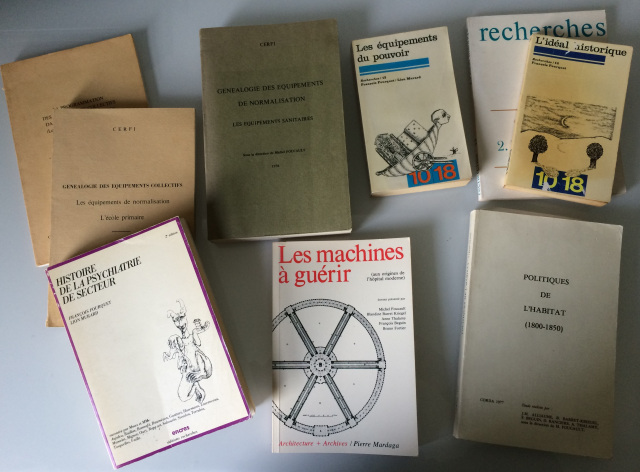
Some of Foucault’s collaborative projects are well-known – the I, Pierre Rivière collection; the Herculine Barbin memoir; Le désordre des familles with Arlette Farge; and the posthumous Technologies of the Self volume from the seminar at the University of Vermont.

On a dedicated page on this site I have listed the bibliographic details of other collaborative projects Foucault was involved with – either as contributor, research team leader or enabler. Comments, corrections or additions welcome.

View original post

Silcock, M., Hocking, C., Payne, D.
Childhood constructions of contemporary technology: Using discourse analysis to understand the creation of occupational possibilities
(2014) Journal of Occupational Science, 21 (3), pp. 357-370.

Abstract
Ten children aged 10-12 years were audio recorded discussing and demonstrating the types of technology they regularly used at home. A critical discourse analysis of the transcriptions was completed to identify dominant discourses the children deployed. Philosopher Michel Foucault’s theories on the history of existence, power relations, the subject, and ethics of the self informed the analysis. Three discourses were identified: virtual reality as a new dimension, panoptic play, and technological play as risky. The children appeared to assume subject positions within their play that have been created by and through their technology use. These subject positions were created by the unique historical context of the present era and have allowed new relations of power to develop for children. The discourses and associated discursive constructions appear to have an effect on the occupational possibilities available to children at this life course stage, indicating the emergence of norms of behaviour and relations of power unique to technological play.

Author Keywords
Children; Discourse analysis; Foucault; Occupational possibilities; Technological play

DOI: 10.1080/14427591.2013.832647